Love Isn't Enough: Why Trust Makes or Breaks Your Relationship
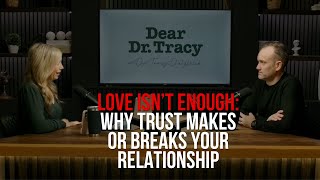
Dr. Tracy Dalgleish and her husband Greg explain why love isn't enough to sustain a relationship without trust. Trust builds through small moments of reliability and follow-through, while it erodes through inconsistency, emotional shutdown, and micro-betrayals like small lies or omissions. Your attachment style shapes whether you pursue, withdraw, or shut down when trust breaks.
Chapters
Hey, it's Dr. Tracy and I'm sitting here with my husband Greg. Thank you for joining us. We have a good conversation coming today. We're going to talk all about trust.
Yeah, it's an important topic and I.
Think it's something that I hear a lot from people where they'll say something like, I love them, but why don't I trust them? And this is one of the most common misconceptions in our relationships and that is that if you love someone, it automatically means security, reliability, and trust. But I think we forget that trust is built brick by brick by these micro moments every single day.
It's interesting. It seems like a catch all for a lot of things. Is that what you see in, in therapy?
Oh, absolutely. Kind of how we throw these words around, it's this like, well.
You know, what does it mean to love? What does it mean to trust? And I think trust is a really specific thing in our relationships that we don't explicitly label. So even if you think of our relationship, I remember the moment where I said, oh, I, I love you, but have I ever said. And I was like, think of that first year together. Did I ever explicitly say to you, I trust you?
I don't remember. Shocker. But probably not. It's just not something that we don't tend to use. I think it's in. Maybe it's overly implied in relationship relationships.
Yeah, absolutely. It is overly reply implied. And because of that implication, the internalization of it, then when it's broken, it's even harder then to repair because we don't really know what that looks like.
Interesting.
So today we're going to dig into understanding how trust is different from love, how attachment styles play a role in trust, and how trust breaks down.
Okay, okay, I'll be good on that. Attachment piece, I think.
Yeah, I love. And I want to pause too, because I received a really cool DM and I sent it to Greg this week and.
Oh, from my bot followers?
No, from the person who said, you know, I love listening to when Greg's on the podcast because you bring this different perspective that I know I can't necessarily bring. And one of the things, actually I wanted to start by sharing even with listeners today, people who are watching the podcast is a moment recently in our own life that I think even helps to build trust in others. So this was just recently with one of our kiddos around, you know, just in the spirit of cycle breaking and how we're reparenting ourselves and parenting our children differently, you really showed up for one of our kids that said, you can trust me with your emotions and your feelings. And it was this moment of, I'm not going to throw this in your face. I'm not going to shut it down. I'm not going to tell you, this is not a big deal. Why are you worrying about this? But you were just so present in this kiddo's emotions. And I was like, yeah, we're. We're doing it. That. That right there is trust. It's the early foundation of what it means to build security.
With others.
Cool. Well, thanks for sharing that.
Does that make sense, what I'm trying to say?
Yeah, I think so. Yeah. I think it speaks to maybe how your early childhood and modeling can really impact maybe how it shows up later in your romantic relationships.
Yeah, absolutely. Well, I'm. I already immediately want to jump ahead 10 steps. I'm going to slow down. And first, let's talk about the difference between love and trust. And if you just heard the door crack open and now you're going to hear the paw prints, Lachlan is like, hey, you guys are doing a thing without me. And why wasn't I invited? I think of something one of my clients once said, and so many of us can relate to this when it comes to thinking about trust. And this client said, I love my husband so deeply, but I stopped sharing parts of myself with him every time I was vulnerable. He shut down, which is. That's. Trust is required for vulnerability, and that's about your partner being there. And I think of another client who said, when my partner chooses to spend every weekend with friends and doing his own activities, I feel this sense of separation and I don't feel seen. And so I question if he even gets me. And when I think about those two examples, it's not that love was absent from those couples, it's that there was a trust rupture.
Yeah, that makes sense. Like, for me, I used to think trust was like, if I wasn't cheating or lying, I'm trustworthy. Like, it's kind of like, I imagine a lot of people are kind of in the same boat, but I think over time I've learned to understand that it can be broken in kind of in much more subtle ways. Maybe kind of like you just mentioned kind of these. Maybe not even broken, but ruptured. These kind of small micro moments. Yeah, it's like one of the paper cut analogy used. Right? It's a version of that.
It's totally the paper cut analogy. And it's the how many Paper cuts over time until it starts to really affect you. It's the, you, you know, you're postpartum and you. Your husband said he'd be home from work because, you know, maternity leave. Thinking of in Canada, it's a year. How many times in that month did your husband say, I'll be home at 5. And you're still walking around the house holding baby, and it's 5:30, 6 o', clock, and they're not home yet.
Are you talking about me?
No, but we did have that happen. But that. That's a moment of trust, right? Of like you do the thing that you say you're going to do.
Let's talk about love versus trust.
Start with the difference.
Yeah. So when we think about love and trust, we tend to use them interchangeably, but they are actually quite different. So love is this emotional bond. It's the feelings of care, affection. It's connection that you have with somebody and it makes you want to share your life with them, to support them and to show up. And there's this element of.
Just the sense of being with the other person you deeply care for them. But I think the catch here is that love alone doesn't guarantee a secure relationship. Of course, that there are so many people who don't feel that sense of safety and feeling soothed in their partnership. So while they love the person, they don't feel that. So the way I describe trust to my clients is that it's like a foundation of your house that allows you to feel safe. And it's built on reliability, on consistency, on honesty, on the ability to follow through what you say you're going to do. And if you think about the foundation of your house, if there's a crack on it, how do you maintain that house? How do you continue to build on it? How does the house feel? Strong and sturdy. And no matter what storm comes your.
Way, things get infinitely harder when there's that.
Absolutely.
And it starts as a small crack.
Absolutely.
Yeah. Analogy.
Right. And so trust means believing your partner will honor their word. Going back to that when you come home. Example, I'll be home at 5. And I believe that you'll be home at 5. And if you're going to be late, I trust you'll text me and let me know. Showing up for things and holding your word to something. Something. This is much different than the forgetting moments. You know, I've shared the story in the podcast about, maybe not on this podcast specifically, but on my appearances around ketchup and how one time I Asked you to get ketchup and you forgot. That's different.
Yeah.
That's not necessarily trust, but it does speak to this element of repeated moments where a partner doesn't show up.
Yeah. I think for people listening, it's in isolation. Things happen, life happens. And we can still show up with kind of.
Right.
Giving our partners the generous explanation. Benefit of the doubt.
Yes.
I think it's the consistency, the repeated nature, where it starts to.
Right. Because if I say. If I say to you, you didn't get the ketchup, I don't trust you. How am I supposed to ever trust you? It's not ketchup in isolation. It's the repeated pattern, that consistency that's not there and not having that follow through. But then the next piece, I think that is really important here is around how and knowing that your partner is going to hold your vulnerabilities with care and compassion. And this is not throwing the things I share with you from a deep, vulnerable place back at me in moments when you're angry with me or upset about something. So we don't weaponize our partner's vulnerability.
Yeah.
And that. That happens a lot, unfortunately.
Yeah. It's something you see in with your couples a lot.
Absolutely. And that's so hurtful. Like, there has to be this baseline agreement that if someone shares something with you from that vulnerable place, you do not throw it back at them. So harmful. But then the other piece around that, though, is you knowing inside that you're not going to harm or betray me.
And so then when we think about these ruptures, the ruptures are actually my favorite analogy around talking about trust is from Brene Brown, which is that trust is like these small drops of marbles into your big glass jar. And when there's a rupture, that's when the jar gets knocked over and the marbles just roll all away.
Yeah. That's a good visual line.
Such a powerful visual. And then what ends up happening in couples is because of the discomfor and our attachment styles and our avoidance and coping mechanisms. Then we're trying to hurry up the process. Well, why don't you trust me? Just trust me. I won't do it again. Well, no, hang on. The jar is empty. We need to have all of these moments again. Show consistency, show openness and vulnerability. And each time you do that, that's the drop of the marble back into the jar, which builds up trust.
Interesting. It's interesting to hear you say.
That. People kind of weaponize that vulnerability a lot. I'm surprised to hear that. I wonder. I'm sure there's an, a ton of reasons why, but is that like a coping mechanism? Is that a protective mode kind of in these couple dynamics? Why do you think that is both?
Yeah. For some people it is a form of. And you know, I don't use these words loosely, manipulation or gaslighting. So that is the time where I want you to doubt yourself. Yeah. So then if I'm going to use your vulnerability, I'm going to say, well, it sounds like this is one of those times where you just don't feel like you're good enough. So that's probably your issue and not mine. I've wrapped up that vulnerability and I've thrown it back to you as if it's your problem. The other thing that we do and we, we all do this, I want to really normalize this and we can commit to change. In the heat of the moment when you are angry and upset and you are looking for connection from your partner and you go to them, you, you're just like your mother, you don't know how to do it right.
Like in those moments, the more subtle version of it.
Yeah. It's the moments where we go offline and we're dysregulated and we're caught in our cycle. That and, and this is especially true when one, when the partner who shuts down. Because we really need to remember that shutting down sends a panic signal to our partner's brain because you're their attachment figure. So if you shut down on me, then.
Happened.
Pardon?
Has happened.
It has happened. We're both human. I've shut down on you as well. When you, if you shut down on me, my brain goes danger, danger, danger. You've just lit off the panic button from the back of my brain and I'm going to do anything to get your attention. Which means my first pokes, my second pokes, my third pokes don't work. And then I'm going to say the thing that I know will hurt you.
Which is throwing this vulnerability back in your face.
Totally. That's exactly what that is. And, and here's the other reality is when you are in a committed long term relationship, you know exactly how to hurt your partner.
Yeah.
You have more information, you know the things. And that doesn't make it right. It does mean. And we'll talk about the how do you heal? Than it is about repair. So here's a reflection question for people as they're listening. Do I feel both love and Trust in my relationship or is one stronger than the other right now?
Oh, good question.
It's not an all or nothing. It's like how much of one versus the other. Yeah, interesting.
Which I think then brings us into the next piece around talking about attachment styles and how that goes hand in hand with trust in our partnerships.
Yeah, I think how people show up in their style is really going to make a huge difference. I know I can speak for myself being on the more avoidant slash anxious side. So anyways, yeah, so.
So this was one of the reasons why I was even thinking about the example with our kiddo and what you did recently. Because attachment styles are formed from cradle to grave. We all need figures in our life and those figures might not necessarily be ones that help to facilitate security, but we need connection. We're hardwired for connection. I know I'm totally going off script what I wrote for us to talk about, but I, I just. There's no love doing, I love doing this attachment piece.
Let's be clear. There's no script. There's a agenda.
We have notes, agenda. But I mean, to clarify for people listening, my PhD included attachment styles. We looked at the attachment styles of these couples who then went, they did an FMRI pre post therapy. They went into eft, emotionally focused couples therapy. We looked at their attachment styles. So I spent many years talking, thinking all about attachment styles. And I do think that one of my frames of working with people is around attachment. And one of the things that we often miss looking at attachment security is it's not just what I do, it's also what you do. And so we look at the caregiver and also the care seeker. So how I put out my flag to you and then how you respond. And inside all of us, we have what we call internal working models. And that model is what do I believe about myself and what do I believe about you? And we form those internalized beliefs from our earliest caregiver experiences. So as a child, if you cried and your parent came and picked you up and held you close and said, they're there, I got you. You are more likely to develop the belief of when I put out a bid for connection, if I use that language or when I am distressed, then other people will be there and I, I can put out my signal and you will be there for me.
Right.
And that's the basis of secure attachment. Secure attachment is being able to see that people are reliable, that your caregiver will be there for you, and that your needs will be met.
Okay. And how do they show up in kind of modern adult relationships? Yeah, romantic relationships.
Yeah, absolutely. So then someone who is more secure in their relationship and within themselves, then they can balance closeness with autonomy, interconnectedness with independence, which is actually. So for people who are listening, I'm using my two hands. If you think of two things that you're holding, they can feel quite opposite in a way, like, oh, hang on, I have to be autonomous, but I also have to be interconnected. Yeah. That's the place of intimacy, that we're coming together.
Right.
And then also remembering that our attachment systems are activated in times of distress, stress, anxiety, and conflict.
Right.
And so if I'm struggling with something, what do I think inside my mind? Do I think that I can turn to you and do I believe that you will be there for me? If I'm secure, then yes, I can do both those things.
Awesome. Okay. Talk more about anxious attachment.
Okay, so the.
You hear a lot about this kind of in the ether.
Yes. Anxious and avoidance are the two top ones that we talk about, but we know that there are these four if we're going with the categories, which is one area of research around attachment. So I'll just name them. First. We have secure attachment, anxious attachment, dismissive, avoidant, Dismissive, fearful. And anxious is often called preoccupied. So then we start thinking about someone who is anxiously attached to struggles to believe that they're worthy. They hold a lot of self doubt, but they believe that the other people are positive and the goal is to build that connection. They're the seekers for connection because they waver inside of themselves. So when it comes to trust, then they're craving that reassurance, but they might doubt their partner's commitment to them.
Is this where people pleasers live and anxiety? Yeah, potentially.
Potentially. I see caregivers in avoidance. And this is not an all. Like if you're. This.
Not all or nothing.
Yeah, it's not a binary, but it, it's. It's interesting. I remember identifying avoidant attachment with one of my clients who really did a lot of caregiving. And by caregiving, there was an ability to not have to be vulnerable and show themselves. And that is part of what dismissive avoidance looks like, which is that they struggle to fully trust that others are going to be there for them because deep down their fear is that they'll be let down, they'll be controlled, or they'll lose their independence.
Okay, so let's finish up. Anxious.
Yeah.
So again, how does that show up in the romantic relationship?
So I think of then also attachment styles in our cycles that we get stuck in. The anxious partner tends to be the more pursuing partner. They're seeking connection, they're leaning in. So then when we think about times of distress there the cycle of. I'm thinking of the lesson inside be connected. Because I, I see this like mapped out so clearly in this is that everybody experiences distress in some way and then it's what you do next. Everybody makes some form of reaching to you. So I would reach to you and then I wouldn't feel soothed by how you responded. So I reach again and then I wouldn't feel soothed. And then they reach again and it's like this vicious cycle and maybe you don't even respond to me depending on the situation. But then I keep reaching so much. Knock, knock, knock knock. Hello? Are you there? Tell me I'm okay, Tell me. Okay, right. Are we good? Are we good? Are we good? And then until you're like okay, we're good. And like the blow up is like oh, okay. Or it forces the other person to be like, okay, I'll cancel my plans, we'll spend all Friday night together. Because I, I see you're not feeling good. Right. And you can even start to see how that dynamic then doesn't feel good enough.
Yeah. It's almost like self fulfilling too to it.
Right. Because it pushes the other person away. So the person who is anxious that when there is any sense of their partner pulling away, that increases their anxiety. Any ambiguity increases their anxiety.
Okay, all right. So you touched on the avoidant as I asked about people pleasing. But circle back to that because that's another one that resonates for sure.
Yeah. So when we think of then that cycle of reaching out of how do we then get out of the distress avoidance, still have the emotional experiences. They still have pain, sadness, hurt, anxiety, loneliness. It's what they do then to cope.
Right.
They shut down their feelings.
Okay.
And then they don't turn to the other person, they shut it down. They do all this internal work and then they're like, okay, I'm good. Right. It's also why we talk about when people who are more likely avoidant, they compartmentalize and yeah, it makes sense. I use the analogy of the shipping container where it's like you packed that in a box and you've put it in the shipping container and they really hold into this part of their lives that say I can rely completely on myself, I don't need anybody.
Yeah. They don't do the pursue thing that the anxious, right? Yeah, it's the opposite.
I remember when I first started researching attachment and I was 21 years old and I go into my supervisor's office and he's this like 60 year old, white haired, six two, male. Every time I sat in his office, he'd give me this other, like, here's this research paper, here's the, this one. Now read this one. And so one day I sit down with him and I say, I finally get it. I know I, I'm. I don't need anybody. I'm securely attached. He's like, tracy, independence is fine. Interdependence is better.
And how did that land for you?
I was like, what?
No, I finally got to this part where I'm fine by myself. It's, you know, it's just the.
That's cute.
Yeah, it's one of my favorite stories of learning about interdependence in relationships.
So. Following the same framework, though. So is there another example how that shows up kind of in romantic partnerships or. Or how you would see it manifest yourself in with couples you work with?
Yeah. So someone who is more avoidant, they're going to hold themselves back. They don't want to be risky. They don't want to be vulnerable like that. Vulnerability feels risky for them.
So which breaks trust, Right, because that's part of the.
Yeah. So if someone is struggling to be vulnerable, then you have to understand that that doesn't give the drops into the trust bucket. And that's so tricky because on one hand, we want to see that you, as someone who is more avoidantly attached, brings all of what you do into a relationship. And at the same time, then your goal is to have to work through learning to turn to your partner, learning to rely on it, learning to open the door and share just a little bit more. Which is tricky. Yeah, it really is tricky.
Okay.
The fourth. Yes, you used a different term, but fearful, avoidant.
Yes, Disorganized, fearful, avoidant. That's how we talk about this fourth one, this fourth person, this fourth attachment style is someone who has their low sense of self and low view of others. So those two dimensions, so this, because of that, can often sound like someone who is longing for closeness. That's the anxious part. But they also fear getting hurt, and that's the avoidant part. So trust then feels like a push and pull. I want connection, I want closeness. But then as soon as you give it to me, like, whoa, too close. No, I don't want to be hurt. I don't want to be Betrayed. I want to be abandoned. And in our partnerships, then sometimes it can feel like a testing or a poking. It's like, do you love me? Come close to me? No, actually, I'm not available. I don't want to hang out with you. This might also be someone who is more suspicious of things even when there's nothing happening. There's a lot of dysregulation for them.
Yeah, it sounds tricky. Does that show up as you're going through these four kind of scenarios? I'm thinking of, like, the proportionality of it. Like, are most people anxious versus this fearful? Yes, I would imagine there's a spectrum.
Yeah. In the research, I think it's higher likelihood of anxiety and avoidance along with security versus someone who is more fearful, avoidant, disorganized. This is someone who has experienced a deep sense of betrayal and mistrust and physical and emotional harm in their earliest relationships.
That seems to make sense.
Yeah.
So I think really ultimately what I'm hearing, it's not just about trust, isn't just about the behavior. It's kind of how they show up in the relationship vis a vis their attachment style.
Like, two people could have the same partner doing the same thing, but their experience could be totally different because how these things interact.
Yes, that makes sense. Yes. So the person who is more avoidant comes home and said, I'm home at 5. What else do you want from me? Or sometimes what I hear from someone who's more avoidant, they say, I'm here. What else do you want? Like, I, like I'm here. Don't you see? I'm here. Instead of seeing that the pieces that they can do into the, like bring into the relationship is more vulnerability and sharing of the internal stuff that would then help to soothe their partner whether they're secure or anxious or avoidant. But then that anxious partner then has to also practice seeing the drops into the trust bucket instead of the self doubt or wondering if they're really loved.
Right.
Yeah.
Interesting.
So a reflection question then, for people who are listening. When trust feels shaky. So ask yourself this question. When trust feels shaky, is it because of my partner's actions? Right. Is it really something that they're doing or is it my attachment pattern that is feeding into this doubt, which is tricky.
Couldn't be both.
It could be both. And that, that also too is where I know when we talk about love languages, people will say, my love language is acts of service, but they're my partner is always coming to me with physical touch. And well, their love Language is physical touch. So people do to their partners what they want, they hope for instead of seeing the information that your partner is giving you. And I've talked about this in lots of different ways, which is the cognitive bias. So if I believe that you are late and you're always late and how am I supposed to trust you if you always come home late? I keep using this one example, but if you always come home late, then I'm only going to notice when you're late. And so my brain only pays attention to that and then doesn't feed into the other moments where you are demonstrating trustworthy behaviors.
Right.
And so is it really about trust or is it about some kind of sticking behavior for your partner? And let me just confess this, I'm the worst with you and you are so compassionate and understanding towards me. You say, when are you going to be home?
Oh, you're always late. Yeah, but you communicate with it. I think that's the difference.
Yeah, I do talk about it, but it's still, it's the, I say I'm going to be home at 5:20 and then it's 5:30 and you're like, I see, I haven't left the office yet. Oh, I got distracted. I'm doing like 30 other things. So. So is this really the moment of what builds trust? And for some people, they might say that's the one because of our history, because of the context. That's what I need versus.
You know, how else does somebody else build trust in your relationship?
So earlier we talked about trust being this kind of really big thing in the relationship. Again, to me it feels like kind of a catch all for a lot of other things, as I think you've kind of explained the last number of minutes. So maybe talk to us about ways that trust gets broken, but also maybe things that are different than trust getting broken. I think that'll kind of come out in some of the explanations.
Yeah, so I've already mentioned inconsistency and that is where one person says one thing but then does something else. So if a partner promises to cut back on drinking during the week, alcohol is a common struggle that couples bump up against or any other substance, but then keeps coming home late after having just a few beers or they've said they'll go easier at the event, but then ends up being six drinks deep. So it's that mismatch between what I'm saying and promising to you and then acting in a completely different way.
Recurring though. Right. Not just these one offs. Yeah, I think we're trying to really be real with people that like life happens, but it's, it's the recurrence. And how often is that fair to say?
I think that's really fair to say. And I love that you added that because of course there's this nuance in our relationships, which is why some of these quick hit social media posts don't hit what really happens. Yeah, they miss the mark. They miss the nuance and context in a partnership, which is this is not a one time thing. Because after the one time you go to your partner and you talk about, hey, this was hard for me and you probably didn't know my feelings about this and I didn't know your expectation. Right. What are our expectations going into an event that there's alcohol, for example.
We should talk about that.
Yeah.
So one moment doesn't completely break trust.
Right. And I think when we talk about things like this and you don't want to feel like you're coming down on people or anything, it just, it just doesn't help. Right. Like we're trying to come to it from a place of grace and like nuance and curiosity. Curiosity and understanding context. Not, not the sanctimonious high, high horse kind of deal. Not that we are, but I think I'm biased towards that.
Tell me more.
Well, I just, I mean, I, I think it's easy.
Maybe for listeners to like, I don't want them to tune out because it's like you don't want them to feel any shame around something or. Yeah, yeah, I don't know.
I appreciate that. Yeah, I'm glad you added that.
In the bias towards the. Maybe it's the realest in me versus like, and this is maybe where I bump up against stuff online. Sometimes it's like concept versus reality and sometimes the disconnect is so big that.
Yes, of course.
Okay, so that's my rant.
So no it's relevant here though. So we're looking for inconsistency in multiple scenarios repeatedly. The other one is the emotional withdrawal. And this is where someone refuses to engage with you or they shut down at any time, but mostly in conflict. So for example, in the middle of an argument, one partner walks out of the room refusing to talk and the other is left feeling abandoned and unheard. And you can just imagine that when that happens repeatedly, it's the, well, how are we ever going to come back to be close again?
No, this one landed for me because I, I'm holding in mind some of the like, coaching calls. You've done and be connected and different things. Where I've heard partners, typically female, say about like an event happens, something goes south and the partner like doesn't talk to them for days after. And A, I'm a little bit shocked, but B, I'm like, man, what? Like, hey, that's super difficult. But when an erosion of trust too, right. Like you don't trust me to come back and repair and you shut me out for days. And I, I, I think what I'm saying is, sounds more common than I would think.
And it, it is one of the common pain points that people have when they come in to be connected because they're at a loss of what to do. They don't know how to have these clients conversations. They don't even know how to start something without again further shutting down their partner. And it's so tricky because.
On one hand we want to understand that our partners are disregulated and what's happening for them. And on the other hand, you have to take responsibility for your own regulation, your own state. And to shut down a partner for days is so damaging and harmful to your relationship, to your partner, and also.
To you big time.
Right. And, and maybe you can speak to this, but when you shut things down, it's not like roses and butterflies and you've got like this great song going on in your head.
Well, no, because it just consumes your mental space and it just, or maybe dozen, which could be a separate problem. But I. Right. It doesn't, you don't. It's in a coping mechanism, but it really doesn't help move things along.
Yeah, yeah. So when you shut me out, I feel like I can't feel safe to turn towards you about other things. And that, that is just so, it's so harmful in a relationship. There's more I want to say in there. I think I'm going to pause it right there though, because it is, I understand that for couples that some people have learned to do that to stay safe. Right. And, and my Be Connected members know that I do this. I frame. I first, I zoom in and I zoom out when I support people in the sense that when I look at someone's childhood patterns, what they learned about love and repair, that shutting down was once a safety mechanism because. Because as kids we learn to do anything to remain connected to our caregivers, even when it meant it was hurtful for sure. For ourselves especially. But then the work now is recognizing that you're not with your caregiver anymore. You're with this person. And you've got to figure out a way to come back to it. There's. There's a clip from Terry Real that says he's. He's. Terence Real is the creator of relational life therapy. And he says, I hear about all these men shutting down for days. No, you don't get to take days. You take a few hours and you come back to it, but you don't take days. Yeah, and it's. You know, we need to.
It lands hard when he says it.
Oh, I know.
I heard him a couple times. It's. He's got a good.
Yeah. Okay. Let's talk about another thing that erodes that trust, which is micro betrayals. And these are those small lies, the omissions, which is one that the community really shared with me and the not following through. So it might be something where you think it's harmless, like, I didn't spend that much after shopping, but you're hiding the receipt repeatedly.
It's just a white lie.
Yeah. It's forgetting to book the doctor's appointment for your kids when you said that you were going to. And then when your partner comes and asks you, they're like, yeah, I did, and they haven't done it yet.
Mm.
Yeah. Or like, it's the. You and I talked about this. And in another episode, it's the. That micro betrayal of, like, okay, I'll do it, like, leaving the mug beside the sink. And then you don't. There's a deeper issue in that, which we talked about that episode. But then there's also this idea of opening up to other people and giving the good stuff of you to someone else that crosses the line. But you're describing it as just friendly. And that's something that's come up in the community a lot as well.
Yeah. These ones are seemingly almost a little bit more insidious because they're. They're small. They're easier to, like, self apologize for, it seems. I mean, I think we've all done it in some way, but it's. Imagine the. Like before. It's the repeated.
Nature of this that really is harmful.
It's the death by a thousand paper cuts.
Yeah.
So I think what's important to remember about the micro betrayals is that it's not just the big lies. It's the small cracks that are chipping away at that foundation. Going back to that foundation analogy. Okay, another one. Lack of repair. This is. Oh, this is this similar to the emotional withdrawal, but this is the. I'm going to avoid Taking accountability after a rupture. So if I snap at you in anger instead of apologizing, I just pretend it never happens. If I say something like, I didn't do anything wrong, but clearly you're upset. And then letting days go by without hurting, without addressing the conflict rather, and the hurt just goes on.
Yeah. It's really interesting as you're working through these and, like, how. How we just talked about the attachment styles and how they show up in kind of each of these. So far.
The through lines are.
Fairly obvious.
So the lack of repair very much lands on someone who is more avoidant in their coping mechanisms because they're going inside themselves, packaging it all up, putting it in the shipping container, and saying it's fine. And your partner is left out to, like standing on the dock or the image I use in therapy is your partner's driving the boat and you're down below deck, and she's like, hello, I didn't want to drive the. Where are you? I want to drive the boat with you, but you've left me.
Interesting. Okay, so set it. I'm going off script a little bit, but said another way. So if we better understand our partner's attachment style and we might have some of these trust issues in a relationship, is that, like, one of the keys to working through it?
Oh, absolutely.
Or is it just information we need to know to move forward?
We need to know who our partners are. We need to understand who. What makes them tick, what their triggers are. It's not that we'll never trigger them and we'll never hurt them. It's more about holding in our minds. I know who you are. And I know that if I'm late, it really sets up that old wound from you where your biggest relationship history behind me is that guy who was so unfaithful and hurt you for those years.
Right.
And then when I'm not on time, when I come through the door and I say to you, oh, sweetie, I'm late. I didn't get a chance to text you, and I can just imagine what's happening for you right now. But I'm here. I'm here. I'm not that person. I'm here. Imagine what that's like when you can hold your partner in mind instead of coming home and bracing yourself for it and saying, it's not a big deal, so what, I'm late. Right. And that. I think a lot of people, too, get stuck in this. If my partner is this way, then my goal is to change them. Instead of saying I've chosen this person. Now, how do we work together to build this security and someone who is more avoidant in sharing things? It is our jobs then, to hold it in mind and to accept that that's who they are. You don't enter into a relationship to change them. Yeah, I. I saw this quick little reel I actually shared at the Client in session recently from Dr. Orna. She's the psychologist, psychoanalyst in the Showtime couples therapy you and I watched.
Yeah, yeah, yeah.
Oh, this clip, it gives me tingles thinking about it. And I think she was on Jay Shetty. And so Jay Shetty is like, what's your top relationship advice? And so Dr. Orna says to stay in your own lane in your relationship. And at first I was like. And then I thought a little bit deeper about it, and I was like, yes, because if I'm coming into your lane and saying, you have to do this like I do, you have to experience the world like I do. How does that work? I don't know. I'm curious how you interpret that.
Yeah, it's interesting. I mean, my first reaction, particularly as a guy, is like, right, right. But I also, I. I haven't seen this clip, so I also imagine she's not saying, don't go. Create. Don't.
No.
Show up with compassion, nuance. Right.
No, no.
But there is an element of, like, your partner kind of is who they are to a certain degree. They've been shaped by many factors. They're upbringing, modeling, all kinds of stuff.
That's the reason you chose that person.
Yeah.
And are you going to accept them or are you going to suffer by continuing to make them and hope them to change? And you can't make people change.
Oh, this just lands for me in a way, because this is not lost on me that we're having a podcast. Probably people might be watching this on social media, but is all this information content in and of itself.
Exacerbating that? Because now everyone.
But please keep listening to our podcast.
Correct.
But. Oh, I hear you.
I'm coming to this with curiosity and realism. Like, is this. It's kind of like parenting right now. It's like, are we truly just on overload, where people consuming all this stuff and therefore.
Maybe trying to unduly influence their partner and over.
So then you're saying to me, and I'm being cheeky, that the reels I send you should be a balance of the dirt bikes, the relationship stuff, the parenting stuff, and maybe some golf stuff and some funny parenting. I'm kidding.
Yeah, but potentially, though.
Yes, yes. That we are over consumed on information. I think you and I come back to this repeatedly.
But again, it's not lost. And that's what we're doing.
100. Okay, back to the podcast. We don't get lost in our big existential questions. So let's. Let's do two more here and then we'll wrap up. So big betrayals. Of course, the big betrayals are part of this. We need to talk about this. This is the infidelity. This is the secrecy. This is the broken agreements. So I remember one case example of a betrayal, and it's not infidelity or secrecy, but it is. A woman's parent is diagnosed with cancer. She's crying on the stairs, and her husband says, okay, well, I'm gonna go golfing. And she's left there.
Did he know what had just happened? Yes. Yeah, right. Dick move.
Yes. So. Right. But so these betrayal, these broken agreements. And that agreement, even in our relationship, is, when I am going through something so hard, you will be there for me. You will. You'll sit beside me. And actually, when I think about couples who go through infertility and multiple losses, this shows up for them as a. As a broken agreement of you weren't there for me, or you told me that we'll just try again, or all of those things are wrapped up in there. And then, of course, we have the infidelity piece and the secrecy.
Yeah, those are the obvious ones. It's the.
Those are the obvious ones. And it. It's so harmful because you think of the structure of your relationship. You've agreed to that. You've both agreed to it. And I recently did an affair episode, which. The infidelity episode, which landed really well with people. So if you haven't listened to that one, go and listen to that one. But I think it's really important for people to understand that when these ruptures happen, that it knocks over the. The marble jar. Trust of trust. Right. Okay, last one. Guilt and shame. Oh, this one is so hard. I remember working with a couple that every time she would come out and say, I feel so lonely. I need you to come to me. I need to be close to you. He would go into shame and he would say, I'm such a bad partner. I'm horrible. I can't believe you're even with me. And how does that then work with the two of them? Because she's trying to reach, and you're like, literally rolling into your own shame and tunnel of darkness and That's. Yeah. It breaks trust, though.
Right.
And so then what happens is his pain becomes the center instead of actually him taking his shame and holding it to the side and like, then coming and turning towards. Yeah.
This is one you wouldn't think of as a breaking of trust. It's a little bit more nuanced.
Yeah. So I think it's really important to understand that trust is not just about losing it in those big moments, but it's often eroded in small daily actions that don't align with our words. It's the forgotten promises, it's the quiet withdrawals, it's the lack of repair. And all of these things start to accumulate over time and breaks that foundation. And when we then think about, well, how do we rebuild this? And is it even possible? The goal in any relationship is not to never hurt the other person again.
It's not realistic.
Not realistic. We're not going for perfection, but instead, it's consistency, it's repair. It's turning back towards each other.
Yeah. Well said.
So we're going to pause it here and we're going to do part two. And in part two, we're going to talk about, so how do you rebuild trust? And we have so many great questions from the community that we're going to answer here in the next episode.
Yeah, come back because we're going to really lean on your expertise because I think this is where the prescription comes in. This is where, yeah, you really shine.
We couldn't do that without this first, though, because I love this as a foundation.
I know it's kind of more the academic stuff, but it's important.
As we wrap up, I often know that the question people come to me about in my DMs is, okay, so, like, how can I actually start to do this? How do we even do this work in this busy space that we're in? So I want to make sure that listeners know that we have our 30 days to us challenge. It's one of our favorite challenges that we have. It's one small thing. Each day it shows up in your email, you're going to get a small practical tip, or step rather, to reconnect with your partner. And. And it's all built from the pillars of building a healthy relationship. And we receive emails from people within the first few days of doing this challenge saying we are already feeling closer, which is always so cool. And also appreciating just how overwhelmed people are. This is now. We're not just consuming content, we're putting it into action. That's what I'm.
There we go. That works.
Yeah.
Right?
All right, so.
Okay, cool.
Okay. As we're wrapping up, take a moment just to reflect for yourself. When in your relationship.
Where are you right now? Do you feel that sturdiness in trust with your partner? Do you feel like you're struggling with it? And I want to just. I want people to know that trust is actually really complex, and it's just something that we are continuously building in relationships by the small choices we make every single day.
Yeah. And maybe not take it for granted.
Yeah. I think that's important. Okay, well, thanks for joining us today. I hope you will come back for part two, because we're gonna deep dive into some of these questions. And if you have found anything from today's episode helpful, go ahead and, like, subscribe and share this episode. Don't forget to leave me a review. It helps people find the podcast. So until next time, take good care of you.
I have to remind you at the end of every podcast episode that this information is for educational purposes only and does not substitute for the care from a licensed mental health care provider.










