Stressed, Exhausted, or Burned Out? Here's How to Actually Tell the Difference
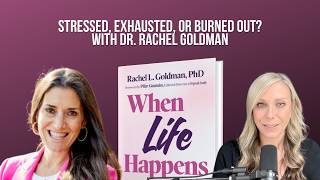
Dr. Rachel distinguishes stress, exhaustion, and burnout, and explains why bouncing back isn't automatic. She highlights diaphragmatic breathing as a portable reset tool, and emphasizes that small intentional actions like boundary setting and transition rituals help restore control when life gets unpredictable.
Chapters
Dr. Rachel, can you share with us what you mean when you say "when life happens" and why this work matters so much right now?
Yeah, you know, it's, it's a funny story in terms of the, the title of my book and, and why I say "when life happens." So I'm going to give a little backstory about it. But before I do that, I'm going to just say, you know, if we think about it, like, life happens. Like, no matter what we do, no matter how much planning we put into place or how much we think we have control over things in our life, life is going to happen. So, you know, the idea of this book is really that idea that when life happens, how can we be as prepared as possible knowing that there's not, you know, we don't have control over everything. Plans don't always go as planned, but what actually is in our control? And the story behind the title and why I chose When Life Happens is because I'm a runner, and for years I was signing up for different races, and friends would always be like, What, what are you training for? What are you training for? What are you training for? And one day I wasn't training for a race and they asked me what I was training for. And I said, I'm training for when life happens. And they were like, what do you mean by that? And I was like, well, I want to be in as best physical, emotional shape that I can be in that is in my control for when and if I want to train for a race or sign up for a race that I like in 3 weeks, I could just run it. So it was kind of this idea that I was going to maintain a certain amount of mileage and health, mental health, physical health to be able to do that. And of course, bigger picture, just again, we never know what is thrown our way. So I had thought, and I still believe this, that if I could do what's in my control, hopefully I will be able to get through, be resilient, get through whatever is thrown my way, even in the moment if it really sucks, which we know some things just really suck, that I would be able to kind of bounce back and be okay.
You're really tapping into the essence of resilience right there.
I was literally just going to use that word, and then I was like, well, I'll explain it in this way first. Yeah. Right.
And, and that is, we often think of this forward motion always going up, you know, the, the graph goes straight line up, and that's not what life looks like. It's the squiggly lines of ups and downs. And I love this idea that you're sharing right here because I know for so many women and mothers especially, I know how many mothers listen to this podcast, but it's this idea that we're just juggling so much and trying to hold it all together, and it's hard. Yes.
There's so much that we're trying to hold together. There's so much that we're juggling. And, and, you know, I think this is, you know, a reminder that I like to tell people is that we can let go a little bit, right? We, like, I encourage my clients to take things off their plate, to make a not-to-do list, to take some of that pressure off because there's so much external and internal pressure that if we can try to focus on what's in our control and do a little bit less, which doesn't mean that we're less worthy, it doesn't mean that we're less productive, that actually allows us to do what we do the best that we can and be more efficient and effective, that I think we can then be able to be more resilient, bounce back, and get through those really tough times.
I wonder if you could help us understand what happens psychologically, emotionally, when we are carrying all the things and trying to do all of it all at the same time.
Yeah, I'm laughing inside because I'm kind of going through one of those phases of my life right now. And I'm trying to say no to what I can and let go and really take my advice that I give to clients and everybody else to heart because it is one of those times for me. But unfortunately, when we are stressed, stress is not necessarily a bad thing, right? There's a good stress called eustress. I always like to spell it so people understand, but it's E-U-S-T-R-E-S-S. There is a good stress that helps us stay motivated, right? It helps us like stay up a little bit later the night before a big presentation or an exam. Stress is not good. It's adaptive. It helps us. But when we're in this fight or flight stress state for too long, it becomes chronic stress. Chronic stress really starts wearing at us both physically, emotionally, in every way— our mind, our body. It can also lead to burnout, of course, but things kind of start shutting down or they don't work as efficiently. They're not working as effectively. We're not able to fight off disease as well. You know, it really impacts every part of our bodies and every system. And I think that's what people don't actually realize, or when they hear it and they're like, I'll deal with that later when I'm, when I'm stressed, I'll deal with it later when I'm sick. And really, the idea of my book is to not wait. Like, let's take a proactive approach. Let's take that preventative approach. Just like I often say, don't wait until you're in crisis to start therapy, because when you're already there, it's not that it's too late. Because I think that's a negative outlook and is very feeling of hopelessness, which, right, exactly, which it's not. It's not too late. So if you're listening to this and you're like, oh, I wish I heard this earlier, did something, it's okay. It's not too late. But if you can start turning inward, and this is where that pause comes in, if you could start turning inward and start identifying the way that you react to stress, the way that your body responds to stress, for some people it could be high-grade migraines and headaches. For some it's like shoulder and neck tension. For some people it's clenching, right? It could be sleepless nights. But if you can start understanding how your body and how you react to stress and you can catch that earlier, you then can start doing something about it. And again, if not, I'm not saying that stress causes illness, but chronic stress can definitely exacerbate and impact illnesses. And also recovery of illnesses as well. So, you know, I think it's just a great reminder that it's never too late to start understanding your body a little bit better before it gets to that point.
One of the things I experience for myself is this kind of clenching of jaw. I get the headaches, my shoulders and my neck start to get sore. Those are my— those are always my early warning signs. And then I start to feel frazzled. And then if I don't listen to that, I get a cold. I will— my body is like, oh, you didn't listen, here you go, now we're giving you a cold. And if I'm particularly in a pushing season, then something else shows up. So I remember last year I dislocated my shoulder, and I thought I was doing so well, right? And I— and just, it's like, nope, sorry Tracy, we're gonna make you stop. You know, it's time to rest, it's time to break. You have to reshuffle everything. And it's frustrating.
It's so frustrating. And I like that you had shared that because actually that experience is so common. A lot of people actually do clench, have headaches, have neck, shoulder pain. And then you're absolutely right. Our mind and body are connected. And I like to remind people of that. And your body is going to give— tell you like, okay, you didn't listen, so now I'm going to force you to listen and slow down. And that's when that cold happens and that's when those other things happen. And it's a great reminder. To everybody. And it's, you know, I also clench. It's funny, I haven't clenched in so long. I actually was like a big clencher. I think it was in college and I was getting headaches and I didn't understand why I was getting these headaches. And finally, just at a random annual dental visit, the dentist was like, oh, are you clenching? And I was like, oh my God, I've been having these horrible headaches. And we figured it out. And I haven't in so long. And then recently, like I would say in the past year or so, I've noticed that I kind of massage my jaw a little bit and I realize that as well. But it's So important. And, and you know, it's interesting because the past 6 months, I would say my entire family has gotten sick besides me twice. They all had the flu at one time. They all had some other weird cold at one time, and I didn't both times. And it shocked me because I remember saying, being the mom and like the mental load, I was like, oh my God, if I get sick, like this household is shutting down. And somehow I didn't get sick. And I really do truly believe it's because I prepare for these when life happens moments. And I, you know, do really listen to my body. And I do all of those, those things on most days. I like to tell people it's not what we do every day. It's what we do on most days.
I want to come back to that. But I want to first, before we kind of wrap this piece up, I know so many people struggle to differentiate between stress, stress exhaustion, and burnout. I mean, I'm wondering if we could do a little differentiator there for people listening.
Yeah. Yeah. So, so first, the way I'm going to— I'm kind of going to generalize for a moment, but I would say most people experience— well, everybody experiences stress at one point or another. Most people probably would say that they're stressed right now, just given the state of the world and probably for the past several years. I would say most people could say if we said in a group of people, how many of you are experiencing stress at this very moment? Most people would raise their hands. Stress is, you know, like there's daily stressors that come up. We feel overwhelmed, we feel stressed about different things. Burnout, the easiest way I like to explain it is emotional, physical exhaustion to the point that sleeping in one day over the weekend is not going to, quote, cure it. I don't like the word cure in this sense, but it's not going to fix it. Let's say it that way. Whereas like sleeping in a little bit, taking a day off, like a mental health day during the week if you can, that will kind of help reset that stress, but it will not fix the burnout.
It's this idea that burnout gets to the point of it's all too much.
Exactly.
Um, in the sense almost that one of the things I talk about with my clients is the not enough, right? Stress exhaustion is too much on your plate. Burnout is not enough in the sense of not enough joy, not enough play, not enough—
Exactly.
Saying no and nurturing yourself. Yourself in all of that.
Exactly. A lot of it is that, right? The not enough setting boundaries at work, the not enough speaking up, the not enough, you know, all of that. Absolutely. And, and that's where burnout really comes from, right? Is, is kind of also this society push for hustle, right? Like, let's just do more, let's do more, let's do more. But while you're doing more, you're not doing enough of those other things, right? You're doing too much of all those other things and not enough. I, I love that distinction that you made. I, I haven't thought of that, and it's, it's so true.
Yeah, yeah. It's, um, I'm thinking about mothers too, in the sense of when you're— you finally put the kids to bed, and maybe this is even for people listening in your own business or the things that you're doing in life. You put the kids to bed, you've been mothering all day, you've been parenting all day, and then you decide to quote unquote relax on the couch. You open your phone, but then you're now reading that post about how to respond to your child and what's the best parenting strategy. And because social media works in an algorithm, you scroll a bit, you see a friend's thing, and then you scroll again and you get another parenting post and suddenly you're parenting and in the parenting world all day long. That's going to burn you out and exhaust you.
Exactly. Because that's not a true break. That's not true rest, right? Like even if we're not behaviorally acting, doing the parenting in that moment, you are still thinking about it. You're, you know, it's like taking a vacation without your kids. You're still a parent, but how much are you able to really emotionally get away? Like, yes, you're going to think about your children, you're going to call them, you're going to check on them, but are you reading posts about how to be a better parent the whole time, or are you sitting on the beach or at the pool reading a whatever fun novel that gets you in your own, you know, escape somewhere else? So, so you're absolutely right, and it's so much. And that's where, you know, I think we have to create these moments, right? So, and if you start noticing that and it's like, oh, this is my break, what am I doing scrolling and reading about parenting skills? But we have to know ourselves enough to be like, you know what, this is not good for me right now. I'm going to put that away. What can I do instead? And we really have to create those moments for ourselves to kind of escape in a way. Or focus, just really shift our focus on something else, something like you said, joyful, maybe a hobby, something else that really, you know, allows us to rest and allows us to relax or reset.
So that circles back to this building resilience, because when you— when we make those choices, we are practicing bouncing back. I'm wondering, when you think of all of the people you've worked with, what are some of those myths or misconceptions that people have about resilience?
You know, I think a lot of people assume that, you know, that you can just quickly bounce back, right? That like, oh, I don't need to do anything about it. Like, this is the human body. This is human mind. It does it. To a degree, that's true, right? Like our bodies and our minds do really do what they need to do in survival, right? For survival. Like our brains are wired to survive. But when it comes to kind of rest and resiliency, it doesn't necessarily bounce back in that way. Now, when we're in chronic stress, like I always like to use this example, we can all go back to some point in our life probably and think like, wow, how did I get through that? I know there's like a few things that stick out in my head and my life in particular, but like, wow, that was really hard thinking back. Like, how did I get through that? That's our body doing what it needs to do. That's the stress fight or flight response. And we got through it. But looking back, when, when those things that I got through, I got through it and I was ill afterwards, right? Like maybe like you had the, you know, dislocated shoulder. I remember I actually, I had stomach ulcers at one point after like a really stressful time of my life. So like, yeah, I bounced back.
Which is also the like behind the scenes joke between psychologists after completing their PhD. It's like, what ailment did you have while you were doing your PhD? I had chronic chronic back pain, back and neck pain. And honestly, Rachel, I never connected it to my PhD. And then guess what happened a year after my PhD? It was gone. It was gone.
So yeah, there was a major life stressor that I went through. Not, not getting my PhD was another one. Um, and after I got through it, I literally was like, how did I get through that? Yes, I got through it with stomach ulcers afterwards, but I got through it, right? And I think, again, that's the kind of misconception that We will get through it. But having those tools in place ahead of time again is going to help us get through it, bounce back better, and then be more prepared for next time. Right? I like to— like, I always talk about a growth mindset, and I think this is a great example of how we get through really tough times. Like, you know, I don't want to sugarcoat it. There are really yucky, sucky things that we go through that, you know, people go through in life, and you will get through it. But it doesn't mean that it's not easy. It doesn't mean, you know, we don't want to take that away. But when we get through it, we are stronger. We do. And the reason is because we have that experience under our belt, right? We now know, like I knew after that really stressful time in my life that I needed to make some changes. Right. And I learned from it. And then the next time I had whatever, maybe another stressful time, thankfully I didn't have stomach ulcers. But, you know, you do things differently and you learn from those experiences. But there's that learning piece that I think a lot of people— that, that's like a myth, right? Like, oh, we're just going to bounce back and then I move on, or I bounce back and I keep going and going and going and going. And then there's going to be this pushback, right? Your body is going to give you that pushback. So I think, you know, if nothing else from this conversation, the idea that we have to acknowledge these things, right? Like, if you don't want to fully change or like tweak things, I like to use the word tweak. That's fine. But acknowledge the fact that stress and burnout are real and that your mind and body are connected and your body is always giving you signals. And if you don't listen, your body will force you to slow down.
Oh, as we're, we're recording this. So I'm a few months out from my second book launch. And Rachel, one of the most common things I hear from people on the outside who don't know the behind the scenes and all of the work that I'm doing, they'll say something like, wow, look at all that you're doing. How do you do it all?
I get this question all the time. I'm so curious to hear what your response is, and then I'll tell you mine.
So first, I have been really understanding that one of my top values in life is work centrism. It's not a, it's not a bad thing. And I think a lot of times for women, we feel like we shouldn't have work centrism as a top value. I love what I do. I thrive in teaching and offering deep knowledge and connecting with my clients and the broader community here. I just love that. It fills me up. So recognizing that that's one of my top values, I am driven to do the things that I do because it just fuels me and it's so meaningful. That being said, I am also kind of recovering from this massive push at the end of last year, which was to release my second book. I, and I think I had texted you one day saying I just had 5 hours of podcasting and media appearances, and that's like presenting for 5 hours. And I was completely drained. And one of the things I've really had to do, which again, no one knows this, is I have been so intentional in the last, I guess, 2 months now to just be slow. And every time I'm trying to go fast, no, hang on, slow down. I can still do the work that's meaningful for me, but I'm not in that pushing season right now. I can't be, otherwise I will collapse.
Exactly. And I think that's also an important reminder that it's not the season you're in right now. And it's the season you almost had to be in before in order to reach the goals and accomplishments that you had wanted to, right? Like, like, yes, we could think back and be like, yes, you and I both made the choice to write a book and release a book to the world. And there comes pressure with that and work. And I'm so similar to you. I also really get fuel and energy and joy so much from, from the work that I do, which is why I think we both do what we do. But, but absolutely. And I'm already telling myself, I think I just said this to my husband last night, I was like, You know, because my book comes out April 7th, I had said like, all right, April and May is going to be a big push. And like June, July, I'm going to slow down. And I like put it out there already. And I know I already have some speaking engagements over the summer, but I was like, this is going to be when I really take a moment before I say yes, I'm going to really think about, is this what I want to be doing right now? And does it have to happen right now? Like right now, a lot of that is yes, like it has to happen right now. And I, and I'm telling myself, and I know that I'm going to be slower in the same way that you are intentionally. Intentionally slowing down, because if not, you're absolutely right, we will collapse, we will burn out, and, and it's just not worth it. I mean, it makes me actually think back— it's funny, I'm running a half marathon in a few weeks, and it makes me think back to a year ago when I was supposed to be running this exact half marathon, and I had a very, very tight hamstring. And I remember the doctor said— I literally, I always tell my doctors, tell me yes or no, can I do it or can I not? If you tell me maybe, I'm gonna do it. Like, I mean, like, even when I was pregnant, I remember being like, can I run? Don't say like, ease in, yes or no. Because if you like, I'm a runner, I want to run. And I remember the doctor was like, you can do it, but you will probably get injured. And I, and I was like, this is not the season that I'm in to be getting injured. I'm like, I have two young children at home. It is not worth it for me. And I knew. So I said no to that race and I deferred it to this year, assuming I'm physically well in the next few weeks, I will be at that starting line. But the point is that that wasn't the season for me to think that maybe I'm going to get ill. If I knew that that was a maybe, I wanted it off my plate. I just didn't want to be thinking about it. And that's what we're talking about here is like, we know that if we push ourselves more right after that big launch, that we're going to get burnt out. And if we already know that, there is something we can do about it to prevent it, which is to slow down and be more intentional with our time and saying those nos. But that's because we're thinking ahead. We're anticipating it.
Right. And I think of it like the gas and the brake. How am I, you know, it's okay. And I remember going to one of my care providers and the first thing I said to her, I said, please do not tell me to do less. If you tell me to do less, we are not a good fit for you to support me because I do the things that fill me up. And I was just being honest with her. So please don't tell me to do less. And she's like, okay, I will not tell you to do less. And at the same time, at the same time, we're now also talking about the choices that I make. And I had to admit, Oh, I'm just going to admit this here. I have been so good at getting in my workout. Strength has been something I've been working on in the past 6 months for myself. So not last year, I also sprained my ankle, which was like back to back. I was like, oh my word, body. Okay, I'm listening to you regardless. So here I am, I'm building strength now and I'm feeling much better in terms of strength. But then I've developed this habit of doing my emails and any personal responses in the sauna afterwards. Instead of the taking that 10 to 20 minutes meditating and just being silent with myself. Because again, it's this mindset of what am I missing, I won't have enough time, I'm behind, I have to, and that just completely spirals me. And, and that right there is me pausing and saying, okay Tracy, be honest with yourself. How are you really treating your time right now? What are you really doing in that off moment. So it's not about me taking away work, it's about me shifting those moments to be more intentional with where my mind is hanging out.
Yeah, I love that. And you know, there's certain reflection questions that I always tell my clients to do, and kind of whichever one resonates with you. But what I'm hearing you say is like, what is not working for me right now? And doing your emails in that sauna wasn't serving the right purpose for you at that moment. Right? It doesn't mean that you can't be looking at your emails, but at that time it wasn't you doing the best thing for you. And again, you are so in tune to yourself though, that you were able to catch it whenever you know it was and then be able to make that shift and be like, you know what, the sauna and that time for me to kind of sit with myself and be intentional is more important than checking my emails at this time.
Right?
Like the emails are going to be there. And don't get me wrong, I'm the same. Like, every minute I get, I feel like I'm like looking at the phone, checking an email, and like sometimes I have to remind myself, like, nobody else gets back to people right away. Why do I have to? Right? Like, it can sit. It's okay. Not much is going to change in these 20 minutes, for instance. And it's funny because that's one of the things that I love about outdoor running, actually, because my phone is in my pocket. It is the only time other than when I'm sleeping, the only time that I don't feel the urge to check my phone, actually. So like, I was running on the treadmill yesterday and like, it's sitting in front of me, the phone. That's all you want to do is look at the phone. And I'm like, nope, I'm putting it away. Just like— but again, I prefer to run outside for many reasons, but that's one of them. Literally, like, I will not look at my phone for the amount of time that I'm outside running. And it is something that I very— like, not going to say very strict about, but it is like a boundary, a setting, a limit that I put on myself, which also like, who's checking their phone while they're running, right? It's just unsafe. But It's one of the things that I'm very, you know, kind of adamant about. So I'm glad that you identified that and I'm glad that you're doing that. And again, you're absolutely right. It's not that we're, you know, doing less. It's that we are being more intentional with our time, really, and thinking about what do I need right now? What phase of my life am I in right now? What season of my life am I in? What can I say no to? What do I need? And I hope in 2 months And I hope in 2 months after my book launch, I hope I could say the same thing as you, that I'm intentionally slowing down and really protecting myself in that way as well.
Motherhood has taught me to constantly every day ask myself, what do I need in this moment? And am I willing to listen to it? And it's not perfect. I mean, I'm, as you're talking, I'm thinking, okay, hang on, let's, let's add some James Clear strategies in here. How do I like, I'm gonna put a no cell phone sign on the door of the sauna so that when I'm transitioning Right. So something that I think about too, when it comes to burnout and stress and, you know, all the stuff that I do online and outward facing is around couples stuff. But I'm curious your thoughts around how stress exhaustion and burnout shows up then in our relationships.
Absolutely. I mean, it shows up big time, right? I mean, the way that we present ourselves, the way that we show up, the way that we walk in the door impacts everybody around us. Right? And, and it's like, you know, I remember, you know, a lot of people kind of still work from home, but I remember during the pandemic I spoke a lot about this, that like if you don't take that transition time between work and stepping out of this door and into the next door where your family is, it is going to show up with you. And you need that moment, you need that transition time, because it absolutely impacts every relationship. If you are stressed, it impacts your mood, it impacts your— the way that you communicate. It imp— you know, you will probably be more irritable, all of these things. And you are less responsive and more reactive. And I think that's— and you're the couples expert, not me— but I think that to me, I think is the key in terms of how it impacts relationships because we are more reactive. I mean, I feel like you— I think I'm quoting you when I say this. But like, it's not about the dishes, right? It's not the dishes at the stake. It's about something else, right? But what ends up getting the, you know, like it ends up being about the dishes in that moment because we're reactive and we're not communicating what's going on and how we're feeling.
We get so pulled into all of the other stuff that we can't step out of it. And what I'm talking about a lot right now with my clients even is just eye contact. Can you look at your partner and share something that's happening inside of you? And then the other person look back in their eyes and just listen and witness what's on their face. That is connection. And I think sometimes what we forget too is connection is also an antidote to stress. When we're in connection, we are more resilient.
Absolutely. I mean, when we are more stressed, we tend to pull back more and we tend to isolate more. We don't share as much. We're holding it all inside. So absolutely, I think that connection allows us to communicate. And then that communication is a coping tool, right? We are leaning on our loved ones. We are sharing and communicating what's going on and how we're feeling. And sometimes that is enough, right? Like, I mean, I know you've heard me talk about coping tools before, my coping toolbox, but that's one of them. Like, lean on your loved ones to a degree, but lean on them when you need to. You need that support. You need that connection, but you're not going to get it if you don't communicate. You have to communicate, this is what I'm going through right now, and this is what I need, because nobody's a mind reader.
It's so interesting because I think sometimes, like, we do a lot of— and I know your book talks about this— is addressing the thoughts that are getting in the way, that are stopping you from being resilient. And everyone's going to go and check out your book after listening to you here today because it's coming out soon, and we're so excited for it. I'm— I, I think about this piece here which is how do we hold both? How do we hold the two truths in the sense that it's not, am I more stressed than you? It's the, how do we share what's happening inside of us to make room for both? And I even think about parents when they become new parents or second kid comes along and it's the, oh, I'm so tired. And the other person says, I'm even more tired than you. And it's like, well, wait, why are we competing with each other? No. Stress, sharing the overwhelm is really about connection. And then how do we do this? How can I support you and how can you support me in that rather than a like you versus me strategy?
Yeah. And I think when it becomes a you versus me, it also becomes this vicious cycle of like holding in, holding resentment. Again, the dishes in the sink, you know, not communicating what's really going on and isolating and feeling like you're alone in this challenge or in this season as opposed to communicating and allowing space for— we can both be feeling stressed, we can both be tired, and what can we do to help support each other?
You mentioned earlier that you have your own toolbox. So I know your book, when it comes out, When Life Happens, you are going to walk us through building our own resilience toolbox. I want to hear from you though, what's your one piece that you go to that you regularly lean on? Because you had said, you know, I'm preparing for when life happens? What's that thing?
Yeah, so if I had to only choose one, and I'm going to explain why I'm going to choose the one I'm going to choose, because running is in my toolbox, but I'm not going to choose that one as my one, because if I felt stressed or overwhelmed about to go on a TV segment, say, I can't just run out the door and go running. That's not realistic, right? I know I love using that example because it is so funny and so unrealistic, but it's true.
You have to have strategies that are going to work in your life. So you can't always go and grab a hammer when you're trying to put in screw, right?
Exactly. And that's exactly why I say that we need to have more than one tool in our toolbox, and at least one needs to be internal that we don't need anybody else for or anything else for, which is why the one and only, if I could only choose one, is going to be a breathing exercise. For me, it's diaphragmatic breathing, but really any breathing exercise or relaxation technique or imagery or meditation or mindfulness is a good enough internal tool that somebody could choose. The reason I do that is because I have practiced enough that I've trained my body to only need one. I need one intentional breath to kind of— I'm not going to say to kind of snap out of stress, but to hit the reset button. And I like to think of it that way because I'm literally resetting that stress response. It is automatically forcing my body and my brain to slow down. Everything is slowing down at the same time on the physiological level, the thoughts, everything. And right there and then I'm able to step, say, on stage or step and do whatever I need to do. As much as, again, I would love to say running, it's in the toolbox, but I can't always pull from it. I don't need anybody else or anything else for the breathing. I can do it and nobody even needs to know I'm doing it. So actually I do it as a preventative tool any time that I may be walking into a potentially stressful situation. So say before I step on stage, I just intentionally take a deep breath before I walk out the door to whatever I'm about to walk out to. I take that moment to breathe as I'm walking to fill my water bottle. You know, that's not going to be stressful, but I just take that moment. I create those moments throughout the day and when I know I might need them. But by creating those moments, what I'm doing— and I like to think of it as a stress ladder— every moment throughout the day we are climbing this ladder because stress happens, life happens. And if we are intentional about doing something like a deep breathing exercise or just a breath, we're able to come down that ladder as we're going throughout the day instead of, or rather, going up. And then I walk in the door and it just comes out, right? Like I'm blurting, I'm irritable, I'm all these things in my family. I'm setting myself up to try— something's out of your control— but to try not to get to that point by creating those moments. I'm taking those breaths throughout the day.
So powerful. I, I think that for people who are listening, if you can just check in with where your breathing is right now as you have us in your ears, just do that right now. Take a slow breath in and out through your nose and just ground yourself right here. And I think that is such a powerful thing that we can always carry with us, and it's such an entry point into all of the other things after that. I can think of a recent kind of event that I was at, and that was the like go-to of Can I just ground myself into my breath? And whatever else happens after that, I know that I've completely lowered my stress, gotten rid of the thoughts that are spiraling, which I know you teach us more about how to do that in your book. Without giving away the whole book, what's one thing you hope people take away from after they read your book?
If I had to choose only one, um, I mean, I, I hope people realize that You can be more in control even when life feels like it's out of control or out of your control. We can always go back to things like we just said, like all we need is that breath and it's going to immediately hit that reset button. Really, we don't need to like overhaul our whole life to start feeling more in control. It can simply be making this one intentional breath and making this one intentional breath and creating that moment. When we need it.
I love that. Rachel, thanks for hanging out with me today.
Thank you. I always love hanging out with you.










