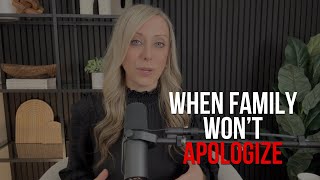
Dr. Tracy Dalgleish explains why waiting for apologies from family members often keeps people stuck and outlines a common interaction pattern: expressing hurt → defensiveness → justification/denial/minimizing → shame or attack → no apology. She recommends shifting focus from eliciting apologies to controlling one’s own healing and setting clear boundaries, distinguishing between protective estrangement and avoidance, and practicing internal forgiveness to release resentment and redefine relationships.
Chapters
We've been having lots of conversations about family dynamics and boundaries, the missteps and the hurts. And the top question I continue to get is this, should I hold out for an apology? And the answer to this question is really about the person that you are dealing with and the past experiences that you've had together. Here's what I keep seeing happening in families. You first share your hurt feelings. They get defensive. Defensiveness often shows up because they feel attacked, even if you are not attacking them. Then the defensiveness leads them to over, explain, justify, deny, or minimize what happened. And that leaves you feeling worse, and of course, rightfully so. You express again that you're just looking for an apology, and then this ultimately triggers their shame spiral. And now you are more frustrated because what happens when someone slips into shame? They either go into one space, which sounds like I can never get it right with you, or. Or they escalate into another attack. And both of these leave you still without the apology. With my clients, we explore how these patterns aren't new. And when it comes to parents or in laws, likely this is a long standing pattern of connecting with you or others in the family system. So the question then becomes, what is the apology about? For me, holding out for an apology can be a really tricky path. And I want to first say this. It's natural to want acknowledgement and validation for the hurt that you've experienced. I really want to emphasize that I'm so sorry that you have experienced the hurt. With family, with extended family, with in laws. It is incredibly hard to be in this space today where we're learning what it means to build healthy connections and then to turn to somebody and desire that for them, but they can't meet you there. And then there's the next piece. Waiting for an apology that may never come can keep you stuck in a cycle of frustration, of anger, of disappointment. And then it only leads to resentment and all of that then spirals and creates greater disconnection. So here's what I think is even more valuable. I think we need to shift and focus on what you can control. You get to control your own healing. You get to control your boundaries. Because the reality is, if you are holding out for an apology, you will end up looking backwards at those past experiences and continue to spiral with this person. When they've shown you the evidence that they don't know how to do it, then it then requires you to go into what your values are and how you move forward in that. And while I know for so many people, they do get to that very hard decision of estrangement. And if you haven't yet, go back and listen to my estrangement podcast episode. It's such a good one. But I know that not everybody wants to live in that space. And I also believe that not everybody should, because healing, generational healing, doesn't come from this living in an all or nothing experience. And I want to call this out right here. I've seen this in the Reddit boards, I've seen this in posts and comments, is that it's often this experience where we ask for our boundaries to be met, and when they don't, we immediately then go with when they don't meet our boundaries, we then go to this other space of cutting people off. That's not healing, that's avoidance. And building relationships that work allow you to find and sit in a lot of this gray space, which really, that is uncomfortable because if you are here saying, I wanted the apology, they didn't meet me there, it then stirs up a lot for you. I think there's also a really big difference here where healing can look like us setting boundaries. And it also means we're not going to allow our children to live in the same pain that we did as kids. But that doesn't mean you have to cut people off. So I really wanted to add that into this short conversation here because it is such a nuanced conversation. And I know that for so many people, cutting off is not the way they want to go and nor should it be, because that's not necessarily how we heal. I think this is where, when it comes to this conversation around healing and generational differences, we do want to find this gray. Just because someone isn't able to apologize doesn't mean we cut them off. Means we find a pathway through. And it might mean that your boundaries then are becoming even clearer to you and that you get to make more decisions based on what you do next. So I want you to remember this. An apology is about valuing the relationship more than one's ego. And the reality is not everyone is ready or willing to take that step. And if someone doesn't take that step, it's not because they don't love you. It's not because they don't respect you sometimes, it's because they really don't know how to do it or they believe that they have already done it. And I really want to differentiate this right here because this doesn't mean that you have to continue to accept disrespectful behavior. Please hear me When I say that, it means again, you're finding what your boundaries are. So that when that disrespectful behavior comes up, you end the conversation. If you're talking to mom on the phone and she gets into that spiral, you say, hey, mom, we're in that tough place again and I'm going to end the phone call and I'll talk to you next week like I always do. And you hang up the phone with your in laws. If they're criticizing your parenting and you have asked them before to not talk about parenting with you, if they are coming in at you and they're being disrespectful, then that's the moment where you say, our time here is done. We're going to pack up the kids and go. So I think that what's so important here is that you prioritize your emotional well being and the health of your immediate family. And instead of trying to focus on getting them to apologize, you now focus on moving forward. Focus on what truly matters to you. And I want you to remember this. Forgiveness isn't about letting someone off the hook. It's about releasing your own experience from that cycle of hurt, resentment and that protection, that self protection that is keeping you stuck. Because when you're hurting, you keep saying to yourself, they should change, they need to apologize. And it's focused outward. But forgiveness is actually something you do inside of yourself. And it's you being able to say, I'm not going to let them control this anymore. I'm not going to let them have this hold over me anymore. And I can release the experience. I can do that through movement, I can do that through processing. This is not forgetting. It's not having to go back to where you were in the relationship. It's not excusing the behavior. Instead, this is about you redefining what this relationship looks like moving forward now that you have this information. So do you hold out for an apology? The question really is, what person are you dealing with and what's the relationship you hope to have with this person and are they even capable of doing that? There's so much nuance in there. All right, thank you for tuning in today. Thanks for clicking play and I'll see you next time.