How to Use a Value Ladder to Grow Your Online Coaching Business | Customer Journey Mapping Examples
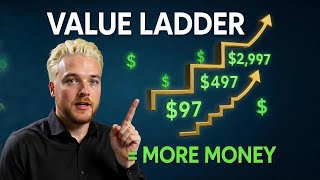
Dylan Vanas breaks down the five-level value ladder for coaching businesses, from free content to ultra-high-ticket offers. Russell Brunson's ClickFunnels and Tony Robbins' empire show how it works: convert 1% of free users, then move 20% up each level. The math: Tony's 7M Instagram followers could generate millions across his ladder of books, events, and platinum coaching.
Questions this video answers
Dylan Vanas (uploaded April 7, 2024).
Level 0: free; Level 1: ~$7 to under $100; Level 2: ~$500–$1,000; Level 3: ~$3,000–$10,000; Level 4: ~$25,000–$250,000.
1% initial conversion from Level 0 to Level 1, then ~20% ascend rate between subsequent levels.
7 million followers → 1% = 70,000 buyers at ~$15 (≈$1,050,000); 20% ascend to 14,000 at $500 (≈$7,000,000); 20% to 2,800 at $10,000 (≈$28,000,000); 20% to 560 at $100,000 (≈$56,000,000).
ClickFunnels: roughly $300/month or ~$3,000/year; Russell's Inner Circle coaching cited as roughly $50,000–$150,000.
Chapters
This is Russell Brunson and this is Tony Robbins. And while you might know Russell for being the founder of the app clickfunnels.com and you might know Tony for writing the motivational books or being the guy who throws these massive 5,000 person events selling out arenas all over the world, they're actually using a marketing strategy to help get you to spend more money with them. Now, if you're someone that has a coaching business, is thinking about starting a coaching business or, or does consulting or courses or any of that stuff, you're going to want to learn this strategy and use it in your business. In fact, this strategy is the key to these guys building these wildly successful brands. Now in this video, I'm going to show you what this strategy is. It's called the value ladder. I'll show you how they're using it, I'll give you the exact examples and price points of their offers, and I'll show you how you can create your own value ladder in your business. Now, if you're not a coach, consultant or course creator, that's okay because I'm also going to help you understand how this could work. And in any business, this is the process of taking customers in and helping ascend them to higher level products. You'll learn about exactly what that looks like. And I'm going to go through and actually show you this document right here. And by the end of this, I'll give you a link for you to actually download this document and create your own value ladder. Now with that being said, let's go ahead and talk about what a value ladder is. Now, a value ladder has the different levels of products within it, so is typically drawn out kind of like this. Now I don't really know why it's called a value ladder when it's really more like a staircase, but the truth is this is the way that is typically visualized. Now, I look at this as there's different levels of products. We got level zero, we got level one, we got level two, we got level three, and we've got level four. The way this works is this increases this way in price, okay? And then it increases this way in what we could say is value. So as we go through these products, each one of them becomes more expensive. The Level 0 product is the least expensive. And in this example, the Level 4 product is the most expensive. Now this does actually continue up this way and it actually also continues down this way. But for the sake of this example, we're going to keep it really simple here. So the way this works is in these value ladders we have these different products. Now a level zero product, we'll talk about what this could be. But typically level zero, it's actually free. Level one products are typically products that are in the range of a few dollars could be anywhere from $7 to typically under 100. But in some cases, some different businesses, these prices actually slide up. But for coaching businesses and course creators and consultants, typically these are the price points. Level 2 products typically are in the price range of anywhere from 500 to 1000. Level 3 products are typically several thousand dollars. It could be 3k to 5k. And in some cases a level 3 product could be as much as $10,000. And level 4 products typically are anywhere from 25,000 to usually about 250,000 is where they would cap out at. So that's 25k all the way to 250k. And it does go beyond that with higher ticket products. Now that's the basics of a value ladder. Let's talk about the purpose and the reason for it. So the purpose of having a value ladder is so people will know that like and trust you. You see, there's a lot of fear in the marketplace. People don't want to just cop out money to work with you and buy your stuff just because you told them to. You have to give them a reason why. And sometimes if you're coming in and you're going to ask someone to spend five grand, ten grand, three grand with you, but they don't have, they haven't had an experience of working with you in a smaller level, most people are not willing to do that. But what if there was a world where you could take people in, you could charge them, well, maybe even nothing. They could consume content about you for free and learn more about you. Well, that's what this is about. And then from there, maybe they're interested and they actually think like, okay, you could be a good fit to work with. They might want to work with you. And then maybe you want to charge them, let's say $30, they're willing to buck up and buy a book or maybe buy a little course of yours and they spend 30 bucks. And maybe from there they get comfortable with you and they're willing to spend 300. And then from there they get some results, they're enjoying whatever you're selling and then they're willing to spend 3,000. You see what's happening here? Now there's what's called the profit multiplier. Now what this is, this Means that typically these products down here, they don't make you as much money. We could have a hundred people come in and see our free stuff. We're going to make nothing on that. But let's say we get 10 people to buy our $30 thing. Now all of a sudden we've got $300 from this. And then we get, let's say two of those people to buy our $300 thing. We made 600 bucks off that. And then let's say of those two people, one bought the $3,000 thing. And now we've got 3,600 Rs. We're plus the 300, we got basically $4,900 of revenue. Or, excuse me, 3,900. There we go. There's my chicken scratch. Now, with that being said, we got $3,900 in total revenue. But the thing is, is if we were just selling this $3,000 course or program or whatever it is, the likelihood of one of these hundred people buying it is very low. 1. Well, what if we were just selling this while we would have only made 300 bucks? Well, what if we were only selling this? Well, we probably wouldn't have got those two people to buy. But let's say we even we did, we only would have made 600. So the profit multiplier states that the higher the products go, the more profit you'll make. Because those higher ticket products typically is where you make the majority of your money. See, in this example, we made $900 from all of our products. And our highest one, we made $3,000. So in this hypothetical example here, we made over three times our total revenue by having one high ticket product. Well, what if we took this one step further? What if we had a $30,000 product and let's say that one person who happened to buy this product also decided they want to buy this one. Well, now we just made a total of $33,900 we made on just by having these last two products here, we made an extra $33,000 that we wouldn't have had otherwise. We made 3x from this and we made 10x from this. And that's the power of the value ladder. Now, without going into too much detail on all the intricacies of this, I want you guys to understand, if you have a 1% of people who see your Level 0 products and then you get people at each level, you get 20% to go to the next level, you're doing a pretty good job. Okay? And these are the rough math we're going to use. These are, this is not hard, cold, fixed numbers for every industry. But this is something I've seen and if you're hitting these numbers, you're doing well. Well, okay, so let's say we have 10,000 people that are seeing our free stuff. Maybe they're following us on Instagram. We'll get 1% of those, let's say 100 to buy our stuff. We'll get roughly 20 to ascend to the next level. Or when I say a hundred, 100 people to go to. This is. This would be, by the way, this is level zero, this is level one, this is level two, this is level three, and so on. Okay, so we've got 10,000 people at level zero. We'll get 100 people at level one, then we'll go into 20%. So level two, level three would have four, and then so on and so forth. So that's the purpose and the basic of it. Hopefully that makes sense. Now what I want to show here is an example what this would look like for your coaching business. So the, the way this works is we've got cost and value, as we just talked about here. And at the very basic level, we've got about the $0 stuff. So this is typically going to be content. This is going to be stuff people are following on Instagram. This could be someone sees you speaking at an event. This could be someone listening to your podcast. This is really something where people who don't know about you can find out about you and it doesn't cost them anything extra to do. So from there you'll go to the low ticket level. Now the low ticket level is typically the level that you go to and you're at when this is very low price stuff. So under 100 bucks, as we just discussed, typically this is typically going to be like books and intro courses. Intro courses or paid consulting. Like they come in, let's say a trial offer. So a chiropractic office would have maybe their $37 paid consult. Whether you come in to get a consultation with the chiropractor. Mid ticket is going to be stuff that's in the hundreds, up to about a thousand, usually about 500 to 1000 or 997, just because we've got to throw the seven in there. High ticket is going to usually be 3k to 10k. And then ultra high ticket is going to be the stuff that's in the 25 to 50 to 250k. And again, these are going to be like masterminds these are going to be done for you services. These are going to be things where you're meeting, you're going out to specific locations to work closely with someone like the mentor, the coach or consultant. And these are usually courses that come with coaching. These are typically just courses. That's it. So this is the general value ladder that you'll see in a coaching business. It's very important to have each one of these levels because as you have the Level 0, Level 1, Level 2, Level 3 and Level 4 products, you're able to do what you're able to get more profit. Now, with that being said, let me show you a couple examples real quick here on what this looks like in a business. So Russell Brunson, right, The founder of ClickFunnels, he's got his own value ladder. The way his value ladder works is he actually goes and he has his Level 1 products, which he has Level 0, which is content, social media content. It's his ads, it's his free quizzes, he has, it's his website, anything. Again, level zero is stuff where people can learn about you without having to spend to to learn about you, okay? Content, ads, speaking events and trials offering free trials for the software. When it comes to level one, his level one products are typically books. He has his free plus shipping books. These are also any way for someone to pay to be a part of something. He does challenges from time to time where he'll do a paid challenge. Then we go up to ClickFunnels, which is his software. This is where he's actually going. And he's having people sign up for click funnels. You can Pay, I think 3,000 bucks for the year or $300 per month to do it. Then he's got these event or $97 is also, I think they have different tiers, 97 to 297. Then they had, then you have events, courses and access to expert experts to help you with your click funnel. Then he has his inner circle, which is a coaching program which ranges between 50k to 150k. And that's Russell Brunson's value ladder. Now when I look at this, one of the questions a lot of people often ask is, well, Dylan, I've got this recurring income. Where does it go? I have people paying me 97 bucks a month. Where does that live? And some people might think it lives. Well, it lives right here, right? This is what I said with ClickFunnels. And let me just skip over here a little bit because if we look at this let's say we have a $97 per month thing and we've got this $97 thing here, we've got a 997 thing here, we've got A 4997 thing, 4997 thing here, and so on and so forth. Where does it live? Well, the 97, typically with recurring, you consider, okay, how much is this going to cost? An over. Over. How much is someone going to invest over 12 months? So you multiply it by 12 months and that's your price. So in this case, that would be about 1200 bucks. So in this case, this would actually live right here. Or you know, I would just slide it under whatever this997 product is. Let's say it's a course. I would just also list this as like another item that's in this L2 bucket here. Hopefully that makes sense. Now, with that being said, I showed you Russell Brunson's example. Let's go through Tony Robbins example. So Tony Robbins value ladder is really interesting. At the bottom, he's got his content, his speaking, his ads, his podcasts, and all the ways for you again to learn about him before you really are investing anything additional to learn about him. Now, obviously you might pay to go to someone else's event, or you might Pay for a YouTube subscription to a YouTube Premium subscription to Watch or a Spotify subscription subscription to Listen. But with all this stuff, you're not paying anything extra. You're not investing directly into him. L1, Level 1 is when you start to get into. This is the very first action people are taking to learn about Tony. So now you're starting to purchase his books, you're starting to. He has an app, he's starting to get involved with his intro courses. These are courses that cost $97, $47. And then L2, these are his intro events. So intro events could be things like upw, which stands for Unleash the Power Within. In fact, I went to this back in 2016 and these could be his lower ticket courses. So the courses that cost a few hundred bucks, his personal power program. This is example of Tony Robbins value ladder. Then we go up and we look at, okay, well, what is the core product that they're offering? Level 3 stuff is typically going to be his core product, which is his business Mastery program, which is a 10k program. Or it's going to be his Date with Destiny program, which I believe is a 5K program. And then they have other core programs in here. They also have some other Programs that you can go. And they're in the 20k, roughly 20k range. For Tony, those would live in this core product bucket. Those are the core things he's selling and generate the bulk of kind of the revenue. But then there's the profit multiplier, because as you're going up, every one of these products, you're getting more and more profit as you go through it. And so we look at L4 level 4 products. What this looks like is he actually has. I put plat here. It's called the platinum program, where you become a plat number. Platinum. And then he's also got lions, which is basically plat, but you're a little bit more premium. And that's 250k for the year. So this is his value ladder. Now, if we look at it, I mapped out what I call Tony money, which will show us exactly how much money Tony's making and where it's coming from. So, so if we look at this, I just took his Instagram following as an example. He's got 7 million followers on Instagram. Now, of the 7 million followers, let's say we use our math. Remember, at the start, we went through the kind of the math that we have right here on this one right here somewhere. Here we go. 1% of people that see your, your initial products, your level 0 products will close. Then we have about 20% ascend through the level 1 through level 4. Okay, so we go over here to Tony Money. We've got of the IG, the Instagram followers, we've got 7 million. Let's say we have 1% closed. That's 70,000 people. Of those 70,000, it's at $15 per. So 15 times 71. 23. 3 is 1.1 million and 1. Excuse me, $1,050,000. So 1,050,000. Now, of that, if we have 20% ascend, which again, if you're doing that, you're, you're, you're in a good spot. You're going to get 14,000 people ascend to his intro events. Let's say it's UPW at 500 bucks. You now have $7 million. Even though you had like 50,000. 56,000 more people buy the books. You're gonna make more money off the next level product. Now let's watch the math unfold here. Okay, well, let's say we now get 20% of people to ascend to the next level, which is his core offers, business mastery or these other date with destiny and so forth. 2800 people at $10,000 per, that's $28 million. Isn't that interesting to see how that's how you're gaining more and more as we go through this and the final level product, let's say we get the 20% to ascend to 560 people at $100,000. We got 560 people at $100,000. That equals 56 million. So with this you can see how every step in the process is creating more profit for the business owner and also more value for the buyer. See, I think selling is a good thing. It's good for everyone because with this, it's good for you as the person buying the products, you're able to get more value and it's good for me or whoever's selling the product because we're able to make money and it's good for the economy because everything, everyone's winning, right? And so with that being said, this level, this value ladder is extremely important to business. And I think one of the most critical parts to making business a success. So if we look at this Tony Robbins made on just Instagram alone with his hypothetical example, 35, roughly $90 million. But if he only had the books or only had the low products, he would have ended up with about 10% of that. So if we go to the next slide here, this is. We talked about recurring revenue. So how do you guys build your own? Well, here's the way I look at it is what we want to think about is number one, first you want to write down what products you have. Okay. What are the things you currently have that you can use? Now if you have something that's. Let's say you're one on one consulting, Consulting. And you charge, I don't know, let's say you charge $300 an hour. Perfect, you've got that. Or let's say you've got some course you made. Or let's say you've got an Instagram page or a podcast, let's call it content. Just write that out. Whatever it is that you've got that is funnels in your ecosystem, write it out. You got a website. Cool. Alright, then I want you right next to it, you're gonna write out the prices. So $300 for the one on one consulting. Let's say the course is, I don't know, let's say it's 197, the content's free and we write out the prices. Now from there we want to write out and actually draw out number three, I think we'll put like a 2.5 in here, which is, then you map it onto the value ladder. So you draw out the ladder and you write L0, L1, L2, L3 and L4 and you review. Okay. L1 is 0, is typically $0. So you write out all the free stuff you have here. L1 is typically under $100. So you write all the stuff you have there. L2 is typically under a thousand bucks. So you write all the stuff you have there. L3 is typically in the 3 to 5k range, so you'll write out what you have here. And then L4 is the higher, higher ticket stuff. So anything above that, that you have now, with that being said, you'll probably notice, oh, look, I have a gap here. You know, I've got my one on one stuff, let's say it's up here. But I don't have my this. Or I have this, but I don't have this. So you'll notice the gaps. And now we'll know what we got to create. Don't slow down or stop just because you don't have every part of the process. It's not necessary for us to have all of it today. The goal is that we know we need stuff and we're going to create more of it in the future as we go on. But this exercise helps us identify, okay, what products do we have, what products do we not have, and what do we have to create in the flow throughout the way? So here's you guys next steps. What I want you to do is go ahead and just take out a piece of paper or a pen and, and write out what you have as far as products go, what the prices are. Then map it out onto the ladder. Draw out the physical ladder. Literally draw it out. Put what you have at each step in the process and then you know what you have to create. Then you put that, what you have to create just on a list for the future. When you have time, when you're able to, you can create those additional products. Hopefully this is valuable for you. Once you have this mapped out, by the way, go ahead and you can just send me a message on Instagram and it's Y, L A N V A N A S. I'll actually review these personally. So if you just shoot me a message, send me a picture of your value ladder. I'll go ahead and actually review these personally and give you some feedback on it. Hopefully this was helpful. Hopefully you learned something from this video. If you're new here, my name is Dylan Vanis. I have done tens of millions of dollars in sales and coaching programs my businesses online and I make videos about growing a coaching offer, helping you build your business, helping you scale your brand. So if you learned something, you were inspired, go ahead and hit the like button. Give me a subscribe and until next time, I'll see you guys in the next video.
More from Dylan

Why One Conversion Path Won’t Convert Everyone - Choose the Right Funnel #Marketing #Sales


Why Your Business Is Losing Customers Before They Even Get a Chance to Buy (It's Not What You Think)