Watch This BEFORE You Hire Employees
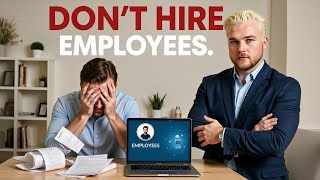
Dylan Vanas walks through the order to add labor as you scale: freelancers first, then agencies or white-label partners, employees only when revenue justifies the risk. He covers trial periods, remote vs in-person tradeoffs, and accountability systems like individual KPIs and Zoom breakout rooms.
Chapters
In this video, I'm going to take you guys through four parts talking about freelancers, remote workers, partnering with agencies, and finally hiring employees. Because I think hiring employees should be the last thing that you do. And hey, I know this because I have over 100 of them that work for me and my companies and they represent the largest risk. So I'm going to break down the journey of what you should go through when you're starting up a company and trying to scale it and, and then when you should get to the point where you actually have employees. So to start off, let's talk about freelancers. You see, freelancers are effectively pay for hire workers. They're the kind of people who you can go on sites like Upwork, Fiverr, Freelancer.com and you can pay per project work. It's great because it's extremely low risk when it comes to finances. Now there are some downsides because you don't know if you can necessarily trust freelancers. In fact, in the past I've had freelancers, they actually poached my clients from me because they don't have a relationship with me necessarily. They're trying to make money. And so there are some risk associated. But the biggest benefit of it is you don't have any kind of long term commitment. It's easy to scale up and down. Let's say you get a few more clients, you just hire a couple more freelancers. So I think that every business owner, as you're starting to scale, you're going to start to realize that your time is limited. You're going to start to see, okay, I can't do this all myself. And in fact I'm working 40, 60, 80 hours a week. There's no way to scale. And so that's when you should look at actually bringing on one freelancer. Now in my industry, I work in the marketing space. So for me I would bring on like one little marketing expert who knows technicalities, knows how to make social media content. And I try to find someone that's a little more broad in their experience. But as I scale more then I look okay. Like this person's good at kind of the broad stuff. But, but let's say, you know, you got five clients right now, this person could kind of help fill in the gaps with some of the clients. But let's say if you had 50 clients, well then you're gonna want a little more specialized experts for each area and that's in which case you could have like in my case, a social media manager freelancer, a Facebook ad freelancer, a web design freelancer. And that's how I would scale my team if I were to start over all over again. But there's actually a much better solution out there than, than just freelancers. And this is through agencies and partnerships. You see, there's actually specialized companies out there that they'll go ahead and they'll partner with you and they'll work with you on a per project basis where you don't actually have to go out and hire someone or risk working with a freelancer. So you get all the benefits of working with a freelancer. You know, you can scale up, scale down, but you don't have to worry about them poaching your clients. You don't have to worry about the work quality because if you it's all been proven before and you even get a benefit from their scripts, their testimonials and their all the stuff they built for your own agency or your own business, whatever kind of company you have. And so what I would say is if you're looking at opportunities to scale, you can look at freelancers to start or better yet, you can find agencies or pay per project companies, also known as white label companies that will actually do projects on your behalf. So for you and so you can focus on what you love to do inside the company and what you do best building the business with that, it's probably a good time to plug my company called Agency Box. We do white label marketing solutions. So if you're an agency owner, you can actually work with Agency Box to go ahead and get clients for your own business. So that's Agency Box wanted to give you a quick plug agency box.com if you're a marketing agency or if you're a business owner looking to get marketing services at a discount, you can check out Agency Box link below as well in the description. Now as your business starts to scale, you're probably doing a couple hundred thousand dollars or more per year in sales. You're going to want to start looking at hiring employees. Now when it comes to hiring employees, you have two options. One, you could hire people in person that sit next to you in your office or co working space or whatever it is. Or you can hire people that are remote workers that work for you. Now there's pros and cons to each of these and again, I still think you should always start with hiring agencies or doing partnerships or freelancers. But if you really are at the point where it's time for employees, here's what you need to know. Number one, Finding the right person isn't going to be easy and isn't going to be quick. If you think a referral from posting a little post on your social media page or from one of your friends is going to be the answer, it most likely isn't. You see, the one thing that I would like to leave with you guys, if you get nothing else from today's video, is that when it comes to employees, that the main difference between good employees and bad employees is that the good employees, I don't hear about their shit. You see, everyone has stuff they're going through in life. The good employees, it never affects their work or performance. In fact, I never hear about it. They're the kind of people who come into work no matter what happened. Their car broke down, their boyfriend dumped them, they have crazy stuff happening, and somehow they managed to show up and, and do an amazing job. You see. But the poor employees, there's always some excuse. There's always some problem. I'm sick, I'm not feeling well today. You know, my tire fell off my car. It's like, it's like, okay, like, I don't know if these guys are just making it up or if they truly have the worst luck possible. But the second subset of employees are the ones where I'm always hearing about the stuff going wrong. And so I just wanted to share that with you, is that when you are, if you're working with someone, give them a trial period of 30 days. If they're constantly having problems, they're showing up late, there's an excuse for xyz. They're probably in the second category, and I'd probably look for someone else. All right, now, the second thing when it comes to hiring employees is in person. Employees are great. I believe in the creative ability to collaborate in person. I also think there's increased accountability in person. But you see in person employees, especially if you're in the, in North America, in the United States or in some of the, you know, Europe or some of the more expensive countries to live in, people are a little more expensive. And so, you know, someone on average in the, in the US makes about 40k per year. So 3 to 5 grand a month. You see, you can hire someone overseas for, you know, about 20% of that, between 7 to 700 to $1,000 per month. And so if you have really good systems and processes in place where you can hire and train people, well, you could get five to 10 people overseas for the cost of one person in the U.S. and so that's Kind of like something you should consider is like, okay, could I build a remote team? Now, whether your team is remote or in person, you do need to have a lot of accountability for them. You see these employees, they're not just going to show up and do their job. What an employee does is they're going to do the bare minimum they can do to get by. It's just the way it works. Imagine government workers, but in your own company, like, they're going to be doing this and at the same time they're going to be talking to you, to your face and make it seem like they're doing, going above and beyond. And sometimes there are employees that come through that are like that. But based on my experience, I'd say it's one in every 15 or 20 people that really are the go above and beyond all the time, not just in front of you. And so with that, you need systems to keep them accountable. One of the best ways to do that is just by having stats. So every single employee in my company has a stat that they're responsible for. Whether it's sales, whether it's number of people onboarded, number of support tickets processed, everyone has a stat. And so when we meet up every week, the question isn't, hey, are you working? It's hey, what's your stat? And you can see if the stats go down, well, there's probably something happening where they're not actually working or showing up and doing the best job. So that's one way to hold my team accountable. The second way is through Zoom breakout rooms. So what we have, we actually have a virtual office space that our company and our team jumps into. This is for both remote and in person employees. And so we actually have a remote receptionist. They sit on Zoom all day and they welcome the team in. And every team member that comes in, if they're a sales team member, they'll get a breakout room where they'll actually do sales calls in for team members where they're just working as part of a small team. They'll have their team and their supervisor within one room. And with this, I can literally jump in. I can see everyone that's online at one time. If I want to have a qu. If I have a question for someone, I can just jump into their room and talk to them. It also gives people like, it's the funniest thing. People actually hang out in the reception area and they kind of talk to each other. You see people passing through and on the, like, it's just like in a real office space walking down the hall. So it's a great way to, number one, create culture. Number two, hold people accountable. And number three, be able to organize your work and see all the people that are working for you. So that's the overview on hiring employees, how I look at it and kind of the benefits, pros and cons of both. If you're looking to scale up your company again, start with the lowest risk possible, which would be some form of partnership or freelancers. And then from there, you can look at scaling up with remote or in person employees. Just make sure you're holding them accountable. All right. Well, if you enjoyed this video, go ahead and like the video and subscribe. And I would love to see you guys in another video on my channel. So see you soon.
More from Dylan

Why One Conversion Path Won’t Convert Everyone - Choose the Right Funnel #Marketing #Sales



Why Your Business Is Losing Customers Before They Even Get a Chance to Buy (It's Not What You Think)