Can You Do High-Ticket Sales Part-Time?
Dylan Vergara explains how to earn $6-8K weekly in part-time high-ticket sales roles, sharing his own path from roofing to closing deals alongside other projects. He covers offer stacking, why early-stage companies hire part-time, and real examples of engineers and SDRs making $4-5K monthly, but notes that serious money typically requires full-time commitment.
Chapters
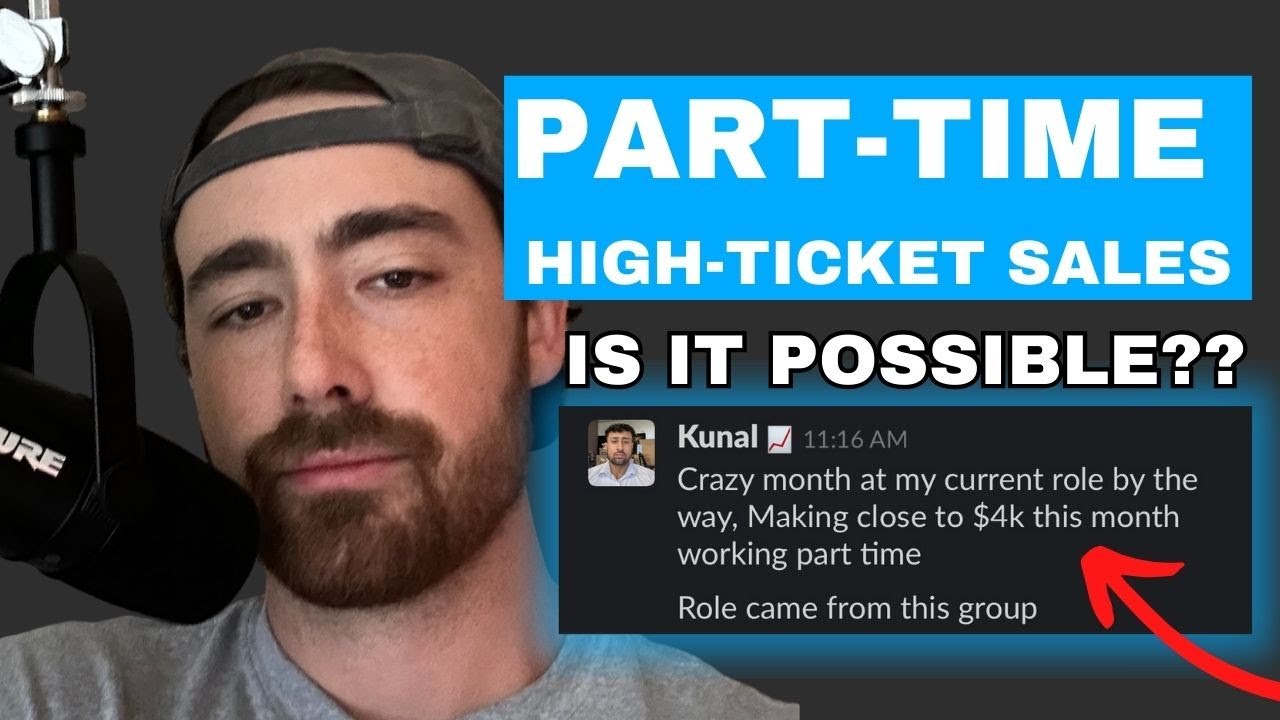
What's up, you guys? You like that walkout song? How to get, how to get a little hype. We've got a good video ahead of us talking about part-time work and high-ticket sales. Probably one of the most common questions that I get from those of you who are looking to get started with high-ticket sales. You wanna ease into it whether you're a student working another job. So put a lot of work into this. I'm gonna walk through step by step how I see it, my experience. I mean, you can see it all right here. Short answer, long answer on if it's possible, defining what exactly part-time high-ticket sales is. My experience with it, the point of view of you, the rep, point of view of the business owner when it comes to why part-time, offer stacking, examples of people doing this, questions that you guys had. I posted on Instagram and you guys had some questions come in and then my overall thoughts. So gonna be a value-packed one for you guys, but let's get right into it. Basically, I've over the last 2 years been closing I've helped hundreds of guys break into high-ticket sales and I work with a lot of the business owners as well. So I do see, you know, full-time roles, part-time roles, I see it all. So short answer, guys, yes, it exists. And let me zoom in just a little bit here. Short answer, yes, it exists. Long answer, it exists. However, there are many reasons as to why you may or may not want to consider part-time work as a contracted sales rep, this video's gonna cover it all. Now, what exactly is part-time work when it comes to high-ticket sales? It's just like another job. It can mean 5 hours a week, it can mean 20 hours a week, 30 hours a week. But I'm just gonna classify it as like something that can be done alongside another job or obligation that you have. Oftentimes these roles are gonna be about 3 to 5 hours per day, but you will, oh, you may be, you may have a role that gets put in front of you where it's like a call or 2 a week, which is like really not ideal, but it can be really close to full-time. It can be basically nothing. Now, my experience working part-time, Let me clean this up. So I started out part-time when I was in roofing sales still. I knew about high-ticket sales and I was like, let me, you know, take a step into it, have a little bit of an experience with it, see what it's about. So I started out part-time with a small agency and it was one of those where I'd have a call or two a week and it It was enough to kind of show me what high-ticket sales is like, but not really enough for me to get any serious experience or get comfortable enough to go all in. So I eventually found another role. It was a more serious role that quickly became too much for me to manage alongside the in-person job. And that's when I made the leap. So this was technically part-time, but it was more of that. 25, 35 hours per week alongside, I had a roofing sales job. I was in person driving around in the city in people's houses and I just, it's very difficult to manage. So I did spend a large amount of 2022 closing for about 2 to 4 hours a day. I'd have 30-minute calls. So that's 4 to 8 calls, which honestly it was, it was probably like 3 to 5 calls a day. I was on one team there. I'd average $6K to $8K with this part-time gig. And I would also, I was running this alongside my other projects, my community. And then I was picking up part-time closing roles in the midst of all that as well. So it was, for me, it was a very ideal scenario because I had already been in the season of grinding and maxing out my income. And now I was looking for something that was more so chill so I could get away, spend the summer doing what I wanted to do, and then work on things that I wanted to work on. So this was perfect. But yeah, one, I would even call it like 1.5, 3, 3.5 hours per day. And I would make solid money doing that. So To specifically seek out a good part-time role though, it is quite difficult and I'll explain why here. Close this up. So from your point of view, why is part-time attractive? It can be the safest transition out of your current job and into high-ticket sales. It can let you test the waters before you fully commit. It can give you time for your other obligations. And then you'll also be able to learn the ins and outs of what it takes to scale an offer with a tight, you know, you're gonna have a tight feedback loop oftentimes with a small team. And those are just skills that are good to have as you progress through high-ticket sales. The downside of this, you won't be considered for the best roles as they are generally not seeking, or they're generally seeking full-time talent. You won't get a true taste of what's possible with high-ticket sales by limiting yourself to part-time roles only. And also when you are applying to part-time roles, it doesn't really scream that you are the most driven, hungry sales rep out there. It, you know, depending on the situation, if you're just looking for part-time, 'cause it's like, I wanna take a few calls a day and coast, that's not a good look as a sales rep. As a sales rep, you should want to get in there and make the most of any opportunity. Being a lazy sales rep isn't, isn't good. So it's best to apply to something that's already listed as part-time than trying to get on an interview for a full-time role and selling them on the idea of having you up part-time. So that's it from the rep's point of view. From the business owner's point of view, Notice there's a lot in here. The appeal for them is they're not as responsible for the income or wellbeing of their reps, less liability on them. They could probably sleep a little bit better at night. Also, they're in a nothing-to-lose situation, or they could have nothing-to-lose mentality, which is basically like, oh, you know, I'll give this guy a call or two a day. It's no big deal. It's not like it's his main source of income. If it's not there, it's not there. You know, so there's no, not as much accountability on their end, which can be good for them, bad for the rep. And then it does allow them flexibility to work on other parts of the business. So a lot of these earlier companies where you've got 1 or 2 people doing everything, sales is usually one of the first things they're trying to outsource so that they can go fix the fulfillment or fix the marketing and stuff like that. But the downside From the business owner's perspective is the team is gonna be more distant and not as committed. When you don't have a culture of a decent-sized sales team pushing each other, competing to be the best, to get the best numbers, you're just gonna have people that you speak to once or twice a week. And it's hard to like create that fire within a sales rep without that competitive environment. You also, as the business owner, won't be able to expect as much from these reps because, dude, you're just a— you're a part-time thing, right? You can't expect much. Contract only, a few calls a week. You can't expect the moon and the stars. And as a business owner, it does become difficult to attract quality talent because the best sales reps want full-time work and The best sales reps aren't really sitting around with empty or like with empty calendar space. They're full-time, they're busy, they're making the money they wanna make. Huge point of emphasis here. High-ticket sales roles are usually not part-time by choice of the business owner. They are usually part-time because they cannot currently generate enough leads for a full-time hire. What does that mean? They can't generate enough leads for a setter to call, book, and make a full-time income, or they can't generate enough appointments for a closer to close enough in order to make a full-time income. Why can't they do that? They're usually an earlier stage business and they're working out the kinks. You will oftentimes find yourself coming into something that is rough around the edges and you are gonna be responsible for kind of collaborating with the team to refine what they have and make it better. Which as a sales rep, it can be a good opportunity to learn complementary skill sets. That's what you're looking to do. Now these do, yeah, they do have the potential to turn into great opportunities. You can usually work out a pretty favorable comp structure if you are qualified, if you're good, if you know what you're talking about in order to provide the necessary value to get them to the next level. So this is like the biggest takeaway that I would take from this part of it. It's just like, there's a reason it's not full-time. It's not by choice. And the reason is because they're probably early, can't generate leads. Is that a team you wanna be with? You choose. Offer stacking, working 2 to 3 offers at the same time, meaning at least one of them is part-time. If you're working 3, 2 of them have to be part-time. Or if you're working 3 and you have 1 full-time and 2 part-time, that's a lot of work. And even 3 part-time is a lot of work. It can be hectic, but if you find some good stuff, it can be worth it. But I would rather, if I'm gonna jump into high-ticket sales, I'd rather just get 1 really good offer that lets me make what I wanna make. But that, you know, when you're getting into this, it's not always the easiest thing to do. So sometimes you have to stack some offers. I know tons of guys who do this, including myself. I've done 2 or 3 at a time. Examples of people doing this. So this was some screenshots from me when I was taking 3, 4, or 5 calls a day. This was a screenshot from the team. This man closed 3 freaking deals today. He's on fire. I was on a hot streak that day. Dylan, you just tied company record for total clients signed in a day. I think that was the same day. Kunal here, he's an engineer out of the UK. And so 9 to 5, after that he works with an American company, making close to $4K this month working part-time. Role came from this group through my community. And then Diavin here, he's a software sales rep. SDR, really good one. And he picked up a setting gig for an e-commerce company, did this while still working 9 to 5 and trading, and he made again like $4,000 part-time. So can you do it? Yeah. And I've seen all everybody, I've seen everybody do this. The only thing that would allow you not to do this is if you are working like an in-person job 80 hours a week, or you just don't Go and try to do it. Even, even guys with zero sales experience. I mean, students, people who are in sales in another industry, or people who are in a different industry and not doing sales, you can do it. You can do it just like Kunal here. He's an engineer doing that. He's not the only engineer that I know that's doing that. So you guys had some questions. I posted On, let's see here, let me clean this up. I posted on Instagram, geez, I posted on Instagram that I was making this video and I said, hey, give me your questions. So does part-time mean taking calls on certain days or certain hours? How flexible is part-time? Short answer, yes, but you'll want to be on the same page as your offer owner, and that's usually by defining a clear schedule for when you can and cannot work. Generally speaking, they would rather have you work less hours on more days than more hours on less days. I'm gonna cover this a little bit more in depth in the next section. But yeah, you're gonna, when you accept the role, you're gonna have to set clear expectations for when you're available and when you're not. What to avoid. Not necessarily specific to part-time work, but just avoid bad gigs altogether. Avoid jobs where the math doesn't add up. See my last video to understand this better. It was called like, don't stop accepting bad high-ticket sales jobs or something. You'll see it if you search for it. And then avoid offer owners who are highly uncertain of what they want or need out of you. You will see this with part-time gigs where this is like their first hire. They're not really sure what they're doing. The only way that I would jump into that is if I'm very knowledgeable in what I'm doing and what we're looking to do. And I feel like I can wheel us to success, which a lot of times you're not gonna have the, the control to do that. Someone asked an ideal work-life balance, possibly even for college students who work. Yes, it's possible. However, I would replace your current work with high-ticket sales if you are looking To get into it because it's just gonna be way too difficult. Not too difficult, I don't wanna say too difficult, but it's gonna be very difficult to find something that fits within these odd hours that you're able to work. And if you're in school and you're working a job, like your time is gonna be very limited. And yeah, you're just gonna have difficulty juggling this for more than 30, 60 days, I'd imagine. Would I be taken seriously without a phenomenal resume? Yes. If you're applying to an entry-level role and you apply and interview well, usually appointment setting roles, and in the job posting, a lot of times they will say this is beginner friendly. But man, I know, I know guys who just got out of high school making $7,000, $10,000 a month appointment setting, no sales experience. So there are a lot of roles out there that they don't really care about a crazy resume. If you have some sales experience, you're already a step above others, but you have to understand how the high-ticket sales space works. And so if you're on YouTube channel, if you're in my community, you would probably have a good idea of how that works more so than other people who just Come, you know, from, I don't know, solar door-to-door. They haven't done any research. They start applying to jobs and they have no idea how this stuff works. Lastly, my overall thoughts on this, guys. It's worth it, but you just need to consider everything listed above. Where are you with your job? Where are you with your savings? What are your goals financially? What are your goals outside of finances, like your lifestyle goals, stuff like that? You will not realize the true potential of high-ticket sales working part-time. You're not gonna make $20K a month working part-time. I'm not, again, I'm not gonna say you're not, but very, very slim odds for you to get to making $10K, $15K, $20K+ per month part-time. You will likely have had to have worked your way up and up and up. Probably over the course of a year, 2 years, and just land a killer opportunity, which is not the easiest thing to do. So you, by being part-time, you are limiting yourself as far as consideration for the good roles by a lot. And while it works, I would not suggest pursuing part-time as your end goal. Like if your goal is to just be a digital nomad and close To fuel that lifestyle, you can do it, but it's not gonna be, it's not gonna be as fruitful as just going all in and giving it your all. And by the way, guys, a lot of these full-time roles are not 40 hours per week. Now, some of them, they will pack out your calendar. Every white space on your calendar would be filled, will be filled with a call if they like. Or if you let them, but many of them are 5 to 7 hours per day. And then, you know, admin meeting, one-off communicating with the team, and it can get up to 35, 40, 45 pretty quickly. But getting back to the question up here, like working high-ticket sales alongside school and another job. If you're coming in with a schedule like this, like extremely specific, hey, Monday and Wednesdays, I've got 2 hours here. Thursdays I have this time and Friday and Saturday I have this and Sundays I can't work. Like, dude, don't— I would just say wait, wait until you can free up some time or free up larger portions of your day. Again, it's not impossible. I've seen a lot of people pull off a lot of things in high-ticket sales, but this is just adding a level of complexity that doesn't need to be there. And if you're serious about high-ticket sales, you are just going to get the most of it or the most from it by committing. So that's my overall thoughts, guys. If you are looking for part-time work, full-time work. And let's say you're transitioning out of another job. You don't have the time to go out and watch tens of hours of YouTube and go source your own opportunities and then not know if they're good and not have other people who can tell you if they're not good. I have my sales community. If you watch my stuff, you know that by now. We help guys from all over the world, all different backgrounds, get into high-ticket sales. And it's not just, you know, some sales training on how to handle the same objection 20 times over. It's more oriented towards taking this seriously as a career, making sure that you have a smooth transition from where you are to where you wanna be, and making sure that you can be in high-ticket sales sustainably for a year, 2 years, 3 years plus, instead of getting on a bad offer, jumping off in 2 weeks, 30 days, and being like, high-ticket sales doesn't work. So if you're watching this and you wanna look into that some more, links in the description. Also, you can DM me on Instagram, DM me the word part-time. I guess. And I'll talk with you, see where you're at, see how I could potentially help. So if you made it this far, we hit the 20-minute mark. I appreciate you and I'll catch you in the next one.









