How To Avoid Objections on Your High-Ticket Sales Calls
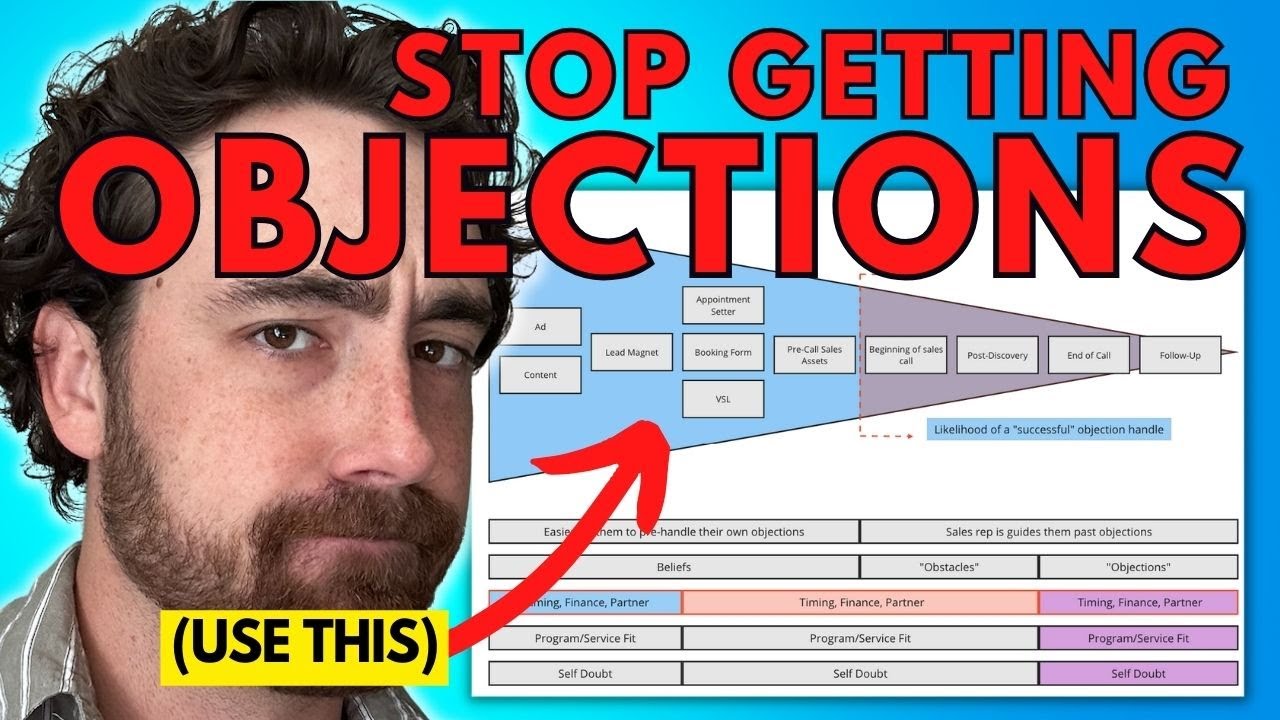
Dylan Vergara shows how to handle objections before your sales call by addressing them throughout your marketing funnel. The three most common objections are timing, finance, and decision-maker concerns, which usually stem from fear, priority, or permission issues. Pre-handle them with storytelling and yes/no questions so prospects reach their own conclusions.
Chapters
What's up, you guys? New YouTube video. This time around, we're going to talk about not objection handling, but front-loading objections, pre-handling objections, basically not getting them at all. Because in high-ticket sales, you can do that if you play your cards right. I'm going to talk primarily about the main 3 that everybody gets, which is timing, finance, And the decision-maker objection. And I have some diagrams which I'll pull up right now that I feel illustrate things pretty accurately. So, just give me one sec. Share screen. Cool. Okay. So, in my mind, a lot of people are out there teaching objection handling while on the sales call. And a lot of them are teaching it, you know, from here on, which is like when you're at the end of the call, that's when you handle objections. That's the last place you wanna handle objections during, okay? You don't wanna be in the position where you've already asked for the sale and you're trying to like justify and strong-arm into a program or a service 'cause that's how you get refunds, chargebacks, and just— Buyer's remorse, all that kind of bad stuff, right? You'll see that this triangle in the back here, the further up you go in that client journey, or the journey of the lead, let's call it, the larger the triangle is, meaning the easier it is to pre-handle these objections. Okay, once you get onto the sales call, you know, if you're making attempts at the beginning, it's still better than nothing. But ideally, Based on what I've done for myself and what I've helped other people do and teams I've been a part of, the earlier you can handle these, the more likely that you're gonna be able to handle them. And it goes all the way up to the first touchpoint, which, you know, if they find you off an ad, an organic piece of content, you can handle objections there. So ads, content, usually the first touchpoint. I'll kind of walk through it here. Then A lot of people are going to be driving down to a lead magnet, free training, free resource, maybe it's a YouTube video, stuff like that. And then there's a few different things that could happen. Every funnel looks different, but they'll either get in touch with an appointment setter, maybe they'll see a booking form, maybe they'll land on a page with a VSL. This, you know, some of these can come before, some of these can come after, but generally speaking, This is, you know, these 3 are gonna fall about right here. Then once they hit the booking form, there's gonna be pre-call sales assets that you can set automations, send out videos, reminders, case studies, stuff like that. At this point of the call, it's so much easier to handle the objections that they're gonna bring into the call. Once you're onto the call, it then becomes kind of like you versus them. Right. So again, it's better to handle at the beginning of the sales call, but you know, they can technically still be handled after the follow-up or like after the first call in a follow-up, but it's just not as likely. So in the first half of it here, you're really trying to get these people to pre-handle their own objections with, you know, if you've studied objection handling, you know that the best way to get people past their objections Is to kind of get them to walk themselves to that conclusion versus you saying, no, you are wrong, you need to do this, or you need to think this. So up here, it's easier for them to pre-handle. Here, the sales rep is having to work them past the objections. Can be pretty soft and nonchalant, or it could be pretty upfront. At this point, you'll see that, you know, I categorize this as beliefs. For some reason, these people have been led to believe one thing in the marketing, in the pre-call assets and touchpoints and all that. You can shift these beliefs a little bit easier. And then Hormozi does the obstacles versus objections, right? So anything on your call that is pre-pitch, meaning you haven't asked for the sale yet, these objections are just Obstacles, they're a lot easier to get past. What, like, while you guys are still kind of on the same team. Once the ask is out there, just human nature, people get defensive, people back away, people will get closed off. And that's when you're handling objections. So if you can't handle the beliefs up here with the marketing, which you as a sales rep, you may not have control over. You're best off handling the obstacles before you get, you know, after the discovery, before your end of your call, right here is your pitch, before you hit some objections. Now, talking about the big 3: timing, finance, partner. You can handle all of these at, you know, throughout this entire process. The earlier you do it, the more effective it's going to be. And if you can do it a little bit Here in the ad and the content with the lead magnet, and then a little bit before the call and in the beginning of the call, like you may not even have to hit it at the end of the call. If you're not hitting the blue part or the red part, you're just hitting this, you're still, I mean, if you're good, you're gonna be able to get sales through, but again, it's not gonna allow for the best client relationship in a lot of cases. The other 2 objections, we're not really gonna talk about them that much, but Program/service fit, and then self-doubt. Again, these can be front-loaded all the way up into the marketing, but in most cases, the program/service fit, they aren't going to have all the details until the end after you give them the pitch. So a lot of times you will be handling these here, but you— I mean, honestly, you can kind of front-load them up here too. And then self-doubt. Nobody wants to admit that they're— they don't believe that they can do it, or that, you know, fear is the objection until you boil it down to that, which oftentimes will happen at the end of the call. So handling the big 3. Grant Lennon, interviewed him on a podcast. He said the only real objection is fear. And if you really, really, really want to boil it down to that, I would say it's accurate. It's fear of one thing or another, right? So timing, the things that it could be— priority, fear, finance, partner. Finance could be priority, fear, timing, partner. Finance is always a logistics thing. It's, it's never about not having the money because if it was worth it, they would find the money, they'd make it work. That's logistics. And then partner priority, fear, or timing, or finance. The partner is usually permission. Again, maybe you guys have heard the Hormozi permission versus support. When they need to ask their partner out of support, it's a lot easier to get past than if they need to ask out of permission. But all of these, you know, if you, if you're taking continuous sales calls, and you keep getting Hey, this just isn't a priority for me. It's a timing issue. Then perhaps in your marketing up here, you go back and you say, hey, this is why this— there is never a perfect time, or this is why this is as good a time as any, even though you're super busy. If you're getting, you know, a finance objection and it's logistics, well, you know, up here, When you're having like the pre-call sales assets, you're showing them people who were in worse positions financially who made it happen and made their investment back or whatever the case may be. So depending on, you know, what the exact objection is and the objection behind the objection, because it's never timing, it's never finance, it's never partner, it's these things beneath. Okay. And oftentimes people will say timing and then it'll be Logistics. They'll say finance and it'll be fear or priority of timing. They'll say partner and it'll be fear of finance, right? Or fear of logistics. So boil it down to these. And then the earlier you can stick it in the marketing, the better it is. If you're taking all of these objection handles and then trying to handle from like here on, you can do it if you're good. It's just not gonna result in the best client experience. So bringing this back up in the marketing, you're mostly going to be sharing stories of others, people who are able to do this with, you know, coming from worse situations or with less resources or support. And you're going to be showing people that you don't need X to get this result or how likely it is to get Why the result, right up here, you're just making them feel like, hey man, if this person can do it, so can I. Once you're on the sales call, it's a little bit different. At this point, you are confronting beliefs that they have brought into the sales call, and who knows how long they've been holding them, right? How do you do this? Well, you're asking yes or no questions. You're going to be labeling, giving, you know, summaries, and then having them confirm, and then basically guiding them to their own solutions. This is like super, super surface level. I'm not going to go into how to handle these objections in this video, because that could be a whole other video. But the goal here is to, you know, eliminate or minimize The big 3 objections that you're getting and front-load them so that you're not getting stuck at the end of the call without, you know, an invoice paid, right? A lot of guys here, and there are people who just straight up teach objection handling, which in high-ticket sales, it seems, it feels almost backwards. But your last resort is objection handling. And the later that these objections are faced, the more direct and personal the overcomes must be. Up here, I could just talk about other people all day long, and then they'll eventually convince themselves that, hey, if that person could do it, I could do it as well. Over here, you know, you've really backed them into a corner. I mean, look at this, like, triangle right here. Like, they're backed into the back of that triangle, and they feel like they have no way out. And a lot of people are afraid to say no, and then you're going to put them in an uncomfortable spot. It's not ideal. So Guys, if you have the say to, I don't know, change things up here based off what you're seeing at the end of your call, absolutely do it. If you are a sales rep and they don't let you touch anything except the words that you say on the sales call, you need to be doing your best to front load all of these into when you set your agenda or the beginning of your discovery. If on their application, there's a problem with timing, finance, or spouse, and you know that already, don't let that get to the end of the call without bringing it up. And if you've seen my one-call close video I posted earlier this year, and I'll link it at the end of this video, you'll see exactly what I mean. So, that's really handling the big 3 most common objections I've seen. In B2C. Last minute, if you do want to learn how to properly handle these objections, in my community, I've got a course or some course material on how to handle the 5. In my mind, there's 5. If you really want to boil it all down to one objection, which is fear, I think that's valid, but you're going to approach it a little bit differently based off the context. So, if you hop into the community, you can find the links in the description below. More Information. You can read this stuff here. We're doing some good things. Stop getting objections. Get in front of a lot of jobs. Get connected to guys that are doing this every single day, making the money that you want to make remotely, part-time, full-time, and not having bosses breathe down their back. Serialsalescommunity.co. And you guys let me know in the comments. Hear any questions, any video recommendations. Again, taking YouTube pretty seriously. So we'll take it from there, guys. I appreciate you watching. If you made it this far, have a good one.









