How To Never Get a "Trust" Objection Again
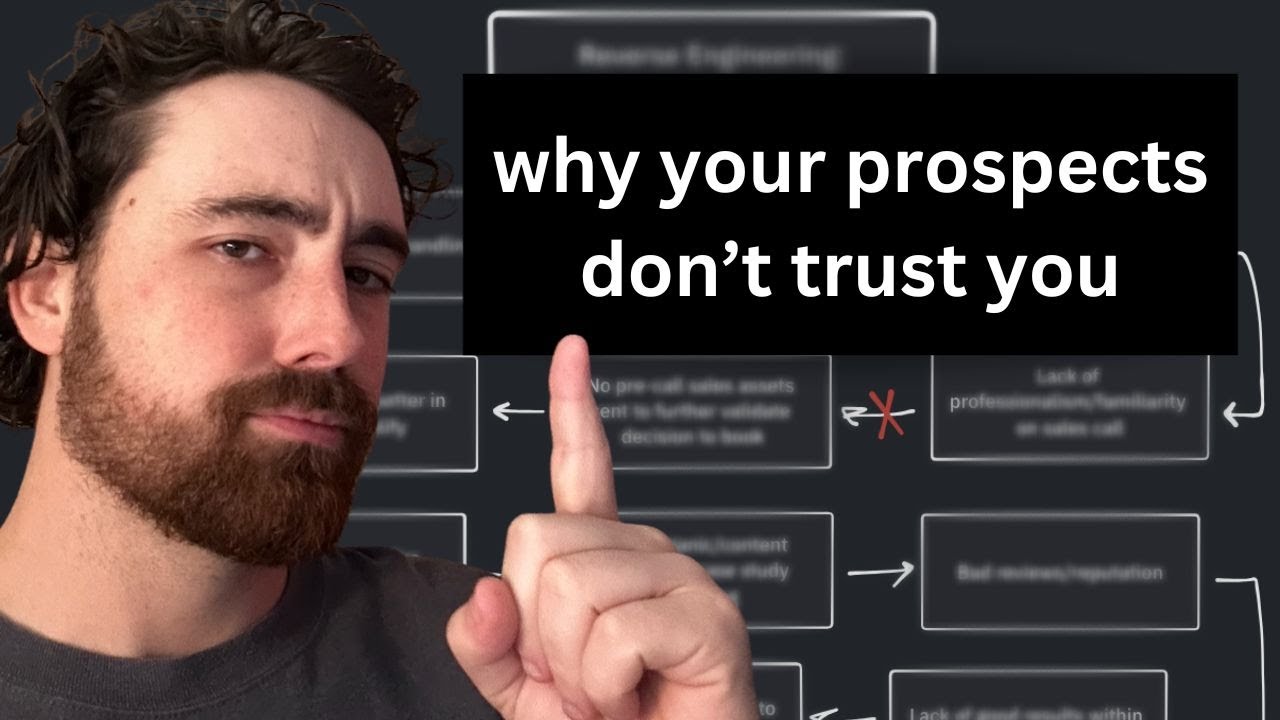
Dylan Vergara maps where trust breaks down in sales: weak marketing, poor discovery questions, unprofessional appearance on calls, bad reviews, and lack of results. He shows how to fix each stage with tie-down questions, pre-call assets, professional video setup, and strong social proof.
Chapters
What's up? You're probably watching this video because you get trust objections or people who are not sure if you are the right fit for them. Because if there was 100% certainty there, you wouldn't be getting it, whether it's just that they don't believe you or they don't understand you. So in this video, I'm going to kind of reverse engineer this Objection. The lack of trust or belief. This is for salespeople and offer owners, and I will segment it up so that it's clear, you know, who holds the responsibility depending on the problem that's being faced. And we're gonna kind of go through, we're gonna identify the problems, when they happen, why they happen, how to fix them, and then how we can prevent them altogether. So Without further ado, let's get into it. By the way, this is a new whiteboard app type deal. Shout out to Abdullah for putting me on, but let's start at the top, guys. End of your sales call, maybe you spent 45 minutes with them. Maybe this is the second sales call you've had. You run a 2-call, even a 3-call model or something like that, and you get this. You've— we've all been there. If you're a salesperson, you've been there. If you haven't yet, you're still early. I'm not sure. Usually this is hidden behind like, I need to think about it. And you get past that, it's like, I'm not sure. I just need to, I don't know, I need to sleep on it. I don't make decisions on the spot. You will also get this after getting through a financial, a partner, a timing objection. Where like they're truly at a loss for words, usually it's just because they don't want to tell you really what's on their mind. So I'm not sure. Right before that, why would they not be sure? Well, maybe they were giving you other objections and the way in which you were handling them were throwing red flags. It was showing desperation. It was showing that you'd say or do anything for the sale. So if they give you a timing objection and they say, hey, can Q whatever, Q3 is when we're looking to start this. And you try to overcome that in a super abrasive manner, that's just gonna throw people off. It's gonna put a bad taste in their mouth. So you could do everything right up to that point. And then if you handle a different objection in a distasteful way, you'll get, you'll get the trust objection. Now before that, After you pitched your service, you didn't confirm that it was at all relevant to them. Now you should know that it is, but you need them to buy into it as well verbally, because they may, they may be thinking it. If you did a good job on everything before, like they are thinking it, but they just haven't said it. So Cole Gordon calls these tie-downs, just asking questions that are gonna get them to verbally Commit to the thoughts that they're having, right? So, Mike, having seen all this, do you see how this is gonna help you get from point A to point B while saving you X, Y, and Z? Yeah, I do. Okay. I, I'm just curious, based on what you've seen, is there any reason as to why it wouldn't work for you? And just asking questions to get their thoughts after now they know what it is that you've got. So getting that verbal buy-in is important. If you're not doing that, you're working from a position without much leverage. So you want as much leverage as you can get. You didn't give them a reason to believe that you were the person for the job before the call. And this can go all the way back to the marketing. The pre-call stuff. But in your discovery, you have to be competent and ideally you need to know what you're talking about and you need to understand their business. I'm not gonna say better than them, but you need to understand the line of business that they're in and what problems they're likely facing, why they're facing those problems, stuff like that. Because if you don't understand them, they're not gonna trust you to do the job. Right. I was talking, or I was on a recording a podcast with Grant Lannon. He said, we're talking about objections. He said, the only one objection there is, is trust. Because if the trust is there, you'll figure out the money. You'll make the decision without your partner. You'll, you know, you'll make the decision now versus in a month. Like, if you truly trust the person and the product, You will make it happen. So, I don't know, just food for thought on that. You need to be garnering trust throughout every step of this process. Now, let's say you did this stuff right, but maybe you messed up just being a professional on a sales call. You show up and you're— I don't know why you do this. You're not wearing a shirt or your shirt's all wrinkled, or you're in your bedroom and your messy bed is in the background with Freaking dirty laundry hamper and an open closet with all this crap in it. So I don't care if you have the best product on earth and you're selling it at the best price. If you show up and you don't look like a professional, you don't sound like a professional, you will completely deter people away from working with you or your company. So this is a big thing. I mean, it's really an effort thing because that's within your control. You can change the angle of your camera, you can change your shirt, you can brush your hair. Whatever it might be. But yeah, this could be something very easily within your control that you can fix that would prevent that objection from happening. Now, there's a red X right here because everything that we've talked about so far is really the responsibility of the closer. And if you're running a small business, that may be you, or if you are just a closer watching this video, that's you. Now, there's a little bit of overlap here. If there are no pre-call sales assets being sent prior to the call. So, you know, just like letting them know more about the service, the results, the case studies, why this is a fit for them, why it's not a fit for them. Honestly, that can be automated, that can be done through an appointment setter. But if it's not happening, you as a closer should take matters into your own hands and get it done. So these pre-call sales assets are some of the most important materials that you can get over to a prospect before. Make them easy to consume, make them qualifying, and you can mess around with it. But I've, you know, teams that I've worked with have had great success by sharing the price of the program right here so that when we get on the call, it's— there's just less pressure. You're also gonna kind of weed out some of the people that weren't gonna buy anyways by throwing a price into something like this. So. Test around with that, but really just give them a good expectation of what it's— what they're walking into and what the service is like. Then the appointment setter either is not there, you either don't have one, or they are not doing the job correctly and setting the right expectations. This is going to be huge. You don't want the appointment setter cold calling people or setting inbound leads. And having, you know, I guess giving the prospects the idea that this is a coaching call, a consulting call, it's a free consulting call. You want them to know that this is a sales call and you don't wanna say like, this is a sales call, because then the pressure's up, people aren't gonna show, but you want them to know that we're here to talk about a potential, you know, business interaction, okay? So make sure your appointment setter is setting the right expectations because if they don't and they get someone on a free call and then the closer goes and pitches an $8,000 solution, boom, trust out the window. So everything needs to be in line or else trust is gone. There's another red X here because as a setter, these 2 are your main priorities as far as Not getting trust objections and just being transparent to the people that you're selling to. This part and going forward is really on the offer owner. And if you are a closer or a setter, you need to do your best due diligence before you join a team on some of these things. Because going all the way through the video, when we get into some of this later stuff, which is not too much more, It's completely without, like, not within your control, but you will have to deal with it if you are on the team. So to start, if you're the offer owner, your marketing is just— targeting's way off. You're getting in front of the wrong people. You're attracting the wrong people. You're— maybe you're out of touch with what the market really wants. Or how the market really works. So how do you fix this? You get to know your customers. If you're watching this video, I'd assume you've sold something before, you've had customers before. Talk to them more, be more hands-on, be more one-on-one, make sure the results happen, and you'll get to know your customers. And before that, could be a problem with like weak organic or content presence. No case study marketing. Basically, you're a ghost online. It's 2023. We're heading into 2024. Anytime there's an ad that's ran, people are clicking on the profile. If it's a cold email, they're searching the domain. And if they don't find anything, that's weird. It's weird, bro. You're shooting yourself in the foot, especially if you do good work. Don't be a ghost. Go out of your way to make sure that you have a presence on the major social platforms. You have a website. Stuff like that. If you don't, it's kind of sus, right? It's going to be a red flag. Even if you have a good service, it will be a red flag if they can't find you or if you're not present. So yeah, this is another easy one to avoid. Post content. Don't be a ghost. Now, before this, maybe you've done the service before and you don't have good reviews. Maybe you didn't get the best results the first time around. This will absolutely make people not trust you. And a lot of times, like, this will be the bottleneck that prevents people from even booking a call. They'll see this and they'll be like, ah, I'm gonna ignore that. I'm gonna ignore the DM. I'm gonna ignore the email, whatever. So simple fix to this, guys. If you can't do the work, either stop doing it or bring someone on who can. Pretty simple. Now, why do you have bad reviews? Why do you have a bad reputation? Because you can't get results. I'm not really going to hit on this one too much. If you're a closer or you're a setter, make sure that the offer you work on gets people results. If you're running an offer and you don't get people results, figure it out, bro. Figure it out. Why don't you get results? You're making money, but you're not getting results. Your retention is bad. Your reviews are bad. For that reason, you don't have the material to go and market based off of what is possible because you don't get results. You're probably just being short-sighted and you're pushing for a bigger number in your Stripe account this month, next week, cash collected. I want to see it in my Google Sheet. I want to see $20K cash collected next week. But you have just like a blown open backend of your, of your service and there's no accountability, there's no structure and no results. Lastly, guys, wrong values/targets from the business owner. So like, if you're watching this and you're a business owner, you don't get results, you keep getting trust objections. It could be any of the things we've talked about, but really, man, it all boils down to the type of person that you are. If you're a high integrity person, you're not gonna run a low integrity business. And if you accidentally found yourself in that situation, you're gonna get yourself out of it as quick as you can. If you continuously run a low integrity business, it will come back and bite you in the ass, and you're gonna ruin your reputation for anything that you do in the future. So closers, setters, if you have a feeling that any of this stuff— sorry, it's, uh, Holy cow. New whiteboard thing here. Wow, this is crazy. Okay. If you have a feeling that any of this stuff is happening that's outside of your control, dig into it before you spend time and effort and energy in onboarding with a team like that. So this is it, guys. If you are Getting the, I'm not sure, just like you're getting hesitancy at the end of your calls. Something here is going wrong. Some of this may be within your control. Some of it maybe not, but it's up to you. Do you wanna stick around? Do you wanna help them fix it? It's very situational and I can't, you know, it's not one size fits all. It's not black and white. I can't tell you if you should be out or if you should do that. If you get— if you watch this far in the video and you're in that situation where it's not in your control, but you like the team and you think there's potential, send me a message. I'll help if I can. But this being said, guys, this is how you reverse engineer. And if you are a sales rep watching this, you can use this on any objection. And honestly, the part regarding the sales call may be a little bit different depending on the objection, but a lot of this is the same. So screenshot this, print it out, put it on your wall. You don't have to do that, but understand this because it's important. Now, if you are a sales rep, I run a community, been running it for the past year and a half. We're killing it, quite frankly. We've got guys who joined last month who just landed their first offers. First closing commission, $1,440 from one closed deal, inbound lead came from in-home sales. We had another guy hit his first $10K month, took 33 days on the offer that he landed through the community. He's an anonymous guy, but he's going to make a post in School sometime soon, which is where we host it. And if you're in the situation where your offer owner has wrong intentions and low integrity and you're ready to jump, We've got the most active hiring channel in the space. I know because I've seen others. There are people in here who are in basically every other program out there. And this was taken this morning, but 21 minutes ago, 15 hours, 18 hours, 21 hours. And they're— it's basically every day. So if you made it this far, guys, thank you for watching. Let's try not to get these objections anymore. Go to serialsalescommunity.co, book a call. You'll talk with me directly or someone from my team, and we'll take it from there. Peace.









