How to sell more with advanced opportunity cost analysis
Dylan Vergara shows how to calculate opportunity cost for sales pitches using concrete numbers. A UGC creator missing $48,000 in six months pays $4,000 for a 12× return. A professional saving 15 hours weekly gets a 37% income boost and 8.25× ROI on an $8,000 service.
Chapters
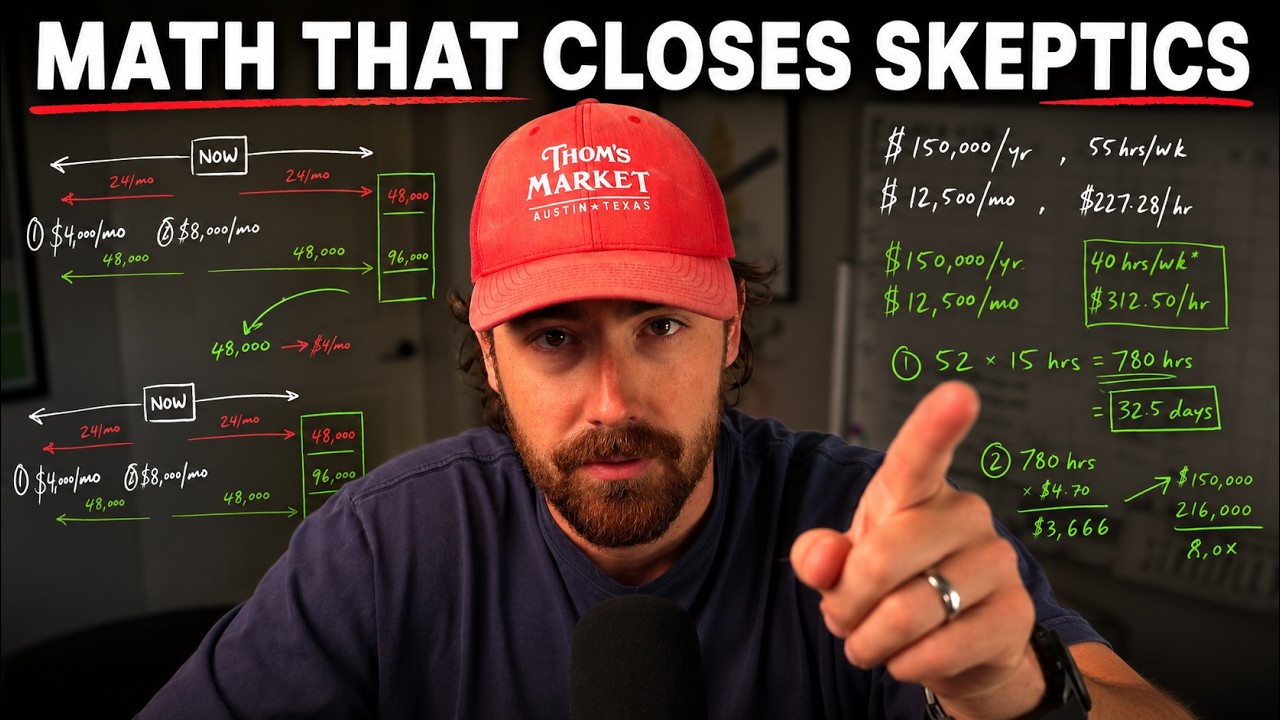
Hey, what's up? I'm Dylan. I am a self-proclaimed skeptical buyer, and I like to see numbers. Numbers make sense to me. So if you sell to someone and you think that you can gain by showing them the numbers of them not doing it, of them not having done it, of them actually living in the upside, this video is going to be for you. We all know what opportunity cost is. It's basically if you don't do this thing, you're going to miss out on this. But I'm going to show you in this video some different ways to skin it basically. I got my iPad, we're gonna do some drawings, and I'm gonna call this something like advanced opportunity cost breakdown because at surface level, standard opportunity cost may not resonate with who you're trying to sell to. But I think there's a way that we can probably get through to most people. So stick around, I'll show you all the ways that I've got. Also, all the ways that I'm gonna show you, I have a tool that you can go and grab. It's basically a calculator that allows you to put in all the numbers custom to you and then actually turn it into a PDF, unbranded, So anybody can use it, but turn it into a PDF and then ship it off to that customer, ship it off to that client. That person in your pipeline might be worth it to you. That second link down below if you want to grab it. Okay, so opportunity cost at a basic level. Let's say you're on the sales call right now today with someone and they've been thinking about doing this thing for 6 months. And let's just say they may not do it for another 6 months. For the sake of example, let's say you sell a service offering that helps people create a side income with UGC creating, like making videos for companies. Right? Right now, let's say that person is making $4,000 per month at their 9 to 5, but they're capable of $8,000 with UGC, right? Okay. Well, that's $24,000 they've done over the last 6 months. And if nothing changes, $24,000 over the next. However, if they were already doing what they know they're capable of, that would be $48,000. $96,000 and $48,000, which leaves us at $96,000 versus $48,000. So right now, if they've been thinking about this for 6 months and they know they're the person capable of doing it and they know they want to do it for at least 6 months, not solving this problem today is actively costing them $48,000. It's a $48,000 problem that on paper should make sense to anyone with a functioning brain. And if they could solve that $48,000 problem and you only charge $4,000 for that, that is a 12x return on their money. So either stay where you're at or get a 12x return on your money or try to do it on your own and like have a lower likelihood of this working altogether, right? Like this is opportunity cost at the fundamental level. If you don't change, nothing changes. You stay the same. You are missing out on things. that you want and that you probably know you're capable of. But let's break this down a little bit deeper. This one is a 3-headed dragon, we'll call it. So let's say you run or you are selling an offer that is going to help someone condense their work week into 40 hours. And you sell this to people that work too much. They probably make good money, but they work too much. So they wanna condense that, right? And how you do that, I mean, it's beyond the point of this video, but that's what we're gonna be selling. We help you get the same result by working Less, or by working a full-time hourly work week. So I wanna show 2 scenarios. One, you make $150,000 per year, but you work on average 55 hours per week. This is not too far-fetched. That comes out to about $12,500 per month or $227.28 per hour. Now let's assume nothing else changes except we just become more efficient. Puts us at $150, but 40 hours per week. We're still at $12,500 per month, but our hourly is bumping up to $312.50 per hour. Not bad. Now here's something to Consider. This is a difference of $84.70 per hour, or 37% more efficiency, more outcome for the work that's being put in. That's a big, big, big pay raise, right? And you get your sanity back. So for this person who's earning well, I mean, they're still going to be working full time, but like, how do we properly motivate them? Maybe it is more Maybe it is more time back with their kids. Maybe it is the future potential because they're gonna be working this role for 30 more years. I don't know. You have to make that judgment case, but we're gonna run the, the math on some of those scenarios right now. So scenario 1 here, 52 weeks in a year times 15 hours back equals 780 hours back. Back. 780 hours back is also 32.5 days, which is over a month of their life back for the same money. That is a month of their life that they could put towards spending time with their kids. That is a month of their life that they could put towards bettering their marriage, getting in better shape, doing something they actually enjoy. Not everybody who's earning money is going to be super motivated by Earning more money. But once people do start earning money, they start to realize that time is the greatest asset. So being able to provide a service where you're giving someone back an entire month of their life every year, that's a 12th of the year you're giving back to them. Scenario 2, let's say someone is a little bit more money motivated. We get 780 hours of our time back. Let's say they don't have kids, they're not married, they're young, and the only thing that they have to do right now is to work their ass off. Well, 780 times 60 times 84.70, which is the difference between their old hourly and their new hourly, equals 66,066, which means they're either making $150,000 at 55 hours or $216,000 $0.66 at 55 hours. So if you just want to dump that time back, well, congrats, you just unlocked an extra $66,000 working the same amount. And our solution is only going to cost you one time $8,000. Hypothetical, right? It's going to cost one time $8,000. The difference equals 8.25x Return. Now here's where this gets fun. Like we establish the basics, we establish what can happen in 1 year or what has happened over the last 6 months and across the next 6 months. But I want to take this a little deeper. What we just talked about is enough to get the average person over the line. As long as you made a case leading up to that and you show them the math and it works out, I mean, you're not going to need too much more. But what I'm going to show you is the calculator that you guys have access to. If you go down below to the second link in the description, I'm going to show you this is a tool again that you guys can use. Project these numbers out for people that are increasingly skeptical of buying things online or whatever it is that you're selling. So you can come in here and write the report. And let's just say we're gonna start from today and look over the course of the next 5 years. Scenario A is not doing anything and they're doing $150,000 per year. Scenario B is working with us. You can label these as you please and it's making $216,066. So I'm not gonna turn on these real life reality We'll toy with these a bit, but this allows you to kind of go and you can even do this live on a call if you'd like and see the difference. I mean, in just 1 year's time, they're missing out on $66,000. We already established this, but in 2 years' time, they're missing out on $132,000. Right now, let's say we're going to factor in real life scenarios. Okay. And let's say with that gap, I'm going to take out the growth there and I'm just going to say with that gap, they invested 7%. They invested the difference at 7% in an index fund. This is accounting for inflation. For today's dollars, 3% inflation. We can also measure enterprise value if you sell this B2B, something like that. But here's pretty much the timeline. I mean, this looks the same here, but then in terms of the final results here, over the course of 5 years, if you do not make that change and become more efficient with your time, you can set this timeline of 5 years to be whatever you want. Not only are you leaving this directly on the table, but if you were to invest that difference at 7%, there's a little bit more. Now, if I say that offer price is $8,000 because that's what I said earlier, that'll actually come down here and let me know what the return is. And if I go and we said this person wants to do this for 30 years, well, this is going to get spooky. I don't have to read these numbers to you guys. This is quite incredible. You know, you can look back if you had someone that was on your call and they said, yeah, I've been thinking about going back to the first scenario. Yeah, I've been thinking about doing UGC for You know, the past year and for the past 6 months, I've not done anything. Let's say our offer is $4,000. They do $48,000 a year. Now they know they're capable at ground floor of 96. Let's say they invest the gap. I mean, it's all right here, right? And if you invest the gap, this is only the future gap invested, but it will start to compound total left on the table here. And if you do $4,000 offer and there's risk reversals, it's pretty difficult to make the case that this is not worth it. And then you come down here Download the report, and this is what the report is going to look like. There's no branding, has the date. You can put this person's name and everything on here, but there's that. There's also the side of this that is not accounted for in the calculator. But let's just say that you start to make an additional $4,000 per month and you get 1% better every year. You get— or I'm sorry, let's say you get 1% better every month. The way that this curve starts to exponentially grow just adds into the opportunity. Because like, this is like the baseline opportunity cost. And let's pretend we don't even invest the gap. I don't think that changes the chart. Like, this is base level. But like, again, what do you now do with your family? How do you now invest your dollars? What does your tax savings look like? What, depending on what you're doing, like, what house does that afford you? What bills are no longer a pain in your ass? So you guys, like, we can get on here and run the calculations. Honestly, there's something to this that's quite authentic. But if you don't want to get on and do public math in front of your client or your potential client, use the calculator. You get it down at the second link down below. I'm a skeptical buyer. And personally, like I mentioned before, this is one of the ways where I can be convinced to buy something, even if it's a lot of money or it's scary. If there is potential For serious opportunity costs, and I genuinely believe that I'm the person capable of achieving X outcome, this will get someone to move the needle. If you're selling something good online that costs money, that usually has a financial return. And there's a whole other side of this where you just run it on time, like their whole thing is time, just run it on time. But if you're selling something good and there's a financial incentive, this tool will help you do that. And if you need help selling something good, We post on average over the last year, 20 jobs per day. That's over 7,000 inbound work from home, 1099 contracted remote appointment setting or closing roles that are looking for salespeople. This is for coaches, consultants, agencies, services, masterminds, bootcamps, events, everything. Everybody runs an online business these days, B2C, B2B. You don't necessarily need sales experience, but that's what our community helps people get into. And if you're interested in that, and you want to make that easy because finding those jobs is not the easiest thing on your own, go down below to the first link in the description. We'd be happy to help you. We've been doing it since August of 2022. We're very good at what we do. Don't get hung up on financial logistics, opportunity cost related questions. Get this calculator, get something good to sell. If you don't have something good to sell and you can't deliver these results to people, find something new to sell. And if you need to find something new to sell, join our community. We'll help you do it. Anyways, that's it for this video. Be sure to like, comment, subscribe, and I'll see you next week. Thanks all.









