Use our secret method to land a good high-ticket sales job today
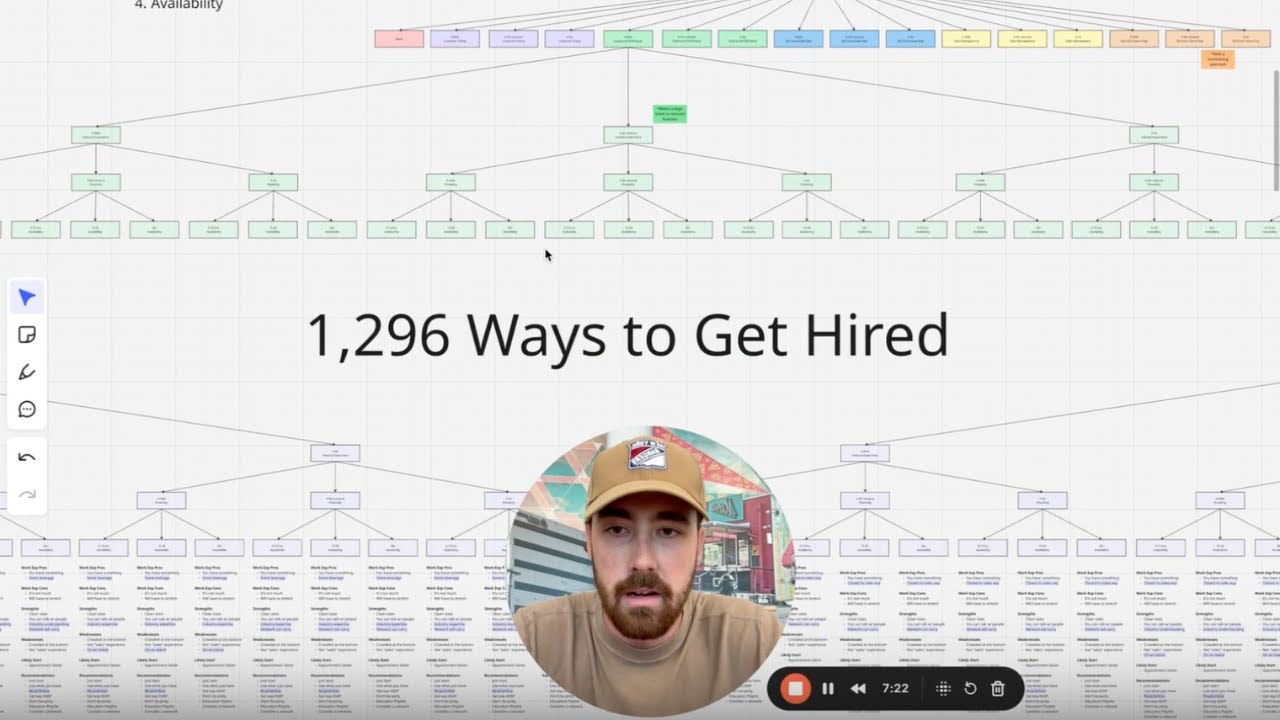
Dylan Vergara maps 1,200 possible outcomes for landing a 1099 high-ticket sales role using four factors: sales experience, industry familiarity, network proximity, and availability. He shows how to plot your profile, find your biggest bottleneck, and fix it first.
Chapters
What's going on, you guys? We got a new video here. This one, our Thursday videos are always some type of strategy deep dive showing you how someone achieves something cool or how you can do it. Uh, so that's what this video is going to be. Uh, it's been a long time since I really put some work in on a Miro board, so we're about to dive into that. But just so you guys know, the schedule is Thursdays deep dive video if you're trying to learn like the ins and outs of how to do this. Watch those videos. On Sundays, we're releasing more of like lifestyle, showing you the results of making this happen. And there's also some strategy in there. And also I'm just documenting like building businesses and living in Austin and hanging with business owners and friends and sales reps. So, uh, this video again is one of those strategic ones. We're showing you a lot of different ways to get hired. And actually, if you stick around to the end, you should know Based on all the literally 1,000, 1,200 possibilities based on what you've done, what you have, everything included, what is the best path for you? What are your weaknesses? What are your strengths? And what is the lowest hanging fruit in terms of what you can do right now to increase your odds to get considered for a 1099 high-ticket sales role? So that's what we're gonna get into. Now, if you kind of really look at this, I boiled it down into the 4 main things that determine that each of these things can send you on a different path. If you guys have ever seen those videos of people gambling, I think it's called Plinko, and they drop the ball on the top and there's all these pins and the ball hits one pin and it goes this way or it goes that way. These 4 things are basically those pins that can seriously route you in a different direction than if the answer was yes. The opposite. So your sales or relevant experience, whether you have literally no work experience, some customer-facing, some outbound SDR, some closing, some sales management or business ownership, all of those are going to start you in a different place. And then, you know, how deep you've gone into one of those or many of those puts you in a different place, which again, towards the end of the video, I'm gonna show you kind of how that works out. The next thing besides just what have you done is how— not experience necessarily. Experience is ideal, but your familiarity with the high-ticket industry. Do you know nothing? Is that a whole nother week that someone has to train you when you get onboarded to show you how this works? Do you know something? Do you know a lot? Have you worked in this industry before? Have you built your own business in this industry? So again, sliding scale, how well do you know this industry? Is in my opinion, right behind the actual experience that you have on your resume or the work that you've done. Next is the proximity or network because high-ticket sales and 1099 sales is kind of more of an underground scene. It's not gonna be blasted on LinkedIn, Indeed, Glassdoor, all that, like the proximity and the network that you have to be timely when these roles open up to see them before they get blasted into Facebook groups. To get that like backdoor connection with someone who's on that team, like that plays a really, really serious part in your ability to be considered for roles quickly and at a high frequency. And then the last thing is availability. And honestly, when we skip to the later part of the video, you'll see I kind of start with availability because that, that is the only one of these That is a little bit more binary because if you have zero time, then there's zero possibility of this working. So, we break that up as well. So, I got into kind of projecting out all the different scenarios. And you can see here, here's an example experience. And I basically broke it down into none. We got the customer-facing, whether you have a little, a fair amount, or a lot. We have the outbound SDR, a little, a fair amount, a lot. Same thing with closers, sales manager, business owner. This is assuming you have a sales team, but within one of these, there's, you know, if you have a little SDR experience, then there's the question of, do you have any industry experience? I have a little SDR experience. I have either a little industry experience. This is supposed to say A fair amount, or this probably is wrong too, a lot. Now, based on what you have, if you're extremely familiar, if you've been an SDR in the high-ticket industry for 2 years, you're again in a completely different league than someone who is an SDR at like a software company that was not high-ticket, completely different structure. So Based on that, you get put into another division. And then the next thing is proximity. So let's say you're an SDR with a little experience. You have a fair amount of industry experience. You've done selling for like 6 months, 3 months in a high-ticket role. And you have a lot of proximity. You either have a lot of proximity, you have a fair amount, or a little. A little is like, hey, I'm on an island. I know, I know nobody who does this. I don't even know where to start seeing these jobs if they were available. That's a tough spot to be. A fair amount is like, hey, I have like 3 to 5 people I kind of know through social media. I have one guy's number, we talk and they seem to be doing well and I can ask them questions. A lot is one of the biggest needle movers. It's basically, I have a, you know, usually a paid community, an invested group of people who are doing this at a high level, who are in front of opportunities. Now, proximity is not just proximity to people, but it's proximity to opportunities. And again, whether you have that a lot or whether you have that a little bit, it really, really does determine where you go after that. Then it's the availability. And this is the last big thing. And we can get even more granular here, but if you have a lot of proximity, but hardly any availability, it's gonna be hard. Like honestly, if you have, doesn't matter what else you have, any kind of these experiences up here. If you have 0 to 15 hours available per week, it's gonna be hard. Getting up to 15, doors open a little bit, but like under 10 is, it's probably not even worth your time. Now, 15 to 30 hours, it's like medium. Uh, you can definitely get some good opportunities there, but 30+ is gonna put you into a league of your own. Uh, if you're going up against somebody for a role and one person has this and one person has this, this person's gonna win. 9 times out of 10. So as you can see, there's a lot of potential realities here. There's actually 1,296. And with working with all the hundreds of people that have come through the community in one-on-one or small group setting, these are the things that we really dive into. And if you project those out, so just imagine if you have no prior work experience, there's this, there's this many outcomes. And I started going through and highlighting like, what are your strengths? What based— if based on, if you have no work experience, no industry experience, a lot of network and 15, 30 hours availability, what are your strengths? What do you lean into? What are your weaknesses? What are your blind spots? What do you need to be aware of? And I started doing this through everything. So getting into the customer-facing role, like let's just say You have a fair amount of customer-facing work experience. That's like cashier, retail, not sales, but like you're dealing with people. So you have a fair amount of that. You have little industry experience. You have a lot of proximity because you paid to get into a community and you have medium availability. Well, you have some leverage because, you know, you know how to talk to people. Your strengths, you have a network and And because you have a lot of proximity, this can carry you if you let it, if you use it. But because you only have medium availability, you might wanna reprioritize to open up the funnel down at the bottom. The best scenario is going to be, again, for this customer-facing person, let's go over here and see, this was taking me a really long time. I was like, there has to be an easier way to simplify this, which is gonna be at the end. Um, but let's just say you have a lot of customer-facing experience, you have a lot of industry experience, you have a lot of proximity and full-time availability. This is the best scenario that you can be in. You're pretty much closest to having that sales experience. You have industry expertise, which is not something everybody has. You have the network that will carry you. Now, there's a difference in the network that can carry you and a network that will carry you. So just know there's a difference and you don't have the reprioritize. Like this person is primed to get the best role, the best opportunity. So I was gonna, I was gonna go down the line, but just for this one piece of work experience, I think there was 81 outcomes. And I was like, this is taking me way too long, man. I don't have all day. I got other stuff to do. And if you see here, all different possible outcomes, I'll actually zoom out. All the different possible outcomes. So I was like, I need to simplify this. So this is what I did. Um, let me move my head. So this is the exercise that I want you guys to do, and feel free to pause it, screenshot. Um, but this is what I would do if I were brand new getting into the industry and trying to become aware of what my strengths are, what my weaknesses are, what I should focus on. So you start from the availability perspective, and if you can, I mean, take a screenshot, draw your own arrow. I did the arrow for the sake of the example, but let's say you have medium availability. You're not really connected to people. You do have a lot of industry experience. Let's say you were a client success manager for a high-ticket company for 2 years, but you don't really know people in the sales space. You don't really know, have access to these businesses. And honestly, this actually doesn't even make sense. I'm gonna change this up. Let's say you have a fair amount. So medium experience or medium availability, maybe you have a part-time job. You have, you're not very connected, but you did buy a course that teaches you about the industry. So you understand it a fair amount, nothing life-changing. And you just so happen to have sales experience in another industry. Let's say you were an account executive for a software company. Let's say you were selling cars, you were medical device sales rep, solar sales. It could be many things. And you have a fair amount of experience there. So these are the main things that like you see these green triangles, the more downward that you are into the larger green portion, the more leverage you have within that. Now this one is a little bit interesting because just because you're a business owner doesn't mean you have more leverage than an outbound appointment setter. You could actually have less. So that's why I added in this, this one, which you can see here. This positioning, or says positioning here is less important than the positioning here for roles with sales experience. So this is arguably more important than where you fall on this, if that makes sense. So let's take— I wonder if this— it won't work. But pretty much like you just become aware of this, all the different outcomes. And then if you come and put that, the same arrow pattern here, you can start to see your weaknesses, your strengths, what you should focus on. So let's say I'm middle of the, middle of the, I don't even know what to call this, that the likelihood of success area. I don't, I don't know, but let's, I'm just gonna follow the pattern. Generally, if I have medium availability, I should probably consider reprioritizing or making more room to get myself closer to here. If I can't do that, then I know that there's potential for that to be a bottleneck or create friction for me versus someone who might have 100% availability. So this is all about just being aware. Okay. So if I come through here, hey, my bottleneck might be that I don't have full availability. There are people who have that. I'm aware. Next thing is proximity. I, the arrow comes this way. I'm disconnected. I don't have anyone. I'm not quite on an island by myself and stranded, But I'm disconnected. Like I got in this group and I don't know, like it's not active. Nobody's actually having success. So I'm disconnected, but I need to be aware that there are people in communities such as the serial sales community, quick little plug, that have a network that will quite literally carry them if they show up and talk to them. Like if they're just known, if they get on a first name basis with 5 to 10 people, who are where they're at or ahead. So if you're disconnected, know that, you know, it could be a little bit worse, but you might wanna focus on getting into a network that can carry you or a network that will carry you. And it's not all through like paid communities, but, you know, depends how fast you want it to happen. 'Cause you can do this organically. You can go and message people on social media and find people and vet them and this, this, and that. Or, you know, You just make it easy. Then getting into the industry. So we go from disconnected down to industry understanding. You bought into this course and they teach you about the industry. Cool. You're not quite an expert. So again, be aware of the blind spot because you haven't done it yet, but you are a little bit ahead than someone who knows nothing. Because if you know nothing, these companies are gonna be very hesitant to hire you because then your onboarding is potentially twice as long, or there's a situation in which you don't catch on, so they have to fire you, and business owners don't wanna risk that. So if you're disconnected, but you have somewhat of an industry understanding, that's gonna help you a little bit. And then down here, I should have probably— let me see here. I should have probably— let me see if I can make a real-time edit. Uh, let's go send to back. This is gonna go here. Valuable. So this one, again, it's— this is why I added the second one, um, the second arrow here, because This is not as black and white as these 3 are because being a business owner isn't inherently better than being an appointment setter for what we're trying to do. So just understand that, you know, if you come down here to AE/closer/sales rep, that is valuable. Um, the market is most crowded down here from setter down, specifically customer-facing and down. It is going to be The most crowded. There's too much noise. There's not a high signal-to-noise ratio. When you get from like setter up or closer up, there's a higher signal-to-noise ratio. There's less people. But if we're looking at like a bell curve, like the middle of the bell curve where most of the populace is, is going to be customer-facing and down or setting and down. So just understand like where you exist within this. But then understand, like, look, if you've been a closer, like we go down to closer and you've only done it for a little bit, like it's really not gonna have as much weight as if you've done it a lot because that's impressive. So like some people, hypothetically, if we look at like outbound setter or SDR or appointment setter, they would rather have an appointment setter. Let me show, let me show, uh, For the sake of the example, some people would rather have the setter that's here than the sales manager that's here. Or some people would rather have the setter that's here versus the sales manager that's here. So it just depends on the role that you're applying to, what they value, how confident they are in their systems and their ability to ramp you up. And also like where you are in your career, because people like to invest into people that they believe are going to be around for a while, that are going to really help their business. So, um, just be aware of that, guys. But just so you guys know, and I'm, I'm a really big— like, I like to break it down and make it black and white simple. Everybody's situation is different. I was going through and filling, filling these out, and I was like, okay, yeah, a lot of these are familiar, but there's some of these that I've, I've never seen before. So just know that your situation is unique to you. And it requires a unique approach. So what I would encourage you to do, I'll actually zoom out right here so you could, um, screenshot this or just pause it and like take your mouse and go over this. And based on what your weak points or your strong points are, I don't know, take a piece of paper, open your notes app, and write this down. Because if you want to get into this, this is going to be the path of least resistance. Now All this being said, there's one thing that can make this a lot easier. I can't— we can't help you free up time. Now, we can help you free up time by giving you quality opportunities, but we can get you maxed out on proximity. We can get you maxed out on industry minus you having actual experience. We can give you access to the best opportunities here. Um, so if you want to just like snap your fingers and do everything within your control to give you the best odds, then I have something for you. Uh, first link in the description, serialsalescommunity.co. It's a sales community I've been running for 3 years now. Uh, we've worked with literally hundreds. We've had probably upwards of 500 people come through over the last 3 years. Some of those guys going on to make $10,000, $20,000, $30,000, $40,000 per month. We've been doing it for a very long time. I work in small group or one-on-one setting with every single person And it's called the Serial Sales Community, but it's not just a big group chat where there's no intention. There is a very structured process that we run from weeks 1 through 5 and then beyond, where there is no point in time before when you land a job where you do not know what you should be doing. There's very clear next steps. As you can see in this video, again, I mean, I just told you I'm a big proponent of making it very clear, like what you should do based on all this criteria. I honestly, if you don't want to draw all these arrows and write notes, just join the community and I will go through this with you and I will tell you, hey, based on this, this, this, this, and that, you have these bills, these dependents, this thing going on at work, you're— you want this kind of income, this is what you should do. If you want that, go to the first link in the description, talk to my boy Diego about the community, and he'll fill you in. Besides that, you guys, that is going to be this video. Let me know in the comments if you like this video. And stay tuned for the Sunday one. I'm really excited to show you guys what we got into. We had a guy who's closed $10 million on the same offer and now is doing fractional sales management on, and it's a banger. If you ask me, it's a banger. So I'll see you guys on that video.









