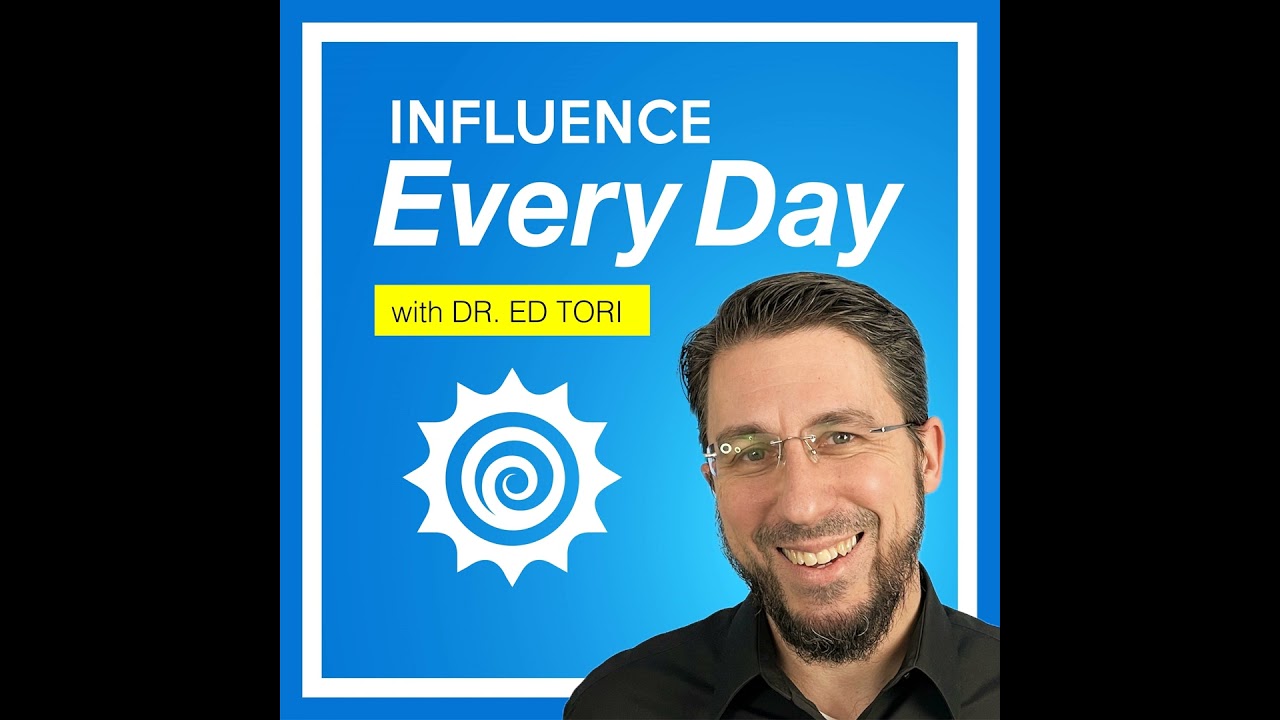
048 Triggered On Purpose - How To Use Everyday Items To Induce Change
Dr. Ed Tori explains how everyday objects work as triggers to make ideas stick. A KitKat ad linked the candy to coffee breaks; a hospital used local football talk to make people think of a surgeon. When something's top of mind, it becomes tip of tongue.
Questions this video answers
"Top of mind = tip of tongue."
Hypnotic Gifts, how to Change Someone's Life in a Single Conversation.
influencebookclub.com and hypnoticgiftsbook.com
Chapters
Foreign. This is Dr. Torrey. Welcome to the Influence Every Day show, where we make every day better and we influence for good. A few things happened recently that triggered me to record this particular podcast episode. First, many of you know I happen to have an Influence Book Club. You can check it out at influence book club.com. well, I happen to be preparing for one of the months where we're going over Contagious by Jonah Berger. Contagious is all about why ideas spread. Okay, so you may have read the book or heard of Made to Stick by Chip Heath and Dan Heath, all how ideas stick. This is more about why and how ideas spread. And in it, he has a book on triggers. So that's what we're going to talk about right now. I want to illustrate it with a few things that triggered me to record this. First, I was recording it for the Influence Book Club. Second, I happened to be flying out to a speaking event in San Francisco. While I was on the flight, they made the announcement, and this was Southwest, where you can choose your own seats. Of least at the time, I think they're changing that, but you could choose your own seats. And so they made an announcement saying, this plane is basically full. There are only two empty seats on this entire plane, so just pick the next one and plop down and take that seat. And they made a joke about making eye contact and all that stuff to try to avoid having the person sit next to you, etc. So it was funny. But nonetheless, there were only two empty seats. So what did I do when they made that announcement? I put on a mask and I pulled out the book Contagious by. I pulled out the book Contagious by Jonah Berger. If you can imagine, I'm there reading the book Contagious, and I'm wearing a mask. Now, do you think people are likely to sit next to me? No, they're not. And so that's what happened. So I happen to have an empty seat between me and the guy at the edge of the. Near the window. And so I was in the aisle. He's in the. He's at the window. And. And we were joking about how fortunate we were to not have someone in the middle so we could put our stuff there, whatever. And so then I told him what I did. I told him that I wore a mask, and I put on and I pulled out the book Contagious and I started flipping through it. Incidentally, I took a picture and I sent it to Jonah Berger himself. So just to let him know, hey, I'm using Your book for non conscious influences, what do you associate that with? What do you associate the word contagious with? Now the book has nothing to do with infection per se. It has more to do with how ideas spread the thoughts. But what is our association? If you see someone with a mask and you see the word contagious, our association is with that of somebody being sick. So why would you pick that for a six to eight hour flight? No one sat next to me. That's the point. Now what that did that event me flying out for a speaking engagement and me going through the book. The reason I had the book with me was because even though it was written in 2013, I think it's worthy that of a month for the book club because of the principles contained in it. So I was reviewing it in preparation for that module. So that's what triggered me to talk about this today. There's a phrase in the book contagious why Things catch on. There's a phrase in there. Top of mind equals tip of tongue. Top of mind equals tip of tongue. Essentially, if somebody is thinking about something, if somebody is triggered to remember something, or if they're actively engaging in something, they're more likely to talk about it if it was very recent, if it was very vivid. And this gets to something they call the availability heuristic, which is you'll often find in cognitive psychology and human factors engineering and certainly people use this in advertising and sales and all these things. But we can use this in our day to day, we can use this now. The availability heuristic, without getting into too many details has more to do with memory. But, but in the book, why Things Catch on, this is more about triggering people to take action or triggering people to think about something deliberately. And the idea of top of mind equals tip of tongue is that people are more likely to talk about something when it's top of mind. And there's a very shocking analogy or statement in there that Jonah Berger alludes to. He says people talk about Cheerios more than they do about Disney and that makes sense. But if you think about it, most people think, oh, something goes viral because it's remarkable. Something goes viral because it's novel, it breaks a pattern, it's somehow different. Yes, that's true in many instances for the immediate effect. But the longer term, something that sticks, that keeps coming back, that keeps being re triggered, that keeps being brought up again and again, it has to be something that's available to us, it's not accessible, it's in our environment, it's in our context, it's in our habitat, it's around us. We are reminded of it, we are triggered. And so sometimes these daily, everyday, run of the mill triggers that we see any kind of moment, we see those because they are deliberately inducing the accessibility of an idea. So, for example, KitKat saying, Give me a break. Break me off a piece of that KitKat bar. First of all, why do I remember it? Because. Because it's pounded into my head since childhood. But why do they keep using that phrase? Because it works. You associate a break, like a break from work, a break from running, a break from taking care of the kids. You associate it with breaking the Kit Kat bar. So even though that's a small trigger, what happens is it makes the fact that you're taking a break, the fact that we talk about breaks means that it's accessible to us. Now, there was a time where I brought two ad ideas. Now, they were at separate times. I brought them to the marketing department of the hospital that I worked in. Okay? So I worked in a hospital that had recently won a con the contract to be the official medical staff of the Baltimore Ravens. And so that happened to have occurred right around the time that the Baltimore Ravens drafted Joe Flacco. So Joe Flacco was a rookie. Now, seeing that Joe Flacco was a rookie and going to likely be the starting quarterback eventually, I went to the marketing department and said, we have a cardiac surgeon in our hospital who is stellar in every way, great character, incredible at the actual act of doing the surgery. Incredible results. His patients love him, the great outcomes and all that stuff. And. And his last name is Fiocco. So the Ravens drafted Flaco and our Chief Cardiac Surgeon, Dr. Fiocco. And so I went to the marketing department and I said, I have this idea, and we can probably pounce on it right now because Joe Flacco is a rookie and we just earned the contract with the Baltimore Ravens, so this might be a great idea. And so the first part of the idea used the concept of pattern interrupts, which I don't need to go into right now. But imagine you see Joe Flacco and Dr. Fiocco in a laundromat. Okay? A laundromat. Now, first of all, they would never be in a laundromat. Like, it's highly unlikely given their salaries. They probably have washing machines or someone else to do their laundry, et cetera. Is it? Given that one is a quarterback in the NFL and the other is a cardiac surgeon. So that right there is what we call A pattern interrupt. It just doesn't make sense. In this ad idea, I said, imagine they're at a laundromat that grabs people's attention. Flaco, Fiocco. They get their stuff out of the laundry, and it turns out that as they pull it out of the dryer, the names have switched. The name Fiocco is on the jersey and the name Flaco is on the white coat. And somebody comes up and thanks Dr. Flaco for saving his life. The point here was to associate the name Flaco with Fiocco. Why? Because they will hear the name Flaco and every single week, especially the Baltimore fan base. The Baltimore fan base is where? In the very catchment area of the cardiac surgeon, Dr. Fiocco. So if you can imagine they're receiving the trigger, it's available every single weekend. Not only every single weekend. I don't know if you know about Baltimore fans. They're probably tier 2 below my favorite team, Philadelphia Eagles. But as a fan base, they're rabid about their team, and so they really care. So it's on their tongue daily. It's not just weekends. They would be talking about Flaco regularly. Now, here's the other thing. Who's the target market for a cardiac surgeon? It's probably people who are eating bratwurst and drinking beer and sitting on the couch watching football. That's the market, because they have a higher incidence of cardiac disease and they're more likely to have all the other things that go with it. So I brought that to the marketing department. They said something like, we don't have the budget. They probably also thought, okay, that's ridiculous. But it was based on real science within the domains of cognitive psychology, social psychology, and multiple other domains where they actually practice influence. It's these concepts of triggers. Another time I went to the same marketing department and said, hey, look, our hospital, it specializes in hand surgery, it specializes in orthopedics, and it specializes in cardiac surgery. Like, these are the things we're known for. So what if we ran ads that had the H sign, the blue H sign for hospitals. That's. That blue H sign is every single place that there's a hospital in the United States. So what if we use that? Because it would be a real world trigger. Somebody's going to a hospital, they're going to a visit. And if we had in our ads the H sign and it said hands, hips and hearts, Right hand surgery, orthopedics, cardiac surgery, hands, hips and hearts. Think of our hospital and have some sort of ad related that why was I doing. Why was I suggesting that? Because of this concept of triggers. There are crazy examples of how triggers have worked in the past. For example, when NASA had its Pathfinder mission and it was trying to launch something to Mars, guess what went up in sales? Mars Bars. Even though it has nothing to do with the planet, it was named after its founder, Franklin Mars. But Mars Bars went up in sales. So these daily, everyday triggers that we see in our environment, in our context, if you attach your influence, your coaching, your. Your good advice to something that occurs in there every day, they'll be reminded of it every day. They'll be reminded of it every day. So look for something in their world that is already there and try to connect it so that it becomes the trigger to make the idea, the concept, the behavior, the habit, to make that more accessible, to bring it to bear, to bring it to the front of mind. Because when it's top of mind, it's tip of tongue. And when it's accessible, they're more likely to take action on it. So this is something that's vital to think about when it comes to influence. I have two ways where you can learn more about this and. And in ways that will potentially completely transform your relationships. So, first is that of the Influence Book Club, which I already mentioned. Go to influence bookclub.com and check it out. But the other is, I'm about to release a book. Now, I'm going to ask my followers, friends, colleagues, students, customers, clients, I'm going to ask them all to help weigh in on the exact title, the exact subtitle, and the COVID of the book. But the book itself will be based on conversational hypnotherapy and conversational hypnosis. And in it, it's how you use conversations to change someone's life, to change their behavior, to change their actions, for them to actually have a major pivot in life. And I personally use many of the concepts I just talked about, triggers and pattern interrupts in everyday conversation so that it leads to deep change in their life. Right now, the working title of the book is Hypnotic Gifts, how to Change Someone's Life in a Single Conversation. Hypnotic Gifts, how to Change Someone's Life in a Single Conversation. That's the current working title of the book. You can go to hypnoticgiftsbook.com to get on the early bird list, where I'll have bonuses, et cetera. Again, another shameless plug. That's two shameless plugs in the same podcast episode, but I hope you get what's so vital about this is that if you want to induce change, if you want to make sure an idea is front and center, that it's on the top of mind, and you want people to to make the change in their own lives or to talk about it more, then it's vital that we understand the concepts behind triggers and how to make them effective and how to use everyday items, everyday moments, everyday interactions, everyday experiences as triggers. Because these are the keys to behavior change. These are the keys to great relationships. I'll see you in the next episode. This is only the end of today's show if you let it be. Who needs to hear what you just heard? Go ahead and share it with them Right now. The Influence Every Day podcast is free. We don't sell advertising space, so telling others is the best way to pay us back. But more importantly, it's the best way to pay it forward. If you enjoyed today's podcast, take a moment to rate and review the show. Then check out the additional links and materials that go along with it. They offer more ways to take your influence, your impact, and your relationships to a whole new level. Now go forth and influence for good every day.