f*ck it. full amazon ppc ads course for private label ($3.23M strategy)
An Amazon seller who's spent $3.23M on PPC across his own brands walks through his framework: start with automatic campaigns to harvest keywords, split budget 80% auto and 20% broad match, spend $500-$1,000 minimum to launch, then analyze search terms weekly to negate waste and scale winners.
Chapters
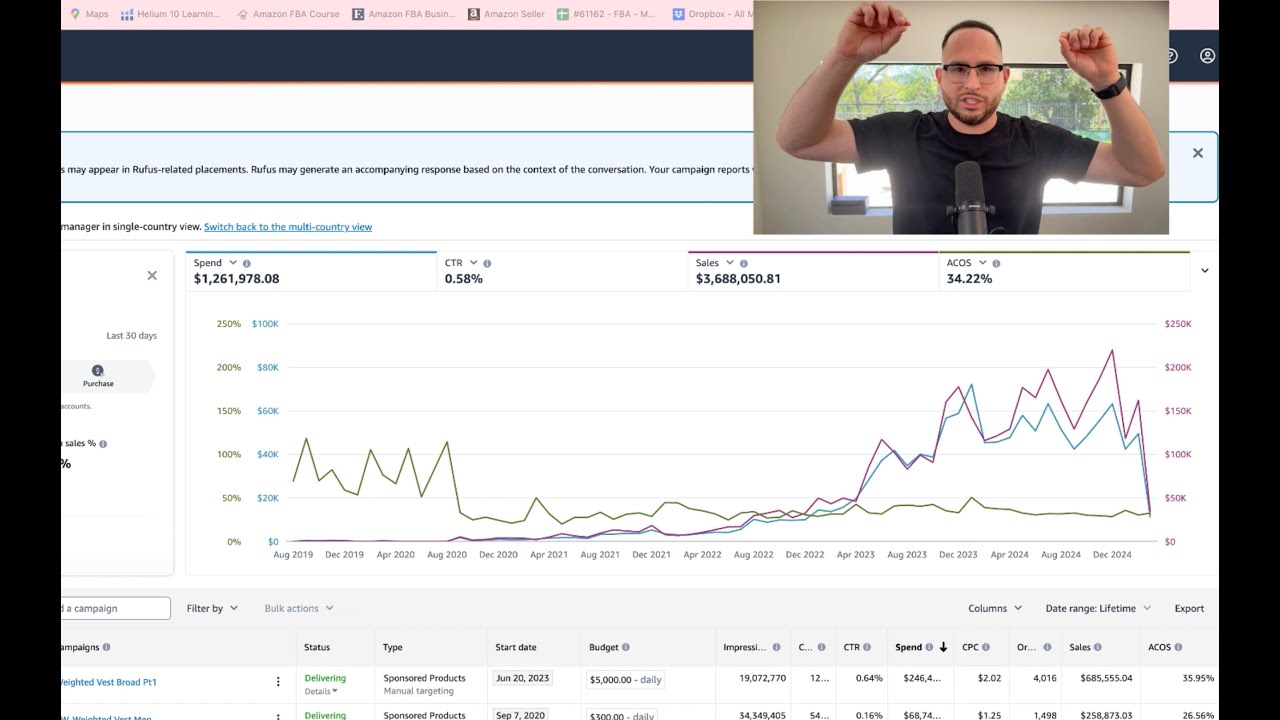
All right, I'm going to give you the exact blueprint of how to run Amazon PPC because I'm going to show you my 3 brands that I currently run. And why is this important? Because I am not an agency. These are brands that I actually own. And why is that important? Is because I actually care about profit. You see, I've hired multiple different Amazon PPC agencies and they will do a good job as far as spending a lot of money. And it would look like you're actually getting sales consistently, But at the end of the day, when you look at the bottom line, you're actually negative. And they will tell you that the reason why they're doing these strategies is because in the long term, it's going to improve your ranking. Well, it's all BS. Honestly, it is. Really is. You as a business owner, especially with an Amazon brand, you have to know PPC like the back of your hand. So in this video, I'm going to literally show you the blueprint. And you can see one of this account, I spent over $1.2 million, but that's not the only account that I go ahead and own. This is another brand, Factory Laced. I've spent over $1 million on this actual brand. I also own a different brand, Relax Support, which I spent $700,000. And this has not included the failed brands that I've had in the past before. So again, in this video, you're going to get a full breakdown of every step of the way, regardless if you're going ahead and launching a new product or you're relaunching. And every step of the way here that I'm going to go over will tell you exactly what strategies you have to do in your own business. So even if you ran PPC before, This is going to show you exactly what holes you were missing and how to effectively run PPC in the future. So let's actually get into the information already because you guys know my style of videos. I don't have to make any edits. So bear with me if I do make a mistake. So first things first, new product launch, or if you're just relaunching an ASIN again, what are you going to do first? Well, we're going to run a lot of automatic keywords, which is again against the grain of what these so-called gurus tell you on Amazon PPC. The reason for that is you do not have data. Keyword research on Helium 10 and Jungle Scout is fine, but auto campaigns will be your best friend until Amazon determines what keywords to actually target. You see, the number one mistake with a lot of Amazon FBA sellers is they don't have a customer avatar. So they just try and go ahead and target one seed keyword like shoe cleaner. And there's so many different types of shoe cleaners out there. There's shoe cleaners for moms, there's shoe cleaners for sneakerheads. There's shoe cleaners for people that have boots, right? So if you don't understand your actual target market, it's the quickest way to burn through cash. We want to scale effectively and we want to start making profit automatically from the very start. So again, this is why we're going to create 4 different auto campaigns. As you can see on this right-hand side, there's a close match, a loose match, and a substitute. And let me try and zoom in as far as I can and we'll kind of go through the entire process, right? So you can see on your Amazon dashboard, you're able to run auto campaigns and they're going to give you these 4 options when you select set bid by targeting groups. There's close match, loose match, substitute. You guys get the point, right? All right. So what do these all mean? Well, close match is going to target highly relevant keywords. As I, as I mentioned before, they will target a shoe cleaner, a shoe cleaning kit, right? You guys get the point there. Loose match will broadly target those actual related keywords. So instead of shoe cleaner, maybe they'll go ahead and target shoe cleaner for leather shoes, for boots, right? You guys get the picture there. It's a very broadly goes ahead and has relative keywords. Complements and substitutes do something similar to close match and loose match, but they target actual competitors, right? So other listings are going ahead and seeing what sales you can go ahead and do. So they target products that are complementary to yours and they target competitors as far as substitutes. So you can go ahead and get the picture as these target keywords, these go ahead and target products. All right. So what is next? So you will get a sense of a broad kind of a seed word, right? Like I mentioned before, shoe cleaner, which is fine to still run these keywords. And you'll— I'll go ahead and see as far as the budget allocation to both of these types of things. And you're going to see that heavily focuses on auto campaign, but let's go ahead and focus on this, right? So it says, choose the 5 top keywords you believe will convert. Again, what you believe, 99% of the times you're going to be wrong, but we want to go ahead and give Amazon the ability to start looking for keywords that you think will convert. So we're going to choose 5 top keywords, whether that be shoe cleaner, shoe cleaning kit, sneaker cleaner, sneaker cleaning kit, right? You guys get the point. As far as what you think your keyword is relevant for and what keywords you're going to go ahead and do that, we're going to run broad matches. We're not going to run exact matches because again, you're going to make a mistake. You're going to bleed a lot of money. And we want to have Amazon get the data for us first before we start optimizing. So again, We're going to run keyword targeting here and we're going to turn on this actual broad match campaign. So we're going to create broad match campaigns and we're going to set it to $0.75 to $1 for bid for your keyword. So this determines based on how big your, your actually selling price is, right? So if you have a selling price that's under $30, I would suggest going ahead and running a $0.75 bid right here, right? If you're running anything above $35 or $30, I would go ahead and encourage a dollar bid. And if you're going into the hundreds, 200, you can go ahead and scale efficiently. I mean, you can go ahead and optimize these based on your actual sell-through, right? And you're also going to choose your 5 top competitors and target them on the expansion tab. If you know about Amazon FBA, you know, when you start targeting competitors, you can target them specifically, or you can go ahead and target them based on an expansion type tab. Again, expansion tab, because even though we think we're going to make sales with these certain competitors, we really don't know unless we actually test. All right. So what comes after that, right? We're going to be utilizing this up and down bidding strategy for both auto campaigns and for these actual broad match campaigns. And when we're targeting the keywords and the expansion tab, why? Because we're giving Amazon the ability to go ahead and we'll raise the bid if they're likely to convert. And after 2 weeks, turn all of these ads to dynamic bid down only. So for only 2 weeks, we're trying to gather as much data as possible from Amazon. And optimize quickly, right? The more we fail, the quicker we fail, the quicker we could go ahead and cut our costs as far as advertising is concerned. And if you have any questions regarding this entire type of diagram that I'm going ahead and doing, just leave a comment below. If I get enough of the same questions or relative questions, I'll go ahead and make a more exact video and kind of dig in deeper about that. But again, I'm trying to go ahead and make a video that's going to benefit all Amazon FBA sellers. So we're going to be running a lot more broad type of topics here. But again, it's going to be a game changer. So again, what is the budget allocation that I mentioned before? 80% of your budget is going to be on auto campaigns and 20% is going to go to the broad and product targeting campaigns. Again, I don't like to make any edits. I'm so sorry. All right. So budget expectations, you will need at least $500 to $1,000 for the first 2 weeks of you running the Amazon PPC campaign for the first 2 weeks. This range varies based on your niche competitiveness. If you think you have a competitive niche, you're obviously going to be closer to that $1,000 for these first 2 weeks. If you don't have a competitive niche, you're going to be running around $500, right? Amazon may not spend all of your budgets, so don't stress out if you have high campaign limits. So you guys get the picture here. This is the first 2 weeks. So we're going to run these ads for 2 weeks and collect as much data as possible. We're trying to fail fast so we can optimize. Okay. So what ends up happening after these 2 weeks? Well, after these 2 weeks, we're going to optimize first, right? So As you can see here, we're going to go into our placement on all of these keywords and we're going to see as far as what— where are we getting these sales, right? Amazon is going to go ahead and give us this bid adjustment tab here and we're going to see how many sales are we getting on top of search, rest of search, and product pages. And based on that, if we're getting a lot of spend on one certain category here, placement here, as you can see, rest of search is getting majority of the actual spend here. We're going to start going ahead and making some optimizations. So what do I mean by optimizations? Well, if a keyword is bleeding money, analyze top of search, rest of search, or product placements and adjust accordingly. Reduce budgets on low-performing placements and increase bid adjustments to top of search, rest of search, or wherever as needed. So as you can see here, I'm going ahead and reducing my bid adjustments based on the data that's been collected, right? So this might be something that already has a bunch of different types of campaigns running, and we can already start adjusting. But if let's say we have a dollar bid, right? Let's say we have a dollar bid here and we start noticing that all of our spend is going on rest of search and we have a 43% ACOS. Well, instead of going ahead and having a dollar bid here, maybe we'll go ahead and reduce it to 90 cents. And we can go ahead and still start going ahead and optimizing the other ones. So we can go ahead and have a higher bid or bid on the actual percentage of the dollar amount. I'm hoping this makes sense, right? So if you are still with me, go ahead and let me know that you're still with me by a like on this video. But you guys get the point, right? So after optimization, we're going to go ahead and do this first. What are we going to do next? So now we're going to analyze the data that Amazon actually gives us. So it's going to look something like this if you're running like an auto campaign, right? So we're going to go to the search term and we're going to actually see what keywords are actually converting and what keywords are not converting. So as you can see in this example, we have weighted vest, adjustable weighted vest. We have weighted vest training. You can see that we had 53 clicks and 0 purchases. So this just means that we're bleeding money here. So what are we going to do in this section here? Well, now you have actual data to work with. You're going to go into the search term analysis that we see here and identify keywords with multiple sales at a cost of 40% or below. Do the same for product targeting campaigns and negate wasteful spending keywords, but be careful with related keywords, right? So this is all going to make sense right here. Let's just go through this. Every product has seasonality, so avoid negating strong keywords. So what do I mean here? Right. So these, these things circled in green are keywords that actually have multiple sales for this actual campaign. So this is the auto campaign. And we can see that there are a lot of keywords that are bringing in multiple sales. So what am I going to do here? This is called harvesting. So we're going to get all these keywords and we're just going to make a list of these keywords that we start seeing a trend on that is doing very well. And we're also going to go ahead and circle in red and take these keywords And we're going to negate them. So you can see weighted vest training, exercise, ruck vest, weighted running vest for men are getting a bunch of clicks and not enough sales, or getting zero sales in this case. So what do we do here? We have the ability to go ahead and negate these keywords. So for sure, we're going to negate this thing called exercise. It's such a broad keyword, and I don't think I'm going to get sales in the future for that. But I'll be very reluctant to go ahead and add weighted vest training, weight vest, running vest for men, or even a ruck vest, because I understand that this is relative to my actual niche, the actual products that I'm selling. So maybe they're not getting sales now because again, the seasonality factor of it, right? So maybe I won't negate it right away, but I'm gonna keep a close eye on this actual campaign. And if the next 2 weeks, it's again, getting a bunch of clicks and not enough sales, then I will negate it from there. So what do we do with these actual products that we circled in green? Well, just a moment right now. What we're going to go ahead and do is that those keywords that we just circled, if you notice the trend of those keywords, create a single keyword campaign for better bid control. So we want to go ahead and do here is once we have just one single keyword campaign, we can manipulate how it's shown on Amazon. So how does that, what do I mean by that? Right? Well, this is a broad match. I mean, this is either a broad match or an auto campaign. You can see there's a lot of data here. A lot of this data might be multiple keyword data. Once we go ahead and establish one single word campaign, we don't— we know that this is not mixed data. This data is only for a particular keyword. So now we can go ahead and start analyzing at a 1-week, 2-week, 3-week, 4-week, 12-month timeframe and see what that keyword is actually performing. And we can go ahead and hyperfocus on how we're going to bid optimize. So maybe we have a dollar bid, But we noticed that a cost per click of 1.3 is being very good for this keyword. We can kind of up this by 40 or 50 or 60, which in this case, it looks like we're going ahead and doing. So that's why you want to go ahead and kind of spot trends very quickly and start making those into a single keyword campaign where we're really hyper-optimal as far as how much we're going ahead and spending on certain keywords. So what do we do after this? Well, then we're going to give another 2 weeks to collect more data. So again, we just went over something that seems very simple, but it's going to take a long— a lot longer, um, as far as going ahead and executing, right? So now we're in week 4. So it's been almost a month now of us running a bunch of different data and running even more campaigns. So what do we do weeks 4 and 6, right? So for all the keyword campaigns, start adjusting bid modifiers to tailor target for converting keywords. So as you can go ahead and see here, this is one keyword And now we're optimizing based on that keyword. So you can see here, this product pages was a 40% ACOS. So my assumption here, based on me doing this hours on end for the last 7 years on Amazon, is that I probably have these product pages bid at 0.9, right? And based on me having the cost per click at 0.9, I know that if I'm getting any clicks from product pages, we're going to start becoming profitable. Same thing with rest of search, right? We know that if my actual bid is at 0.9, I'm raising it by 20%. So I'm telling Amazon that you can go ahead and spend up to 18 cents more if it's coming from rest of search placement. And I'm also telling Amazon that they can go ahead and go ahead and go up 45% if it's showing up at the top of the search page. So again, this video is not intended for new Amazon FBA sellers. New Amazon FBA sellers quickly turn off of this actual YouTube video Because they are lost. You are watching this YouTube video because you are in the trenches of Amazon FBA and you understand completely as far as what I am discussing here. And this is going to be a game changer. And again, if you are interested in me going ahead and talking about Amazon FBA as a whole and going ahead and discussing different strategies that I'm using, make sure to join Seller Cartel. We're going ahead and accepting very few people for this one-on-one training where I go ahead and look at the bottlenecks of your business. So if you are interested, go ahead and click that link below. So we only want like-minded individuals, blah, blah, blah, blah, blah. But let's go on. This is where the magic happens. Now, after a month, Amazon has enough data to compare your product performance against specific keywords. So again, this is where the magic happens. So what are we doing now? Well, we're going to go into Brand Analytics and we're going to specifically go to the search query performance. So it looks something like this when you go into the Brands tab, right? And what is this search query performance going to go ahead and tell us? Well, they're going to have a bunch of different keywords here, and they're going to tell us how we rank. The most important section of this search query performance is going to go all the way to the right, right here, where it shows you the ASIN share of the actual purchases. So based on these keywords, this is how you're converting against your competition. So you can see 0.46, 1.57. You guys get the picture here. So what do we want to do with the information on the search query performance? We're going to identify keywords that you're actually getting sales for. So a good rule of thumb is try and take this report, whether it's monthly, whether it's quarterly, whether it's weekly, right? A good rule of thumb, if a keyword has more than 2% of total purchases, it's a strong keyword. So write those keywords down. And we're going to take the top 5 performing keywords and create a single match campaign for them. Treat these just like a single exact campaign, running both single keyword campaigns and broad campaigns at the same time. So what do I mean by this? Right. So we're going to take these keywords and we're going to run single keyword campaigns on a broad match level. Okay. So this is going to be very important because you might see that there's going to be overlap on your other single keyword campaigns that might have the exact same keywords. Don't worry about that. You are not competing against yourself when it comes to doing Amazon PPC. And Amazon has came out multiple times to say that. So if you're going ahead and targeting an exact match keyword of a certain, you know, a certain keyword, and you're also running a broad match, you're not going to be directly going ahead and competing with each other. Right. So again, it's perfectly okay. So what we're going to do here, we're going to take the top 5 that have search volume, that have a high ASIN share, which again, it's 2% or higher. And we're going to start making independent single keyword campaigns at a broad match level. Okay. So what do we do next here? Ongoing PPC maintenance, continue negating bad keywords and harvest good keywords. The same thing that we were doing after week 2, never negate a keyword, even if it's being targeted in other campaigns, there is no such thing as self-competition. Again, if you're running different types of keywords and different campaigns, and they're probably the same keyword in different campaigns, it's okay. You are not competing against Amazon. If anything, you're basically telling Amazon to communicate with each other. So maybe you're going ahead and getting rest of search on this campaign, but now you're getting top search in this campaign, and now you're getting product pages clicks on this campaign. So it's perfectly okay to target the same keyword on different campaign levels. So keep iterating these steps over and over to refine performance and maximizing profit. Again, it's not that hard. It's just very complex. Okay. So final, when you continue harvesting high-performance keywords and negating bad spend keywords, this is what you want to go ahead and do continuously. I optimize maybe every week, 2 weeks, 3 weeks. Again, there's a lot of different moving parts that go to this, but if something starts getting very high spend, I start going ahead and optimizing more frequently. Scale successful campaigns by increasing bids on profitable keywords. Again, this is why it's important to run single keyword campaigns, because once we have a solidified keyword, we can start manipulating it very tailored focused. Lower or pause poor performance keywords that are draining the budget. Use data to build exact match campaigns for proven converting keywords. Now we're going to go ahead and expand product targeting campaigns to focus more on top converting competitors. So again, instead of going ahead and doing the expansive view, now we go ahead and target them exactly as far as that competitor. And then we can go ahead and tailor focus just like we're doing with these keywords. And then we want to go ahead and start doing is start video ads and sponsored brand ads to further dominate that niche. Only use top converting keywords or exact matches. And my rule of thumb is if it's good enough for a single word campaign, start running sponsored brands on that actual keyword itself and only do exact match because Amazon is a little funky right now when it comes to actually going ahead and running sponsored brand campaigns where exact match is more like a broad match. And I don't want to confuse you here, but basically even if you're going ahead and targeting shoe cleaner, Amazon in the exact campaign for sponsored brands, Amazon is still going to target relatively broad keywords like shoe cleaning kit, sneakers cleaning kit. You guys get the whole picture, right? So that's basically the rule of thumb here. My final thoughts here are the process ensures that you are making data-driven decisions instead of throwing money blindly. Again, if you hire an Amazon PPC agency, 9 out of 10 times, is going to be the worst decision of your life when it comes to your Amazon FBA career. They are in the game of making money and they can only make money if you continue to get billed monthly. Okay. So your budget allocation should continuously shift based on what is actually converting. So again, if there's bad converting keywords, negate them, cut them off. The goal is to achieve the highest ROAS as possible while scaling profitably. I'm a brand owner. This is the most important thing in my business. If I'm not making money, what's the point of going ahead and continuing to waste money? They'll make excuses that your ranking's getting better, this, that, blah, blah, blah. It doesn't work, right? So PPC is not a set it and forget it strategy. Consistent optimization is required. And if you follow this method, you will have a strong foundation to dominate your niche within Amazon FBA. And again, I've been doing this for more than 7 years. I have spent over $3 million on just Amazon PPC alone. I am— I know what I am talking about. And I do have an SOP, um, that I'll go ahead and share with you guys here. As far as whenever I am launching a brand new, uh, campaign or anything like that in that matter, um, I do have an SOP that goes over this exact type of framework. Um, and it is right here. Sorry guys, I just want to go ahead and make sure it's there. So Amazon PPC SOP for private label products, right? So it goes over this thing in depth. If you guys want access to this SOP, all you have to do is click on that link below, sign your actual email, your phone number, whatever it might ask for you. And I'll go ahead and send this over for you. But again, if you are an Amazon FBA current seller and are looking to expand and scale your brand profitably, go ahead and follow the YouTube channel because every single week I'm trying to drop little nuggets just like this to better help and scale your Amazon FBA business. But until next time, guys, peace.









