FREE Amazon FBA Course | COMPLETE Step by Step Tutorial For Beginners 2025
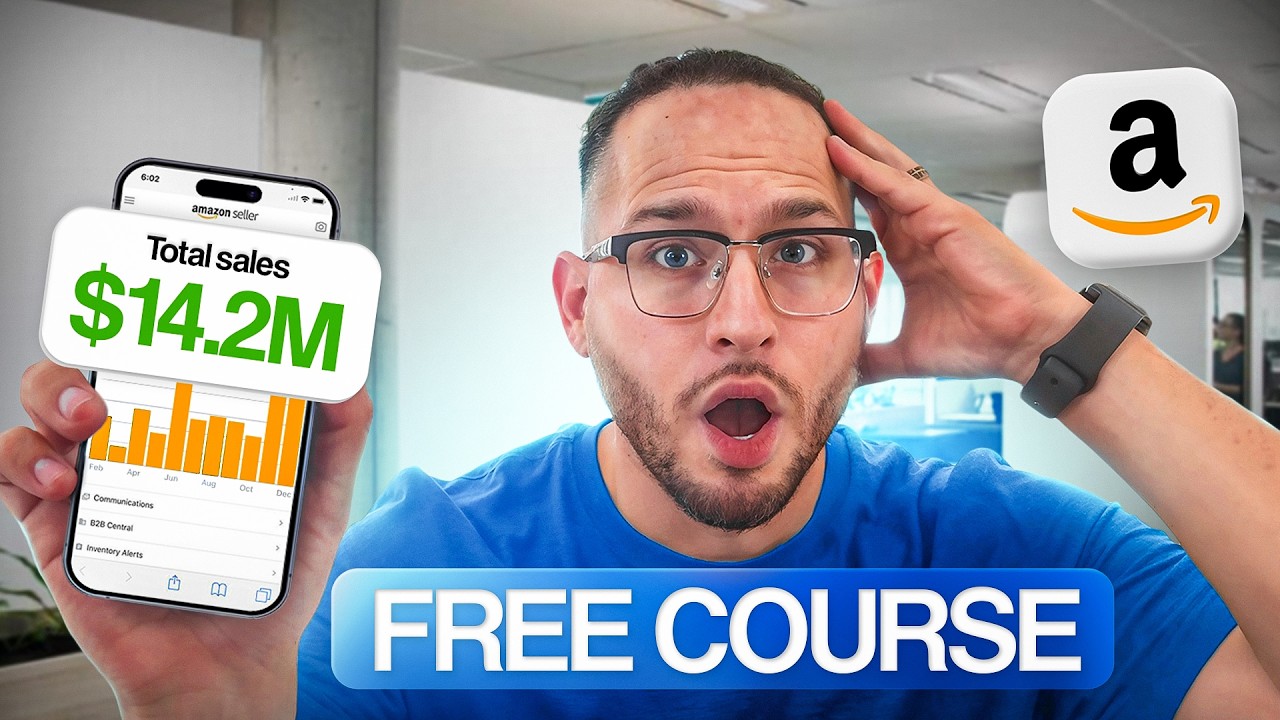
Emanuel Ruiz walks beginners through launching a private-label Amazon FBA business, from product research to scaling. He covers data-driven tactics like using Helium 10 for research, running broad-match PPC campaigns to find keywords, getting a trademark for Brand Registry access, and tracking metrics like conversion rates and keyword rankings. Post-launch, optimize by analyzing your conversion funnel against competitors and iterating your listing.
Chapters
In this video, I'm going to show you how to launch and scale a profitable Amazon FBA brand from scratch. And if you're a complete beginner, it's okay because this video is exactly intended for you. Because Amazon FBA has completely changed my life and has allowed me to go from an unhappy, unhealthy real estate agent who was working way more than 50 hours a week just a few years ago to now making over $90,000 per month In profit, and it still has allowed me to be a family man because right now I am a father of 2 little girls. But not only has it changed my life, it's changed a bunch of people that I know as well. Like Amazon FBA has changed Kevin's life. He went from $0 to $100,000 per year selling one boring product. And it also helped Sherwin, who's doing over $45,000 per month with this brand new product. And it has allowed him to go ahead and buy a new home recently here in the Los Angeles area. And if you guys know anything about real estate, you know that LA is very expensive. And there has been a bunch of other people who were able to completely change their situation by just starting Amazon FBA. And the great thing is, is that this information is going to be basically a free course. And it has the power to change the trajectory of your life and give you that time location, and more importantly, that financial freedom you have been looking for. And there's going to be a ton of value that I'm going to go over, so make sure to cut out all distractions and take some notes while going through this entirely free course. But before I get into it, right, if you'd like to help launching and scaling a profitable Amazon FBA brand, DM me the word brand on Instagram because more details, I'll go ahead and have them in the description below. But let's get right into the information. But for those of you that don't know, there are different forms of Amazon FBA. There's retail arbitrage or online arbitrage. There's wholesale. And what we'll be discussing today is, is private label. And the biggest difference between retail arbitrage or online arbitrage and wholesale is that with private label, you actually get to own intellectual property. You are building brands that in the future, you're building equity in them where you later on can sell this actual business for life-changing amounts of money. So not only are you building something from scratch, putting your brand name into it, getting paid every single month, you still have the ability to actually sell that business, which can't be said with these other forms of Amazon FBA. And basically what private label is, is just you're selling existing products right now that are currently on demand and putting your own branding into it. It sounds very simple, right? So how it works is that you own the actual brand. You have higher profit margins. You're able to customize that actual product based on how you can go ahead and improve on it, what's currently available right now on the market. You have control over the listing and marketing because a lot of times with retail arbitrage and wholesale, at any point in time, these brands can go ahead and tell you you cannot sell the products any longer. And that's not the case for private label because it's actually our brand. It's our actual branding that we're going ahead and putting and selling on Amazon. And less important— and most importantly is less direct competition. Because if you guys know anything about wholesale and retail arbitrage, you are not the only person selling that exact same product. Oftentimes you're going ahead and competing with 20 to 30 people on an actual listing, which we'll go over in a second as well. But private label gives you that trifecta that I talked about earlier. It gives you that money freedom, that time freedom, and that location freedom. Right. And the only thing is that like with retail arbitrage and wholesale, it's still, you're changing, you're exchanging time with money as well. And with private label, you're building systems and operations that Amazon goes ahead and does all the heavy lifting. And you, and your sole purpose is basically branding and advertising your actual products. Right. And there are some common challenges that to expect with private label, as opposed to these other forms of selling on Amazon FBA, and that it's a higher upfront cost. We can go ahead and assume that we're gonna spend anywhere between $2,500 to $10,000 to actually start Amazon FBA private label business. And why is there such a big range? Well, it really depends on how much the product is going to cost. If you're trying to sell a $100 item, we can't expect to go ahead and source that for a dollar in Alibaba or other places in the world, right? Or even US manufacturers. So it obviously depends as far as what you're selling, that ranges from the upfront cost ranging from $2,500 to $10,000. But more importantly, we got to this point, right? So what are the tools really needed to even start Amazon FBA private label? Because some people make it seem very, very complex that you might have to go and manufacture these actual products, which is completely not the case, right? Like, we find manufacturer resource, this actual product. We have a freight forwarder, which again, if all of this sounds foreign to you, I'm going to simplify this in this actual course. And the only tools you really need to be successful with Amazon FBA, believe it or not, is these 4. You need to learn how to do ChatGPT and give it good prompts. You have to know what Helium 10 is because it's going to be a software that we're going to go ahead and be using to kind of validate our products. You have to know how to do Smart Scout, which, you know, we go a little bit in depth as far as how much it costs to advertise these products. And we use Fiverr to go ahead and create our actual listing, get product photography done and stuff that we might not be pros in. But it's kind of crazy, right? We only need 4 different types of software programs to actually be a successful Amazon FBA private label seller, right? So the one thing that's always basically a deterrent as far as what people get started with Amazon FBA is how, what, how can I go ahead and find a product to actually sell, right? Well, you're in luck because again, you're going to get a lot of different types of information here for completely for free. And I think the biggest lesson that you're going to learn from this actual video here is that I'm actually an Amazon FBA seller. I own 3 brands. I own Maverick, I own Factory Lace, I own Nudery Labs, and I'm very transparent as far as the different tips and strategies that I use in my business to better help people in the private label space, right? Because other people might go ahead and just give you theories or frameworks. I'm actually going ahead and teaching you stuff that I'm currently doing in my business that has allowed me to make over $90,000 in profit every single month. So let's do product research, right, and market analysis. So how do we find a product to sell on Amazon? And basically, let's go ahead and start brainstorming, right? Because the most successful products on Amazon currently right now, in order for you to have the most successful product launch right now, is finding products that has big pain points and insecurities, because that gives you the best chance to win when it comes to Amazon FBA in 2025. And once you know this, and we're going to go over some examples here, is that you're going to go ahead and know what product you want to sell based on who the ideal customer is. And I put here, You are the ideal customer. So when we're brainstorming kind of products, I want you to take a look at your browsing history of when you were shopping for actual products online, right? Like, why did you buy those products? What pain points were you going ahead and experiencing that you needed to buy a product to go ahead and solve that actual pain point? And more importantly, is there an insecurity that every single month, or let's say you need to buy a certain product because you are insecure about that thing, right? Like, and we'll go over a little bit of examples here, but make a list of items that you have purchased because that was a pain point, as I mentioned before, and you needed to go ahead and fix that problem. So let's actually go ahead and start doing some market research data. So let's go on to Amazon. And you can see that my wife is shopping for a lot of different things here. I'm shopping for a little different things here. So this is my type of explore page when it comes to Amazon, right? And I'm going to give you 2 different examples. I'm going to give you an example of this hiking solar fan caps, right? The pain point here is that it's summertime. And people are going hiking and maybe people are going hiking for a long period of time and maybe they need something to go ahead and charge. Well, because this particular hat goes ahead and gives solar where you don't need to have it plugged in or charging in order for it to go ahead and give you a fan, the electricity, people are going ahead and buying this and people are brand new to the space that have less than basically 4 reviews over here and are still making a killing when it comes to selling this product on Amazon. Why? Because it's such a pain point that somebody is going to go out there, maybe hiking for hours or a few days, and they don't want to go out and it's going to be hot outside. So they're willing to go ahead and pay for something to go ahead and fix their pain point. Another thing, as I mentioned, is hair loss, right? Like hair loss is probably one of those biggest things that people will spend millions of dollars on to go ahead and fix that insecurity, right? So you can see that these 2 things are different scales of pain points and insecurities. Yes, there is a pain point that you're going to go hiking and it's going to be hot and you want a fan. And maybe the fans that are currently available right now need to have a charger attached to it based on how long you're going hiking. With opposed to something like this, right? You can see I'm insecure about my actual hair. So I've purchased this thing 9 times. I've also purchased this item 1 time. I purchased this 2 times. So you can see that based on me having this insecurity about hair loss, I'm willing to go ahead and pay this over and over and over again. So now think about it yourself again. What are you insecure about? What are your pain points right now? And let's actually start researching to see if we can sell this actual product. But that's step number 1. Step number 2, as I mentioned on this actual sheet over here, is we have to validate our actual products. And how do we really validate products that we're going to go ahead and sell on Amazon FBA as private label. We want to make sure that there are new sellers that are currently making money, because if new sellers have just launched and are making money, that means that we have a chance to make money as well. And again, do not get worried about all these high reviews and get discouraged because of it, because the same thing is that you can have the same product and target different people. As we're mentioning here, Right? Like, this is the simplest thing I can go ahead and kind of explain, right? You have products here that are targeting women, and you also have products targeting here that are targeting men. Most of the time, this is the same exact product, but some products specifically target men, some products specifically target women. But that's just a simple, like, one-layer arching approach to this, right? We can really get deeper, especially when we, when we start going ahead and talking about, like, pet products, right? Like, we can be targeting pet owners that have pets that are currently indoors and that are— how— that are like, uh, have shedding problems, right? Or we can go ahead and target actual pet owners that have outdoor dogs and don't have shedding problems. Something like that, right? Like, I'm going ahead and trying to overcomplicate things, but at the end of the day, like, the same product can be going ahead and being the same exact thing, but we're just targeting different people. So how do we know that new sellers are in this space actually making money? Because that's the first step. If we are able to find people that are currently brand new, maybe started selling this year, that are currently making money, then we have a good opportunity. So let's go ahead and take a look at Helium 10. So once you have Helium 10 downloaded, and again, I have all of these tools on the description below that you're going to have information on, we go to this X-Ray tab where it's basically an Amazon product research phase. And this is going to pull up all the information we need to validate if a product that is currently right now selling on Amazon is going to be a good product for us to sell. And all we're going to do here is we're going to slide all the way to the right and we're to go based on date creation. So we want to go ahead and look at people that have just launched this product this year, basically. And you can see there's been a lot of different people that have launched this product this year. But more importantly, are they making money? So if we're going ahead and loading it up here, we can start seeing that people per month, because this is a per month basis, somebody is making $3,000 right here, $1,600 here, and $9,000, $18,000. $9,200, $8,700, $6,500, $5,300. So you can start seeing that new sellers are getting into the space at $12,000 right here and actually making money, right? Same concept of going ahead and kind of making it a little bit bigger here so you guys can go ahead and see. So same concept here, let's go ahead and look at, uh, this hair loss, right? Like hair loss to actual products. We're gonna do the same thing as far as going on Helium 10, sliding all the way to the right, and sorting this based on how, what, how, if there's any successful sellers that are brand new to Amazon FBA actually making money. And as you can see here, we actually see less people actually launch in 2025, right? You can see this based on the difference between how many people launched here as opposed to here. It's already giving me some pause to concern that, hey, maybe this would be a way too competitive niche to get into, right? So as you can see, this new seller is making $50,000. 222,000, 57,000, right? And the list goes on and on as far as, you know, maybe this is a product that has some, some runway as far as going ahead and selling, right? So now we checked it off the list that both of these items are actually in high demand, that there's new sellers actually making money. But that's just one phase, right? Once we actually go ahead and start validating these actual products and people are actually making money, we now have to use Smart Scout. And basically what you want to use Smart Scout for is to understand how much is it going to cost to advertise for these products. So you got to understand that recurring products, like I mentioned before, from like my topic hairspray, my topic, uh, product will be way more expensive when it comes to PPC. And I won't overcomplicate things, but there's this thing called a one-time value and a lifetime value of a customer, right? The more lifetime value, meaning how often are you going to go ahead and continuously reorder your actual product, the more brands are willing to spend on a price per click. Right? So yeah, I hope I haven't lost you here because I'm going to go ahead and explain it a little bit further in depth. So ideally you want to sell a product for a minimum of $17 because we're going to be running advertising on Amazon PPC. So if your PPC, which is the cost per click that people are going ahead and clicking on the actual item, is $4 per click, it will be hard to be profitable, especially as a new seller. And Smart Scout allows us to see how much you'll go ahead and be spending on a click. And we go here to Smart Scout. So go ahead again, I have a link below. And all we're going to do here is go to this product section. And let me go ahead and expand it just a little bit here so you guys can go ahead and see where I'm looking at. So I'm looking at this product section here, right? And I went ahead and put the solar fan. And the solar fan, you can see that maybe this is a seasonal product because you can see the 30-day trends is actually lower on every single keyword, which makes sense, right? Are going ahead and going hiking. It's summertime right now. Um, people are already going ahead and purchasing this actual product. So maybe we know that this is actually a seasonal item based on the trends, and we'll go over trends a little bit later. But what I'm trying to go over now as far as validating your actual product is how much is it going to cost to acquire one click on Amazon FBA? Because all of these words down here that you see under me right now is keywords that people are searching up. So you can see that hat solar fan is searched up 400 different times every single month. You can see solar hat fan for men is searched up 226, right? So being able to advertise for these keywords, you can see that I have to spend right around 93 cents per click, 66 cents per click, 80 cents per click, 86 cents, $1.30, right? And you see another one at 74 dollars. So we're right under a dollar for every single one of these keywords. And as I mentioned before, how much is actual hat cost on Amazon? Well, if you go ahead and look here, you can see that it ranges from going ahead and spending it for $36, which is the one that we're researching here, $39 here, $15 here. So it hits that one segmentation as far as, okay, if I come out with this actual product and I'm selling it for right around $30, I'll be profitable because the cost per click is very, very low. But now let's take into account this hair products, right? All of these different hair products that people are overly insecure about, how much is it going to go ahead and cost per click? And keep a reminder here, like, people are charging $24, $46, $88, um, as high as $500, $40. The list goes on and on, right? There might also be some that are below $30, right? So let's go ahead and see how much it costs for an actual click for this actual product. So let's go here. We can see that the difference— and you can see that there's the trend is only getting higher, right? Because more and more people are shopping on Amazon right now. So more and more pain points, insecurities are going ahead and purchasing on Amazon as opposed to any other site. But you can see that every single search volume here is going higher, which this is more indicative of the fact that more and more people are shopping online. But let's start seeing this cost per click. And you can see that there's some that are $2.89 per click, but there's others that are $12.50 for every single click for this actual keyword, right? $12, $12, $12, $4, $12, $12, $12, $12, $12. It's very, very expensive to get into this niche. And the thing is that $12.58 is probably on the high side when it comes to Smart Scout. So there, it might actually be more expensive to actually advertise for these products. So just by going ahead and doing a quick search here, you already found basically how you do product research and how you validate product research and see if you can go ahead and move forward with coming out with a product. So you can see that that solar fan might be a seasonal item, but it has enough demand. The price per click is there that I would move forward with that product as opposed to the hair loss product because of the fact that it's going to cost us way too much money do advertising. Basically, how much money is it going to cost to acquire a customer? And that's just per click. It might take you 10 to 15 clicks to actually convert one customer. So right there and there, you might be spending $150 to $200 for that one customer, and you're selling a $30 item, right? Other marketers in the space, as far— especially when it comes to supplements or recurring type of revenue, are okay with that because they can understand their lifetime value of a customer. But for this case, And the most successful people on Amazon, we're going to go ahead and just be selling products that might be purchased 1 to 2 times per year. Right? So again, let's say we found a product. You went ahead and put your list together. How do we do competitor analysis? Because it's only one step to actually find a product, but a different step to how to improve on the product to actually steal sales away from our competition. So let's get into this competitor analysis portion of this deep dive. We're going to spot trends and seasonality like we did with that solar fan. People avoid seasonal products at all costs. And that's okay. There's no excuse as far as avoiding a seasonal product because you can get stuck with inventory a lot. But I'd like to actually come out with seasonal products. And I actually tell students that seasonal products are like, kind of like low-hanging fruit, as long as you can forecast demand and have inventory under control. Because the worst thing you can do is come out with a product, a summer product in September. Now summer's over and you have to wait a full year to go ahead and actually start selling through your inventory, right? So as long as you can forecast demand, forecast your inventory, I actually love seasonal products because it is way less competitive. And for 2 months or 3 months out of the year, um, you can go ahead and make a lot of money. A good one here is like fantasy football, right? Like fantasy football stuff in the summer sells like crazy because people are going ahead and purchasing it for basically one single month in August and September. Right, so again, forecast seasonality is fine for me, right? Trends may last longer than you think. Some people always tell me like, hey, is this going to be a trendy product that's here today and gone tomorrow? You got to understand that based on the analysis I have done, trends last longer than you might think, especially like in the supplement space where there's different things that are coming out constantly, like creatine or, you know, uh, consumable type of creatine or gummies or anything like that that's becoming way more popular that people thought were just trends, but they've actually been now accustomed to people's lifestyle, right? So I want you to understand this. When people zig, you want to zag, right? Like you're getting into Amazon FBA private label because maybe you want to go ahead and make a little bit of extra money. You want to go ahead and change your life, right? You want to have that time, location, and money type of freedom, right? So you're already zagging. Do the same thing in anything when it comes to business. When people are telling you don't do this, go ahead and do it because chances are there's gonna be way less competition. Because right now with Amazon FBA, you choosing to do Amazon FBA, you're probably, probably one of the 1% of the 1%. So you're already zagging. So take that and apply it into Amazon FBA as well. So let's get into competitor analysis, right? So once we see that the product is validated, check to see how we can improve on the product. So how would I do this, right? So let's say we're coming out with this hair loss product already and we said, okay, this is gonna be a product that we want to go ahead and come out with. And let's say we want to go ahead and use this type of product because it looks like this is a private label type of product, right? So what we like to go ahead and do, and you can use Helium 10 as well, is that we want to analyze the reviews that we're actually getting on this product. And we can just extract different types of reviews here. And excuse me there, we can go ahead and go here, go out, go on Review Insights, and we can actually start going ahead and basically analyzing this review. So once this loads up, you want to go to this filter page where I'm covering it right now with my face, but we want to go ahead and just see what type of ratings people are going ahead and giving. And I want to go and just hover over the 1-star, the 2-stars, and the 3-star reviews. And based on that, I can start seeing what people are going ahead and saying for these 1-star reviews, right? Like, be careful if you already consume enough of this type of thing. Today marks a month. Makes me sick, made me feel nauseous, caused terrible months-long rash. So you can go ahead and see that there's a lot of different things people are saying that they suffered a bad reaction. And if you start noticing a trend— so this is consumables obviously, but let's say any type of product— if you start noticing a trend, what we want to go ahead and do is take notes of everything people are going ahead and saying that what's wrong with this actual product. Because what we're going to do is once we establish that this product is validated new sellers are making money and I have a good chance of going ahead and making money as well because PPC is very low. Then we can go ahead and start saying, hey, these are the different trends that people are saying as far as like what they dislike about this product. Let's make it 1% better. So we're going to take these notes and once we reach out to our supplier, we're going to go ahead and use those notes as well. But we want to on this point of time start taking notes already. So once we've already established Helium 10 and start going ahead and writing down all these bad reviews and all these trends, Let's go ahead and start going and getting more information here, right? So we analyze all those bad reviews. Is this something that we can fix easily right here in Amazon FBA and for private label? We are not reinventing the wheel. We just need to make a product 1% better and continue to improve on it over time. And this is one thing that I didn't grasp when I first got started with Amazon FBA. I would see a bunch of different sellers for like let's say my shoe cleaning brand where everybody else was selling a 4-ounce bottle. And I told myself, okay, instead of me selling a 4-ounce bottle, I'm going to sell an 8-ounce bottle because I want to be different, right? Like I want to be able to go ahead and offer way more to consumers. Well, it backfired on me. Why did it backfire on me? Well, I shipped it into Amazon and now I'm getting charged more because I have double the size. So my shipping costs to a customer is basically double what it is with my competitors. Second of all, when you're going ahead and analyzing on Amazon FBA, people don't really realize that you're getting a 4-ounce bottle against an 8-ounce bottle. Bottle that easily. You might think that this is very common sense, but when you're shopping on Amazon, some people don't really notice how much they're actually getting. They pay attention to the photos, their listing, what they're saying on their listing, maybe before and afters when it comes to like shoe cleaners and stuff like that. So basically the size of the bottle is not that important. And based on me spending more on the actual product itself, me going ahead and spending more when it comes to shipping this actual item to a customer, and probably me spending more going ahead and having the same price as my competitors, I didn't have enough room to really scale with advertising. So keep that in mind. You don't want to go ahead and reinvent the wheel or do something completely different because at the end of the day, a customer is only going to know that yours is better than the competition if they go ahead and purchase yours at the very same exact time. And what are the chances that you purchase 2 of the same exact things and say, hey, this one looks so much better? That usually is not the case. So keep that in mind when we're going ahead and going through selecting a product and trying to go ahead and fix and basically improve on the product is what I'm trying to say, right? So now that we have this, now that we have a product in mind, we did all the research, we know the PPC is in line, let's go ahead and start establishing profitability, right? So profitability is probably going to go ahead and make or break your success when it comes to Amazon FBA. And you need to find a product that fits this criteria. And you're getting valuable, valuable information just based on you going ahead and watching this actual video. You're gonna already save so much money. And if anything sounds complex here, guys, like, I do offer one-on-one coaching, right? Like, we're gonna go through this video and you guys are interested and you want somebody to hold your hand A through Z. I do offer one-on-one coaching. If you guys are interested, just go ahead and DM me the word brand on Instagram. My Instagram handle is @emanlosangeles, Los Angeles, just like it is here on YouTube. So go ahead and find me there, um, and DM me the word brand. But you can get the— basically, this is my criteria. If we sell a $20 item, like, keep this in mind, here is a rough estimate of the expenses. No more than 60% of $20, right? So if we go basically more than half of it, right, 60% of fees Basically the cost of goods sold, which is producing the actual product, getting it shipped into an Amazon warehouse. Plus we have to add in the 15% commission rate plus the Amazon fulfillment cost, right? And we're going to get all to this, right? But all of these fees combined cannot be more than 60% of $20, which is $12, right? So this means that your all-in cost, if you're going ahead and selling a $20 product, cannot be spending more than $12. So let me give you an example here, right? So let's go back to this hiking, um, cap right here, and let's just say for, for fun, this is a $20 item. This is perfect to go ahead and go for this example. We're gonna see this actual product, and you can see that it's such a pain point that this person has 3.1 stars and still making money, still making sales, which again, if you have a good pain point and a high insecurity, you're going to make money in this line of business. Let's go ahead and see how we can see the fees when it comes to Amazon FBA. So let's say we want to go ahead and sell this actual product. We're going to come down here and because we have Helium 10, it's going to become— it's already going to come included, right? So what we're doing here is that we're going to go to this revenue calculator. You can see down here and the selling price, as we mentioned before, is $20, right? The fees included on Amazon is $2 to sell this actual product and $6 to ship it to a customer. You can see the referral fee is $2 and the fulfillment fee is $6. So right in all, $8 to go ahead and produce this actual product. So what I want you guys to do here is basically take out a calculator, right? So we can see that $8 we're going ahead and spending on this actual product, and I want you to divide that by $20 based on our sales price, right? That is 40% of our cost already. So based on my analysis, we can only spend 10%— or 20%, I'm sorry— to produce this item and get it shipped into an Amazon warehouse. So basically what that means is that I have to go ahead and source this product, get it made in China or wherever it might be in the US, and get it shipped into Amazon's warehouse for right around $4, right? So $4 divided by $20, we get 20%. So that's 60% there. So keep that in mind, right? So I hope that makes a little bit more sense as far as like what we're looking for when it comes to the all-in cost, right? Producing the product, getting it shipped to Amazon, including the 50% commission rate, getting it shipped to a customer. And we get that by going ahead and using, um, Helium 10. So basically, if, if we went ahead and checked off all that list and we're able to go ahead and produce this for, let's say, $1 or $2, right? And we stay below that 60% expense ratio, this is a green light product is what I'm trying to go ahead and say, right? And I'm going to go ahead and put it right here. Green light product. Why? Because this is not the only type of, uh, fees that are going to be included, right? We're still going to go ahead and have storage fees included. We're going to have some return fees as well. Maybe we do run some coupons, but as long as you stay under 60% of expenses on these things, we can go ahead and scale with advertising, right? The more you are below that 60% threshold of you selling the actual product, the more chances you will succeed with Amazon FBA. Why? Because we can go ahead and spend way more money on advertising, right? So this is why a high margin product is very great because we're able to be seen multiple times when somebody is going ahead and shopping for your actual product. Let's say for this hair loss product here, Um, the more margin we have, the more chances we're going to go ahead and show up multiple times when it comes to advertising. And basically that is the cheat code to being successful on Amazon FBA. The more you can be profitable with advertising, the more you're able to sell, the more you're able to go ahead and work with Amazon's A9 algorithm where they'll reward you with more organic ranking and more organic sales. Okay, so there is a formula, there is a strategy behind everything I am saying in this actual video. And trust me, I'm an operator, I run my businesses, and I run my businesses to be profitable. So that is probably the most significant information that you're going to go ahead and get as far as selling on Amazon FBA, that all your fees all in getting into Amazon has to be below 60% or below of your actual sales price on Amazon. And look, there are certain things, right? Like you can go ahead and maybe sell that $19 product for $25 or $30, right? So it might skew the actual results just a little bit there, but just keep that in mind. And why do I say this, right? Well, we need to— we need money to advertise, like I mentioned before, right, with PPC. And it is estimated that we're going to go ahead and spend 20% of our actual ads cost or retail value So let's say we're going ahead and have a $10 or $20 item. It is expected that we're going to have to go ahead and spend anywhere between $2 to $4 to acquire a customer, right? So again, meaning the worst case scenario, we are trying to net 20% in net margin, right? So if we want to get to $100,000 in revenue every single month, expect that after every single fee associated, we'll get— we'll net $20,000 per month in profit, right? So keep that in mind. And obviously I'm doing this based on me trying to have you succeed and have a high success rate. So follow this to a T. So let's say we just did everything right. Like we know that Amazon is a, you know, a vehicle that we want to go ahead and use. We went ahead and did product research. We validated it. We know our PPC costs. We did the numbers. Now it is actually time to start Amazon FBA. So how do we do this, right? So first and foremost, we have to set up and register for a Seller Central account. So we do this by clicking on sellercentral.amazon.com, and it's going to bring you to this page here. And obviously we're going to sign up to become a seller on Amazon FBA. And let me go ahead and kind of widen it out. You're going to get to a website that looks exactly like this, and we're going to sign up to become a new seller. And when we go ahead and sign up and become a new seller, they're going to ask a series of questions. You can see here that I obviously already have an Amazon account, but they're going to ask you a series of questions as far as what type of, um, you know, uh, type of, uh, account do you want, right? Is it a professional account? And there's different types of a free account as well. We want to go ahead and have a professional account. This is going to cost us $40 per month. And why do we want to do this, right? The reason why we want to go ahead and pay is because if we don't pay $40 a month Amazon's going to charge us $1 extra every time an item sells. So you can see that the break-even point is that we need to sell at least 40 units a month in order to go ahead and cover this $40 fee. Because if you had the free version, then they'll go ahead and charge us a little bit more, right? So that's one thing to consider. We want to go ahead and sign up for the Professional Seller account. So after that, then they're going to go ahead and ask you a series of questions as far as like setting up your deposit, your tax information. And look, I do not want this to be a reason why people don't start Amazon FBA, because you can start with a Social Security number right now. Obviously talk to a tax professional, and once you start making money, then we can go ahead and switch over to LLC, S corporation, a C corporation, whatever it might be in the future. But we want to go ahead and start making money first. So if you don't have an LLC already established, an S corp already established, or any other form of entity already established, start with your Social Security number. And basically what's gonna end up happening is that Amazon might ask you for more documentation, and they might even ask you for an interview to go ahead and start selling on Amazon, which will require you to have a webcam open because they want to know that you are an actual seller, right? So that's one thing to consider. And look, people complain about being all these different types of loopholes— not loopholes, but like different types of roadblocks along the way with selling on Amazon FBA. And just keep it like this. After every single roadblock, people are going to quit, right? By simply having to go ahead and not have an LLC, people are going to step away from this business. When, when Amazon's going to ask you for a webcam to make sure that everything is legit, people are going to go ahead and walk away. When you're selling on Amazon and Amazon might ask you for some documentation for your actual products, people are going to walk away. The more roadblocks that there are, the better it is for you when you sell on Amazon FBA, because more and more competitors are walking away every time a roadblock hits. So always think about that, because with Amazon FBA, there is always a solution. Okay, so after you set up that Amazon account, now it's starting to go ahead and start— we'll start discussing trademarking, right? Trademarking and brand registry. And we'll just do an overview right now because there are different tabs that we're actually going to go in depth. But basically You want to sign up for this as soon as possible because it unlocks data and benefits from the very, very start. And you can go ahead and get this. And basically any Fiverr offer— and we'll go ahead and go into Fiverr and the people that we use as well— um, they charge around $200 plus the United States Patent and Trademark Office fees, right? So again, we don't have to do this now. This is when we've already established a product, we're already reaching out to suppliers. But I wanted to go ahead and introduce it because of the fact that when you do sell up for a Seller Central account, they'll start asking you if you want to go ahead and start getting Brand Registry. We don't have to currently do this right now. We have set up, but once we start adding products onto our actual Amazon account, which we'll go over as well, um, they're going to go, we can go ahead and get the Brand Registry at that point. Right. So what's the next step here? Right. So validating and selecting your actual product, right? So now it's time to go to Alibaba and Alibaba is the number one place to find manufacturers. I don't care what anybody says about these whole tariffs and trying to find other places to go ahead and manufacture their products. I have tried everything. I went on ThomasNet, I would try Google. To go ahead and just save you the time, Alibaba is always going to be the place where you find manufacturers. So let's go ahead and kind of start talking about solar heat fans for dogs, right? So this is a product that obviously we have been researching here, and there's 2 different things before we even start going ahead and looking for these actual suppliers. 2 things you want to check off: you want to make sure that this is a verified supplier. So you can go ahead and see on the top of my head right here, verify supplier, right? That is basically going ahead and establishing that every person that we reach out to is going to be verified by Alibaba already. So that's one thing, right? The next one we want to go ahead and check off, especially as new sellers, is this trade assurance. Basically, this is like the PayPal for Alibaba. If anything goes wrong throughout the entire production phase of our product, we're backed up by trade assurance, meaning that we can go ahead and put a claim and say, hey, my supplier said this and this is how my products turned out, or hey, my supplier ghosted me, um, whatever it might be, right? But it gives us the peace of mind that if anything does go wrong, we are protected. And look, I've been doing this since 2018. I work with 8 different manufacturers that I found all on Alibaba. The number of times I ever had an issue is zero. I've never had an issue. Why? Because I vetted them in the first place, and that's what we're gonna go ahead and do. So you can see that there's different people selling this exact same product. Even that one product right here that we saw here that we said that we can't get it for more than $4, and you can already see it is more than $4. So we want to go ahead and do here is that despite the price that you might see, right, you can see $5 here, you can see $8 here, well, we can— you can see $1.36 here. Right? There's going to be so many different types of pricing. What you want to do is that you want to reach out to as many suppliers as possible. And I say as many suppliers as possible, you need to reach out to at least 8 different suppliers of the same exact product. Why? Because now we can start negotiating against themselves. So once we start asking them, and I'll go ahead and have a link down below as far as a free template that you're going to go ahead and send all of these Alibaba suppliers once you go ahead and have a product established, So go ahead and make sure to read all through all the descriptions and go ahead and download everything that might be available down there. But one of those downloadable things is going to be a script that you go ahead and send to these Alibaba suppliers. And based on that script, they're going to give you pricing and say, okay, if you order 500 units, it's going to cost you X amount. And if you have 10 different quotes from 10 different suppliers, you can now start negotiating against themselves and say, look, this person is going to is saying that they'll give it to me for $2. Can you go ahead and do better than $2.20? Right? So obviously all these suppliers, especially now, I'm telling you, based on the tariff, a lot of these Chinese manufacturers are struggling to keep manufacturers, like, you know, suppliers just like us, right? Like they're struggling because when tariffs hit, I went and tried to find every single type of backup and all of them would basically want my business, right? Like to this day, I sell a lot on Amazon. I get emails every single day from manufacturers that basically sell my actual product, and they'll tell me the world as far as like they'll go ahead and give me the best pricing possible because I know that China is struggling right now. So basically those are 2 things that you want to go ahead and put. You want to be able to put verified supplier and trade assurance when we're going ahead and setting up and reaching out to these manufacturers on Alibaba. And this is when everything that I told you to write down comes into play, right? Like how are we going to differentiate our actual product. Can your supplier improve on the product based on the reviews that I mentioned earlier, right? So what you wrote down, especially some, some common negative reviews on your actual product, now it's time to ask the supplier, can you go ahead and fix X, Y, and Z? Maybe going ahead and changing the material because people are saying it's not sturdy enough, right? Maybe going ahead and changing up the dimensions because, you know, people are saying that it's too small. Or maybe it's just going ahead and adding a product insert as far as how to build something, right? If people are saying, hey, the instructions are very unclear, maybe adding a product insert for free, right? So this is where we ask them, the suppliers, if they can go ahead and improve on the product based on the research we have done. And then we're basically calculating the all-in cost of everything, right? The unit cost, the shipping cost, the FBA, and the miscellaneous fees that come with actually selling on Amazon FBA. And as I mentioned before, and I was very adamant before, are all expenses less than 60% of that sales price, right? Before it gets into Amazon. And again, in that template, it goes over DDP shipping. We'll go over shipping as well later on in this actual video. But all in all, we need to get a rough estimate and we have to make sure that it is at 60% or lower as far as your sales price, including every single type of expense. And again, does it hit the pain point? Does it hit that insecurity that you are trying to go ahead and solve right here? And how big is it? Right? There's a huge discrepancy between a pain point of you going hiking and not having, you know, the right fan that's gonna go ahead and charge, and someone losing their hair and buying this actual stuff multiple times, right? How big is the insecurity? How big is the pain point? Because I'll tell you this right now, the bigger the pain point, the bigger the insecurity, the more you're able to charge for your product, the more margin there is for your actual product, the more likelihood you will succeed even with bad reviews. Because I can go over a list of bad review products that are killing it on Amazon because it's such a big pain point to customers, right? So you have to identify that, right? So, and again, are new sellers making money in this niche category product? That's probably one of the biggest ones as well, right? If there is new sellers making money, there's a proof of concept already that people are just started selling this and are making money, right? So that's probably the best proof of concept that there is right there. And do you have a customer avatar, right? So when you're selling a product on Amazon, you're not speaking to everyone because if you're trying to speak to everybody, you're speaking to no one. And with Amazon FBA, that is exactly the case. You need to make sure that your photos, your description, your bullet points, and we'll go over all of this, but just go ahead and just, you know, think about this right now. You have to be directly talking to the person that has that insecurity or that pain point and how your product Don't worry about the features of your actual product, but how are they going to feel after they go ahead and use your actual product, right? So again, the whole hair thing, right? How am I going to feel after I use your product? I'm not going to be insecure anymore, right? As long as I'm fixing that insecurity, I'm willing to go ahead and pay the extra money, right? So one thing to— there's basically a cheat code that people don't really go ahead and talk about is order your competitors' products, right? Because when you order your competitors' products, you're able to identify what's included in their packaging, right? Like the label design, what's included in the actual labels that they have, right? The full customer experience, because you're purchasing this as a customer, right? So you identify what their packaging looks like, what they include in the actual labels. Maybe they include a product insert or like an instruction guide. So you want to be able to include everything they are including because you don't want to make a mistake. Maybe they have to have something on their actual label. Like for instance, like I sell repellent spray, right? Like a shoe repellent spray. And I have to have something on my aerosol can, right? Because it's required by Amazon. I wouldn't have known that unless I actually purchased a competitor's product. And another thing is it's really important to understand what type of packaging they have, because another mistake I made— and again, you guys are saving so much money based on the mistakes that I made, right? So I came out with a shoe cleaning brush kit. And I wanted to make the customer experience the best there is. So I ordered packaging that was way expensive. It was nice presentation. I went ahead and included stuff that was way pricier than my, you know, manufacturer recommended. Why did I do this? Because I wanted to be elite. The thing is, people won't know you're elite unless they purchase side by side the same exact product. And they'll be like, wow, this one is so much better than the one that I just purchased. But the likelihood of that happening is basically zero, right? So don't stop focusing on the wrong stuff and just start focusing on actually making sales on Amazon on a profitable way, right? So perfect. I hope, I hope I've drove that, that point home, right? Stop going ahead and doing stuff, um, that, you know, isn't worth it. So finding a supplier and sourcing your actual product, right? So identifying and filtering based on what I just noticed right there as far as a verified supplier, trade assurance, Key questions to ask, and I have that script down below. So you guys will have the script to actually go ahead and you know talk to the actual suppliers, right? So and how do you evaluate the right supplier and if the right supplier is for you, right? So these are key things that I look for whenever I try and find a new supplier. How fast are they responding, right? Do they have these auto sequences up, right? Are they following up consistently? So if I'm not responding, how often are they going ahead and following back up? And are they reasonable with price, right? So if I get a bunch of different quotes and everybody's around the $2 mark, but there's someone that tries to charge me $8, that's a walking red flag right there, right? They're just trying to go ahead and either are a trading company, which we won't get into in this video, or they're just trying to go ahead and get it, pull a fast one on someone, right? So this is why we ask for multiple quotes. But these things are the most important thing, right? You want them to be sure that they are fast to reply and they're fast to follow up with you. Because when you're in an 8-year relationship with them or 7-year relationship with them, you know, I have a 7-year relationship with some of these manufacturers. They're still the same person that they were day one when I first reached out to them. They're always responding very fast. They're always following up with me to see if I need more product. And that's what a good supplier is, right? And then more importantly, like ordering and evaluating samples, make sure to order a sample. Right? So let's say you, you put your list down to 2 or 3 suppliers and they're all saying the same thing, you know, pricing looks good, and now you want to go ahead and see which one to go ahead and pick. The way you're gonna find out which one to pick is by ordering samples and seeing which one has the best type of product, right? So once you've identified your supplier of choice, order a sample with your branding on it, hopefully, right? We will get to that in the next slide, but like What you want to go ahead and do is that you want to try and make the sample be as close to the end result as possible. Sometimes, let's say for instance, for some of my brands, as long as the same function is going to go ahead and be the same, I just have to go ahead and change the branding on it just a little bit, I'm fine with that. I'm— I more care about the functionality or how the actual product works than the actual branding of it itself, right? So as long as you get a sample and it works, perfect, green light. But you won't know that unless you order a sample, right? So finalizing the product differentiation features, right? This could be as simple as just adding like instruction guide. So like I mentioned before, you don't want to reinvent the wheel when it comes to Amazon FBA. Just make it 1% better. How we're going to go ahead and basically beat out our competition is by advertising. So that's why we want to go ahead and make sure that we have that 60% expenses, expenses. So do not add any cost that isn't necessary. Again, I think I beat it down over and over and over again how I made mistakes continuously by going ahead and upgrading stuff that just didn't matter. The end result of how a customer is going to feel is way more important as far as what packaging they get on their actual product. So keep that in mind, right? Obviously we have to go ahead and do some legal checks for branding, but here, if others are selling the same exact product, if you're seeing multiple people sell the same exact product there's no IP, there's no intellectual property. And why do I say this? People that have patents, have intellectual property, are a hawk because they know that they have basically a monopoly on their actual product for a short period of time. So if someone is selling their product, they're gonna go ahead and hit up Amazon, and Amazon's gonna go ahead and take your listing down immediately. So this is why I'm saying, if you see multiple people selling the same exact product, 99% sure they don't have intellectual property. 99% sure they don't have a patent. And it's not only in the US. Like, I got a patent infringement case, uh, out in Europe for selling a brush that I had no idea, right? Like, I'm not selling in the actual market. I've already had a good established brand here in the US. I sold it in Europe. I guess somebody had a patent in Europe. I had to go ahead and take them— take it down, right? So as long as multiple people are selling the actual product, there's likely no IP. Your supplier will also let you know if there's any concerns, right? Like, once we've vetted these suppliers, once we have these different types of samples, or maybe even the infancy stages of going ahead and saying— of going ahead and reaching out, they will tell you if there's any concerns, right? Like, they have customers. This is why we vet these actual suppliers to make sure that they are legitimate or legit. And most times, if there is any type of IP concerned as far as trademark or patent or anything like that, they'll let you know ahead of time, right? And you can always double verify with like Google Patents. You can even double verify with ChatGPT, which we'll get into a little bit later on. But Again, don't be overly concerned on this. Like people are saying that they're so scared that there's some, like some legal camp, like the worst case scenario that ends up happening is you stop selling the actual product. Right. But based on this checklist here, um, you're good to go there and then start planning for brand registry, right? Like your Fiverr Pro will let you know if there's any type of issues, because we're going to get into the branding, how to get trademarks, uh, brand names, logo names, this and that. Like if you come out with like a, a, uh, a brand name that might have some issue when it comes to registering with the United States Patent and Trademark Office, The agent on Fiverr will let you know. And how do I know this? Because I use them multiple times. All right, so negotiating your first order. And we went over this a little bit with, uh, when it came to the script itself. But negotiating your first order, whenever you want to do your first order— like, I made this mistake, right? Like, when I first got started with Amazon FBA, I ordered 1,500 units because I took a course and they said, hey, you want to order as much units as possible because you don't want to run out of stock. And now that I'm in Amazon FBA, it doesn't matter if you run out of stock. It really doesn't. They call this honeymoon phase, and you probably watch other videos. Again, they give you frameworks, they give you ideas. They're not actual sellers. I've been selling for 7 years. I will do $5 million in revenue just this year alone, right? And like, my goals are to get double that next year. But you always want to test your products. You want to order a minimum for sure of at least 250, but do not order more than 500 units, please. All we want to do is do a proof of concept. We did all our research. We know this product is going to go ahead and work, but still there's some things that are out of our control. So we want to order just a maximum of 500 units. So perfect there. So payment terms and timelines, 30% upfront, which again, using trade assurance. And again, based on trade assurance, you might have to go ahead and pay some duties, this and that. There are some loopholes that if you use a Chinese address, you don't have to pay all these different types of fees when it comes to trade assurance. But that's a different video for a different day, right? And if you guys are interested again in one-on-one coaching with me, DM me the word brand on Instagram. It's Eman Los Angeles because I know it's a lot that we went over. I'm trying to give as much nuggets as possible, but if I work with you one-on-one, trust me, I'll hold your hand through the entire process. So 30% upfront. Once manufacturing is complete, which we'll go over how long it takes, you pay the remainder 70% before the item ships. And always again, Use trade assurance on your first order. I do bank transfers now, but because I've been using some suppliers, like I mentioned before, for over 7 years. So go ahead and keep that in mind. And then manufacturing and lead time considerations. Typically it is 30 days to produce your product, right? No matter if you're ordering 250 to 1,500, maybe 1,500 is going to take a little bit longer, but just frameworks, right? It's going to take at least 30 days to produce your actual product. Another 45 days to ship your product. And into Amazon. If you have a lightweight product, very lightweight, let's say less than a pound, you can choose to airship some of these products and it'll be 5 to 14 days to get into Amazon, right? So that's how you save some time. If you have very light products, you can airship the product. That's what I did with my first products, right? So keep this in mind. So now comes the fun part, right? Like we did all of this and we producing our actual product on Amazon FBA. FBA, which is a great, great, great, great, great, like, you know, basically lift off of our shoulders, right? Like we actually committed, we put the 30% down. Now we're doing the fun part, which is choosing your brand name and ChatGPT. Go ahead and use this once you've established a customer avatar. And I want to go ahead and get you familiar with the STP method and customer avatar. And what is this, right? Customer, I can't even write right now. So STP method means how are you going to segment? How are you going to target? And how are you going to position your actual product? And again, I mentioned earlier where if you try and speak to everyone, you're speaking to no one. So any product you come out with, ask ChatGPT, hi, I want to come out with this actual product. Please do an STP method as far as how I'm going to go ahead and succeed. Right. And we'll use an example right now. So I just want to chat to you guys, but I want to come out with a solar fan hat people can take hiking or on long trek adventures. Please come up with the STP and exact customer avatar. And this is what I'm discussing right here, right? You're gonna get this, my segmentation. Break down the market by these categories, right? I'm going to be targeting someone that's 25 to 45 years old. They're all both genders, slightly skewed towards males. They're making $60,000 to $120,000 per month, and they're located in US, Canada, Australia, states with hot climates— California, Arizona, Texas. There you go, right? This is exactly who we're targeting. Outdoor lifestyle lovers, sustainable conscious, adventurers, the weekend warriors, early adopters, behaviors that buys hiking, camping, basically just gives you your ideal customer, right? As far as who the segmentation is, and then we're going to be targeting, right? We're going to be targeting avid hikers and backpackers, ages 28 to 40, right? They RV campers. They like to go to festivals. Elderly walkers needing to go ahead and have some protection. Positioning. We're cooler and more sustainable than ice pack hats, right? Longer lasting than battery operated fans. And sleeker design and no gimmick funny hat looking thing. And this is what I'm talking about as far as who your customer avatar is. Jake, the trail warrior, right? Jake Murphy, he's 38 from Arizona, software engineer, weekend coder but weekend hiker— weekday coder but weekend hiker. Every other month he is out doing 2 or 3 backpacking trips in the desert or the mountains. His pain point: heat exhaustion on treks, sweaty scalp, and discomfort from standard fans. Concerned about overpacking gear, wants multiple functioning tools. His buying behaviors, right? Where to reach him. And basically like bonuses in product development, like create a wider brim, lightweight, adjustable airflow. I would say don't go ahead and take this into consideration because we already did our actual research. But there, right? Like, would you like me— what would you like help crafting your product listing, Amazon bullet points, and branding for this idea? Yes, especially brand name, right? So it's literally going to go ahead and tell us, and we're doing this live, right? Like, I don't like editing any of my videos, even this long-form type of content, right? Like, I go ahead and just literally tell you what I'm doing in my businesses because that's what it is, right? So we're going to go ahead and go over all of these different types of things. Like, once we know and establish the STP and our brand avatar, customer avatar, ChatGPT knows exactly what we're talking about, right? And even gives us brand names of Venture Trek, Soul Von It, uh, Trail Cool, Solar Strider, right? Like, these are cool brand names and even gives you like domain availability and all this other stuff, right? Like, you're able to find out so many different types of brand names, right? And that's— this is just scratching the surface. And everything we do, save it. These are all important steps. I'm literally cutting through all the BS that you find in other YouTube videos to just give you a condensed look of how to be successful with Amazon FBA. So So everything I am telling you to do, go ahead and write it down somewhere because we're going to use it in the future. So now we have our STP method. We have our customer avatar. Now it's time to actually start designing logos. And you can do this for free, right? Like for the actual logo itself, you can go on Logo AI and they'll literally tell you what your brand name is going to go ahead and be a slogan. And let's go ahead and just do this just for the fun of it and completely for free, right? This website literally gives me all of these different types of things that I can go ahead and use to actually have a logo and a branding for my hat company, right? And based on that, then we can go ahead and just purchase one of these or go to Fiverr and just finalize it, right? Like, look for a logo design company on Fiverr that's gonna go ahead and charge you $10 to do this. And then a visual identity, right? Like, going ahead and taking what ChatGPT just gave you as far as your STP, who your customer avatar is, and literally just building out a mood board based Right? Because we want to go ahead and be able to give all of this to a product photographer to really bring your, your vision to life, right? Like going ahead and having the A+ content, all the visuals, all the secondary images just to fit your customer avatar. Because the more you speak to that customer avatar, the more likely you are to actually convert into a sale. So again, I'm giving you information that's going to get you to be successful on Amazon FBA. And then packaging design. Best practices. Do not add cost on unnecessary packaging, like I mentioned before, and do what your competition is doing. Just make it 1% better. That's all I'm asking you guys to do is making it 1% better, because I mentioned again, over and over and over again, we're going to go ahead and make our money based on advertising, right? So creating and optimizing your actual Amazon FBA listing. So let's actually go ahead and do that right now. So when you get a listing, all you have to do is just come all the way down here. And look for this category tab. And you can see that this person is under fishing, um, fishing hats. So we want to create a new listing. All we do is go to the home screen. Once you've already, you know, have Amazon FBA, um, your Seller Central account, and we're just going to add a product, right? And based on that, we're going to do here is that we're going to get a product that is currently not on Amazon, right? So we're going to go ahead and put our product ID. You can do whatever it might be, or you can just do a blank form. Right? So we're going to go ahead and start from scratch. You can see that I've already created some of them. We're going to discard this, and we're going to literally start this from scratch and call it a solar power hat fan. And then from there, we're going to be searching it up. It has hat right there, but as we noticed here, it's fishing hats. So we're going to do here, we're going to set it something else, and we're going to type in fishing hats. And the reason why I want to do this is because, again, we do not want to reinvent the wheel. So we find it right here, fishing hats. We don't want to reinvent the wheel when it comes to Amazon FBA. If people in our niche that are selling the same exact product has it under this type of listing, then this is where to go ahead and do— we're going to go ahead and put it under the same exact listing. And this is very important because if you go under the wrong type of category, Amazon might think you're a different category. So let me, let me break it down like this. If you try and put Amazon recommended for this, let's say Amazon recommended I'm a ladder, right? But I'm actually a hat. If you put yourself as a ladder like Amazon suggested, then Amazon's gonna be confused based on your copy, right? Like, you're based on your bullet points, based on your title, based on your reviews that you're going ahead and getting. And now you won't get visibility on Amazon FBA because Amazon won't know what type of product you are. So this is why it's important to, again, not reinvent the wheel. Don't take Amazon's suggestions to heart. Go ahead and go to your competitors, see what they're doing, and go ahead and kind of emulate their actual listing page. And this is where we go ahead and put our brand name, our external, as far as like our UPC code, which brings me on of how to get UPC codes. So I'll have it linked down below, but GS1 is the only place, especially for private label sellers, to get barcodes. And you guys know what barcodes might be. It's like, as far as like any type of product has these type of barcodes at the bottom of their actual products, right? So these barcodes are needed if you're a private label seller and you're trying to sell on Amazon. So go ahead and register on GS1, get yourself a barcode. And based on the barcode itself, you're going to see these prefix numbers. Um, let me go ahead and just get into one right now. Let me fix the screen. So once you've already downloaded, um, you know, got purchased actual barcodes, you're going to get prefixes that you can see here. Based on that, you're going to get this GIT number right here and you're going to click on it. It's going to give you all the information as far as like what your actual product is. As you can see, this is one of my products. That's a Maverick 1,100-pound weighted vest. And we're going to get this number right over here, which is the UPC code, right? Once you've established what the product actually is, the product description, you might have to wait 24 hours after you've already purchased the GS1 to create the actual listing. But let's say Amazon's already synced up your data. All you're going to do here is copy this actual UPC code and then go back onto Amazon. And type it in there. So let's go ahead and do that right now. So I just copied and pasted that. And we're going to do here, we're going to literally paste that actual external barcode and it's going to be our UPC code. Right. And then you put your brand name. And after you do that, you're going to hit next. And Amazon is going to tell you as far as what the product titles are going to go ahead and be, what the description is going to go ahead and be. And we'll get to exactly how we're going to do that right now. So the next required items Amazon is going to go ahead and ask you for as far as building out your SEO, which is search engine optimization. This is very important here because We want to tell Amazon exactly what our product is, because when we start running ads, we want to be able to actually be, um, you know, seen or visible based on the keywords that we're trying to go ahead and rank for. So we already did the hard part and we don't want to get cute here, right? There's some people that take this a technical approach and other people go ahead and take a human approach, right? Find keywords your competitors are using and humanize the words, right? Because the thing is that like, if you try and be too much of a robot, Everyone is doing that, right? You're competing with other people that have no idea what the American consumer is looking for, and that is your competitive edge. So instead of keyword stuffing, which you'll see a lot of YouTube videos go ahead and say, I want you to go ahead and take those keywords that your competitors are going ahead and using, but just humanize the entire experience. As long as you're using some keywords, Amazon knows exactly what keywords you're trying to go ahead and rank for. This is the difference between you and a foreign seller, as I mentioned before, right? So you can go ahead and get keyword research on Helium 10. You already have it, right? You can do Cerebro Magnet Listing Builder to go ahead and help you out to make sure that you're hitting all the key points. But you don't need all of this, right? Emulate what your current competitors have and then prompt ChatGPT to understand that A9 algorithm and build out a listing for you. You already saw that based on me getting a customer avatar in the STP as far as the segmentation, targeting, positioning of our actual product. Amazon, I mean, ChatGPT already knew to go ahead and give me a listing build out. And I would literally rather trust ChatGPT with this information than going ahead and going on Helium 10 or trying to go ahead and do this myself. Trust me. Okay, so we got that out of the way. You're going to go ahead and build out your actual listing. And now comes the images. And I went ahead and included down below the person that I currently use for product photography and A+ content. So go ahead and again, check out all the description every single point is going to be important. So images and video strategy, right? Your main image is your most important real estate when it comes to Amazon. And treat this like you have a Malibu Beach home and you need to make sure that it looks presentable at all times, right? So look at the top brands and how they make their images pop, right? And the best way to do this is go to the supplements niche. Supplements Supplements is one of the most competitive type of markets there is on Amazon. And people are in there trying to go ahead and do A/B testing like crazy. The top brands that are getting market share, if you go into supplements and you start seeing the people that are killing it the most, that are basically walking the fine line between terms of service when it comes to Amazon FBA, that is the people to emulate, right? Those are the top of the top of the top of the 1% on Amazon FBA, and they're doing everything just to get a 1% edge on their competition. So if you want inspiration, look at supplements and seeing what are the top brands doing in order to go ahead and stand out. And that will be your golden ticket as far as standing out in your niche, right? So secondary images, this is important. Stop giving benefits of your actual product. No one cares. Every other product does the same exact thing. Trust me. Show the pain point and how you will fix that pain point in your secondary images, right? Show how the end consumer will feel after they use your actual product. For instance, my weighted vest. My weighted vest benefit isn't that it's 35 pounds. They already know that. There's other people selling the same exact weighted vest. What I show is that after 90 days, they're going to achieve this level of results, right? So again, do that with yours. My chest pack, same, same exact thing. Based on me using your chest pack, the pain point of you not knowing where to carry your most essential stuff when you're going on long runs is fixed because you're able to fit everything on your actual chest pack. My shoe cleaner, I don't care about it being 8 ounces, right? What you do care about is that it's going to make the before and after of your shoes look good. And when you're out in public, everybody's going to go ahead and notice your actual shoes. So again, no actual benefits of your product, What is the end consumer going to go ahead and feel and how are you going to fix their actual pain points? Remember that once you have sales, videos— because one of those things that everybody wants to go ahead and have a perfect listing before they go live— once you have made sales, creators will make content for you. Trust me, it happens all the time, especially on Vine programs, right? And we'll talk about what Vine is in a minute. Once you make money, invest in videos. It's really not that deep, right? We want to prove a concept first. We want to start making money first. Once we have already started making money, then you can rely on going ahead and, you know, investing some money into some video ads, but don't do that upfront. UPC codes versus GTIN. Like I mentioned before, GS1 barcodes, no excuses. You're a brand, get all the benefits, right? So be what a legit brand is going to be. Get the GS1 barcodes. Setting pricing strategy. That's going to be one thing that you want to go ahead and kind of play with when you're, when you're launching on Amazon FBA. Set the highest price you think you will ever sell the product for when you're setting this up initially. And this is gonna be some strategy when we go into going ahead and launching on Amazon FBA. But if you think that you can sell your product anywhere between $14 and $39, set your price to $39, right? Again, we want to have as much margin as possible. Don't worry about a customer thinking they can't purchase your actual product. We're doing everything in the back end as far as talking to that customer avatar to understand why they're going to pick your product over the competition. So remember that, right? So finalize and review your actual draft listing. So again, use the highest price possible. So now we're preparing to inventory shipping into Amazon. So what do we do here? You can inspect. Let's say your manufacturer is already complete. They've already finished your actual products. What is next to do? You have the opportunity to do inspections. You can bypass the inspection in this step because you have trade assurance. And this is what I do, right? Like, people might not believe me, but I've never done an inspection when it came to Amazon FBA because I know that the people that I have vetted for when it came to Alibaba don't want me as a client for the first time. They want to build a long-term relationship with me, and they're not gonna jeopardize them making a bad batch on our first order, right? So you can bypass this step, but you can always find an inspection company on Alibaba. Right? Again, you have trade assurance. If something goes wrong, if all your product, you know, for whatever reason flops or anything like that, based on the actual quality of your actual product, you have trade assurance to back you up, right? So then you have inspection company if you want to go ahead and do that, right? Product labeling, UPC codes, analyze competitors' products and how they are packaged. This is the reason why we buy our products, uh, our competitors' packaging— I mean, uh, product— to understand their actual packaging. Make sure all your products have a UPC that's scannable. Some people like to get cute and have different shapes and sizes of UPC codes, especially when you're selling like consumable products. As long as it's scannable, make sure it is scannable because you can get penalized on Amazon when you're checking in the actual products. FBA packaging requirements. If your competitors are shipping like this, it's compliant, right? So again, what I meant to say by this is that we're ordering the products from our competitors. If the packaging that we received, you received it, that means it's already compliant with Amazon. So again, don't reinvent the wheel. Whatever your competitors are using to ship the actual product, just use the same thing, right? They're already compliant as it is. Don't try and get cute and try to like get the most expensive type of packaging because maybe Amazon doesn't even accept it, right? So that's why you want to emulate what our competitors are already doing and then creating your shipping plan step by step. And let's kind of go over it right now. All right. So you've already established your actual product. You already added the actual product. You have 2 ways of doing this. Either by going to the Manage Inventory tab here or going to the actual Shipments tab here. Let's go ahead and make sure that you guys have this actual product. It's already live and listed on Amazon FBA. We're going to go ahead and do here. Let's say we're going to ship in this inventory right over here. Right. So what we're going to do here is we're going to go ahead and I was looking at a parent variation, but let's say we went ahead and looking to restock this actual item. We're going to go to the little 3 bars right over here and we're just going to go ahead and send and replenish inventory. Right? So you can do that either here or you can go straight to the shipments tab that we have up here. And we're going to just send inventory into Amazon. So how this is going to be set up, and let me kind of fix my screen because some people get confused on this and there's obviously other videos that you can go ahead and watch. We want to make sure we're starting brand new, right? And based on this, you're going to see the different types of products that you currently have. The first thing Amazon is going to ask you is how many actual items are in each type of carton packaging. So for instance, this product here, as we go and edit it, we can see the dimensions of the master carton. Let me move myself out the way again. It's gonna be one, one of the more important type of videos when you're shipping in your products into Amazon, right? So they're gonna ask you as far as like how many units are in each box. So how this works is that maybe you have a product that is so big that it's only one unit for every master carton, right? Like I do with my weighted vest. But let's say something like this where I have 50 units inside one box that I ship into Amazon. Well, Amazon's going to ask you how many units are inside one box. And then they're going to ask me the dimensions in inches, right? So obviously convert that into inches. And after that, go ahead and put in those dimensions and how much the box weighs entirely based on that. And then you can put your prep category. Usually the way that I just taught you in this actual video, we use manufacturer barcodes, right? So this is all you really need. You don't need any type of prepping necessary, right? So once you have all this documented here, all you do is hit save, right? And then from there, you're going to tell Amazon, I'm going to go ahead and ship in, let's say we ordered 500 units of this actual product. We're ready to go ahead and send this into actual Amazon, right? So we went ahead and put this here. We're going to go down here and actually continue this. And let's say we're shipping this straight from China into the United States. Right? So this is going to be loading up here. And let me get a sip of water in the meantime, because I've been talking for over an hour now. It's crazy. All right. So now that this is loaded up, we're going to put our shipping date, right? So we can go ahead and say we're getting it shipped today. And you have 2 different options. You can either ship it to 5 different warehouses on Amazon. And we choose 5 because we don't want to get charged a placement fee, or we get to choose it to one actual item. I always suggest if it's brand new, shipping it straight to Amazon, but it's way cheaper if you go ahead and ship it to Amazon warehouse. But let's go ahead and do what I do, right? So I ship it to 5 different warehouses and you have the opportunity to ship it to one again, but you get this placement fee, right? So if you're willing to pay this placement fee and get it shipped to one location, you can go ahead and do that. Right. But But for this particular case, we can go ahead and do 5 different locations like I'm going ahead and doing. You have 2 options. Either you tell your freight forwarder that from China into the United States, go ahead and give me one price there, and then I'll give you this price as far as shipping into the United States. I mean, to ship it into Amazon. And this is sometimes what I use with my freight forwarder. If I want them just to give me one price straight from China into the United States and into California, basically, I tell them, look, go ahead and charge me one fee for that. And I'll give you the labels to ship it to the rest of these actual places. Right. So that's one option. And that's basically the option that I go ahead and use. But let's say you don't do that and you want to get it shipped right into Amazon's warehouse. Right. So this might not be an option just because it's a low type of boxes that are being shipped, but you can ship it in pallets or you can ship it just based on every single carton. Right. So for this place, we'll go ahead and just do this. All we're going to do here is that we're either going to use UPS shipping. Or let's say we want to go ahead and have our supplier ship it straight into Amazon, right? Because usually that's the case. We can go ahead and put other here. And based on that, they're just going to ask you when it's going to go ahead and get delivered. So we can just say it's going to get delivered in a month from now or something like that, just because obviously if they're sea shipping everything, it's going to take a little bit longer, right? So let's go ahead and just put any random dates here, just because I want to just show you the entire process of going ahead and doing this. Then we're going to go ahead and get accept charges and confirm this actual order. As you can see, it's $0 because our actual manufacturer is going to go ahead and charge us for the shipping fees for this. After this, you can go ahead and see there's going to be boxes or labels that Amazon's going to go ahead and give this. These labels are intended for the purpose that they know what they're expecting when it gets to these warehouses, because you can see it's going to different types of warehouses here. One of them is going to Um, you know, Illinois, one of them is going to Arizona. One of them is going to California. One of them is going to Pennsylvania. The other one's going to California again. So how Amazon knows how much cartons is actually getting into their actual warehouses, they give us labels for that. And you put this in the outside label. Once you get this label and you give it to your manufacturer, they're going to know exactly what to do with it. And then from there, it's like, again, you're able to use Amazon's partner carriers. Usually you do that if you get it shipped to your house, or again, if you're going to get shipped from China, to California and then you want the freight forwarder to go ahead and use UPS to check it in. One huge hack is if you do use Amazon's partner carriers, they get checked in faster. There's a big problem when it comes to you using your freight forwarder that sometimes there might be delays that go on and Amazon doesn't prioritize those. If you use Amazon's partner carrier, which is UPS right now, they usually don't have to set up an appointment and they get checked in faster. You will likely use DDP shipping when you're going ahead and using this. So again, when you're discussing, and I didn't mention it earlier because every single template when it comes to reaching out to suppliers talks about these DDP shipping. But don't worry if, again, if you guys need a freight forwarder and you guys are in the one-on-one, not obviously not this free actual course, but if you guys are on the one-on-one, you can use our freight forwarder as well. That should be the best pricing. So, okay, preparing for your actual launch on Amazon. Right? Getting your initial reviews. And there's some here that you're able to go ahead and do. Vine program, request a review, inserts. And you want to use all 3 of these. So the Vine program basically allows you to get up to 30 reviews, which Amazon goes ahead and gives to influencers that they've already partnered with, right? So if you're in the Vine program, people are able to go ahead and basically receive free items in exchange for a review, right? The thing with the Vine program and why people don't like to go ahead and use it is because it's not a guaranteed 5-star review. They're gonna give their honest opinion on the actual item because they are getting it for free. I have seen a lot of my Vine review programs give you the benefit of the doubt even if there's some flaws in your actual product. So I would rather know upfront if my product is crap as opposed to investing way more time and effort into getting more customers only to find out that I'm getting nothing but bad reviews. So I think a Vine program is actually the perfect way to validate that everything is good with your product. And you'd rather find out sooner rather than later if you have a good product or not. And then once you actually start receiving like orders, because sometimes organic sales will happen, um, when you're launching your actual product, already start requesting reviews. And Amazon does a good job as far as going ahead and every order that happens, you can request a review right away. Again, I would rather find out now if my product is good Rather than find out after I spent so much money on ads and I'm getting bad reviews in the meantime, right? There's also inserts. There's also a gray hat tactic you can go ahead and use, which is basically asking friends of friends or families of friends of friends to go ahead and purchase your product in exchange for a review, right? Again, these are, these are gray area tactics, but it's done over and over again, right? And again, pricing. Once Vine products are claimed, right? Let's say you went ahead and put that you want to— you want Amazon to claim 30 influencers to give you reviews. Once you start getting your initial reviews, start dropping the price. As we mentioned before, when we are launching on Amazon and once we're creating our listing, you want to list your product at the very high end that you think your product is going to sell. After you start getting your initial reviews, you want to drop that price to the lowest that you go ahead and think that you can sell that actual item to. The reason for that is you're gonna get a strikethrough price. And a strikethrough price looks something like— let's see if I can find one here quickly. A strikethrough price looks something like this, right? Let me widen it out just a little bit further. Let me find another one here. If I can't find another one, I'll go ahead and go to that top one that I just saw. Just trying to look for a better example of it, but I can't find one. So basically what it looks like is something like this. Let me move myself out of the way. Right there. So you can see that the list price of this actual product was $40. You can see here, and I just lost it again. Okay, that's what happens when you do this stuff live, guys. Um, you can see right here, it's still here. So you can see that this price was listed at $40 and now it's for sale for $32.49. What ends up happening here is if you initially launch your product with Vine Programs, people are technically purchasing this product or getting this product for $40, right? So then after you go ahead and, you know, drop the price down, it's gonna show up as a— it was listed for $40 and now it's $32. And when you go on the actual listing, you can see that, you know, it holds way more weight as well, that it's 27% off, right? So that's a cool little hack as well that you can go ahead and start using once you've already, you know, established your initial type of reviews. And this is where PPC structures get into play. And again, I can go into the backend of PPC and show you guys step by step, but I have way more in-depth videos on this, especially when you're going ahead and launching the product. So I'll go ahead and tag it down below in the description that gives you step by step of going ahead and doing that, because that can be a whole hour video in itself, right? I'm just trying to go ahead and give you the SparkNotes of going ahead and trying to figure out the best way to go ahead and do that. But I'll tag it somewhere up here in the video, but it'll also be in the description below if you want in-depth, like an hour-long tutorial as far as how to do Amazon PPC. It's probably one of my most watched type of videos because this is basically how we get sales on Amazon, right? So there are these 2 things called auto and manual type of campaigns. An auto campaign basically stands for automatic campaign, which Amazon, based on your product images, your bullet points, your title, your A+ content, knows what your product is, right? So you're telling Amazon, go and do an automatic campaign And tell me who you think will purchase my actual products, right? And it's separated down to 4 different layers. Close matches, basically your product exactly. Loose matches, maybe something along the lines of your actual product. For example, a shoe cleaner, right? Like let's say I'm selling a shoe cleaner, but somebody typed in boot cleaning for bottom of shoes, something like that, right? Like it's broad enough or loose match enough that Amazon is going to still target that actual product because based on my initial description, my title, my bullet points, all of this, they're going to go ahead and, you know, um, um, you know, think that loosely matches my actual product. Then there's, uh, substitutes. There's basically maybe somebody is going ahead and looking for a shoe cleaner, but my shoe repellent spray shows up. That's a substitute. Um, and then the last one is complements, right? Like if somebody purchases this, they're more likely to go ahead and purchase this as well. So that's automatic campaign. Manual campaigns are basically keywords that you already know, or you know, think that you can go ahead and convert on, right? So those are the 2 types of things. And what I like to go ahead and do when I first launch on Amazon is I like to do a low bid auto campaign with an up and down strategy. Again, this sounds super confusing, and this is why I didn't want to jump into my Seller Central account and go into the ad manager to go ahead and show you guys, because if you guys are in this stage, go ahead and watch my other videos that go way more into depth. Basically what this means is that I want to get keywords at the lowest cost per click as possible. So maybe I will tell Amazon that I'm willing to pay $0.25 per click. Go and find keywords that are $0.25 or lower, right? And I do up and down bid strategy here because I'm telling Amazon that if you think someone's going to convert and it's going to cost me up to $0.50, I'm okay with that. But the whole concept of this is to try and find keywords that are very cheap to convert, right? So This is your right, the auto campaigns. And then I do broad match campaigns for my manual campaign. So let's say I have top 5 keywords for shoe cleaner. I'm going to put shoe cleaner, shoe cleaner kit, shoe cleaning kit, sneaker cleaner, sneaker cleaning kit, right? And I'm going to use those 5 keywords in order to go ahead and do a broad match term because I'm trying to have Amazon go and source keywords that are similar to those keywords. Again, it seems foreign if you're brand new to Amazon FBA. But if you're in Amazon FBA and you're up to this stage, watch my other videos. I just want to give you a synopsis of it, right? And then we optimize from here. I never want you to put exact match keywords or like think exactly these keywords will convert because oftentimes you really don't know what's going to convert until you actually start selling on Amazon, right? So, um, there's, there's the bidding strategy here. There's basically budget strategy that we can go ahead and go into, but more importantly, once we start getting data, This is what optimization is called, right? We start collecting and harvesting keywords from there. And we also get brand registry. So this is why it's important to get trademark, important to get brand registry. Because once we get keywords that, you know, Amazon is telling us both convert for ads and for organic, the sky's the limit as far as where we can actually scale, right? So there's other things we can go ahead and use too when we're launching, which is like 5% off coupons. And if I can find one quickly, I could go ahead and show you what that looks like. Um, but I can't find it right now. But let's go ahead and kind of look for like scooters, for example. And I know you guys, uh, yeah, scooters, for example, right? So what coupons basically are, and it doesn't look like I can find one quickly here, like these are deals. And deals are, you know, structured in a way where like when you're looking to scale your actual business, there's different strategies to go ahead and do that. But what I'm looking for is a coupon, and this is one right here, right? A coupon is basically you can put on your actual listing that kind of stands out, right? Like it's not this limited time deal that kind of screams at you, but it's this green button that says, hey, this, this product is actually $59.98, but you pay $50 if you have this actual coupon. So this person is going ahead and giving away like a 10% coupon code here or 20% coupon code here for you to actually buy this actual product. Right. So when you're launching, coupons are really, really good. So you want to go ahead and be able to go ahead and put coupons because it helps with your click-through rate and ultimately your conversion rate. And the thing is that when you're early on, You want to get as much data as possible. So the more data that you can go ahead and get for people to click on your actual product and convert on your product, we can start adjusting our listing from there. Right. So again, tracking key metrics, like track keywords and organic ranking over time. So like, if you know that shoe cleaner is like your one keyword that you're going after, track that keyword and start seeing, okay, I started off on page 4 and now they, day 3 has passed by and I'm on page 2. Okay. My ranking has jumped up X amount of times and I'm going ahead and spending X amount of money for those actual keywords. Again, stuff like this that you want to go ahead and start tracking day to day to make sure that you're actually moving the needle as far as ranking higher onto page 1 when it comes to Amazon. Right. So again, keep track of those key metrics and then post-launching, right? Like once you've already launched your actual product, it's tweaking season, right? So, and it sounds bad, tweaking season, but whatever it is, what it is, right? Start analyzing your conversion rate, right? Like how many people are actually going onto your listing? And from there, how many people are you converting? If that conversion rate's really low, something's wrong with your actual listing. Amazon's an easy game, right? How many impressions, how much click-through rate, and what is your conversion rate? And based on like you not getting enough impressions, let's drive more traffic. Your click-through rate sucks. Let's improve your review. Let's improve your actual pricing. Let's improve your main image. If your conversion sucks, That means we're not speaking enough to our customer avatar. Very easy game when it comes to Amazon FBA, right? So start analyzing your conversion rate, analyze Brand Registry to see competitors that have higher. This is why Brand Registry is very, very important because not only are we going to get data for ourselves, we're going to get data based on what other people are doing very well. And again, this is more foreign to new sellers, but we can start seeing based on keywords, why are my competitors have a higher click-through rate than me? Is it because they're way more optimized for one certain keyword? Is their main image more optimized than mine that I can go ahead and start taking away some like key details based on their main image? Again, I, I don't want to get in depth into this, but I can make a whole hour-long video as far as brand registry is concerned. Um, and inventory planning and reordering, right? You will know when organic sales start coming in when you know that this product is going to be a hit, right? If you're struggling to get sales right away, and I'm not talking about organic sales right off the bat, right? Like if we're running Uh, PPC and we're not getting any impressions, obviously that just means that we have to get more traffic onto our listing page. So that just means that we have to start advertising more. But once we start actually getting sales, you'll start knowing if you have a good product. And that is when we have a winner, right? And that is when you try to ask for terms with your supplier at that point, right? Because it's going to take time for you to sell through that inventory, for you to have enough inventory to reorder money, reorder inventory again. So there's always like this delayed payments when it comes to Amazon, but always try and ask for terms with your supplier. And what terms just means is that, hey, I know that we were 30/70 last time, but maybe I can go ahead and put a 10% deposit now. Or maybe instead of paying you the 100% when it's finished, maybe I can go ahead and pay you 100% when it lands into the United States. Because at that point, at least you've already sold through enough in those 30 days that it takes to get from China to the United States for you to have extra money to pay that supplier, right? Like different terms like that. And if funds are tight, but you see growth is like incredible and inevitable, just like it was with Maverick, like start considering zero APR credit cards or investors to jump on board, right? Because the faster you can actually grow, the more you're building equity in your actual business. And this is where you get to like, you know, uh, $2 million, $3 million, $4 million valuation when you're looking to sell your actual business. Um, but if you already know you have a home run product and you really believe in it, 0 APR credit card is going to get you there, right? Like if you can get a 24-month 0 APR credit card, that will get you really far, right? When it comes to actually growing. And then obviously stay on top of this, like customer service, review management, like you're creating a product, but you want to improve on the product eventually, right? Like you don't want somebody to come into the space and like do exactly what we did, right? Like did the reviews right, you know, are going ahead and making your product 1% better from there. You constantly want to evolve and make your product better. Um, and then PPC and scaling, right? Like PPC scaling and app optimization. Amazon PPC will literally make or break you. Like if you can't get keywords, and this is why we don't go after keywords that are very, very expensive because we can't scale with ads, right? Like if it takes us $12 for every click and it's going to take us 10 clicks to get one sale, like we're unprofitable. At what point are we going to be profitable? So PPC will literally make or break you. Learn it like the back of your hand. Like you need to be an expert. Expert when it comes to Amazon PPC if you are a private label seller. And if you are not an expert when it comes to Amazon PPC, you're doing yourself a disservice. Okay, so building external brand presence. And once people start getting a little bit of success on Amazon FBA, they're like, oh, I gotta launch this thing on eBay, I gotta launch this thing on Etsy, I gotta launch this thing on TikTok, I gotta launch this thing on Walmart, right? You are an Amazon brand. Block all the noise. And this is probably more valuable advice than you might think because I would spend and spent all this time researching how to be successful on Walmart, Etsy, eBay, how to list on these actual platforms to make extra money, where if I could have used all that time and effort into just scaling when it comes to Amazon PPC or Amazon, the Amazon A9 algorithm game, it would have brought me to where I am right now way faster. So block out all that noise. You're an Amazon brand. Focus on just Amazon itself, um, because the likelihood of you getting into a Target, a Walmart, even if you're a significant seller It's very, very slim. And oftentimes you don't even want to become a wholesaler at that point in time, but that's a different video for a different day, as I mentioned before. So, and then once we start expanding, because this is like strategy at this point in time, right? Like we have a homegrown product, it's really working. Now it's time to find a new product. Well, start with your variations of the same product, right? So let's say you're selling one product instead of coming out with a completely different product, come out with a red version, a black version, a white version of that same exact product. Maybe come out with different sizing of that actual product or coming out with a different bundle set of that same product, right? So focus on expanding that way. Like once you've squeezed as much as you can off of one product, different scents, sizes, colors, start expanding to a different product line at that point in time. Because if we found one home run product, let's try and increase sales on that one product as much as we can. And then obviously like stay updated on like Amazon's policy changes and whatnot. Like Amazon's obviously changing just like any type of business, right? Like a roofing company doesn't become a roofing company just because it stays stagnant. Start going ahead and implementing what new sellers are actually doing. And that's why you follow my YouTube channel as well, because I'm consistently putting out different content as far as what I'm doing in my business, because Amazon's always changing. And basically like conclusions to this actual video, and hope you guys enjoyed it, right? Because I put a lot of time and effort into going ahead and giving you guys basically a shortcut to being successful on Amazon FBA, but basically leverage tools like Helium 10, Smart Scout. ChatGPT. Leverage, leverage, leverage. Be resourceful, right? Adapt and continue learning. And then long-term success, right? Like scaling systems, brand equity is the most important thing. Like continuously go ahead and put this over everything else because you're actually building a brand that has equity. So look, the information I went over in this free course can really change your life. So I hope you took some notes and you went through this, and I hope you found this very, very helpful. And if you did, I'd really appreciate it if you go ahead and drop a like, drop a subscribe on this actual YouTube channel, because I'm always coming out with content just like this to better help your Amazon FBA business. And if you have any questions at all that are unanswered after watching all of this, go ahead and leave me a comment down below, and I'll personally be checking them out and would love some feedback as well. Because if I didn't go over something that, you know, is very, very crucial, I would like to go ahead and answer it. And like I said, Amazon has changed the lives of people, and I hope you can be one of them as well. And I know I really do believe in you, right? Like, I gave you all the tools necessary for you to go ahead and take action and gave you just the most important snippets when it comes to Amazon FBA private label. And if you're ready to take action, then go ahead and DM me the word brand on Instagram, Emanuel Los Angeles, and I'll go ahead and include it in the very first link below. But that's all, you guys. I hope you guys really enjoyed it, but on to the next one. Peace.









