The ONLY Amazon Private Label Course You'll Ever Need to Watch
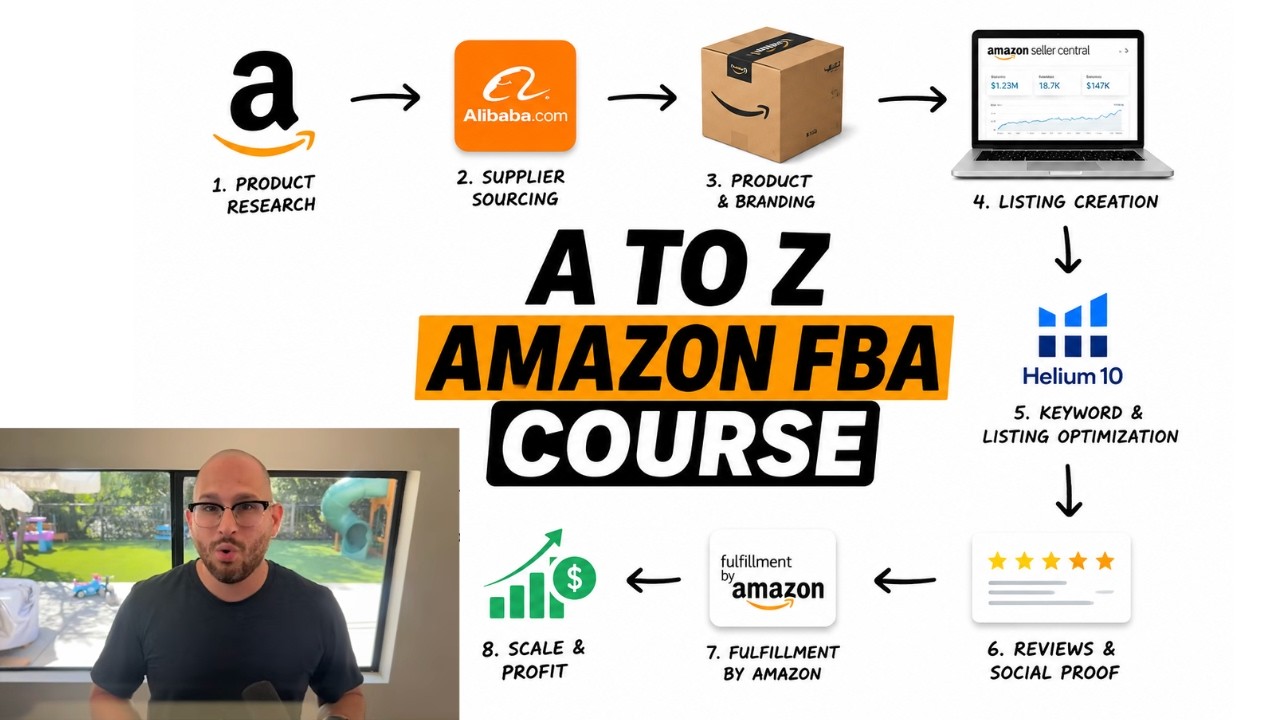
Emanuel Ruiz walks through launching an Amazon FBA private-label business, from product research to scaling. He made $7,000 in a single morning and $4.1M last year with 18-20% net margins. The course covers supplier sourcing on Alibaba, listing optimization, PPC strategy, and requires a $2,500-$10,000 startup budget.
Chapters
If you're watching this video in 2026 or even 2027 and you're interested remotely in Amazon FBA private label, I want you to sit down, take out a notepad, and take as many notes as possible because I'm going to be an open book and I'm going to give you the guidance and the step-by-step tutorial on how to go from complete beginner to Amazon FBA to scaling on Amazon with your own private label product. And I think this year alone, there is a golden opportunity for you to be able to scale. And if you stay to the very end of this video, you're going to know exactly what I'm referring to. But before I even get started, as far as what I'm going to go over, you can see that today so far I have done over $7,000 in sales and we are barely at 11:30 AM. 36 AM Pacific Standard Time. And again, I'm an open book. You can see the exact items I sell. Why? Because I know how Amazon goes ahead and works. I know what information is vital in order to be successful when it comes to Amazon FBA. So I'm happy with showing you my actual products, and hopefully you can go ahead and find some inspiration in that. And if we look over the last 12 months, you can see as I refresh this page, over the last 12 months, I have done over $4.1 million on Amazon FBA. And obviously this is revenue and revenue does not equal profit. But based on that, I operate at an 18 to 20% profit margin. There are different forms of Amazon FBA, all of which you can make money on. There is retail and online arbitrage, wholesale and private label. We will be focusing on private label in this video, but think about retail and online arbitrage, going to a Ross, TJ Maxx, and looking for a product that you can resell on Amazon for more and make that profit in the middle. You can make money. The thing is, it requires your time and patience to try and find these actual products. Wholesale is a step up to that where you're actually physically reaching out to manufacturers like Nike, like Apple, like Hanes, and trying to get discounted items you can resell on Amazon. The problem with this is one, these companies can basically say no to you at any given moment and cutting off your revenue stream. And 2, there's so many people reaching out to these same exact companies. The reason why I focus on private label, and you can see here what private label is, is selling existing products and putting your own brand to it. Is because you actually own the brand and it's a sellable asset once you build it up. And we'll go over a little bit about building it up and trying to sell these actual businesses later on in this. But other benefits is that you'll have a higher profit margin at the very beginning as well, right? Obviously we have to run ads with these actual business models, but when it comes to profit margin, we operate at anywhere between 40, 50, 60% profit margin before running ads. Ads, right? We can customize these actual products based on what we know the customer needs. And you have control over the listing, control over the marketing, and it's less direct competition. And what I mean by less direct— no one is in your buy box. And if you guys don't know what buy box is, if you're doing private label, you don't have to worry about that. But that is a headache for retail arbitrage and wholesale. And more importantly, the reason why private label is undefeated is that it gives you the 3 freedoms that everyone is looking for: financial freedom, location freedom, and most importantly for me, time freedom. Especially me having kids now and wanting to spend as much time with them as possible. This business model gives you that flexibility. But there's obviously a con to this. You can get into retail arbitrage or wholesale for a few hundred to maybe $1,000. With private label, realistically, The bare minimum, if you want to make this work, is $2,500. And again, this is bare minimum, and you might have some cash flow issues in the future once you start reordering. The range that I always tell people to start with private label is $10,000 because you won't feel stretched. You'll be able to reorder, and you'll actually be making decisions based as you as a being a business owner and not relying on this money. Month to month. But there's obviously tools that you're going to need for private label and finding a product on Amazon. So the tools that you need, which is again great, is you need ChatGPT, which I'm sure a lot of you guys already have. And again, if you have Claude or anything like that, that works too. The reason why I still choose ChatGPT over all of them is because of the fact that you're able to generate images the best on ChatGPT right now. I know Nana Banana goes ahead and has anything like that. But right now, as we're speaking in 2026, ChatGPT does a great job as far as all the tools you need when it comes to creating a listing, getting the images done, etc., etc. Then you need a tool, something like a Helium 10 and a Jungle Scout to do initial data. Basically what this means is we're using this to find profitability and making sure that new sellers are currently making money in the category that we'll go over here. And the most important one, and why I put it in bold here, is Smart Scout. Smart Scout is going to give us the top new products that we're trying to find so we can get inspiration when it comes to product research ideas, niching down, and most importantly, what is going to be the average cost per click. In the previous deck that I went ahead and went over, I said that we have high profit margins at the very beginning. The problem is we have to run ads. So that's going to go ahead and kind of dictate to see if this is a product that is going to have longevity as far as scaling is concerned based on the cost per click and the cost per acquiring a customer. So Smart Scout is going to go ahead and be huge. And don't worry, at the bottom of this video itself in the description, I've already reached out to every single one without ChatGPT because, you know, trying to talk to ChatGPT is a problem in itself if you ever tried. But I reached out to Helium 10, Jungle Scout, and Smart Scout, and especially Smart Scout. They're giving me the best deal possible for people that sign up with that link. I think it's either 30 or 40% off by the time you're watching this video. It might change or not, but that's a huge discount that you won't find anywhere else. So make sure to go ahead and click on that link. And lastly, I put Fiverr here, and Fiverr is a maybe now because AI is moving so quickly. I use Fiverr basically for A+ content. And again, if you guys don't know what A+ content means, uh, you'll slowly figure out what A+ content is after this actual video is done. But now how ChatGPT is going, I don't think I need Fiverr anymore, but I go ahead and put it there. Next, we're going to talk about product research and really get into it. The most crucial thing of your Amazon FBA journey is going to be finding the right product to sell. So instead of giving you so many different options as far as product research, I'm going to give you tunnel vision and have you just pick because I've had so many people get analysis paralysis and never get started with Amazon because they can't pick the right product. So I'm gonna give you the top 2. Number 1, niche brainstorming. We're talking about pain points and insecurities because that is going to be your best chances to win. Because the thing is, if you pick a pain point and insecurity and a niche your customer, you will win on Amazon. And let me give you an example. I maybe have insecurity with going ahead and not having hair. So maybe I'm looking on Amazon to try and figure out different things to make my hair grow. But niching down is important. I'm a dad, I'm in my 30s. I don't want to take junk that would jeopardize my health. So instead of finding any product out there under the sun to to try and go ahead and have hair regrowth, I'm trying to look for natural remedies because I'm taking my health as the number one priority. So in this exercise, I want you to be your ideal customer. Look at your shopping history and see what is the biggest pain point and insecurity that caused me to purchase a particular product and write that down. It could be you not being able to sleep, or maybe you're a new mother. That can't sleep, right? Trying to find different ways for you to find a product that helps you sleep, that doesn't affect your breast milk, that doesn't affect your health as well. Think about that, right? And then number 2, and probably the best product research method that no one goes ahead and uses, is top new products on Smart Scout. So hopefully at this point in time you've already signed up for Smart Scout and signed up for the free trial using that link, or sign up for the cheapest plan that's going that's available right now because every tier has access to this one right over now. So once you sign up for Smart Scout, it will take you to this page right over here. Um, and let me kind of zoom out just a little bit so you can see the entire screen itself, uh, right there. So it's gonna look something like this where you're gonna have access to all the different tools on the left-hand side. What I want you to do is just type in top new products in this search field and hit enter. What it will take you on step 1 is identifying viral launches. And basically what this gives you is a whole list of different products that have just launched on Amazon within the last 6 months that are currently killing it. And the thing is, I don't want you to look at this page and go all the way up here and see these people making— you'll see right now estimated revenue right above my head, right there, $1 million every single month. And the reason why I don't want you to focus on this, because these are big brands, right? We're talking about HP. We're talking about Ring. We're talking about Nintendo, Anker, Sonos. We cannot compete with these actual brands because they have unlimited budget, right? But what we, what we can compete with, as you can go ahead and see over my head right now, is not the million-dollar brands, But we can start coming down here and start seeing, okay, what are people in the $80,000 or $90,000 or, you know, $70,000, even $40,000 range that are making it every single month that just launched on Amazon? Because you will go ahead and see on this left-hand side, there's a bunch of different random products. You can see here, double stroller, these different types of tech products here, right? You can see sea moss. There's all these different types of random products that I already went ahead and found based using this. This is a perfect one right here, right? Something for dogs that you're able to go ahead and have them jump on your bed. This is the perfect pain point, insecurity, and niching down that I'm talking about. Owner of this pet, maybe an older dog already that can't jump on the bed anymore, needs something, right? So this is what I'm considering niche products. And I went ahead and found a few of them, right? This one here is a poolside storage basket. Huge, huge niche market, right? Obviously some seasonality to it, and we'll kind of look at it as well. But as you can see, if you downloaded the Jungle Scout app and the Chrome extension right here, they're making $56,000 in revenue every single month. Single month, and they just went ahead and sold 2,000 units in the last month alone. So this is growing, right? Only 300 reviews, and this individual went ahead and launched— you can see here— around 1 or less than 1 year ago, right? In April of this year is when they launched. So in just 2 months they have been— or 3 months in this case— they they have been able to go ahead and make $56,000 in revenue. And again, this is the pain point that I'm referring to, that if you niche down far enough, you don't have to compete with these big brands like an HP, like a Sonos, like a Nintendo, because those people are not looking for these actual products, right? So you can see here, like super niche. This is exactly what I'm going ahead and looking for. And again, some people might think that, oh, it's seasonal. I don't want to go ahead and come out with this actual product. This is just one product, right? You can have a home run product that's in the summer. You can have a home run product in the winter. You can have a home run product in the spring, whatever it might be, right? But don't underestimate niche products. Another one, like I said, niche. This ladder to get up to this one individual pool. Again, you might think, who is buying this actual item? But at a price point of $329, 100 people in the past month bought it. And what I'm talking to about insecurities and pain points, this has a 3.8 stars. You would think that no one is buying this actual product, but it's such a pain point that people are willing to purchase this product even at a 3.8 stars. And this person is making $400,000 every single month. And look, as you look at the buy box here, there's only 17 units left. So what this is telling me here is that they're actually making more money, but they continue to run out of stock. Meaning that if they had enough inventory, this number would be a lot higher as far as what they're making per month. And again, only 27 reviews and launched over the last— you can see here, April 15th. So April, May, June, we're talking about 2 months ago, this individual went ahead and launched and continuously running out of stock, right? So these are 2 basically seasonal products that you can come out with right now that no one else is looking at because it's a seasonal type of product, and you can go ahead and make a killing as well, so long as the margin fits. And we'll go after the margin here, but I want you to write down as many unique products as you find on Smart Scout. And then lastly, not such a unique, uh, or seasonal type of product here You can see this toy storage bookshelf where maybe someone is having a newborn and they don't have a lot of space and they want to be able to go ahead and kind of fixate junk in a corner of a room, right? You can see here this individual makes $32,000 every single month in revenue selling 400 units per month and only 35 reviews. So you can go ahead and see all of this. And this individual went ahead and launched, it looks like maybe, you know, in March. So a little bit more than the previous competitors, but you can see in just as little as 3 to 4 months, this individual is going ahead and making $32,000 in revenue every single month. And as a new seller, this number will basically go up because you're still optimizing. You're still trying to figure out when I don't run out of stock, How much inventory should I order? And for those of you guys that think that Amazon FBA is dead, I literally showed you 3 different new sellers that are currently making a killing. And when you use the Smart Scout tool, you will see so many more. What I would advise you, if you're brand new to selling on Amazon, try and stay away from electronics or heavily electronic items and stay away from supplements because that's a different beast when within itself. Once you have a few products under your belt and you want to explore that route, go ahead and do so, but only after you have experience, because you might need different certifications, return rates might be a little bit higher, you will need to know the Amazon ecosystem. But these 2 things are going to be great for you when it comes to product research. And again, the next thing you just want to verify is new sellers going ahead and making money. So in this case, what we'll do here is that we'll do poolside storage basket because we know one person at least making some money, right? So we'll do in this situation is we'll go to all departments and we'll put it in the search bar, pool storage basket. And from here, you want to use either Helium 10, Jungle Scout, it doesn't matter, whatever one you're using as a Chrome extension, and put in the, the scan search results, and it will go ahead and bring up all the detailed information. What I'm looking for here is is this date first available? Because it will show you all the different types of new sellers that just launched in this actual niche. So you can see there's a few of them that just launched in the last 6 months alone. And you can see based on the monthly revenue, this person is making $100,000, another one making $100,000, another one making $53,000, another one making $214,000. So we just verified that new sellers, not just one, are making a killing for this particular product. And hopefully by this point you have a list of like 10 to 15 different products. New sellers are going ahead and making money. And I want you to check this step right over here. This is why Smart Scout is very, very important because using Smart Scout, you'll make— see, you'll see how expensive it's going to be to advertise on Amazon. It's always on a cost per click basis. So if someone's typing in a keyword, How much is it going to cost me for someone to click on my listing, view my listing, and potentially buy? So in this case, this is why I avoid supplements and like recurring products or even electronics because they get bought multiple times, is that recurring products will be more expensive when it comes to PPC. So cost per click, right? So ideally we want to sell products for a minimum of $17, right? Because At $17, we won't absorb so many Amazon fees and commissions and all these different things. There's a reason why $17, I put this here and you'll find out later on in this actual video. So the cost per click, so PPC is $4 per click. It will be hard to be profitable, right? So we wanna know what is going to be the cost per click and how do we find that? Well, in this situation, I already kind of highlighted here, but we're trying to find the ASIN. You can find the ASIN, whether that's like this product summary page right over here, you can find the ASIN, lower in this actual page right over here where we go to, uh, this section on the actual product detail page where we get the ASIN right there. But what we want to do after that is go back to Smart Scout, right? So instead of you going to this new product section here— and I'll move myself out the way a little bit so you guys can go ahead and view it— is that we want to go to this section right over here where it says products. Okay, so we want to hover over products and click products, and based on that, we're going to input copy and paste that ASIN that we just got. And because this is a brand new product, sometimes they won't appear here, but in this case it does. What we want to do next is click on that actual ASIN that we just went ahead and submitted. After that, hit search terms. And this is going to be a gold mine of information because you're going to see so many different types of keywords. You're going to go ahead and see their search volume. And I'll move myself out the way so you can go ahead and kind of clearly see all of this that I'm viewing here. So as you can see, you can see like their ranking, how often these key terms get searched up. And most importantly, and let me zoom out the way just a little bit here. Most importantly, you want to see that average cost per click. So you can see on the, on the whole right-hand side, estimated PPC bid, $1.35, $1.07, $1.73. The goal here is to get this number as close to $1 as possible. Especially if you're selling an item below $20, right? So in this case, this item is $26, so it hits that threshold. And we see that most of the cost per click here is below $1.35. So we know that we can get into this actual niche and actually start making some money, because the last thing we want is to find a sub-$20 product with a cost per click of $4 or higher, or even like $2.50 and higher, Because it's going to be an uphill battle when it comes to advertising on Amazon. So when you're finding your products, I want you to take two things into consideration: trends and seasonality checks. People avoid seasonality trends like it's the plague, and the truth of the matter is every single product is seasonal. Think about it, right? Toilet paper—you don't think it's seasonal because you buy it every single month, but the high season. As far as when toilet paper companies make the most amount of money is during the holidays, right? Because people are consuming more, so they need more toilet paper. Same thing with like cleaning products, right? Like maybe going ahead and getting Windex or you know Dove or whatever it might be as far as like cleaning products is concerned. You would think that this sells year round. No, spring cleaning is the time that they make their killing. So every single product that you look at. Is seasonal. So that's why I'm saying the trend of when people zig, you want to go ahead and zag, right? And the thing is, people always say too, maybe this is a fad, maybe this is a fidget spinner. For every fidget spinner out there that went ahead and came and died out, there's 100 different products that people thought was gonna be the next fidget spinner and didn't happen. This is why trends may last longer than you actually think. So keep that in mind when you're doing product research and you might think to yourself like this, maybe this is a fad, Maybe this is something that's going to go ahead and die out. I've seen it countless times that people built brands based on actual products that people thought was going to go ahead and die. Right? So keep that in mind. And then the next one is competitor analysis. This is a huge one because everyone always tries to differentiate their product to make the best product in the market. The thing is, we are not trying to reinvent the wheel. As I put here, we just need to make the product 1% better and continue improving on it every step of the way. And this is as simple as looking at your competitors currently right now, seeing what are people complaining about the most and leaving 1-star reviews and saying, okay, is that an easy fix? If it's an easy fix, then fix it. Now you just avoided all the 1-star reviews. If it's not that much of a big deal, It still has a 4.5-star. Just come out with the same exact product because all we want is a proof of concept and you don't want to reinvent the wheel. That is probably the one biggest detriment to every Amazon FBA seller is they try and add way more value that the customer doesn't even want. And it hurts conversion rate as well. So again, analyze bad reviews and see if it can go ahead and be fixed quickly. Next, and probably the most important step as well, how profitable is my actual product? Because you need to find products that fit this criteria. So if you're selling a $20 product, here's how to watch every single type of estimate, right? Because we want all the fees on Amazon, cost of goods sold, everything before we run ads to be no more than 60%. That means that we want a 40% net margin before ads. All right, I'll show you exactly how this kind of looks like before. So let's kind of look at this example here. As we saw earlier, this person making, you know, $56,000 every single month on this niche seasonal product that people will stay away from. What we can go ahead and do here is come down to our Helium 10 Chrome extension, which is already going to go ahead and be here and found here. And instead of going to sales estimator, let's go to revenue calculator. And based on this information alone, we'll know what the fees are on Amazon. The referral fee is going to be $4 based on the price point. You can see that there is a closing item fee of $0.99. Don't worry, you're going to get a professional plan that's going to go down to zero. So you're not wasting a dollar there. And then you see the FBA fulfillment fee is going to be $7.48. We want to go ahead and guesstimate that we can probably sell this item, especially because today is Prime Day and they're offering a Prime Day deal. You can see that they're— I'll show you, the regular price is $31.99. So let's go ahead and kind of make it safe here and make it at $29.99 as far as like our projected sales price. And again, this can be all the way up to $34.99 because we want to be 10% of whatever this person is going ahead and selling right now. But now we know what our estimated fees are going to look like. And all I want you to do is do a basic, basic, basic search on Alibaba. And what I mean by basic search is literally just copy and paste the main keyword that's on your actual product and go to Alibaba and just see what is the average cost. You can see here that I went ahead and started looking it up. The average cost is around $6.52. So we do in this situation is we go back to that actual listing on Amazon. Come down here. We're going to go ahead and, and, uh, let me move myself out the way so you can see it here. As far as the product cost is concerned, once we figure out— let's go back— it was $6.52. So $6.52 for this actual item. Plus, let's go ahead and give or take based on the actual volume here. I always like to cut it in half to try and see this is going to be the cost for shipping into Amazon. So in this situation, we'll round up all the way up to $8 for this actual item, or $8.25 just to be safe on this side. So you can see that based on every single expense on Amazon, we want to make sure that if we divide this net profit by the actual sales price, it's above our 40% target market or net margin per se. So all we got to do is, is All we got to do here is just simply divide $976 divided by our sale price. And we hope this number is above 40%, which it is not. That means that we only have a 32%— or here, let me actually move it out the way right over here. We have a 32.5% net margin before ads. So it might be a problem here. Either we have to go ahead and negotiate even harder and bring our cost of goods down when we start going ahead and reaching out to these manufacturers, or what we do here in the situation is can we raise our price? So if we can raise our price and we think we can go ahead and sell this item for, let's say, $37.99 and keep everything else the same, well, maybe we get to our actual target range. In this situation, 16 $14.56 is our net. Our sale price is $37.99, and we're now at 43.5% net profit margin. So what we do in this situation is that we take a competitor analysis. We start seeing, okay, I know this individual is selling for, in this case, $31.99 at their regular sales price before Prime Day. Can we see other competitors selling for $37.99 and seeing success? As long as you see other people in that price range or within that price range of making money at $37.99, this checks all the boxes. Because now we know based on every single Amazon fee, which is a 15% net selling fee, which is $5.70, based on Amazon picking, packing, and shipping to an actual customer, based on our manufacturing costs, our freight costs, all in worst case scenario, we will have above a 40%, 40% net margin before ads. You guys might be thinking to yourself, why can't I have a 35% net margin? Why do I need to have at least 40%? Isn't 35% great? Well, yeah, 35% is great, assuming that you have no returns, no storage costs, and all of your sales come in organically. The truth of the matter is I've been doing Amazon for more than 8 years now, and 70% of all of my sales still come through ads. So this is why I always say at the very beginning, you're not going to have any organic type of sales. They're all going to come through paid ads, right? So this, this is why you estimate that 20% expense on your product price is going to go straight to ads, right? And then from there, we optimize, we start getting ranking, and then hopefully we get to a point where we don't rely on ads so much, but how everything is going, Amazon is a play-to-pay or pay-to-play system. So we're always going to be running ads. So that's what I'm saying. Worst case scenario, if 100% of our ads come, or 100% of our sales come through ads, we wanna make sure that we're insulated and still have at least a 20% profit margin. Because again, we don't know storage costs. We don't know returns. We don't know refunds. We don't know all these other exterior forces until we actually start selling. So we want to have some buffer. So either raise prices or negotiate even harder when it comes to your supplier. The next step here is I want to breeze through this, not because it's not important, but because you're going to set this up anyway. So at this point in time, just set up a Seller Central account. You want to fall forward and you don't want to have any friction as far as why you're not moving on to the next goal. So right now, off the bat, go set up your Amazon seller account and you're going to have different options. I want you at the very beginning right now, set up for the free option because it's going to cost you $0 to get started. But once you have your items at Amazon, quickly switch over to the professional seller account, which is $40 a month. And the next question I always get is, how do I set up my entity? The truth of the matter is you might not even make any money your first year on Amazon. So if you don't have an LLC, an S corporation, a different corporation set up right now, be a sole proprietor, right? Go ahead and use your Social Security number at the very beginning. And then once you actually start making money, then transition into a corporation. That's only if you don't already have a corporation already ready to go. So again, fall forward. Do not go ahead and, you know, not move forward with this, right? The next one, trademark and brand registry overview. Again, this comes after we have already selected our actual product. This comes after we've already went ahead and, you know, set up our Seller Central account. Now it's time to actually start unlocking the true benefits of getting that conversion rate up. And the first step is actually getting your, your actual brand name trademark registered. So you can go on Fiverr right now. That's why I'm saying Fiverr is one of the tools you go ahead and use and just type in Amazon Brand Registry. And usually what they'll do is they'll charge you $200 to do the fee yourself. You can set up a trademark yourself as well. The thing is that in order for it not to be complex doing it your first time and taking days and making a mistake, I would rather use someone on Fiverr that does this for a living. That will charge me $200 plus United States patent and trademark fees. This will unlock the data that you need long-term. Trust me, whenever you are launching a product, you don't want to launch it based on a generic name. You want to establish a brand name already, and we'll go over a little bit more as far as like how to find the brand name, what to call your actual product, everything here. But just keep this in mind that trade or brand registry is the most important data you will get from Amazon, and you only get access to it if you have a trademark. So we've gone over so much already. We have the product selection, we have the profitability, we have our Amazon account set up, we get an idea as far as what brand registry and why it's important. Now let's actually start looking for legitimate quotes on Alibaba. And Alibaba is probably the only place you're going to need to find a manufacturer for your product. So all we do, go to Alibaba.com. Once you've figured out what product you want to go ahead and sell, all you do is put it on the search bar. And let me make this a little bit smaller so you guys can see the entire page here. But all I did was I searched up the main keyword, which you can see at the very top of the screen says multifunctional storage basket, pool storage basket, whatever it might be, right? The main keyword for this. What you want to do in this situation is you want to click 2 things. You want to click Trade Assurance, and I'll tell you exactly what this means in a second. You want to check out Trade Assurance, and I want you to do Verified Supplier. So Verified Supplier means that they've inputted all the information that Alibaba needs to legitimize that they are a legit seller of these actual products, right? So that's one, Verified Supplier. That's, that's bare minimum. The next one I clicked off was Trade Assurance. What trade assurance is, is like a PayPal, which means if anything goes wrong with your actual product, you can reach out to Alibaba. They're going to see the communication you had with the seller. And if something happened with your product, whether that's not the quality that you, that you talked about, it's not the actual product that you guys discussed on messages, you get to go ahead and report a claim just like you do with PayPal. So it's important. That you're only talking to people that have those 2 things to minimize your actual risk. And even from there, right, we just found one that has both these checkmarks that has that same exact product that we mentioned before from anywhere between $4.90 to $6.52, right? And we just go down the list and try and find other type of suppliers. Again, it doesn't look like there's a lot of them here, but this is why it's hard. We still have to go ahead and try and figure out maybe there's other suppliers that might not be advertising this product, but if they have other products like this one over here, maybe they can make that same product. So all you do is just basically start chatting now, right? And basically just sign up on this situation. And all you're trying to ask for is, hey, I am a brand seller on Amazon that is interested in buying X product. Go ahead and put that, right? I would like to know what is your MOQ, which is the minimum order quantity. And you're going to put out these numbers here. How much is it for 100 units, 500 units, and 1,000 units? At that point in time, you'll get a real quote on what this product actually goes ahead and costs. And while you're at it as well, try and ask to see what is the all-in price, including DDP shipping. What DDP shipping means is that it's delivered duties paid. You do not have to pay for anything else but the final price that they're giving you. So at that point in time, we can go back to that listing, put into the Helium 10 Chrome extension, and see the true landed cost in Amazon. So this is why it's very, very important to put it in that sense. And the goal here is to order 200 units at the 1,000-unit price and negotiate down from there. Right? So again, that's 101 as far as going ahead and asking for a supplier. And if you guys are in the one-on-one with me, I will give you my personal freight forwarder that will give you the best pricing available. If you guys are interested in that, follow me on IG. You guys can learn more on that in the future as well. So after that, once we have all of this type of information, let me go ahead and go back here, is the differentiating strategy, right? So once you've already asked that and If you went on Amazon and saw a bunch of 1-star reviews that have a common issue every single time, simply ask the supplier, can you fix this? Or can you remove this? Or can you add this? Right? Whatever that common trend is as far as why people are leaving 1-star reviews, that is your differentiating factor. Do not reinvent the wheel as we mentioned earlier. And then now you should have every single one of that cost. So you can go back here, go into this section when it comes to FBA costs there, see all the research you've already been doing and input that final price. So now we have concrete. We're no longer guessing. We know what our profitability is going to be like before we even start manufacturing. But before we even start any of this, hopefully you have a list of maybe 3 to 4 different suppliers from Alibaba. And now it is time to actually start getting some samples done. So it's important, right? We have all these different checklists, all our expenses are there. Basically you have your customer avatar, you know exactly who you're targeting. Again, this is niche branding. So even though we're coming out with a generic type of actual product, we're niching down to our actual customer. What we want to do at this situation is start getting samples because everything can sound great and dandy and they're going to give you a good price. You want to order a sample to try and make sure that those 1-star reviews are going to be eliminated. And I'll jump a little bit ahead here, but what you want to go ahead and do is you want to order the number 1 competitor on Amazon. The reason you want to do this is because you want to identify What type of language they're using in their packaging. What type of packaging are they going ahead and using in general? Are they including product insert cards? Like I put here, label design. Are they giving that customer a customer experience and unboxing that you want to do as well? Because you want to compare if the top seller is having this much success, what are they including? What does the packaging look like? And that is a great thing to go ahead and do as well. But even with that, right, Now we want to make sure what the seasonality, what the conversion rate is, what the return rate is going to go ahead and be. Because again, we want to have a list of 5 to 10 different products that all hit these check marks. And we want to be able to decide what is that one product we're going to go ahead and launch. And I'm giving you guys so much freebies. So if you guys appreciate anything I've said this far in this video, all I ask for in return, like this, this actual video, subscribe subscribe to this YouTube channel, cause I'm always going ahead and giving out free game. And this one's going to be game changer. We're going to look at Product Opportunity Explorer. And again, I'm super psyched. Hopefully this video doesn't have a lot of views because you guys can go ahead and take full, full advantage of this. And what Product Opportunity Explorer does, and the reason why I tell you to get an Amazon account right away is that you get access to this. And once you— there's a new version of this. If it's a new version, as far as like your desktop, go ahead and go to, uh, this and type in Product Opportunity Explorer. But if you still have the old school Amazon thing like I do here, all you do here is go to the left-hand side. And let me zoom out here so you guys can go ahead and see it. You will see it down here, uh, this, uh, this section right up here in the top left corner. We go down to Growth and we're gonna go to Product Opportunity Explorer. So what we're gonna do simply is take the main keyword here poolside storage basket, which it looks like right over here, and we're going to copy and paste it right up here. What we're going to do here is we're going to allow Amazon to give us all the different type of data for this one product, and this is golden information that no one is going to give you because no one even knows this exists. This is why it's extremely important 2, only take advice from actual people that have been selling on Amazon. And something to consider here, right? Search growth over the last 180 days is down 21%. But context matters. This is a poolside storage basket, meaning people are probably only ordering this in the summer. So what has happened over the last 180 days? And if you guys are watching this video, we're like around July time in 2026. So the last 180 days hasn't been summer. We are barely entering summer right now, right? So again, take this with a grain of salt. But what else is this going ahead and giving you? Over the last 360 days, we have a 2% return rate. So if you go ahead and find your product and you're seeing a 10% return rate, uh-oh, that's a red flag because now you know that you have to account for a 10% return rate, meaning that 40% no longer is attributed to you. You better find something that has at least a 50% net margin before ads because we have to account for the 10% return rate. So this is already ticking the boxes as it is, right? After that, Amazon's going to give you all the data that you need in this actual product because now we know that our peak season is late June, which is right now. We're in prime season for this actual product, and our off-peak is actually late December with nobody searching this item up, right? And it makes sense. Mostly everybody says that you want to get ready for selling season, which is Christmas time, this and that. Well, this is telling you no one is going to buy your products in December. And the other cool thing about this here is it literally gives you a trend based on search volume. So if you look at this chart here over the last 2 years, it will tell you what is the search volume month by month. So you can see here in June of 2024, 7,000 people searched this up in a single week, right? So this, this week, this week, this week, this week, and you can see the dead season here. So this is highly, highly, highly, highly seasonal, right? Because you can see here that it spikes around June to July and it comes straight down and it gives you both the conversion rate and the search volume, because this is great. You can see here over the last 90 days, it's a 2.89% conversion rate, But over the whole year as a category itself, we're operating around a 6%, I mean, a 6% conversion rate. Why is this important? Well, now we know how many clicks it actually takes to get a sale. So in this situation, over the last 360 days, it takes 100 clicks to get right around 6 sales. And this will base it based on if you have a good listing or not. Because the rule of thumb for me is that you want to be at least double this conversion rate. That means that people are landing on your listing, you're resonating to their pain points, you're resonating to their insecurities, you're solving those things as to why they're even shopping for this in the first place, that they don't need to go to any other listing because they just landed on the perfect product that's going to solve their problem. And that means that you have an A+ listing if you have double the conversion rate of the average. Because again, the average is a C. You want to be well above the average. So now we can kind of reverse engineer everything, right? So if you have double this, let's take it at 10% conversion rate. That means for every 10 clicks, you're going to get 1 sale, right? So if your average cost per click is $1, that means it's going to take us $10 to get 1 sale through advertising. Again, assuming that every single one of our sales Comes through ads. So again, vital, vital, vital information, and I hope you took a lot of notes on this. So after all of that, we have like the conversion rate, what the return rate is, what the search volume and conversion rate might be. So I know I mentioned or hovered over this before: you want to order a competitor product on Amazon. Why? Because you want to identify what they're including in their packaging, what the label design looks like, what the customer experience. Experience is like, because there are some products where you need some sort of labeling. Like for instance, I have a shoe repellent spray that has to have a flammable warning sign. We want to make sure that whatever product we want to come out with, we have the right type of label design that is required. So it's really, really important, right? And we want to also make sure that when we are receiving samples, it's up to par and it's quality. But let's go back to finding the actual supplier, because people overcomplicate things. And this is probably the easiest thing to go ahead and do because Alibaba makes it very, very simple. And we already went on Alibaba, went ahead and checked off verified supplier, checked off trade assurance to make sure that they have like the PayPal version of protection. But what you want to do is you want to ask some key questions. And the key questions I mentioned earlier is like minimum order quantity, how long does it take to manufacture this actual product, etc., like that, right? And I have a script down below that you can literally just copy and paste onto Alibaba whenever you are reaching out to these people. And if you are a part of the one-on-one, that's also included as well. But what are you trying to evaluate? You're not always looking for the cheapest price possible because you have to understand when you reach out to these manufacturers, it's the first time that you're going ahead and communicating with them. You want to see how fast are they actually responding. Are they following up? And are they reasonable in pricing? So let's kind of hover over the first 2 questions. How fast are they responding? And are they following up? Why is this important? Can you imagine you as a new customer trying to purchase products to them with, with its actual manufacturer? If they're taking forever to respond back or not even following up, can you imagine when it's time to reorder or trying to come out with different terms so you can scale your business without feeling cash-strapped. Like, this is, this is why it's important that sometimes the cheapest price is not oftentimes the best type of suppliers. But obviously you don't want to go with the one that's most expensive because then we get into, is this really a manufacturer or a trading company? And again, this is more so advanced level stuff. As long as the price is reasonable and you see other different quotes coming at the same price, that's all you really have to worry about, right? And then Like I mentioned before, you want to make sure to order the sample. This is why we buy the bestseller on Amazon, because we want to actually make sure that we're including everything that we need. That's number one. We want to make sure that the quality is there as well. Are we going to get bad reviews if we start mass producing this actual item? That's why it's important. And then once you've identified the supplier of choice at the very end, so hopefully by this time you have 2 to 5 different suppliers that sound great. You order these samples and you eventually are going to focus on just one of these suppliers. Once you've chosen that, you want to order another sample with all your branding, your packaging, the final design before you start mass producing your item. Very, very important. So finalizing everything here, and we're going to go over the branding and everything like that too, so don't worry too much about that. But finalizing the product differentiators, right? So once you receive these samples, once you receive the Amazon product as well. What is going to be your differentiating factor? And again, I don't want you to think about adding on or bundling. That's the last thing you want to go ahead and do. Once you start bundling frequently bought together items, your conversion rate is actually going to go ahead and shrink. Why? Because a customer is going on Amazon and trying to purchase one thing. If there's a bundle, maybe there's value there, correct? But at the same time, maybe they don't even need those other items. I've had people come to me and say, look, my item is struggling. I don't know what to do to get some traction with sales. And the thing was that the actual next item that they bundled together wasn't really needed. So why would somebody want to go ahead and order that item if they don't really need that product itself? So you differentiating anything can be as simple as you just adding an instruction guide. And I'll give you guys a heads up. Like I have a brand of a weighted vest. The biggest complaint I always get is that I don't have an instruction guide of how to put this actual weighted vest on, and I get messages all the time. So just by simply doing that, my brand and products went from like a 4.5-star to a 4.8-star just by including the instruction guide that literally was free to go ahead and include. So again, do not add any unnecessary cost if you don't— bundling is one of those biggest things. And the last thing you want to do is— this is why ChatGPT or AI is really great— is just do some legal, uh, actual like research, right? So there's oftentimes some products that might have a utility and might have a design type of patents. Usually the manufacturer already knows this and they will tell you straight up, hey, this product might have a patent in the US, so be very cautious about that. I'll tell you this much, this is not legal advice. Go ahead and seek it yourself. There's a huge difference between utility patent and a design patent. If somebody has a utility patent, oftentimes you want to stay away. If there are design patents, there's workarounds with that. Work with your manufacturer, seek legal advice. But I want to bring this up to your attention as well. And then after that, I want you to get into the mindset already. Once you have the branding done, once you have your name done, once everything is kind of complete, start looking at Brand Registry on Fiverr. And you do this by simply just going to fiverr.com, typing in Amazon Brand Registry and hitting the search bar. And once you get there, you'll see so many different people that have completed so many tasks that have great reviews. All you want to do here is make sure you start reaching out to a few people that have this 4.9-star, 5.0-star, because they have dealt with numerous types of United States Patent and Trademark Offices, and they'll be able to get you brand registered for a very, very cheap price. You can see here that some of these are starting as little as $30, $20, $100. So just make sure to go ahead and use this because again, it avoids the headache of you trying to get registered or brand registry on Amazon. And you need this in order to unlock all the best features as far as data, A+ content, adding video to your actual listing, which helps out with conversion rate. And when you are going to production, there's certain things that you want to keep in mind. I always tell students, you don't want to order 1,000, 1,500, 2,000 units at one single time. Why? We want to proof of concept. We want to make sure that we're ordering products that not only one, sell, two, get good reviews, but three, lead to profitability, right? And that's the biggest one because we want to ensure that the products that we're going to do mass productions on, we're talking about 2,000, 3,000, 4,000 units are already profitable. So this is why I always say, try and keep it as far as a minimum order being around 200 to 250 units and your maximum order being 500 units on your first order. The thing is half of these units are going to be to use something like, uh, what is called the Vine Review Program, where we're going to give away 30 of these products to Amazon's handpicked customers that will leave you an initial honest review. Once that is gone, The next maybe 100 units is going to be basically throwing spaghetti at the wall when it comes to finding keywords that you are actually converting on. So you can see the first 100 to 150 units are literally going to be at a loss because we're trying to optimize, figure out different keywords. So then the remaining half of our inventory, we're trying to go to profitability. Is there a roadmap to get to a 20%, 25%, 30% profit margin? Because at that point now we can go ahead and reorder 2,000, 3,000 units at a time. And I have a recent student, a one-on-one student right now that basically only ordered 300 units. And it was a, basically he ran out of stock. Everything was going good. Conversion rate is great, but there was a quality issue. So now, because he only ordered 300, even though he was able to sell through all of it, now this new production run, we know exactly what to go ahead and fix. As opposed to if you went ahead and ordered 2,000, 3,000 units at a time, now we're stuck with inventory that might not be the best quality type of product. So always keep that in mind. And then when it comes to actually starting manufacturing, getting into production, this is basically how it works. You do not pay 100% upfront. Number one, use trade assurance. But from there, you want to do 30% upfront just to start production itself. Itself, right? Once that production is finished, that is when you pay 70% before it ships out of your manufacturer's facility, right? So 30% just to start production. Production will usually last anywhere between 15 to 45 days depending on your actual product, and then after that you pay the remaining 70%. Again, always use trade assurance. And then manufacturer and lead time. What this means is how long is my manufacturer going to take to produce my items and how long do I have to wait until it actually gets into Amazon? Those are 2 different things. Usually typical, like I mentioned before, anywhere between 15 to 45 days. I put 30 days here is typically how long it takes to produce your product by your manufacturer. After that, you're looking at around 45 days to get it shipped from China into the United States and into an Amazon fulfillment center. So you can see it could take anywhere between basically 60 to 75 days from when you start production to when it's actually in Amazon. And during this time, what you want to do is start working on your listing. Go ahead and make sure that we're— we have the best converting type of product, maybe taking product photography of our actual product, maybe sending this to a photographer to send different types of photos that we can start using ChatGPT to create secondary A+ content, bullet points, what, you know, you name it. But we have a lot of time for us to go ahead and work on our actual listing. And the benefit for some of you is you might have light products, meaning maybe something that weighs less than a pound, then air shipping is available. And usually that's very, very quick. So if you're very impatient, what I tell a lot of people is like, look, if you have a 200-unit order, maybe 50 of those units can be air shipped if it's a light product. And because you're going to air ship it, you're going to get Vine Review Program. You're going to go ahead and send this to a photographer if you, if you have one, um, and start getting the listing and creation and listing ready for the remaining inventory to come in. You never want to ship 100% of these products by air because profitability is basically gone at that point. And then branding and product preparation is probably something that people get analysis paralysis about or don't want to deal with. Trust me, in the day of today, it's a lot easier than it seems like. And I want to keep this premise that you can go into production without even having a logo, a brand name, or anything. Because usually even any label that you go ahead and come out with can be done post-production. Like somebody can go ahead and make this bottle and this label doesn't come on until it actually leaves the facility itself. So don't stress out too much about needing every everything to be perfect right now, as long as you just start production. But let's go ahead and start choosing a brand name. How do you do this? I use ChatGPT whenever I do start from scratch, because once you have an established customer avatar, which again, if you don't know what a customer avatar is, use the STP method. I can go on and on as far as what this actually means and how to dive deep into it. Use AI. STP stands for segmentation, targeting, and positioning of the person that is purchasing your product, aka your customer avatar. Again, I think we mentioned earlier hair loss. If someone is going ahead and coming out with a hair loss pill, you want to niche down as far as possible. So a 30-year-old that has a family that doesn't want to take chemicals to mess with, mess with my actual health, I'm looking for something very, very specific As opposed to just generic hair loss. We want to find out who the customer avatar is and who our STP is, because at that point we can just ask ChatGPT, based on all of this information, what should my brand name be that doesn't— isn't already there on the United States Patent and Trademark Office, so I can have a good chance of this trademark actually going ahead and passing through? And when it comes to making your logo and visual identity, Don't do it alone. Use these websites. I'll go ahead and do it below. You can use something like Logo AI that would literally make you a logo based on your customer avatar. You can use Behance to get inspiration as far as like what your identity is going to be like. You can use Fiverr as well. Again, don't spend too much time on this. Branding honestly does not really even matter when it comes to Amazon. As long as your listing looks good, as long as your conversion rate is good, people are not going to remember the last thing, the last brand name that they went ahead and purchased on Amazon itself. And that's why Amazon's such a great thing as well, right? And then when it comes to design, packaging design, I used to, uh, or I still do have like the shoe cleaning kit that had like this customizable bundle. And I said, you know, you know what, I want every customer to have the best customer experience when they unbox my item. The thing is, no one is going to care about your item unless they order yours and a competitor's item at the very same time. And the chances of that happening is literally below 1%. So do— you can go ahead and get all the best packaging in the world. Do not add cost on unnecessary packaging and do whatever your competition is already doing. Chances are if the best seller on Amazon is doing very, very well, that means that they've already optimized the packaging to make sure that they're not overpaying on Amazon fees. Because when it comes to Amazon, if you're just a 0.1 pound above, you go into a different tier and now you're way less profitable than your competition. And that means that you don't have enough money to spend on ads like they do. So always be conscious of that, that don't try and improve everything, especially with sizing and packaging. Try and just improve the things that you go ahead and, and know that you can move the needle without adding the extra cost. So hopefully at this point in time you're in manufacturing, it's time to start creating your listing, which is a fun part because again, people overcomplicate every section, but this is probably one of the easier ones to do. So let's start creating the actual listing because all we have to do is go to our competitor listing. In this case, we're gonna go over this one, and you can find it in different ways here, but I like to go all the way down here, go to this section where it says the bestseller rank, and I think my head's in the way. Yes, it is. So bestseller ranking, and we're looking for the category. We're not looking that it's patio, lawn, and garden, but we are looking for that they're number 3 in pool, spa, and replacement parts. So we're gonna do there is copy and paste that. We're gonna go to our Seller Central account and go to the top left corner, and we're gonna do here is we're gonna select catalog and hit add product. And from there, all we're gonna do here is start a blank form, and I'll make myself just a little bit little here so you can see the entire thing and maybe minimize it a little bit. So we're gonna hit this blank form right over there. We're gonna start brand new to this, and we're just basically gonna copy and paste what these individuals have. We're gonna go ahead and fix this later. We just want to make sure that we're setting up this listing right the first time. So here we're gonna do this. They're gonna search it up. It says that's gonna be item containers and No, it is not gonna be item containers because we already know we're gonna go down here and we're gonna hit pool and spa replacements. This is why it's important to copy and paste that. We're gonna select other, and all we're gonna do is hit paste right there, and we're gonna search it up. And there it is, pool and spa replacements. We're gonna go ahead and select that one right there. And now all we're gonna do is set up our entire listing from there. So again, this is why it's important have Brand Registry already, because all you're going to do in the brand name is just hit this dropdown menu and your brand is already going to be there. And now it is time to get this UPC code that Amazon is going ahead and asking for. And that's very, very simple. All we're going to do is go on GS1 barcodes and don't worry, I'm going to have every single link down here. So you guys know step by step where to go, but you can have a choice between doing several UPC codes and just getting one UPC code. I get several because I'm launching different products every single time. But maybe if you're skeptical the very first time, only get one. After that, then you're going to go into a login setting into GS1. And you can see here, I have a bunch of different types of barcodes. You obviously don't need that many. All you're going to do once you've already paid for one, you're going to add a new product right up here. From there, you're just going to put simple descriptions down. So in this case, just go to that one Amazon listing, put the 2 sets with cup holders. From there, go back to GS1, put that there, put your brand name, and you're going to save and continue. And we're going to just continue saving until we're able to set this in use. And basically what that means here, I'm going to go ahead and cancel all the changes, is that you want to get this UPC code. And let me move myself out the way again so you guys can go ahead and see the full page here. But based on this information, you're going to be able to get this UPC code right down here. And it might take around 15 minutes for it to sync up with Amazon because Amazon goes ahead and fetches this data straight to GS1. But once you have it in use, you're able to download this PNG file and send it straight to your supplier so they know to put this on the actual box, your barcode. And then you can just copy and paste this listing or this UPC code onto this product ID right there. And then from there, you're able to make the bullet points, the title, everything else. Here's some pieces of advice. You want to take the top 3 sellers in your actual niche. How you do that is basically go all the way down here as well. We're going to go to paw and spool parts, and we're going to see the top sellers in this actual niche. So let's say we're selling this exact item right over here. We're just going to to right-click it, open on a different tab, right-click it, open on a different tab. We're going to try and look for at least 2 more here. And what we're going to do is that we're literally just going to go ahead and put this into ChatGPT, right? So just leave a note, put all the titles here, here, here, and here, and copy paste every single one of them and say, chat, I'm going ahead and creating a product that is going to compete with the following type of items. Based on this, what should my title be based on Amazon's A9 algorithm? So A9 algorithm is just the newest algorithm that Amazon goes ahead and uses. And we're going to do this for the title, for the bullet points, and any other description, because ChatGPT is going to give us the best type of title to go ahead and put based on the newest type of automation that Amazon currently has, or algorithm that Amazon currently has. And based on going ahead and doing this, we can either do this with ChatGPT itself and ask them for every single module for A+ content, but try and see if you see a different trend when it comes to like these secondary images. But for right now, anything that matters is SEO-focused, right? So that's how I put it right here. Your bullet points, your title, everything else, we want to go ahead and just be able to be optimized based on search engine optimization with Amazon. And Amazon is going towards more Alexa and AI shopping. It hasn't happened as of yet, but we want to make sure that we're basically emulating the best type of sellers currently right now. And I put here that your biggest advantage is that you are a US seller. Most of these competitors that you're going after are all going to be Chinese sellers that are going to get their products for a very, very cheaper price than you. The difference is that you actually know the market. You actually know American culture. Right? I see it all the time that sellers from foreign countries are like, I have no idea about Thanksgiving or like what it means to you. I have no idea what Fourth of July means to you guys, and that is your competitive edge as being an American. So go ahead and kind of build that out. Your main image on Amazon is going to be the most important item out of everything because that literally dictates if someone's going to click on your listing. This is why I put that your main image is the most important. Important real estate on Amazon. When you're shopping for anything on Amazon, in this case, we'll go ahead and put in the 2-set pools that kind of mentioned here. The number one thing that people look at is the main image. Number 2 is the price. Number 3 is the reviews, but it is weighted a lot on the actual main image. This is why it's important that sometimes it might be better to include certain things on your actual listing itself, like you'd see on the one above here, or trying to A/B test nothing on the above, right? So this is why you don't necessarily want to reinvent the wheel, especially as a new seller on Amazon. You just want the proof of concept that what other people are doing is getting them sales. Once you become one of the top sellers on Amazon, that is when you can start experimenting with different types of main images. It's highly, highly, highly important that you don't try and go against the grain, especially with your main image. So always keep that in mind. When regarding your secondary images, that means that the 2nd, 3rd, 4th, 5th photo, what you want to do is you want to spot trends, right? So I put here on the secondary images, I'll go ahead and kind of put myself back on, on there, is stop giving benefits on your secondary images. What I see a lot is people always talk about, Oh wow, this water bottle's water is from this mountain. Why do I care from what mountain it's actually from? How is it going to make me feel afterwards? I'm looking for a certain specific water. Let's say this one is sparkling water. How carbonated is it? Because I care about carbonation in my actual water. So talk about how mine is way more carbonated than my competitors, if that's actually my selling angle, right? So I always talk about— don't necessarily talk about the benefits of your actual product, talk about why they should even buy your product in the first place. How are they going to feel after they purchase your product? So that's important, right? So show the pain point and how you will fix that pain point. Show the end customer how they will feel after they use the product. And I hate giving examples or case studies as far as like, look at my products, or look at this brand, or do this and that. It's literally category by category basis. And what you want to do, as I mentioned before, I have these examples of these listings that are currently killing it on Amazon in this one particular product. Are you spotting trends? What are they all including in their secondary imaging? In this situation, it's sizing, right? In this situation, it's sizing again. In this situation here, it's not sizing, right? So this one's not sizing, but the third image is sizing. And then this one right here, same thing, maybe sizing. You can see in the very, very top corner right there. So maybe they've already done the A/B testing that they get a lot of returns based on the sizing not being right. So that might be a pain point as to why they're going ahead and doing that as a second image. Again, you don't want to go against the grain. Your biggest competitive advantage here is going to be you getting traffic. This is why we're using Amazon ads, and this is why the margin is the most important thing, because as long as someone lands on your listing and you have a high conversion rate, that's all we need because that customer is not going to go ahead and shop around. As long as you're fixing the pain point that they currently have right now and you're showing how you're fixing that pain point, they're not going to go on a different listing because they already saw your main image, they already saw your price, and they already saw your reviews. And that's all you need to win on Amazon. And then another thing that people bring up is like, should I go ahead and get a video done? Once you have sales, creators will start making content for you. This is why when you go on a listing, and I'll go ahead and kind of use this example here, you will start already seeing different types of creators already making videos for you. And at this point in time, you can either use their videos and start kind of running ads from there, or now you have enough money so you can actually start investing into creating different images. So once you make money, invest in videos. It's really not that deep. And then we already talked about that the UPC codes— don't cheap out, go ahead and use that. And then setting your pricing strategy— set the highest price you think you will ever sell your items on, especially in the very beginning, right? So again, I'll tell you why in a second, but you want to go ahead and do this. Oh, if you think that in the future you're going to be able to sell your price— I mean, your product at $54.99, place it at $54.99, even though that won't be your launch price. Maybe $39.99 is going to be your launch price. You want to use $54.99. I'll tell you in a second. Once you have everything complete, just go ahead and finalize that listing and make it go live. We want to see if Amazon requiring any documentation. So while we are in production, we can ask the supplier, hey, look, Amazon's asking for these documentations that I need to submit. Let's go ahead and see if you can get that for me before manufacturing is finished. I would rather go ahead and see Amazon flagging my certain things now as opposed to when it actually lands into Amazon. So the next thing you want to go ahead and do is start shipping these items into Amazon. And how you do this is very, very simple, right? So you go back to the main page on Amazon and let me kind of zoom out of this so you guys can see the entire screen. On this left-hand side, we go to this top left corner, we go to inventory, and we go to shipments. And you can see I've sent so many different items into Amazon. What we want to do is go to this upper left-hand corner, and we're gonna go to send to Amazon. Okay, from there, once your listing is live and complete, you're gonna be— you see all of this, yours is gonna be completely brand new, but you're gonna see your product here. What you want to do is you want to edit this actual section. So you see where I'm hovering right above my head right here? We want to hit this edit button and we're going to ask our supplier, hey, based on the, the end manufacturing date, you're going to put this into a carton box. What is that carton box? How many are going to be in there and what's going to be the size and the weight of that carton box? Right. So you can see here that for this particular item that I currently have, it's case packed. There's 80 of these 1 units inside of this actual master carton box. And this master carton box is 17 by 14 by 16, and it weighs a total of 32 pounds. Once we have this information, we can go ahead and hit confirm and continue. And we're going to tell Amazon we're shipping a total of 320 of these units. You can go ahead and see there once everything is kind of, you know, solidified, ready to go. And from there, Amazon's going to give us the different type of fulfillment centers that these items are going to go to. If you've already asked your supplier to ship these items out, make sure they are DDP shipping. And I go over it right over here as far as like making sure that you have DDP shipping available. Um, and I, I, it's all the way down here, right here. Um, but make sure it's DDP shipping. If you are in the one-on-one, I'm already going to give you my freight forwarder and he'll send you a video, especially as far as like what you need to give to your supplier and what they need in order to go ahead and stick to that outside box. So it's very, very important that you do this step and you know exactly where these items are going into, right? So let's kind of already jump into this. So you know exactly how to send these items into Amazon. So let's kind of jump back into this Excel sheet because once your production is finished, you want to be able to inspect your actual product, right? So you can bypass this step because you have trade assurance. That's what I do. But there's a lot of students that say they want to hire an inspection agency to be able to inspect their products. Just keep in mind that even if they go ahead and see your products visually, when, when the actual customer uses this product, might be a completely different type of inspection that you truly, really needed. So sometimes I feel like inspections are a waste of time, but use that money as you will, right? So you can find inspection companies on Alibaba. And again, if something does go wrong, I always use Trade Assurance. We've already went over this whole UPC packaging. We went over the step-by-step. But let's go into— and if you're using my freight forwarder and the one-on-ones, you already have access to them as well. But let's go over like launching your actual product, because this is where I'm telling you that pricing your products at the very high point, let's say $54.99, is the way to go. Because initially, when you start getting your first organic sales, they're going to come through this program called Vine Review Program. And the Vine Review Program looks like this. You're going to go here, you're going to go to advertising, and you're going to go to this thing called Vine. And here you're able to enroll your products to get their initial reviews. You can see here that I use them all the time as far as like me giving 30 or me giving 20 away. And I'm able to get these reviews basically not for free, but it's the hardest part of Amazon FBA is actually getting reviews. So what you do here is that you put your ASIN at the very top and you begin enrollment and you want to be able to give away anywhere between 20 to 30 units to start getting that initial review. But the reason why you want to price at the very highest price point is because now that is your reference price. So when we do launch, maybe in 15 or, you know, a few days after people start leaving reviews, now we can drop our price to $39.99 and we'll get a strikethrough price. What a strikethrough price looks like is something like this, where on the listing itself it shows that my list price is actually, uh, $44.99, but I'm having a technical sale. In this case, I am having a sale because it's Prime Day, but it will strike this price out and it'll actually show that you're a discounted price because so many people purchased at your highest price point. Why is this important? Conversion rate goes up here. So you want to make sure to take advantage of any little advantage that you want to go ahead and have. And that's the biggest one right now because people buying or going ahead and claiming your products on Vine actually count as a sale. So it's very, very important. Price it very high. And when we actually launch with PPC, That is when we'll cut the price because now we'll have a strikethrough price on our actual product. This very next step when it comes to Amazon PPC to drive traffic is probably the most important part of you launching, you doing Amazon FBA, you scaling. And if I went over this, this would literally be a 5 to 10 hour video. Lucky for you, I have probably the most extensive PPC videos on YouTube right now. So I'm going to go ahead and leave a few of them right up there on that right-hand corner, as far as you launching, you scaling, because the truth of the matter is that if you can't learn Amazon PPC, you're either going to pay an arm and a leg for an agency to do this for you, or you're going to spend so much money on ads that don't convert that you might as well not even start Amazon FBA. So again, it's very, very intensive what Amazon PPC can go ahead and do because there's so many levers. You can go ahead and pull. But I'm gonna give you the basics here, and whenever you're doing research, this is exactly what you do. What we're gonna do here is we're gonna set up an Amazon PPC campaign, and there's different forms. There's auto campaigns and those manual campaigns. I'm gonna go ahead and dumb this down as best as I can. If you do an auto campaign, you're allowing Amazon to analyze your entire listing, your bullet points, your secondary images, your A+ A+ content, your actual reviews, and Amazon's going to go ahead and conclude this is what this item is. The best thing about that is that Amazon's going to find keywords that you wouldn't even think that customers are searching up. And there's split up in different types of ad or auto campaigns. You can go ahead and do close match, loose match, substitutes, complements. Again, it sounds very, very confusing. What you want to do is only turn on close match and only turn on loose match. I'm going to go over it in this video because I think it's important for you guys to know how to set that up. This is one of my other brands, Fade Guys. So again, if you guys saw the old school interface, this is kind of what the new school looks like and probably what you're dealing with right now. All you got to do is come up here, go to marketing and go to advertising or ad console in this situation. From here, it's going to take you to this campaign central and how you create an ad campaign is strictly going to this Create Campaign tab that you see right over here. And from there, you don't want to look at anything else when you're first launching instead of Sponsored Products. This is where you're going to go ahead and live as an Amazon seller, especially at the very, very beginning. Don't even think about doing Sponsored Brands, Sponsored Display, none of that. Live in Create Campaign. 80% of your budget when you start scaling is going to go through Sponsored Products anyway. So what you want to do is you want to name this, um, something that you'll remember. In this case, I'm gonna do close match, right? And you want to just copy and paste this auto close match. And from here, you're going to pick the product that you currently have. And this is where the automatic and the manual kind of look like. From automatic campaign, this is the default standard bid. What you want to do is you want to click set bids by targeting groups, and you'll see there's the close match, the loose match, the substitutes, the compliments that I'm going ahead and referring to. What you want to do in this situation, since this is an auto close match, is you want to unclick loose match, you want to unclick substitutes, and when you want to unclick complements, and you want to set your bid to the suggested bid that Amazon is going to go ahead and tell you to do. From there, all we're going to do is come down here, we're going to change from dynamic up and down bid to dynamic bid down only. What this means is I'm telling Amazon that if you think I can get a sale, go find me keywords that are going to cost me $0.83 or lower per click, right? What up and down bid does is it's telling Amazon, if you think I can get a click at double this range, go ahead and do that, right? So in this case, it would go all the way up to $1.60 cost per click, which again, I don't want to pay that much amount of money. And I don't want to go ahead and deal with that. So I'm going to tell Amazon down only. These are bid adjustments. I do not want you to play with bid adjustments right now. If you guys do want to play around with it, you guys can go ahead and put like 30 here, 15 here. What this is telling Amazon is, hey, if someone types a certain keyword in and I show up at the very top of the page, I'm willing to spend 30% more than my bid, right? So 30% more of this $0.83 that I have up here. And if I'm in the— if I'm in the rest of search, meaning somewhere in the first page or maybe in the second page, I'm willing to spend up to 15% more for the $0.83 bid. And this remainder one is product pages. That means somebody typed it in, clicked on different product competitors, and then they saw my product in their actual listing. Right. So hopefully I didn't confuse you that much. But here, go to and just copy and paste that and put it to close match. And you just launch this actual campaign right over there. Again, you're going to create one close match and then you're going to come back here and you're going to create one loose match. Same kind of concept there, right? So that is the auto campaign. Let's go to manual campaigns. And I always put here that there's going to be certain keywords that you think you're going to go ahead and convert on. In this situation, this is a fade guide. So it's a self haircut guide for men that want to go ahead and do their own fades, right? So maybe I want to go ahead and think that I'll convert for the keyword fade guide, right? So I'll put broad fade guide. And the reason why I say you think is that you really don't know if you're going to convert for these actual keywords. So what you do here is you keep everything the same. And instead of auto campaign, you want to do manual campaign. And again, don't forget to copy and paste this one up top. And here they're going to give you different options. Do you want to run a broad match, a phrase match, an exact match campaign? What this means is that if I just click broad match. Anything that Amazon thinks has to do with the word fade guide— and again, unclick this one, um, you, you don't want to give Amazon too much power here— but what broad match means is that what, what fade guide— if I add fade guide as one of my keywords here, anything related to fade guide, Amazon is going to go ahead and try and look for. So if somebody types in fade guide for men or guide for fades men, I will still show up there because it has to do with my root keyword fade guide. What phrase match means is that it doesn't matter, um, what keywords people are searching up, but it has to have the phrase fade guide. So it could be fade guide for guys, fade guide for toddlers, fade guide for kids, right? As long as fade guide is still in the actual, you know, keyword that somebody is typing in, Amazon will show me. It's very— the biggest difference is fade guide has to be together in phrase Fade guide can be any combination when it comes to broad. And then exact match is kind of like what it means, right? It has to exactly be the word fade guide that I'm bidding for. The reason why I like to use broad match is because I think I can convert for that keyword, but there might be other keywords that I'm not even thinking about right now that will convert. So again, I only run single keyword campaigns, and I'll go ahead and prove it to you guys. So in this case, uh, kind of same concept. Bid down only, 30, 15. And instead of this, you're going to go ahead and copy and paste that. Um, and then you're going to launch this actual campaign. But what I mean by single keyword campaign is we're going to leave this page and I'll show you. Um, let's go back to the campaign central. Every single campaign that I go ahead and make, you'll see by the title, auto loose match, phrase match fade guide, broad haircut, um, broad fade, auto sub. Exact figure. You can see here, right? These are the keywords that I'm going ahead and targeting each one of these. The reason why I only do single keyword campaigns, once you become advanced in Amazon FBA or PPC in general, you want to dive into, let's say this one here, or let me see here. Let me zoom out a little bit here. So you guys can go ahead and see it. What you want to do here is you want to go to like this campaign here. And once you start being a little bit more advanced, you go to these bid adjustments. And you start seeing, okay, and this, this data is telling me 3 different things. This is the data for top of search. This is the data for rest of search. And this is the data for product pages. As you can see, I'm getting 15 clicks on product pages and I'm getting no sales. Right. And I'm getting 238 clicks here. I got 9 sales, but I'm not profitable at this ACOS level. And again, terminology, I don't want to confuse you guys, but basically you can start manipulating your bid. So now you can lower your bid and increase these bid modifiers. So in this case, maybe I put a $0.20 bid and I'm upping this bid modifier because I only want to be seen for top of search when it comes to these loose match campaigns. This is why it's very, very advanced and I can be here for hours on end trying to teach this stuff. But again, I already taught you the basics. Set up those auto campaigns and set up those single keyword broad match campaigns. It might be your top 3 that you think you're going to go ahead and convert for, but we don't know that yet. Once you have this thing running for a few weeks and you have data, this is why you do broad match campaigns and auto campaigns as well. You're going to go to ad groups. You're going to go to auto loose match. And from here, the most important segment here is going to be these search terms, because again, you're telling Amazon to be as broad as possible. So they're going to go after all these different types of keywords you didn't even think people were even typing in. You can see there's 447 clicks from all of these random keywords. What this is called is harvesting. I'm trying to see the keywords that I'm actually converting on. In this situation, you can see self haircut for men got me 7 clicks and 3 sales this past week. Week. What this means now, I didn't think self haircut will actually convert for me, but now I can create my own single keyword campaign for this particular keyword. And I know that there's some hair— there's some keywords here like haircut, barber supplies, stencil for cutting hair that I'm getting clicks, but I'm not converting on. So if these are keywords that no one will ever purchase, like stencil for cutting hair, like I'm I'm not a stencil for cutting hair. I'm like a fade guide, right? What I'll do here is I will copy this keyword. I'll go to negative targeting and you can see I've already added a few of them here. I'll go to add negative targeting. I'll add this keyword. And now Amazon will never show me for that keyword for this particular campaign. Again, there's so many different things that you can go ahead and do with Amazon PPC. That I'm barely even scratching the surface. But again, I do not want to confuse you guys. So check out that next video. And if you guys want more training like this, like I, like I mentioned before, the one-on-one is strictly it. We have a dedicated section just for PPC alone. So you can become basically a newbie when it comes to Amazon PPC to be an expert going ahead and scaling $500,000 per month brands. So now that we're driving traffic, to our listing page with Amazon PPC, how do we move the needle the hardest? And that is going to be by trying to do different things like adding a coupon or a discount to our products, because this will increase click-through rate. And if we increase click-through rate, we have a better chance of increasing conversion rate, which is actually somebody purchasing our product. So how does this actually look like? Well, one of my products you can see here, I have a 5% off Coupon. So what this means is that out of all the different products that are available, and my head was in the way in that one right here, but you can see the coupon price on it. What this basically means is that if I'm compared to somebody else, Amazon is going to show this product has a 5% off coupon code. Is it going to move the needle? Maybe, but not as much as you think. But anything helps, especially when you're trying to collect data. So the way that you create this actual coupon is you go to this left-hand corner, you go to advertising, you go to coupons. From there, you're going to go to this upper right-hand corner where it says create promotions, and you might not see it there, but let me kind of condense this just a little bit further. There it is. You can see create coupons, create a coupon right over there, and just do a 5% off code. I usually don't like to do any more than this because it's not going to make a bigger jump, and I would rather offer a less of a discount anyway. That's, that's coupon. But I want to leave you with something that people don't necessarily use, even if they're an experienced seller, and that's Amazon's data. The whole reason why we're going ahead and doing brand registry and trying to unlock is to actually get Amazon's data. What do I mean by Amazon's data? Well, there's this thing called brand registry. And if you go to the upper left-hand corner right over here and you go down to brands, there is this thing called brand analytics. And this is why it's very, very complicated because it's hard to even get here. What you want to do is you want to go to the search analytics and hit search query performance right up there. And what this is going to give you is loads of data when it comes to Amazon. And you will only have week-to-week data when you're first beginning, but that is okay because that is enough to see what is going on in your business. And I'm just going to go ahead and not try and make this complicated whatsoever. But these are the keywords that Amazon thinks you are highly relevant for. And this is what is called a funnel. And there's a funnel for impressions, clicks, add to carts, and purchases. Let's take into account running vest for men in this situation. Let's look through the funnel. We can see that out of this week, which is June, right up there, June 14th to June 20th, there was a total of 238,000 impressions that were available for this one keyword. That means somebody typed in running vest for men on Amazon, and there was 238 different products that were available to be seen. Out of those 238 products, I was seen 12,000 of those times. So that means I was able to garner 5.42% of all the impressions on Amazon. This is why it's important that you don't try and go after every keyword. You try to go after the keywords that you're actually converting on. And again, this is just a sneak peek as far as being in the one-on-one coaching thing, but this is where most of our coaches live. So this is why it's very, very important that you want to live here as well. I'm not going to overcomplicate things because it can get very, very complex here, but this is where you should be living if you're trying to scale your actual business. And I'd rather go ahead and show you this information. The next one here is going to be the reports. And the reason why I even bring this up in the first place is because there's some people that always tell me my sales are down this week, or like my sales is down the last 3 days. All you have to do here, especially because you guys are brand new sellers and you guys are probably launching only 1 or 2 items, is see, am I getting the sessions? And if I'm getting the sessions, what is my conversion rate? If my conversion rate is tanking, you might be going after a keyword that's just not converting. Or maybe they're all coming from rest of search or product pages, and they're not coming from top of search. So your actual conversion rate is actually suffering. So what order item session percentage means is just the conversion rate, right? So if you see that over the last 3 days you had 0 sales, how many sessions were you actually getting? Because chances are you're probably only getting a few tens or 100 sessions. With that, you might not be able to have a high enough conversion rate for you to even get So this is why it's great to be able to do this day by day, especially if you have one or two different products. But again, this whole thing wasn't here to confuse you guys at all. I was trying to go ahead and make it as simple to understand as possible. Inside a one-on-one, we will go way more granular at every step of the way. So if you guys are interested, with working with me, I'm always going to give out this free content on YouTube regardless, just because I'm barely scratching the surface here. But if you guys appreciate this free content, you can only imagine what we go over with one-to-one type of students. So if you guys are interested, I'll have a link of detail as far as what you need to go ahead and do below, whether that's being on the website, getting on a call with me, or going ahead and just following me on IG and kind of me DMing you back and forth from there. But if you guys appreciate anything I went over in this actual video, all I ask for, if you're not going to book a call with me, if you're not going to join the one-on-one, simply subscribe to this YouTube channel because I'm always going to go out, give out free game just like this, and you don't want to miss it. And consider liking this video because there's so much pie to eat in the Amazon FBA space. We went over it in the very beginning of this video. There's not a lot of searches going on for private label, and there's enough Of a flood of buyers on Amazon FBA. Please ask my wife about that because we get an Amazon package at least 3 times a day. So again, like, subscribe, and I really hope you guys enjoyed this deep dive from going from A to launching on Amazon FBA.









