AI Policy Clash: Anthropic and the U.S. Government | DoW Emil Michael
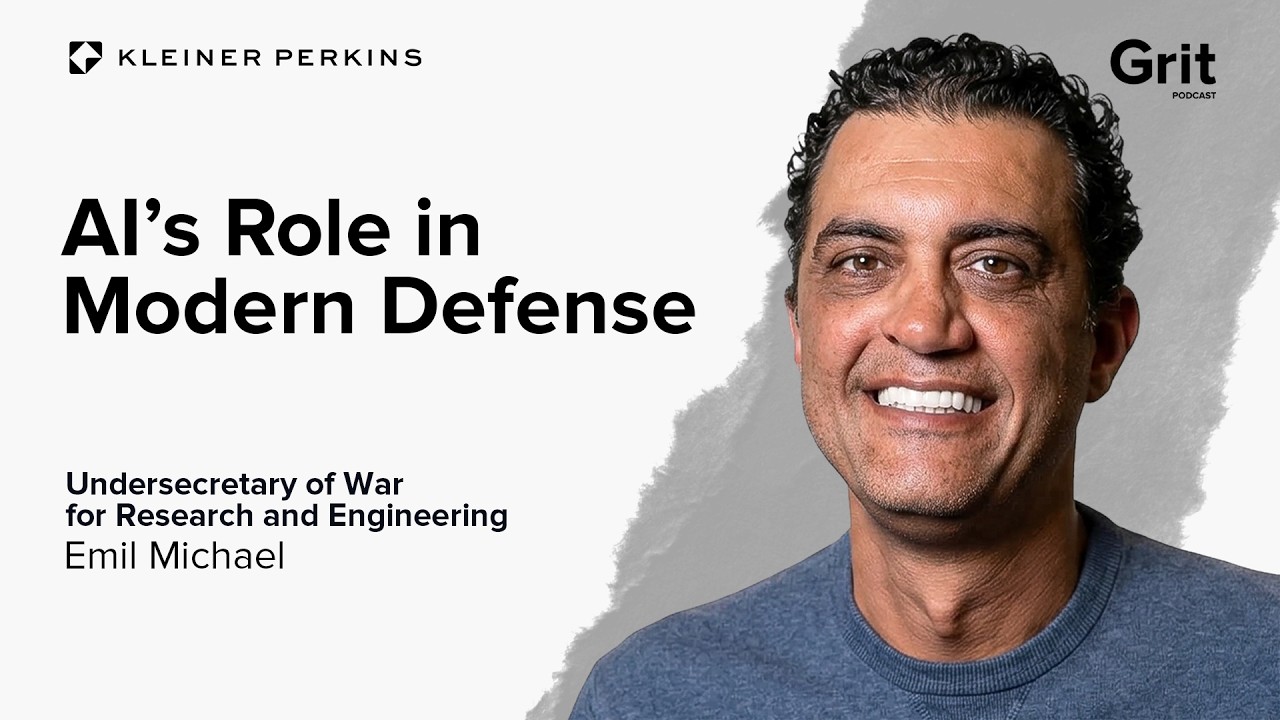
Emil Michael, a former Uber executive now at the U.S. Department of War, warns that China could steal Anthropic's AI models through distillation and use them militarily while the U.S. government stays bound by the company's usage policies. He's embedding AI across 3 million defense workers to boost productivity and warfighting capabilities.
Chapters
I haven't seen a technology that has the potential to disrupt so many other industries in my lifetime. Imagine that some Chinese tech companies are stealing Anthropic tech effectively by doing distillation. Then the Chinese government can use the effective capabilities of the Anthropic model against the United States. But I would be using a lesser version of Anthropic bound by their policies. So I'd be one arm tied behind my back against An Anthropic model that's fully capable by an adversary.
Welcome to Grit. I'm Juvin, partner at Kleiner Perkins, a show where we go beyond the highlight reel and explore the personal and professional challenges of building history-making companies. Are you going to the— there's a shindig tonight at the White House, right?
After the State of the Union, you mean?
Oh, oh, oh, there's a State of the Union and then there's a little— there's a party after. Are you going to the State of the Union?
Uh, no, that's usually, you know, those seats are prized, right? Because the president calls out people, you know, his invited guests, and, and Congress takes up the, the gallery, the audience. So, um, I'm not planning to go, I guess.
What I really actually wanted to know is, are you going to meet the USA hockey team? That's the only thing. That's the only thing I really wanted to ask.
You just ask. I wish we might see— maybe we'll see them around tonight. Those guys look like they have fun.
So if they're around town, tell me if you meet any of them that still have a voice after the last 72 hours of what they've just gone through.
I know they get— hopefully they have it. They're not stuck on their social media looking at all the haters and just celebrating.
Do you get haters these days? More than you used to?
Much less than I used to. Ironically enough, I would say that being at Uber during the 2016, '17 timeframe when all these sort of social happenings were going down and there was sort of kind of like now there's a little bit of a moment of backlash against AI companies. Back then there was a backlash against some of these mobile app companies, whether it was Airbnb or Uber, and the press was super negative. But remember also then the press was less fractured. So there was just like a lot of negativity. Now there's good and bad. There's different elements of the press that support what the administration's doing, some that don't. So you kind of get more of a balance, as odd as that sounds.
I can't remember when all of the Uber What, what size was Uber when you joined?
I mean, we were 100 people.
Okay. Small, small still.
Yeah. I left when we were about 20,000. So how many cities? I mean, we were probably in 500 or 600 cities by the time I left. We were only in 1 or 2 when I'd started.
And at that point, were you still in the media, at least portrayed as the good guys?
Yeah, we were the good guys in 2012, '13, '14, '15. Bad guys in '16, the worst. There's a, there's, there was an article I can't, I always remember, my wife reminds me of it, which was like, Emil Michael and Travis Kalanick are literally the worst. It was like Puck News or something like that. Some, you know, some rag. And that was sort of the, the bottom was '17.
Can you refresh me? Is the real reason why, because you all went from David to Goliath or whatever? Like, is the real reason why you went from underdog to, you know, the incumbent and therefore everybody just turned on you?
There was a couple of factors. Um, I would say that there was some of that underdog to Goliath, which you see some of the AI companies sort of experiencing now, which then everyone sort of, you know, everyone always likes the revolutionary, not the incumbent, so to speak. So you become the incumbent. There's some, some natural sort of antibodies that develop. But also 2017, being in San Francisco when President Trump was elected was like a moment for that city where it was like convulsing in just a politically odd way. And I'll never forget, we were invited to a business council, like Uber execs, Travis and I, and Tim Cook was there. This was like a broad You know, who are the important companies? And we got invited and some set of employees kind of went nuts. They started chaining themselves to our front doors and protest, internal protests, right? Internal. And then that led to a, I don't know if you remember this Delete Uber campaign because there was some miscommunication about like, we remember surge pricing from Uber. We used to have surge pricing. People hated it.
If it's raining, the cost goes up.
Right. Yeah. There's less car. You want more cars when it rains. To get more cars out there, you have to raise the price so drivers make more money. Sort of a market-driven approach, but people still don't like it. And, uh, there was some protest about asylum seekers or something in the first months of the, of the presidency. And we said, okay, we're going to stay out of this. We're going to eliminate, we're not going to have surge pricing to JFK during this protest because the protest was happening there. And people thought— some taxi driver thought we were trying to bust the taxi union, and it spun out of control, and half a million people deleted the Uber app that day. Half a million?
Yeah. That's a lot.
Because it was very easy to delete the Uber app, take a screenshot, post it on your social. You were a cool protester. Uber's bad. And so not to go too deep on that, but that was one other factor. It was just like the sensibilities of Silicon Valley, given what a mono-political culture it was, were offended. And then, you know, we were in a MeToo era. We were in, uh, lots of different factors. And we had a really poor investment base, uh, investor base.
Did you get like, uh, shown the door with Travis?
Effectively.
Shoot me straight. Are you salty about it still?
Oh yeah. I never, I'll never forget that nor forgive.
Are you rooting for Uber these days?
Yeah, I'm, I'm still a shareholder. I mean, the, the thing about, I still love Uber. As a product, as a business.
You're not salty about Uber. It's the, it was the investor base.
No, I'm proud of the company. I mean, we changed, you know, it's a, it's a global brand. It solves a huge need. It's a super profitable company. We should talk about the number of babies that were born in Ubers because people, you know, were like, I'll take an Uber to the hospital versus an ambulance and how many drunk driving deaths were avoided because people used Uber and they started to rely on it as a utility for their social life and how, you know, it made Outer cities accessible, uh, and increase commerce in the city. So there's a lot of good externalities from Uber. And, uh, and, and the business model always works. That's why I held the stock, right? And still do and still root for the company. And I've gotten to know Dara and I think he's a, he's a good leader.
You saw the acquisition they just did?
Yeah. Saw that. Saw that.
SpotHero, a place to park autonomous cars, basically.
Yeah, I guess, I guess that's the, uh, that seems like what the theory is that I've read.
And you guys literally— Uber had it. You had it in like 2015.
You had it.
You had autonomy.
Yeah, we, we bought this, this Carnegie Mellon robotics company and we were investing, um, very early before Tesla was— had FSD or anything like that. Waymo had still been around, but they, but They weren't as big as we could have been. And that was one of the things is the investors didn't like that we were— this one investor didn't like that we were betting on the future so far ahead. And what do entrepreneurs do? They're like, look around corners. They're like, hey, we, this may take a while, but I have to start doing this because you can see the potential disruption if autonomous vehicles become really prominent. So we were investing in that and it was a long-term project, cost a lot of money, but they didn't, You know, they wanted to preserve their embedded gains rather than try to make this a trillion-dollar company. And that was sort of another source of, of conflict.
When you said earlier, like, you know, like about your schedule, and I asked like, you know, how, how is your schedule? And you said, hey, if my boss calls, your boss is, uh, Hegseth. Is that right?
Yeah. Secretary Hegseth.
Okay. Can you like maybe draw out like, what are the things that you really care about in your, in your job?
I care about a few things. I'll say that one of the things that I've been spending the most time of late on is trying to infuse AI into the Department of War. Department of War is 3 million people. It's literally the biggest organization in the world, and therefore it has all the opportunities and challenges you find with how do you make A 3 million person organization that has technology that's 20 years old from a sort of productivity standpoint, how do you make it more efficient? And actually, people are happier if you could take the mundane tasks off their hands. So there's the enterprise level of how you can use AI here, just like any big organization would. And then we do a lot of intelligence gathering and a lot of that's done manually. So how do you use AI to sort of Synthesize lots of data and give humans more capability to analyze more? And then for warfighting, if there's a conflict, how do you take these, use AI tools to make conflict more winnable by us, ensuring that we have the right assets at the right place at the right time, that we're seeing the right things and so on? So that's number one, it's like getting AI into the department and usable across all these echelons and doing it in a smart way. The second thing is new entrants. All these companies in El Segundo, all these defense tech companies and all the money that's going into them. I want to help them succeed for a couple of reasons. Number one, they have good product. They're starting with a clean sheet of paper and they're saying, I'm inventing a new product that's not from the Cold War era, that'll be cheaper, more manufacturable, and has sort of the latest, greatest scientific and engineering thinking on it. And then there's a lot of capital that's crowded in around those companies. So helping them succeed in this big bureaucracy that we're in is something I do every day. Because if they succeed, then more money goes into that sector, which means less spending in R&D by the department, more success by entrepreneurs, more people joining those companies. So it's a virtuous circle. So I spent a lot of time trying to get these new companies in. And then third, I try to solve critical national problems like critical minerals, right? We have a critical minerals problem. We have an industrial-based problem where we've outsourced so much for so long. Batteries, like, you, you, you know, there's several categories. How do we re-domesticate them so we're never dependent on an adversary for something we really, really, really need? And that's sort of the broader administration strategy, but I'm doing the defense part of that.
That makes sense. Call it like CTO-ish for the, uh, for the Department of War, Chief Procurement Officer internally-ish of the Department of War, and then Chief Mineral Procurement Officer externally of the Department of War. I'm making up names, but something like that.
Not chief procurement officer, chief venture capitalist. Like I'm trying to bet on, but bet on the companies and the people who could build new capabilities.
You're like the corporate arm of a, of an established, you know, you know, something like that.
In a way. Yeah.
Like Salesforce Ventures.
I don't know. Something like that. And, and yeah, and then we have the Office of Strategic Capital here, which is where we have a bunch of money to go put in critical minerals companies to encourage them to do things in the US and battery companies and so on. And that's like a little bit more of an invest— like a pure investment philosophy is like, is this company going to produce a set of products that we need to have domestically? And can I back them with a low-cost loan and have cap— you know, venture capital crowd around that? Because it's otherwise unsexy.
Very interesting. You must be— I think Dario's coming to pay homage to you all today and sort through things with Anthropic. Can I give you my version of the beef and then you tell me your version of the beef?
Sure.
And I'm just going to like proud— we're like, we're proud Anthropic investors. So I will put my bias on the table and just say, I love that company, but they are one of the very few approved LLM vendors for the Department of War. And they're approved because of some of their partnerships with Palantir and some of the access to information that they have that nobody else does. And the department's like, great, let us do what we want with the technology. And Anthropic's like, well, do what you want except for a few things. And you're like, well, that's not really how this works. And they're like, well, that's not how we want to kind of solicit our technology. And so now there's an impasse. Things have— rhetoric has escalated, and I imagine everything will get sorted out, but he's coming to DC. I'm sure he's going to talk to you and Secretary Yeganeh and sort it out. How far off am I?
I think you're pretty far off in that— I'll give you an example. It's like if you buy the Microsoft Office suite, they don't tell you what you could write in a Word document or what email you can send or what you could put on a PowerPoint. That's your own regulations and procedures and policies that have to do with your employees and what they're allowed to do on their work products that you, you give them. And we view AI as a, an important tool. And we say, as long as we're using it lawfully, we should be able to do that because you're, you know, here you are out there saying this is the most powerful tools in the world. Well, great. Well, we want to use powerful tools at, at the department. And we'll comply with all laws, all regulations. In fact, we have so many internal policies and regulations that, you know, we almost choke on them so much because we're very restrictive because we've got, you know, in our department, lives are at stake, right? There's no room for error. So in that vein, what I can't do is have any one company impose their own policy preferences on top of the laws and on top of my internal policies, which are pretty robust. And if you're an American champion, like I believe they are, they're one of the most important companies in the country. Don't you want to help your department of war succeed with the best tools available? And it should be a partnership over the long term. You know, we're not, you know, we, we're not fast moving, so fast moving that we're going to be reckless. And, you know, the ironic example I saw yesterday when the Anthropic sort of article came out about the Chinese attack on the distillation topic. It was like, imagine that some Chinese tech companies are stealing Anthropic tech effectively by doing distillation. Then the Chinese government can use the effective capabilities of the Anthropic model against the United States. But I would be using a lesser version of Anthropic bound by their policies. So I'd be one-armed, tied behind my back against an Anthropic model that's fully capable by an adversary. It's totally Orwellian.
You're saying that the, the point of the article was like, uh, that these Chinese model companies are basically just training using Anthropic and then basically building their own version of Anthropic. And then the CCP is using that against us.
I'm just saying that's the scenario. Yeah. Yeah. What the article was yesterday, and Anthropic published this, they call it distillation. You could hit their model enough times that you could sort of reverse engineer What their weights are, and then that's obviously civil military fusion in China. So the military could use the effective capabilities of the anthropic model against the United States. But I have to then be subject to policy restrictions that are not.
Now, okay, this is going to be tough for you, but like, can you steelman the other side for me? What what would be their position that you're like, okay, I can like well yeah steelman their position.
I think their position is that they have a. doomer view of what could happen if AI goes wrong. Like there's, you know, fear for the world, for the planet, for humanity about what happens in a scenario where, you know, we just saw this OpenCLAW breakout the other couple of weeks ago. What is, what is the next 10 things like that that are going to happen that, you know, could get out of control?
Mm-hmm.
And they want to be more careful about, uh, how their software is used. And I think that's sort of the steel man argument. For them and therefore they want to, and they want to comport it to their values, effective altruism and sort of some of the things that, that, uh, are embedded in that company's culture and DNA. So that's, I think they're where they're coming from. But, you know, there's moments of choosing, right? We have the biggest military buildup in world history in China, in world history. And we are trying to champion our AI companies by ensuring power By doing, trying to export the American stack, by trying to do all the things to support our American champions. We have an AI czar for the first time ever, David Sacks, right? So we're taking this seriously. So we want these companies to succeed. And I think our only ask is that we be able to use a technology that they say is super powerful for lawful use cases to defend the country. That seems like the argument's pretty, pretty, pretty easy in my mind, even though You know, I gave you the steel man.
That's fair. Let's put your technologist hat on, like your Silicon Valley hat on for a second. Would you agree that this is the most powerful technology that you have seen in your lifetime?
It is. And I liken it to quicksand. So quicksand subsumes everything. It just sucks up everything that stands on top of it. And the thing about AI that's interesting and really different, just different, it's just so horizontal That you can imagine it's subsuming so much stuff, which is why you saw the stock sell-off the other day when Anthropic had said that people had shown that you could sort of eliminate some of the vertical SaaS categories. And then you're like, okay, well then can it do travel reservations? Can it do speechwriting? Could it create art, movies, all the things that it could disrupt? There's very— I haven't seen a technology that has the potential to disrupt so many other industries in my lifetime.
And given that like argument, and by the way, like where, for what it's worth, not that anybody cares, but where I net out on this stuff is like, all of this is probably not as bad or as good as we think it is. You know, like probably not all SaaS companies are dead and probably we're not going to all be on the beach in a few years. And probably I won't have like parent cyborgs. I don't know, like, uh, it could be famous last words, but like, um, I probably net out that it's like not as good or bad in either, in either case. But like, if it is as powerful as I think you and I would both acknowledge, then like maybe it's good that like one of the most important companies in this space is at least thoughtful. How's that? Is that, is that a, is that fair?
So, so thoughtful, absolutely. But I think you, you, you have to give credit to the other egg companies who are also thoughtful and the democratically elected government in our country that also is trying to be thoughtful and has a say in defending itself. And, you know, we don't have a system and don't want a system where any one company gets to dictate for the country how it governs itself. And it's the other way around. And again, in a capitalist framework, the government sets the rules, companies abide by them. They They could succeed. That's how it works, right? I can't have a company saying, well, you know, we have all these laws on surveillance and what the balance of civil liberties and law enforcement are, and it's hotly debated in Congress, signed off by a president, implemented by the executive branch. But hey, I don't think those are sufficient, so I'm going to add my own. It doesn't work that way. So I think ultimately, I hope this settles out in the right place, but I think, you know, Just like with social media, you know, you're just, you know, you're seeing certain sort of legislators and people like govern that on deepfakes and, you know, some of the legislation that Ted Cruz has passed about minors and, you know, what kind of things you can show and not show and all this stuff. You'll have the same sort of thing with AI. Like as problems develop, government's going to have to address them. And so is industry. Industry's going to have to deal with copyright, right? If Anthropic claims or any of these companies claim about being distilled and having their IP stolen, what about all the IP that these models were trained on? Does anyone get paid for that? You know, are you going to destroy a whole class of folks? Because, you know, how does that work? So these conversations are all going to be frontier conversations, not, you know, no pun intended, where we're going to have to have them as a as a country. And we're going to have to have them on a level playing field. Yeah.
I mean, look, like we are definitely the— these are unsolved questions that we need to solve. You know, like there is no perfect answer here. Like I think both parties have like their own pretty strong points of views that I'm like, this has never been answered before. Like we've never had to ask ourselves this version of this question in the world before. And so like we're asking ourselves now, and Dario's making the pilgrimage to probably ask himself the question in front of you guys, and you guys do the same. And by the time this airs, I'm hopeful that there will be headlines everywhere saying that you're best friends.
I hope so. And I've always— here's where the advantage of having been in Silicon Valley shows itself in the job that I have now, which is I understand the cultural dynamics in San Francisco. I understand sort of enough about this new technology to understand how different it is. But I also now understand and try to communicate to friends in the Valley what we're up against and what we're trying to do. And you do see that more and more now because there's so many Silicon Valley people in the government now that more than ever before, and all of us believe there has to be a partnership. This is not a big tech is bad kind of administration. This is a Big tech's good. Big tech can be good. Little tech can be good. How do we work together to make sure we're doing the best thing for the country? So it's a lot more of a partnership approach, and I see that all the time. I mean, there's companies I meet with that said, "I couldn't get a meeting in the last administration." We'll take all the meetings with the new tech companies. We'll take the meetings with the big tech companies. We'll do partnerships where they sit side by side with us, with Palantir, you know, with this forward deployed engineer concept, and work on. hard problems together. And that's, I think, the only way forward. There is no scenario where these powerful technologies are done in contravention of government or without, or without partnership with government. It has to be both.
I will say that I'm really glad that technologists like yourself are in the administration because look, like, call it what you want, but We may have like 14th century Florence in San Francisco right now, for all of its good and bad, for all of the craziness, the whatever you want to call it, the homelessness, whatever it is. I'm not sure you can have one without the other. And the byproduct of that is like the, there is a renaissance happening here. And I think that's starting to become less and less disputed. It's happening. In the Bay. There's not nowhere else. Like it's happening right here. And you, you come here, like you see it. We've been to these, like, it's insane. And all the capital is here. And, you know, like, I do think that having people like you, I think acknowledging that, like, I think, you know, that and are protecting that in some ways. Like, I think you are truly trying to protect like this Cambrian explosion of innovation that's happening at a rate that's Yeah, probably we've never seen before.
There's no doubt about it. San Francisco has a remarkable ability to renew itself with each wave of like, you know, seriously, I was in the mobile app era. Now we're in the AI era. Before that, we were in the internet era, 3 eras in 25 years, which has created enormous economic value for the world, right? In, in something like 20 square miles, you know, even less if you just want to go down from Palo Alto up through SF. I do think they could have cleaner streets and that's like nonlinear to success. So I don't agree I agree with you on that point. I don't think crime and dirt are— I think those are separately solvable problems. But leaving that aside, I am trying to usher in, to the extent I can, an acknowledgement that this is a national treasure about what's happening out there and it has to be harnessed as such. And you can see it when we go When we try to export the American stack, what that means is that we want the world to be on the American AI system because it has the values that we share as opposed to a Chinese one. And remember these Chinese models, like there's things you can't read there about Tiananmen Square and all these things. And they're inculcated with, you know, the values of, of that they hold. And we really do think that benefits San Francisco, the AI companies, our mobile companies, our chip companies, you name it. There's a whole set of ecosystem players out there that we're trying to champion. One other thing I want to mention is, is there will come a time if this, you know, some of these AI companies are saying this is going to cause 70% unemployment. You're going to see a lot of consensus on both sides that that's a problem if that actually happens in some rapid period, some, some rapid dislocation is a dangerous thing politically. So do I want to know as a U.S. government, as those things develop, what's really happening and what they see as the next disruption so that we can better react to it? Yes. Or else, you know, it could be a real problem for these companies too.
How big was the Department of War when you, um, joined? Was it the same size, 3 million?
Yeah. So, you know, you know, plus or minus 100,000 at any given time.
Okay. So you guys haven't like, uh, I don't know, doged yourself or whatever.
Well, there were some retirements and some of that element to it. It wasn't as much as other agencies because a big portion of that 3 million are military members and our recruiting like skyrocketed. So, um, has it? Yeah. I mean, I think one of the unsung, um, things that has happened here for Secretary Hegseth, who's an amazing leader. He has, because of who he is and how he communicates, we've blown away our recruiting goals like 6 months ahead of time and are on pace to do that again this year, which hasn't happened in decades. So you have a resurgence of patriotism, I think, driven in large part by President Trump and Secretary Hegseth. And it's in the plain numbers. So that's really exciting as someone who cares about the country, seeing people wanting to do that and being proud of it. And it is really exciting.
Speaking of the hockey boys coming to town, like, uh, did you see the interview where— I don't know, there's just something about it where they were just like so proud to be American and they were like just, you know, like bloody, like teeth like chipped off in the front. And they're like, you know, they're just like, they just ride. I don't know. There's just something really— there was just something refreshing about that. You know, it was cool.
I mean, it's grit, right? It's the name of your podcast. And it was great to see young people celebrate, and it was a massive victory, and it was the last event of the Olympics, and the women who had won and the men who— I mean, it was awesome in so many ways.
When did the rebrand happen? Actually, I know when it happened. Why did it happen from Department of Defense to Department of War?
The first We used to be called the Department of War. After World War II, the name was changed to Department of Defense. And the idea of changing it back was, number one, there's an element of a warrior ethos to how you name yourself, right? Which is to be a warfighter, it's not a common thing. Secretary Hagel calls it the other 1%. You got to be very few. 1% of the country is involved in the military in some way. And You do teach them to be warfighters, and if that means if we're in a conflict, you want them to win. Period. However, you want to deter conflict, right? So how do you deter conflict? You have an aggressive posture where you have the best technology, the best weapon systems, the best trained and most ready force, and ideally that deters conflict. But if you get into conflict, you want to win it. And Department of War. Has more of those connotations than Department of Defense.
Makes sense. Can I ask about the, call it venture capital side of the job for you?
Sure.
I guess as much as you want the innovation from California to come into the department, like it's hard, like it's really hard. And, you know, like still to this day, I imagine minus maybe Anduril and a few others. Like the incumbents, the primes are probably winning most of the contracts. Is that true? Like, tell me, is that true? Like, what's the kind of like, how hard is it to like break the roots of this system out of the ground? It's hard.
This is, this will be with, for the whole 4 years we're here, we're going to be breaking down this system. Secretary Hegseth calls it like we're in an unrelenting war against the bureaucracy. And he's not talking about there is necessarily the people, but the system. The rules and regulations, the inertia, the sort of, you know, this is the way we've done it mentality. And we're trying to break that every single day and we make a crack in it every single day. And I've got the Defense Innovation Unit, for example, it's a relatively new unit. It's based in Mountain View, California, has a couple billion dollars and it spends it in rapid contracting. help companies that have a prototype, bring them to the military, and then try to transition them to a military service, right? So there's money, expertise, and we're in the right location. And then we have something called AFIT, which is another billion dollars, which is, okay, you have a product you want to use. Now I want you to build a new production line because I need to scale it, right? And then third, I have the Office of Strategic Capital, which has a couple hundred billion dollars, which I could give these low-cost loans to fill up these gaps in our supply chain. And all that happens before you get to the normal procurement process. So we've created 3 ways to come in at different stages of the company's development. But ultimately, the military is so complex, it has to fit in and you have to train people on what these things are and you have to qualify them, make sure they're safe. And this is what my point on the AI stuff from before is like, we have so many rules. We don't need more from the outside. We've got our own that we have to break down to make it easier for these new companies to get in because ultimately, what is it? What is this all? mean is we have to deliver combat power to warfighters. So in a time of need, they're the most protected, the most ready. And that is the overwhelming sort of desire that we have. And we use that mentality to try to break down some of these barriers to make it easier for these companies to sell into the department.
What happens if the administration turns or something? Like, uh, how does this work? You know, like you do all like, for you, you come— you don't come from this world. You're like, all right, like, I'm gonna go do all this work, I'm gonna set all this stuff up, and I set up in Mountain View, I'm gonna start deploying all this stuff, I'm gonna like rip the roots out of the ground. And then like, is there not, I don't know, some part of you that's like, oh, like, it might be gone, like, it might— we might go back to status quo immediately?
That's why we're running as fast as we're running, right? So the more you rip the roots out of the ground and plant new seeds and they grow, the more resilient they become, right? So you're trying to do things at a pace that hasn't really been done in government in our lifetimes. But the other thing is that there is some bipartisan consensus on what's broken, right? No one thinks that a system that we bought that's over budget by billions of dollars and late by a decade is a good thing. There's no one who thinks that new companies that are making weapons or defensive systems faster, cheaper, and more capable is a bad thing. And so you hope that, especially in my world, that may be not true in all different parts of the government, but I think I have a shot at having these things last because they're, they're just common sense. And they're no one, there's no steel man for the opposite. There's no steel man for, we should have this thing be late and cost the taxpayers more. You know, there's no, there's no argument that that's a good thing. Either we didn't buy what we thought we bought in the first place, and we made the mistake up front, or we made the mistake in managing the process, or the, the defense contractor made the mistake during it and we didn't hold them accountable. No one supports any of the, uh, of those 3 things. So that's what I'm hoping.
The speed that you're moving, can you like, I don't know, like, uh, let's just define What you went through at Uber as a 10 on speed and like work backwards from that to like, how do you feel like, and let's call just like typical government, uh, I don't know, a 1 generously. Okay. So like, where, where does the speed fall in that, in that cadence?
Well, let me give you another analogy first and I'll answer that question. So if IBM was a 1 and Uber was a 10 in the corporate world, right? And the last administration was a 1. I'd say we're at 10. So now I'll do the math on how to convert to corporate land. I'd say that if we can move at a 5 or 6 in government, that's like a 500% improvement on the way it moves. But for a corporation, that would feel like normal pace, like a normal corporation that makes its budgets, that Like looks at its strategy, that tries to do reorgs every now and again, but is efficient because every quarter it's got to meet an objective. So if we get moves that every quarter we're making progress, we feel like a normal company, a normal big company, I feel that that would be extraordinary for government.
And how does it feel like, uh, you know, when you're like growing 10x a year or whatever, you know, it's like humans grow linearly and companies grow exponentially. And the name of the game in startups is like, can you stay ahead of the curve, which is like basically impossible and only very few can rise up. I'm curious, like, how does that metaphor kind of like land in your world today? I imagine keeping pace is not that hard.
Keeping pace is very hard because what you've got is you have an external political environment that could always invade what you're doing at any point. And then At Department of War, you have an external foreign policy environment that also can invade your day-to-day motions at any given time. So, I mean, the idea is you're always going to have the urgent sort of crisis, and then how do you keep on pace with the day-to-day blocking, tackling of reform, removing barriers, and building a sustainable organization that gets fixing the problems that we've got. And doing both's hard. But I'd say that one of the things about this administration is everyone's running at the same pace. And you could agree or disagree with any one policy, but I think it would be hard to agree that we're not moving fast. The number of executive orders, the sort of pace of change, The reaction times that we have are pretty extraordinary. So it's very motivating to be around people who want to move at that pace.
After this is all said and done, you're going to come back out and get back on the horse one more time? I mean, build one more company? Come on.
Oh man. I'll be, I don't know, mid-50s at that point. I may just retreat to Miami and get to know my kids a little bit again, know my wife and my parents and But I was primarily doing investments and boards between Uber and Department of War. So we'll see. I'm not gunning for a next political position, which makes me way more effective now because I could take risks. And I'm not gunning for any boards. I'm not gunning for anything. I'm gunning for doing this job as well as I can. And then I'll worry about that after. But Miami's in my future after this, one way or the other.
How does your day work? Can you walk me through like, like just closing all the way full circle of like, what time does your day start? How is that different than what it was when you're in San Francisco? What time does it end? How often are you on the plane? Like, tell me about the day-to-day.
I would say that, um, you know, it's an 8 or 9 start versus a Silicon Valley 9:30, 10 start. Yeah. And then, uh, and then I try to get home, see my kids for dinner around 7. And then I get, you know, just like Silicon Valley, you get back on the computer after, if you have a family after that. I'm traveling 2 days a week on average. We just did this amazing Arsenal of Freedom tour with the Secretary where we visited all these companies and their factory floors and meet with all these CEOs during the day. We've got a lot of, you know, everything from industry meetings to intelligence briefings to, you know, I'm on the Nuclear Weapons Council, like different sort of statutory obligations. We meet with the secretary multiple times for weeks, like a hard-driving team that connects very often. And we have in the evening, twice a week, we'll have a kind of an event at the White House or elsewhere. It's not the same number of hours because also my work is mostly in a secured facility, right? So I can't do as much remotely as you could in startup world. Right. I'm not slacking at my DOD colleagues or DOW colleagues when I'm out of the building. Right. Because a lot of what we discuss only can be discussed in certain places, but it's more intense, way more intense. And the stakes are bigger, way bigger.
Well, look, I'm glad we got to do this. I close all these the same. When you hear the word grit, what do you think of?
I think of that hockey kid with the broken tooth who just got his teeth knocked out, got back on the ice and won the game. No doubt.
Hey, if you see those guys today, send us a selfie. Will you tell them about it? Tell them we're proud of them and we're happy they're back.
Yeah. And the other grit I see is like, I remember the days in the Valley where, man, you're gritting out a fundraise, you're gritting out a product launch, you're trying to meet the dates and it's the first or second time you did it. And I have a lot of sort of admiration for people who continue doing that every day. And that's why San Francisco is a special place for that. It's sort of like in the DNA of the place.
The water's warm. Come on out when the time is up. Come on out. Well, we appreciate it, man. Thank you for everything. Thank you for everything you're doing for our country, for your service. I'm excited to see what the next couple years looks like for you. And next time you're in San Francisco, come by.
Okay, will do. Take care.
Good to see you. That's it for now. If you liked the episode, please leave us a review or go back into the archives where we've We've done more than 200 episodes with some fantastic folks. This podcast is a Kleiner Perkins production, and I'm Juvin. Thanks for listening.
More from Emil

Pentagon CTO Emil Michael: Anthropic is still blacklisted, but Mythos is a separate issue

Emil Michael: The Department of War Is Moving Faster Than Silicon Valley on AI | The a16z Show

Defense Undersecretary Emil Michael: Anthropic’s Claude would ‘pollute’ defense supply chain

War with Iran + Pentagon vs Anthropic with Under Secretary of War Emil Michael
Inside the Myths: Emil Michael on Palantir, SpaceX, Anduril & the Modern DoW

Department of War’s Emil Michael on how emerging tech is transforming U.S. defense
The Rise of a Dealmaker: The Emil Michael Story at Uber | EP 37 | Aarthi and Sriram

Emil Michael: How I Negotiated the $4B Uber-China Deal, Why DoorDash Caught Up to Uber | 20VC #941