Inside the Myths: Emil Michael on Palantir, SpaceX, Anduril & the Modern DoW
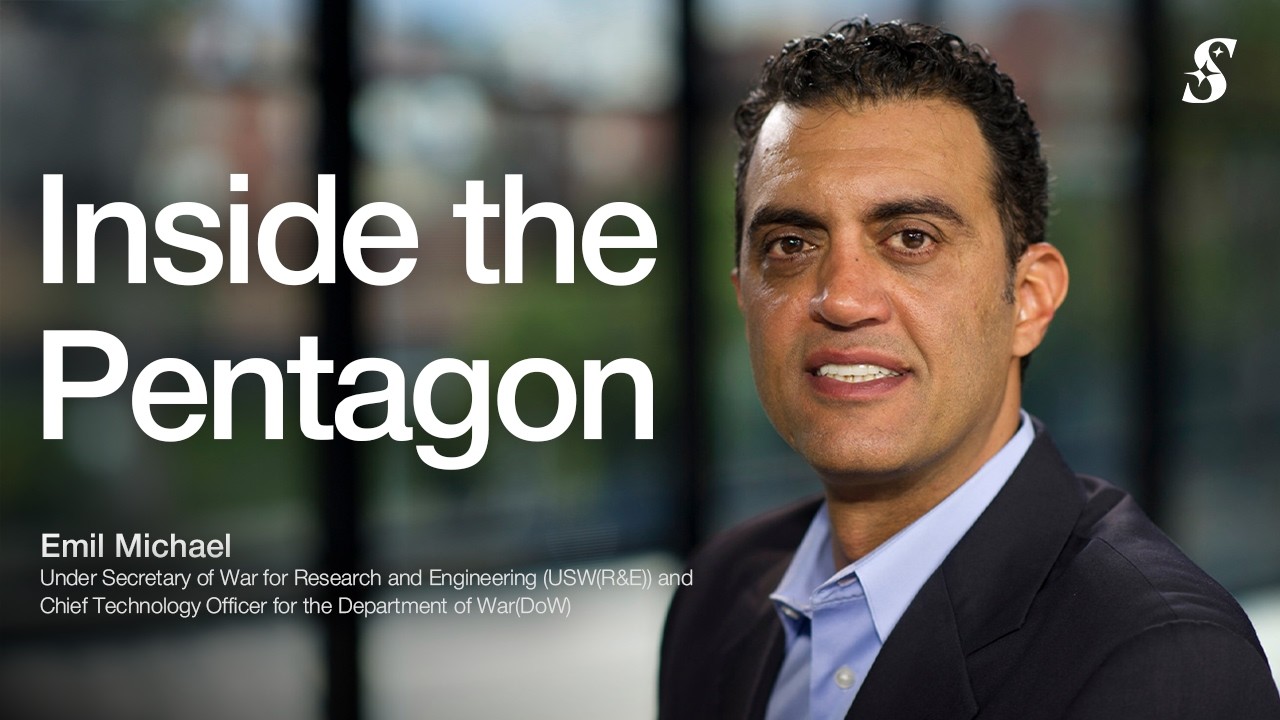
Emil Michael, the Pentagon's chief AI officer, outlines his plan to build five new defense firms and prioritize applied AI, hypersonics, and drone warfare. He calls the moment a "1938 moment" for modernizing defense, highlights partnerships with Palantir and Anduril, and identifies affordable hypersonic weapons as the biggest capability gap against China.
Chapters
I'm Undersecretary of War for Research and Engineering. Everyone talks about Anduril and Palantir and SpaceX. Those are the 3 companies that in the last 10 years have broken into the defense sector to challenge Lockheed Martin, Northrop Grumman, sort of the older primes. My job is to create 5 more companies that work in the department and bring new capabilities. The executive orders are awesome. So is the AI Action Plan, because at least it sets a marker out there and says to the world, we, the United States, are going to be dominant in AI. So it's Pretty exciting for a tech guy to be at that part of Department of War.
And this is exactly like Uber, right?
It's exactly like Uber.
Look, we have a stealth bomber behind us.
It's the same thing. Competition with Lyft, like competition with China. You know, same thing.
What is the biggest misconception about Palantir?
About Palantir? Yeah. Oh, I mean.
Honorable Michael, welcome to Sorcery.
You could call me Emil. You know me from the old days. No, we're gonna.
I'll call you Honorable Michael.
Okay. All right.
So you have many roles within the Department of War. Could you list out all of them?
Well, the primary role is I'm Undersecretary of War for Research and Engineering, and that has a bunch of cool stuff in it like DARPA, which is, you know, the Defense Advanced Research Projects Agency. They invented the internet. I have the Missile Defense Agency there, which was supposed to create the Strategic Defense Initiative, Star Wars, from the Reagan days. And then I have a core R&E, research and engineering function that's working on new stuff with the best scientific labs in the country. So that's like one big— that's the main job. And then I'm also the Chief AI Officer for the department and that organization. called the Chief Digital and AI Office. And then the Defense Innovation Unit, which actually is based in California, in Mountain View. And the idea there is to take all these startups that are doing defense tech and help them figure out a way to do business with the Department of War more easily.
And so how did you get into this position?
Well, I was radicalized, I would say, in 2017, when being a Trump supporter reporter was not cool. And, you know, our employee— I was in San Francisco at Uber at the time. And, you know, I was like, someday, you know, I'm going to go back into government. So I finished Uber, I moved to Miami, and then I was— I met President Trump, had dinner with him in, I want to say, December of '23, before the primaries. And I was— It was an honor to do that, obviously. I started working on the campaign, and then I started working on the transition team, and I'd always loved defense, and I'm in the coolest part of defense, like space lasers, like the coolest tech stuff that's happening in the whole Department of War is happening in my group. So it's pretty exciting for a tech guy to be at that part of the Department of War.
And this is exactly like Uber, right?
It's exactly like Uber.
Look, we have a stealth bomber behind us. It's the same thing.
Competition with Lyft, like competition with China, you know, same thing. Yeah. No, it's very different, obviously. But I'm able to— I will say that with this president, the Secretary Hegseth, who are disruptors, if you think about like what is a political disruptor, someone who sort of comes in and looks at the world the way it is and says, like, this needs to change.
Yeah.
And so if that authority is delegated to me, I could come in and look at what's literally the biggest bureaucracy in the world, right? 3 million people at the Department of War and say, what should we be doing differently? Clean sheet of paper. And that's pretty empowering. It's kind of awesome. So in that way, it's like Uber.
In that way, it is. I'm curious because, you know, you have the private sector experience, you're in the public sector. We're almost a year into the new administration. What's the biggest surprise that you've had?
The biggest surprise is like, is both the quality and camaraderie of the people at the top of the government. I mean, Scott Bessant, Howard Lutnick, Secretary Hegseth, Marco Rubio, like some real talent. And then at the Department of War, my colleagues, Mike Duffy, who runs acquisition sustainment, they buy the big airplanes like you have behind us. The head of policy who's like working with the Ukraine-Russia policy and all that. It's really just Brad Hansler who runs the intelligence security department. They're just great people who are dedicated to mission and going for broke. And it's kind of, it's really awesome. There's not a lot of political infighting. This is about like a team effort. So that's really surprising. I thought politics was gonna be knockdown, drag-out.
With a trillion dollars, almost a trillion dollars in budget, that's a pretty substantial—
Big.
Substantial allocation to have there. As you think about that and the efficiencies of that capital and the different departments So of all the departments that you span across and you have exposure to, what do you think the biggest allocation will be for?
One thing that happened in the last, especially the last 4 years, but really over the time period since the War on Terror ended, is China started investing in really sophisticated capabilities. We were fighting sort of terrorists, you know, random small terrorists who were using improvised explosive devices, right? That was the enemy. They were really thinking about, broadly speaking, what are we doing in space? What are we doing with missiles, you know, that can travel across the world at hypersonic speeds? Those kinds of things. So we have to catch up. So the budget that we're now trying to save money on bureaucracy and put it toward is new technologies, new weapons. New defense systems, like think about drone, a drone attack. How do you counter that? Well, maybe you could use high-energy lasers to pop out drones out of the sky if they're coming at you at a military base. I mean, you could do that with using AI in an automated way. So trying to kind of step forward ahead of the adversary as opposed to sort of investing only in the stuff we know, like those things.
Yeah.
Yeah.
Sorcery is brought to you by Brex, the financial stack trusted by more than 30,000 companies. including 1 in 3 venture-backed startups in the US. Nearly 40% of startups fail because they run out of cash. Brex is literally built to help founders avoid that. Unlike traditional banks that let your money sit idle, chipping away at it with fees, Brex is designed to help you spend smarter and move faster. Their all-in-one solution combines checking, treasury, and FDIC protection into one powerful account. You can send and receive money globally at lightning speeds, get 20 times the standard FDIC coverage through their partner banks, and even high yield from day one. With same-day and even same-hour liquidity, access your funds anytime. Companies like Scale AI, DoorDash, ServiceTitan, Hims, Anthropic, Flexport, Robinhood, and Plaid trust and use Brex. Start today at brex.com/sorcery. That's brex.com/sorcery. In today's high-speed business world, staying ahead means using the smartest tools possible, including the powerful capabilities of artificial intelligence. Meet Turing Intelligence. Turing builds customizable AI systems designed to solve your mission-critical challenges, no matter your industry. From expert guidance to tailored projects, Turing helps top companies realize AI that's more capable, more adaptable, and more effective. With Turing, discover how AI can accelerate your business growth. To learn more, visit turing.com/sourcery, spelt S-O-U-R-C-E-R-Y. That's turing.com/sorcery. Sorcery is proudly sponsored by Carta. Carta is transforming the private marketplace, connecting founders, investors, and limited partners through software purpose-built for private capital. Trusted by more than 65,000 companies in over 160 countries. Carta's platform of software and services lays the groundwork so you can build, invest, and scale with confidence. Carta's fund administration platform supports over 9,000 funds and SPVs representing nearly $185 billion in assets under management with tools designed to enhance the strategic impact of fund CFOs. For more information, visit carta.com/sourcery. That's carta.com/sourcery. Some of you may not have heard this yet, but our sponsor Public just launched something called Generated Assets. And it brings AI into investing in a way I've honestly never seen before. Here's how it works. You type in an idea like AI-powered supply chain companies with positive free cash flow or defense tech companies growing revenue over 25% year over year. Public's AI then dispatches a swarm of agents that scan every single US stock, evaluates them, and instantly builds a custom index around your thesis. What really stands out is how clearly it explains why each stock is included. And before you invest, you can even backtest your idea against the S&P 500. So you're making decisions with real context, not just guessing. And beyond generated assets, Public lets you invest in stocks, bonds, options, crypto, all in one place. They'll even give you an uncapped 1% match when you transfer your investments over from another platform. If you want to build a portfolio that actually reflects your thesis, visit public.com/sorcery, paid for by Public Investing. Full disclosures in the description. Well, that's a good transition and lead into the 6 critical technology areas that you're focused on. So you recently just slimmed this down, you concentrated onto 6. Why did you choose these 6 and where are you seeing the most impact?
So this, the 2 predecessors ago for the job I have now, they added 10 and that was in 2018. And then the next person added 4 more, so there were 14. So these critical technology areas were almost 10 years old since 2018. And if something's critical for 10 years, that means you're not making much progress on it. So that's number one. Number 2, 14 is a lot when you look at corporate values. A phone number is not 14. People have to keep it in their head so they wake up every morning knowing what's What's the priority, right? So the first exercise was, what are the priorities? And let's have them be a small enough number that people could wake up every day and know what they're doing, what they're working on, what the most important thing is. So applied AI is number one. And the reason I call it applied AI is because the big companies, OpenAI, Anthropic, xAI, they're all investing hundreds of billions of dollars in AI and AI infrastructure. So all I need to do is take that and adapt it for the department. So apply it. So that's one. 2 is scaled hypersonic weapons. So hypersonic missile, it's sort of like, it's kind of a geek term for defense nuts, but it's like a nuclear weapon that you may think, or it doesn't have to be nuclear, but it could travel at over 5 times the speed of sound, over Mach 5. That means it could get from China to the US in 30 minutes or vice versa. So they developed those and we have too, but they're really expensive. So I'm trying to scale them and make them cheaper. And there's a lot of companies, frankly, in this area that are working on that. Another one is scaled directed energy, which is this concept I was talking about, shooting down—
Like EPRIS and—
You know, space lasers shooting down things from space, shooting down things from on the border that are coming over like drug drones. How do you use energy to do that? And then the fourth one is what we call contested logistics. So if you're in a fight or battle in a forward place, like, you know, somewhere, you know, near China, for example, and you're not— it's not a home game. they call it the tyranny of distance, right? It's really far away. How do you do things, food, water, energy, munitions, and make those things available in those areas so that, you know, we can win? And then there's one called battlefield information dominance. So right now, like sensors and what you can hear and what you can see, it's all advanced really fast. So everyone can see everything. online and, you know, in the air and through the air and so on. So how do we dominate the information that we're getting in the battlefield so if we ever have a conflict we can win? So those are kind of like the flavor of what we're doing. And then finally, I guess, biomanufacturing. It's how to use biological mechanisms to create new materials. Like, do you know that you could use biological mechanisms to separate rare earth metals?
Yeah.
So instead of mining them out of the ground and doing this like nasty refining process, we use biology to do that. Use biology to create synthetic blood. You could use— I mean, there's a lot of applications. You use biology to create new metals and materials that we didn't have before. So that's another big area for us.
A lot of people in the defense sector, or maybe it's the war sector now, think that we're in 1938. What's your position on this?
We are definitely in a moment where we have to catch up our industrial base. Like you've heard this industrial base problem, right? And critical minerals is a great example. Pharmaceuticals. There's a lot of great examples of where for economic reasons we outsource to other places. And then it turns out if that party that you outsourced to doesn't want to give them to you anymore, you're in big trouble, right? We over-outsourced things that are critical to our country. So re-domesticating those is part of a 1938 moment. Building our defense industrial base up that was focused on old weapons, old ways of doing things so that now we have new ways of actually building hardware combined with software to make sure that we can deter adversaries. Because really the goal is deterrence.
Yeah.
And no one, you don't wanna fight a war. You want to prevent war, and you can only do that by being strong. So that 1938 moment is here where we finally, after COVID, looked at our supply chains, we looked at our defense industrial base, we looked at sort of some of the companies that have all left the Midwest and just devastated communities, the influx of drugs and all those things, and said, wait a minute, we have to rethink the whole architecture of our world. our war-making ability so that we can keep peace. So I feel like it's that moment. I wake up every day thinking that way.
Now that you're closer to the military and you're seeing the impact on troops, on their families, what do you think is most critical for the United States to be aware of or should know between the difference of government support and actually people on the battlefield?
We had— you look back on the wars that we had, the Second War in Iraq and Afghanistan War, and they were long, expensive conflicts where the benefit to the United States looking back on it was negative. It wasn't even neutral. It cost a lot of people their lives. And Afghanistan is still Afghanistan. It's in some ways worse, right? Taliban have taken over. So when you think about warfighters and soldiers, you think about if we ever have to send them to war again, it better be for the right reasons and it better be that they're equipped with the right stuff. Because I remember one of the first projects I did in the Pentagon when I did sort of a fellowship a long time ago was how do we build a tank that doesn't get blown up by these roadside bombs?
Yeah.
And it was really hard to get it done because of the procurement process and all the bureaucracy. in the Pentagon. So I never want to have that happen again. If we're going to send people out there and have their families sort of wait for them, we better be prepared for them and we better sort of be on their side.
A big theme and what many people are talking about is the emphasis on drones and drone warfare and how the future of wars will be actually through systems like drones. We won't have to send people, hopefully, ideally. Because you see everything from prototypes to actually investment, could you just share the state of like where you see drone technology and these new kind of innovations?
Yeah. So the Russia-Ukraine war taught us a lot of things. They're fighting over territory, right? Quickly, like that war became a robot war, a drone-on-drone war. The front lines are robots against robots, right? And that was sort of a totally new way of thinking about war. And then they started inventing how do you use fiber optic cables to communicate to that drone if the satellites are jammed, and how do you do software so that it could do automatic target recognition, all these things. So they're innovating at a pace with drones that's sort of unbelievable. So what we're learning from that, what we have to do, is make sure we have our own drone. Arsenal, big and small. Big ones go boom, bigger, and they're sort of less about territorial conflict and more about, you know, responding to an attack or initiating an attack in response to something else. The small ones are about making sure that we have an arsenal that we have at foreign military bases so they could send out. They with reconnaissance too. They don't just go boom, right? And then the other side of it is how do we counter drones? So we're gonna have to be prepared to make sure there's no threats. We still have it on the southern border. We're less worried about people coming over, but worried about drug drones and those sorts of things. So drone dominance is a real thing that we're trying to perfect at the Department of War.
What are some of the recent technology partnerships that you've done?
Well, the 3 I'm most proud of in a very recent term is we've done 3 deals for critical minerals to reduce our dependency on China in like 45 days. And so we're really taking this seriously. I mean, it's kind of awesome to be able to do that. Now we're also working with, you know, I've kind of, I have a, you know, being from the business world, I've invited all the tech companies that have defense applications in, and I've met with, you know, probably 100 or 200 of them over the last 6 months that I've been in office. And we're able to award contracts and do contests for who could do the best this or that and award contracts for them across the board. So because I want investors to keep investing in these companies and I want companies to keep succeeding. And so I'm trying to move, remove all the barriers. And I think next week we'll be announcing sort of a launch of of AI in the department, department-wide, for the first time ever. You know, so we've got a lot of great initiatives, and those are some of the partnerships I'm excited about.
So I want to talk about AI, the AI Action Plan. I think that was the last time I saw you, maybe, but the AI Action Plan came out, 3 executive orders upon that. It seemed like a really big moment for, you know, I mean, we saw this at the inauguration, and then we also I saw this there. This like really beautiful combination of private and public sector, Silicon Valley and DC. It almost felt like a tech conference. I'm sure like you saw lots of your friends there and then new friends and everything. But I want to talk about the AI Action Plan. How is that being implemented and is this going well? Is this like picking up steam? Like how have you seen initiative versus action and like the gap between the two?
The executive orders are awesome. So say I actually plan because at least it sets a marker out there and say it says to the world, we, the United States, are going to be dominant in AI. Right. And then what are the components to do that? The best chips. We need more power for data centers. We need the AI companies to be free of sort of state regulations and, and all these things that could hold them back. And those things are going to make that industry sort of the potentially the biggest industry that's ever been created. We want it to be built here. And I think the 4 great companies in that industry are based here. Chinese are doing distilling models of doing things to sort of catch up in their own way. But we're putting that into action. We're trying to get permitting for data centers to be faster. We're working on nuclear power generation for data centers, which we'd stopped as a country essentially for decades. We're making sure to keep our best chips here from NVIDIA. We're trying to have our, you know, we opened up a chip factory in Arizona that does NVIDIA, you know, TSMC and NVIDIA chips. We're doing our own lithography now. We're doing all kinds of things to enable this. And what I'm trying to do at the Department of War is make sure now we're using that for sort of enterprise use cases, for intelligence use cases. Like imagine We've been taking satellite imagery for 50 years. Imagine training a model on everything you've ever seen and then trying to train to look for more stuff in the world. And then for warfighting use cases, logistics, modeling and simulation, how do you model like a video game what will happen in a conflict so you're more savvy about it? And then also like how do I do that with to design things using AI, right? At the front end as opposed to like CAD drawings and human drawings and so on that you say, oh, that didn't work, the physics didn't make sense. So using that to do physics and upfront design. So we're working it and it's going fast, faster than ever I could have ever imagined.
Between everything that you've looked at and the geopolitical pressures and China and new technologies, what do you think is the biggest capabilities gap for the US warfighter?
I would say that, you know, when we think about, we used to have a treaty, we used to have an arms race with the Soviet Union, right?
Yeah.
We had this concept of mutually assured destruction. They have so many missiles, we have so many missiles, and eventually we'll control the amount of missiles and then no one will use them. And that kind of worked, right? We never had that deal with China. So they've developed certain capabilities and certain hypersonic missile categories at a price that we haven't achieved yet, which is why one of my critical technology areas is scaled hypersonics at cost. So that's probably the area I think about the most.
So I recently had Alex Karp on the pod. We did a nice walking tour. And I have to ask you, what is the biggest misconception about Palantir?
About Palantir?
Yeah.
Oh, I mean, Palantir is a software company that innovated by taking, you know, they were sort of the first big data company, if you will, and in some ways had AI capabilities that delivered useful software to the government. And it's been amazing to watch how people use their product in the department for all sorts of things. Just inventory, right? We didn't know where our stuff was. We were spending trillions of dollars over the years. Where are our tanks? Where's our munitions? Where are these things? How do we understand where they are in their lifecycle? How do we repair them? All the things that were really just basic stuff. The protesters want to talk about, you know, some of the other stuff they do that they think is more controversial. But I think They're really a nuts-and-bolts software company with forward-deployed engineers that are smart, that sit with the warfighter and solve everyday problems you would in any organization, as much as they do the other stuff.
Why do you think people think they're evil?
People are crazy. I think if helping the American government do lawful things makes you evil, I mean, You know who's not on that list? I mean, we all support our government. We live here, right? We support our elected government regardless of the party. So I think it sort of harkens back to like a long—it's probably before your time—but there was a sort of a solicitation on who would sell the first cloud software to the government, and Google bailed because their employees were like, "No, you can't." So men selling—they wouldn't sell. Cloud to the government, but they'd sell it to companies in foreign countries. It's sort of crazy. I think those days are over. And the number or percentage of people that will say that about a Palantir or Google or any one other company has shrunk so much that hopefully it doesn't matter.
Why do you think all of these defense tech companies do have like— they do get automatically bucketed into this evil group, even though they're meant to help.
You know, it's an interesting thing. I think in some ways the farther you are removed from the problems that a conflict can cause, the easier it is to disdain what it costs to keep the country safe. So if you're in a bubble of, you know, privilege and freedom and so on, and you haven't been around long enough to— or you don't know anyone who's been to the battlefield, right? Or you haven't read enough to understand what the risks are and threats in the world. It's easy to say, well, companies who are in that business are bad. But I guess anyone who touches that world in any direct or indirect way, I think, gets a quick appreciation for what it takes. You know, people use words like— Paul Rilucki uses words like extreme violence. And yes, it's a jarring word, but it's like, yes, if you're fighting a war, don't you want to extract extreme violence on someone who's trying to harm you or your community or your country? And I think that, you know, some of the nomenclature sort of triggers people, and people think this is a kumbaya world, and it's just not.
What are the biggest lessons that you've learned from Pete Hegseth?
I gotta tell you, he— I worked for one Secretary of Defense when I did this White House fellowship, Robert Gates, and he's renowned as one of the great Americans, one of the great American leaders in defense. Pete Hegseth, I think, is going to be and is already probably the greatest Secretary of War in our lifetimes. He is a leader. He comes in with No biases, like didn't come from the defense industry. He wasn't a 4-star general who's sort of like, this is the next job. He didn't— he wasn't in politics. He comes in with a fresh outlook and say, what's broken and what's working? And let's start there. So his leadership skills are extraordinary. He put together this team that I was talking about earlier that's cohesive and working together. And And he's open to any idea. And I think it's a privilege to work for him. And every day I feel that more. And, you know, he's one of the best leaders I've worked with. I've worked with a lot of good leaders and partners in business and so on. He's one of the best I've ever worked with.
Going to that point, how does that differ from working with Travis Kalanick?
Well, Travis was in the tech business, so he had a vision to start with when we started Uber. Strong opinions. And he and I would go at it more because I was in the tech world. So we grew up in the same business, right? So what our partnership was different is that we used to argue for who had the best idea, right? And he came in, he was obviously an engineer, and he came at it from a hardcore tech standpoint. I came at it from a business standpoint. I was like, we should buy Lyft. He's like, we should crush Lyft. You know, so we had those kinds of debates. It's different in this relationship, not only because, you know, he's, you know, third in line to be president, you know, he is at the top of the government and looking at world affairs in a very broad way. But, you know, I didn't grow up in this industry. He served as a military member a long time ago. But so we're less, you know, crushing ideas that are where we've like held deeply for 20 years and more looking at why does this work this way? Should it work this way? At a sort of clean sheet of paper. So a different kind of relationship.
I guess to close out, as we think about the world of innovation and technology, especially as it pertains to like venture capital and the dollars going towards the defense tech sector, what are some of the most like interesting or exciting companies that you're looking at?
You know, I like, you know, everyone talks about Anduril and Palantir and SpaceX. Those are the 3 companies that in the last 10 years have broken into the defense sector to challenge Lockheed Martin, Northrop Grumman, sort of the older primes. And my job is to create 5 more companies that, you know, work in the department and bring new capabilities. So I'm excited about everything from Planet Labs that does commercial satellite imagery to Neros, the drone company, to Hadrian that's doing AI manufacturing, which I find fascinating. We were just there yesterday. These companies are awesome and they're doing great things and they're doing things that are hard, that involve hardware, not just software. And I'm frankly enjoying working with the frontier AI companies. They're all eager to help the Department of Defense do things that they've never done before. So those are the exciting things right now. Having fun? It's the best job of my life.
Amazing. Well, Emil— sorry, Honorable Michael, it's a pleasure to have you on.
Thank you so much. Thanks for having me.
Hey, it's Molly. If you enjoy our interviews, check out our newsletter, sorcery.vc, where we deliver a once-a-week top deals and tech headlines email, and also go deeper on our podcast interviews. Subscribe to Sorcery today, and don't forget to subscribe to the podcast on YouTube, Spotify, Apple, or wherever you listen. Link in description to sign up.
More from Emil

Pentagon CTO Emil Michael: Anthropic is still blacklisted, but Mythos is a separate issue

Emil Michael: The Department of War Is Moving Faster Than Silicon Valley on AI | The a16z Show

Defense Undersecretary Emil Michael: Anthropic’s Claude would ‘pollute’ defense supply chain

War with Iran + Pentagon vs Anthropic with Under Secretary of War Emil Michael

Department of War’s Emil Michael on how emerging tech is transforming U.S. defense
The Rise of a Dealmaker: The Emil Michael Story at Uber | EP 37 | Aarthi and Sriram

Emil Michael: How I Negotiated the $4B Uber-China Deal, Why DoorDash Caught Up to Uber | 20VC #941