From Hire to Hero: Customer Success Training with Emilia D'Anzica
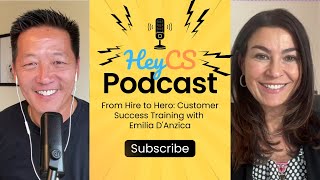
This is a podcast interview between host Tyrone Tan and Emilia D'Anzica (founder of Growth Molecules) about customer success strategies. Emilia emphasizes leadership composure (stay calm, focus on the North Star), upskilling CS teams in human skills (emotional intelligence, communication, the “Art of No Jitsu”), and practical scaling through tooling (AI) and clear client communications—especially during layoffs or organizational change. She also discusses hiring for CSM roles, desirable traits (communication, curiosity, technical aptitude), and Growth Molecules' fractional/coaching engagement model.
Chapters
Hey, welcome to our podcast. I'm your host, Tyrone Tan, and today we have a great guest. Her name is Amelia Dancica. She's an author, a speaker, and most amazingly, she is the founder of Growth Molecules. Welcome to our podcast.
Thanks for having me. I'm really excited about what we're going to talk about today.
Well, right off the bat, I'm really curious. You know, the world of customer success and the economy, things are a little bit shaky right now. What are some of the things that. Let's just say maybe chief customer officer or VP of Customer success, what are some things that they could do to right the ship? Because maybe they don't know that their forecast isn't so great and they're starting to hit rough waters. What are some of the things that they can do to right the ship?
I think it really starts with the inside and that's staying calm, centered and really focused on the North Star. So if you present yourself that way, where you're really focused on the company North Star, your team really understanding what's important to them and the organization, of course, what's important to your customers, you will come out so much stronger. If you show anxiety and stress and instability, imagine how that's rubbing off on your team and they're on the ground day to day with your customers. Right. Customer facing teams. So it's just really important that you stay centered, focused. Really that person that they can count on as someone, even through rough waters, they're able to maintain calmness and really keep laser focused on what matters.
So as the market, let's just say things happen. What are some of the. How would, how would a customer or chief customer officer or how would a VP of customer success start to see that they need to start making changes? I mean, they don't want to get, let's just say hit, hit on the side and just sideswiped. How would they know and how would they be aware and be ready?
Well, unless you're living under a rock, hopefully you're thinking about artificial intelligence and how your team can leverage it to really scale. Because right now the clients we're talking to at Growth Molecules, they're really thinking about capacity planning, segmentation. How can we have more clients managed under one csm, for example, especially in enterprise, mid enterprise and in those segments, you really need to equip your team with two critical things. One are the skills to have communication with clients, not only written, but also verbally in a way that's effective and that's focused on what the client cares about because let's face it, your client doesn't really care about your product. What they care about is how is the product going to help them be a hero and scale and do great things on their end. Now the second thing they really need are tools. And everyone's talking about AI. But what AI tools? How do you use them? Just even simple things like our company now has paid chatgpt. How can we get the most out of it? For example, you can't assume all CSMs are going to take the time to go learn it on their own and leverage it to the best of their ability so that they don't just copy and paste without even reading, without it making sense for what the client's asking. So those kind of things are important. What tools and what skills can we give our CS team to really scale? I think that's what CS leaders are really thinking about right now. Because boards are asking companies, cut back on hiring, make do with what you have. And in some cases you need to reduce your workforce. And so it goes back to the first thing. If you do reduce workforce, for example, how do you again, stay positive, calm so that your team doesn't start feeling burnt out and stressed because now they've just been given another load of clients to introduce themselves to and manage.
Wow, that's, that's really interesting. So, skills and tools. So with that, I mean, remaining calm, doing more with less. So what, I mean that, what are some of the, I guess, tips or tricks, I guess that you would share with a hiring manager who, let's just say they did have to release maybe 30% of their workforce. I mean, what are some of the actual tangible things that they could do with their existing team players? Because they're going to get rocked and it's just inevitable. And there is that feeling of my next. So if you were to, let's just say, sit down with the leader, what would you say to that leader to, to help ensure that there's continuity with the team?
Yeah, and I think I've been through this with companies through Covid, we act as fractional leaders with, with clients oftentimes and when we're going through a reduction in workforce, the, the, what's really important is that you host a meeting with your team. If your CEO can join, especially in a startup environment, invite them, be open, transparent and willing to answer questions. And you're going to get tough questions. I mean, I've had questions like why did you let X go? And why do you still have a job? Why are you here right you need to be able to answer those questions and it's going to be difficult. And you're really role modeling to your client, to your team, how to have difficult conversations with clients. And that's one of the top topics we teach. We call it the art of no Jitsu. Having difficult conversations with clients, you need to be able to model that. So I think it really starts there, being available for your team. Secondly, how do you present these changes to your clients? Right. If there are massive changes coming and you're able to tell your clients up front, they probably need to know five or six times before it finally sinks in. But if it's a sudden announcement that there's a change, you need to be able to have communication ready to go for those clients. You can't just say, hi, I'm your new csm. Schedule a call with me. No one's going to do that. Right. You need to explain to them what's in it for me and why did this happen. So being able to equip your team with either an email or mass communication, that means working with your marketing team. Especially if you have a company with 20,000 clients, there better be communication going out from the top, explaining why is it better for them. And I think an example a company that did this well is HubSpot. They announced were HubSpot house set at growth molecules. They announced a year in advance that changes were coming and they were explaining the investments they were making that were going to make my life easier as, as a buyer of HubSpot. And that's, that's responsible leadership. Right? Making your clients really aware of, okay, why are the prices going up? Why is the model for CS changing? Why are you closed the first week of July? All of those things, being able to answer them up front and then me being able to reach out to a CSM or support if I have questions about that has been a great experience.
Fantastic. Now you said something there that, that, that made me go interesting. Tell me more about no Jitsu, because that sounds like you're, you're literally on the front lines and you're helping people with human skills like communication skills. Can you tell us more about no Jitsu?
Yes. So first of all, thank you for not calling it soft skills. I love human skills. I believe that human skills are essential skills. That's what we call them. And it's unfortunate that, that schools don't teach these skills I think of in high school, they should be taught even younger. You know, I think we don't give children credit to be Able to have conversations that then they're stuck not knowing how to handle when they graduate from college, for example. And as customer success professionals, we're typically nice people. We have to be patient. Right? You're constantly dealing with, with different personalities, different nationalities, different views on politics, religion, all of these things. They, whether it's discussed or not, it's brought with the whole self when they come to a meeting. And being able to say no to a client requires you to have the skills of being curious, right? Why do you want that feature? Why do you want this, our product, to work this way? So you have to be curious and then you need to be able to stay calm and be a good listener before you say no, or that's not on the roadmap, or, you know, let me go back to sales and better understand what was discussed before I give you a no. Because maybe there was a miscommunication during the sales cycle. And so we go through all these different scenarios that then we role play, right? So with clients, we ask them specifically, okay, well, before we're going to host this workshop or this class, what do your CSMs really struggle saying no to? And I can't take credit for the no Jitsu. One of our clients coined it that. She looked at our course list, our academy, and said, oh, this is like the Art of no Jitsu, right? And I said, exactly. What a great day. Yes. I thanked her. I said, we're renaming this course in your honor. So that's why it's called the Art of no Jitsu.
That's fantastic. You know what you just described, there is inquisitiveness. You describe the ability to stay level headed at the same time gathering great information and asking really good in depth questions. Is that what you're referring to in the role playing where you practice that? Because you actually have to practice that in order to get used to it. Otherwise it will be something where you're kind of stuck.
Yes, yes. So you do have to practice it, because there's nothing worse than teaching a skill and then the CSMs kind of trying it for the first time on a customer. What a terrible experience. Right? They're not going to bring confidence to the table. And I'll never forget one of my colleagues and I taught a group of people at their CSKO in, in New York. It was a, a bank. It's a banking tech company. And so we taught it early in the morning and then we did role playing. We, we did another workshop and then it was lunch. One of the CSMs instead of taking a lunch. She went and had an executive business review and came back to the class. You know, we're asking, how was lunch, everyone? You know, what's one key takeaway from your lunch that you're willing to share? And this girl raised her hand and said, I just practiced the art of no jitsu on a client. And it felt so great. I felt really confident. And that's what we want. We want CSMs to say, saying no is. Is not scary. I can do it with confidence and still build deeper relationships with my clients. And that's really what the end goal should be. And that's why we just really work on role playing and, and believe that they should be real life scenarios that these CSMs struggle with. Because the CSMs, we are typically really nice people. We want to help people. Or being a CSM is not the right role for you.
So how does that work when, I mean, you're talking about the early stages too, like the onboarding, and then you're also talking about the client and, you know, you're really in dealing with them during the good times and the bad. How does that work in terms of the asking really in depth questions to get a pulse of where that client is at mentally, maybe even physically and as well as their team, as well as their company and their health. How are, how are you, I guess, bringing that to awareness with your training?
Yes. So things like tone are really important. How fast a person is speaking, how loud or quietly are they using expressions like their hand, all of those different things are really important. Even if maybe they're not looking at you, maybe they're distracted by something on the other side, or maybe they're looking at their phone. Whatever it is is really important to be aware. And we, we teach them that you should be very aware of the environment around you and that maybe when you are coming to a meeting, the environment around you is distracting you. You're not fully present. Your clients are very aware of that. And once they learn these skills around emotional intelligence, that's essentially what it is. Being aware of what you're feeling inside, being aware of your environment around you, and then better understanding what is happening on the other side. With my client, a child keeps coming in or there's loud noises, Being able to pause and ask, hey, is everything okay? Is now a good time to continue this call? They may say, you know what, thanks so much for noticing. I'm actually really distracted. Can we reschedule so I can better focus on our conversation? Wow. Like, someone's really touched that you're able to identify that they're not fully present. And so we go through those different scenarios where this might happen and how it's an opportunity again to build relationships.
That's fantastic. So, you know, I'm really interested. You've had the great experience of being a VP of customer success and not to mention a chief customer officer. You've hired probably countless of CSMs. So what do you think hiring managers or CS leaders are going through right now? What are they struggling with in terms of recruiting or, you know, they put an ad in LinkedIn, they get maybe hundreds of responses. What do you think they're struggling with?
Yes. So I think, well first in that scenario where they are and it is absolutely hundreds. When I, some of the leaders I've talked to have shared in the first hour, we had 800 applications pouring through. It's completely overwhelming and I, you know, we don't even know where to begin, especially if there's one recruiter for the entire group. You're prioritizing, right? They're prioritizing. Your, your in a hurry as well to get someone in seat working with your clients. And so it's really important that you're very clear in your job description, what you're looking for. And then also how do you present yourself on LinkedIn? How do you present the job description? We, we've looked at some with clients that we've worked with. They've shared it with us and I've put myself in that CSM hat. I was a csm for 5 years before I went into leadership and I thought, wow, I'd never want to work for this company. This sounds very robotic. Nothing interesting about it and certainly not inspiring. And so you want to make sure that that position is one where there's interest. So you're getting the right candidates who are curious and they're not just applying with the easy apply on LinkedIn, but that they have the right skills. So you have to be clear in your job description. And then thinking about how are you presenting yourself on LinkedIn, your company and yourself as a leader because you need to inspire people today. Good top talent has a choice, right? They have a choice where they can work. And if you want to hire top talent, you need to be inspirational and people will find out who the managers are if they're not looking you up and doing their homework before that interview, do they really want the job or care or is it just another job for them? So that's where I would start.
Well, that's really well said. So you have 800 applications, resumes, they're filtering through. You call in maybe the top 10 over the phone, you do the phone interviews and then you bring them possibly in person over zoom. What do you think? What characteristics or traits or experiences do you think make a great csm?
Yeah, I again, I'll go back to the emotional intelligence piece. Whether it's a technical role or not, you need to have communication skills and be aware of yourself. And now that I have an 18 year old who's going through internships herself, I gave her the same advice because I'm disappointed the high school system didn't prepare these children to go out into the workforce and get these internship roles. And the advice I shared with her is you are going to be in customer facing roles. Whoever is interviewing you is interviewing how are you going to represent the company to clients? Right. So what you wear, are your nails clean? How are you presenting that smile to a client? How are you listening and answering the actual question question they asked you instead of going off on some other tangent? Those kind of things are incredibly important. And that's the advice I would give is how is this person coming in representing themselves and interacting with you? Because they're going to interact that same way with clients. So being able to pause if they're unclear on a question, asking for clarification before they just jump into an answer, or cutting you off all the very important cues that stem back to emotional intelligence, great communication skills. I think is has to be a starting point whether it's technical or not because that will heavily influence customer relationships.
So based on, let's just say a pie chart, right. And let's break it up into percentages. How would you describe, let's just say a CSM for, you know, growing SaaS company, they have 800 applications. But you know, based on that role, what do you think would be the makeup of that individual as a pie charter and you know, give me the biggest piece first, maybe 40% EQ or you know, I'm just kind of curious to see what the makeup would be.
Yes. So let's break it down to you need to be interested in the product and have technical aptitude. Right. You have to understand and be able to articulate what the product does. And if it is a technical role, you have to have experience in that or be willing to to learn. Even for my daughter, she went and did like a HubSpot internship. Well, of course she went and got all this certification, but she knew even if she had all the certification, she would have to learn some of it on the job and I think that's okay. Then which it stems into the second part. You need to show that you're motivated, interested in the product and willing to learn it because at the end of the day you're going to represent it. The EQ is big, right? Relationship building. If you don't like people or talking, probably not a good job for you in cs. And I, you know, I will say you don't have to be an extrovert. I, I won't. I will confess I'm not a hundred percent extrovert. I definitely like quiet time and being alone often to think and write and do things on my own. So I don't. I'm not saying you have to be an extrovert, but you have to be good at building relationships and have curiosity. I think those are all really important and a good way to showcase that is to send a follow up. Thank you. It doesn't have to be in the mail anymore. I get it. Back when I was applying for jobs, you mailed thank you letters today. It's within 24 hours of follow ups. Thank you email highlighting how you would communicate. Right. Because you're going to have to follow up with customers. Even if there's great AI products out there that now take all the notes for you, they're not perfect. No one's going to, well, I hope not send one of those emails out without reading them first and making sure they fully captured the action items.
Wow, that's really well said. I mean I thought the follow up thank you card is great advice. That's exactly what I tell all my candidates who go on interviews. So that's fantastic. The part that I really liked what you said was showing interest and having the technical aptitude when someone is hiring and they're weighing out. This is a really interesting role because you talked about technical aptitude, but then you're also talking about people skills. That's kind of like sometimes it's the opposite sides of the brain working you. You've got the data side, but then you also have the EQ side of the human. So would you say that that is a challenge for hiring of finding that, that right blend? Because some people have a lot of the EQ but they don't really have the technical aptitude. But you know, so how would you, how would you, how would you describe the blend?
I guess yes. So it is interesting because over the years, so we, I've been, I've been leading growth molecules for the past four years and Increasingly very technical engineers in customer positions hire us privately to do executive coaching to help them with those skills. They went, they got a computer science degree and there wasn't any training on how to write professional emails without sounding rude, robotic, just no lack or, and a lack of structure in the communication. So I have often found myself at a Starbucks or Pete's or whatever, a cafe with one of these leaders saying, I really want to grow my career, but I'm, I'm getting passed up in these positions in, in customer facing roles. I keep getting passed up and I think it has to do with communication. So being able to be in a safe space where they can practice communication and these type of interview skills is increasingly becoming important. People are recognizing them and I do believe technical people can grow and have these skills. I mean, the majority of the support teams we train, they're highly technical. They go through our academy training specific for support roles. They are highly technical people. They've just never received communications training, for example. And so that's what we seek to do, is motivate them to learn them and practice them because practice is what makes progress.
Well said, well said. So you know, we have people, people who are hiring, but then they also have to make a decision. Do we hire the person who has that next level of potential? Because you want to develop from within and you want to, you want them to become leaders as well for the future. What's your take on that? Do you look for the individuals who could be potential leaders or are you just looking to fill and get the job done? What's your, what's your take on that?
I wouldn't be where I was if people didn't give me a chance. But they saw potential and they gave me a chance. My degree is in Canadian studies and a minor in social history. I went and got my MBA when I had three children living at home. So I took a very different path to tech. But my first job was@guru.com in the late 90s and my first boss, Casey, I'll never forget her, she had already hired a customer. Marketing manager had made an offer, but she agreed to interview me. I wrote this letter, found a job on Craigslist, showed up, did the interview with four leaders there, and then I sent them all a handmade card. I still to this day make cards for people. It's one of my, like favorite things to do, a handmade card. They rescinded the offer and gave me the job.
That's an amazing story.
And the, the reason I know where I am today Is because as I grew my career, someone took a chance on me. I mean, how do I become a director when I have zero director experience? Well, someone took a risk on me and said, okay, you've. You've been in a senior manager role. I see you, you know, you manage four people. Okay, can you do operations across 80? That's what I was hired for. After being a senior manager, I ended up being very successful at that across 80 CSMs. I was very interested in scaling, and I told the VP that and, and he gave me a chance. So I believe in potential is my answer.
Amazing. Amazing. So in your past, you know, positions, what, what separated, you know, you've got maybe 10, 20, maybe 50 CSMs, you know, on a team, what separates the best from the rest, if you know what I mean? Because typically the best will kind of rise and they'll. They'll just demonstrate something. What is that something? What is. What is that piece that makes them shine versus others? Not as much.
Yeah. So one of the PE firms we work with, I spoke at their event last fall and they put out some information around their entire portfolio and one of the stats they shared. And now it. It's in all our communication is A players outperform B players by 6x and they outperform C players by 10x. So you absolutely want your A players, right? You want to level everyone up. But if you have an A player that's a jerk, they can heavily influence, in a negative way, the rest of the organization. So not all A players are A players worth keeping. And what separates the A players that you really want to keep versus the ones you know, you. You should really consider, are they really making an impact on your organization is they may not have started that way. They may have started as a C player because they were just learning the space. They were maybe changing industries. And you can bring them up, I believe you can make them A players by. They have to, but they have to be motivated, right? They have to be not only motivated to hit their numbers, they have to be risk takers. They have to be able to identify when one of their colleagues is struggling and that their superpower might be having difficult conversations and say, hey, you know, I noticed the last call with this client. I overheard, he was kind of a jerk to you. Do you want me to join and maybe we can figure this one out together? That's an A player, right? Not like, hey, you sucked at that call. That's not how I would handle it. But rather, hey, let's tackle this together, you know, Those kind of things make an A player is the willingness to identify what's going on around you. What's your forte, lean in on it and help others. I really think that that's how you'll shine, especially in customer success.
Wow. What you just described there was being, doing something bigger than yourself and being more than just focus on yourself. And that's really interesting because that seems to be the common theme in that you're constantly focusing on the exterior and how you're making that impression outside and not so much focus on your inside, if that makes any sense.
Yes, I, I think if you're selfish and you're just focused on yourself, people are going to notice. Right. You'll soon be on an island. And it's, I mean, a lot of studies out there, we have all this great tech, but people have never been lonelier. So I think helping is, is really remarkable. It feels good and it's the right thing to do.
You know, I had the pleasure of seeing one of your other videos on your other podcasts and you mentioned something very interesting. These executives have so many vendors to consider, and the skill of the customer success manager has to be able, with all the data, be able to tell a story, to engage that individual in order to captivate them and to, let's just say, and get their trust. So how important is that ability to tell a story?
More important than ever, especially in SaaS in software companies. And people want to be able to identify with people that are like them. So if I'm an SMB client, I don't care what Apple's doing. Right. I, I, I serve different people. I ha, I have a different service. Why are you sharing a story about Apple with me? That's, that's irrelevant per se. I want to know how did you help another small business and how can you help me in a similar way when with your product? And so being able to tell a story starts with listening. What does this person care about? What are they struggling with? And then sharing a success story where me, Amelia, can place myself and say, yes, I want to be that small business that grew their, their revenue by 10x over the course of 18 months. I'm willing to trust you. Right. Let's go along this journey together. Because if you're able to tell a story, include numbers, place that person in the story, then you're able to gain trust. And that's really one of the essential skills customer success managers need to be successful.
Ooh, that's, that's easier said than done. And that's that was really well said. So, you know, I've talked to other chief customer officers and they have their, you know, war stories where they would possibly bring someone up from the support side and bring them over to the customer success side. Have you seen, you know, positives or is. Would you always recommend that or how do you make those decisions? I guess when you're, when you're evaluating talent and you know that someone is a good employee, they're on the support side. They speak the language in terms of techies. But, but, you know, how do you know if they have the EQ side if you know?
Well, I, I think whether you're bringing them in from support or, or sales, you know, I've hired a lot of sales professional to really have wanted to try customer success. I've asked them why, right? Like, why do you want to move to this position? Often the pay structure is very different. Same with support. Right. A lot of support professionals have a flat yearly salary. They may have a small bonus, whereas often customer success, it's becoming more incentivized. They, they may have a flat salary and then a lot more is either commission if there's upsell, cross sell opportunities. But also it's heavily based on retention and it's a completely different, a different pay structure and it, it can scare a lot of people who, like, I know what I'm going to make every month. So one, you have to get that out of the way. Right. They have to be willing to take risks and have high confidence that they're going to really learn their customers, their portfolio of customers and really focus on helping them and making sure they know how to prioritize. I think customer success, just like support is a high burnout position and so you really need to be able to interview them for that. What do you do when you're not working? Like, if they're just going to be workaholics, probably not. Not good. You're going to lose them soon or they're going to start doing mediocre work. You want to make sure they have hobbies and passions and things they do outside work, whether it's video games or cycling or kids or dog or whatever. I think it's just really important that you make sure they really are keen to learn and that they're going to focus on wholeness. I think wholeness is what's very helpful in high burnout position.
Well, I want to thank you so much, Emilia, for your time. Your, your words are spot on. I mean, great, great, great advice. And how can people learn more about growth molecules.
Yeah, thanks for asking. So, growthmolecules.com is a good place to start. And we're also on LinkedIn. You can find me there as well. Happy to discuss anything that we talked about today, if you're interested.
Fantastic. Now, would you recommend growth molecules just for the large enterprise type companies, or do you recommend them for, let's just say the startups who are trying to make, you know, their first maybe 1 to 5 million? Let's just say.
Yeah, absolutely. So we are so fortunate to work with a lot of C&PE firms that have invested in early stage startups and they bring us in, whether it's fractional leadership, to do an assessment, help them build playbooks. We often work with organizations like yours, Tyrone, where you're doing the hiring, we're filling in fractionally and we're closely with you, or we're scaling, scaling, scaling while you're hiring. And then eventually you will replace us, which is really what we want. Right. If we're fractional, we don't want to be there more than three months. Right. We really want to have a big bang in a company with their processes and systems. You take care of the people part.
Fantastic. Fantastic. Well, again, thank you, Amelia, and I really appreciate your time.
Yeah, thanks for having me.
Okay.
More from Emilia
Why Measuring Perception of Value is Key to Keeping your Customers with Emilia D'anzica
Glassix Spotlight Podcast - Emilia D'Anzica on Fueling Revenue Growth Through CX Excellence