10 Books To Become Dangerously Self Educated
Evan Carmichael lists ten books that shaped Steve Jobs, Elon Musk, Warren Buffett, and other entrepreneurs, then breaks down the frameworks they used to learn: first-principles thinking, building a knowledge tree, and chunking. He covers practical rules on pricing, funding, focus, and scaling.
Chapters
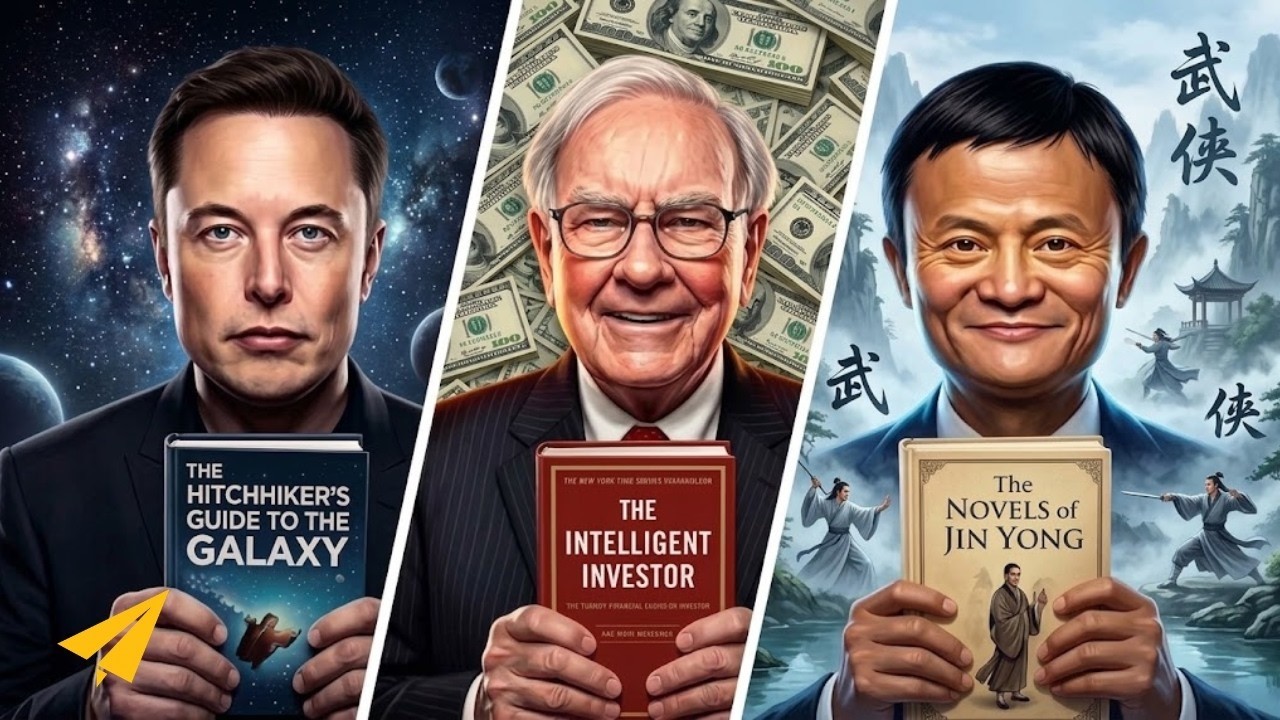
Nobody builds a big company on their ideas alone. Look at the founders that you follow— Steve Jobs, Elon Musk, Warren Buffett— to see where their thinking came from, and they'll name a book. Pew Research asked over 8,000 American adults last October about their reading, and 25% of them hadn't finished a single book all year. So a quarter of this country is reading nothing, and the 10 books coming up are the ones the entrepreneur legends say you need to read. So here are the 10 books that made famous entrepreneurs dangerously self-educated. Let's start with Steve Jobs because of what he chose to put in people's hands at his own funeral. So in October 2011, a few weeks after he died, about 300 people came to Memorial Church at Stanford for Steve Jobs's memorial service. Jobs had planned the whole evening himself while he was dying— the music, the speakers, the seating. And on the way out, every person was handed a small brown box. Nobody knew what was inside. It was a book. It was a copy of The Autobiography of Yogi by Paramahansa Yogananda. Jobs first read it as a teenager before the trip to India that changed how he thought about almost everything. Then he read it again once a year for the rest of his life. He kept it on an iPad and it was the only book on there. A man planning his own funeral who could have put anything in those boxes decided the thing he wanted in 300 hands was a book he had already read 40 times over. He was choosing what to leave 300 people holding, and he chose a book. Now you might be watching this thinking, okay, you don't have time to read. That reading is what people do when other people are out building something. And I get it, I understand. But look at who is on this list. Satya Nadella was running Microsoft. Warren Buffett runs Berkshire Hathaway. Jeff Bezos was building Amazon out of a garage. These aren't people with lots of free afternoons. They read because it's a faster way to learn. Somebody had already solved the thing that they were stuck on, and picking up that book costs the price of lunch on a weekend, working it out yourself costs years. So here are the 10 books that made 10 famous entrepreneurs dangerously self-educated, what each of them said about it, and what the book actually teaches. Read one of them properly this year and you're ahead of a quarter of this country who reads nothing at all. If you've been here before, drop a hashtag believe in the comments below so I can feature you here in a future video. And if you're new, welcome to Believe Nation, the only channel that helps you believe in yourself daily, one video at a time. Elon Musk, The Hitchhiker's Guide to the Galaxy. So at 14 years old, Elon Musk was in what he called an existential crisis, and he went looking for answers on the family bookshelf. Elon said, we happen to have some books by Nietzsche and Schopenhauer in the house, which you should not read at age 14. The philosophy made his situation worse, but what pulled him out was a comic novel about a man whose planet gets demolished to make way for a bypass, The Hitchhiker's Guide to the Galaxy by Douglas Adams. Elon said, everyone has their sort of favorite philosopher, but my favorite philosopher is Douglas Adams. So in this novel, a supercomputer spends 7.5 million years calculating the answer to life, the universe, and everything, and returns the number 42. The answer is useless because nobody ever worked out what the question was. So Elon said it highlighted an important point, which is that a lot of times the question is harder than the answer. That's how SpaceX started. He asked why a rocket costs what it costs, found that the raw materials are small fraction of the price and built a company out of that difference. And he never let the book go. When Falcon Heavy launched his Roadster into space in February 2018, the dashboard read Don't Panic. There was a towel in the car and a copy of the book sat in the glove box. So before you go chasing an answer, spend the time getting the question right. Otherwise you end up with 42. Warren Buffett, The Intelligent Investor. So Warren Buffett was 19 when he picked up The Intelligent Investor by Benjamin Graham. He went Columbia University specifically to study On the Graham, and he spent 70 years telling people to read it. Warren said, by far the best book on investing ever written. But the useful part is that Buffett tells you which pages to read. So chapters 8 and 20 have been the bedrock of my investing activity for more than 60 years. And he says to reread them every time the market has been especially strong or especially weak. So what's in these 2 chapters? Chapter 8, Asks you to picture the market as a business partner who knocks on your door every single day and offers to buy you out or sell you half at a completely different price depending on his mood. You're never obligated to do the trade with him, and his mood tells you nothing about your business. Chapter 20 is the margin of safety. Buy something for meaningfully less than you think it's worth so you can be wrong about the value and still be fine. Those are 2 chapters over 60 years, and Buffett reads enormously to get there. He spends about 80% of his working day reading, and he once told a room of students at Columbia to read 500 pages a day. Warren said, that's how knowledge works. It builds up like compound interest. All of you can do it, but I guarantee not many of you will do it. So read everything you can get your hands on, then find the 20 pages that actually change how you work and go back to those every single year. Bill Gates, Business Adventures. In 1991, Bill Gates was running Microsoft and he met Warren Buffett for the first time and he asked him a simple question. What's your favorite business book? Buffett didn't recommend one. He went and got his own copy and lent it to Gates. It was Business Adventures by John Brooks, which are 12 stories that had run in The New Yorker in the 1960s. Bill Gates still has it. In 2014 on his blog, Bill wrote, more than 2 decades after Warren lent it to me and more than 4 decades after it was published, Business Adventures remains the best business book I've ever read. That's from Bill Gates, a man who's been at the top of the rich list for more than 2 decades, who reads about 50 books a year, and his favorite business book is a 1969 collection of magazine essays that Warren Buffett gave him. The stories are about, uh, Ford launching the Edsel, uh, Xerox betting the whole company on a copy machine, Clarence Saunders inventing the self-service grocery store and then borrowing $10 million to corner his own stock against Wall Street, and the 7 General Electric executives who went to prison for price fixing. What Brooks does in these essays is he makes you feel like you're in the room while very smart people are making giant decisions and lets you actually see how they played out and how it happened. Gates's point is that the fundamentals of business haven't changed since 1969, however much technology has changed. So Ask the best entrepreneur that you actually know for one book, just one, then read it. Jeff Bezos, The Remains of the Day. So Jeff Bezos reads business books like everybody else on this list that we've talked about, but his favorite book of all time is an English novel about a butler. The Remains of the Day by Kazuo Ishiguro follows a man who spent his career in perfect service to a lord and slowly realizes he gave away his own life to do it. So how Jeff describes it, if you read The Remains of the Day, which is my favorite book of all time, you can't help but come away and think, I just spent 10 hours living an alternate life and I learned something about life and about regret. Regret is the word to notice here. So when Bezos was deciding whether to quit a comfortable Wall Street job to sell books on the internet in 1994 with Amazon, he ran what he calls his regret minimization framework. So it goes like this: project yourself out to age 80 years old and ask yourself which choice that you'd regret. And as a side note, that was what inspired me, the regret minimization framework as well, to leave a safe corporate job to go start my own business that I had no idea if it was gonna work out or not. So Bezos says he learns more about life from novels than from nonfiction, which is sometimes strange to hear from a man who has like the largest bookstore in the world. And he could have said anything. He could have picked any book and this was it. The idea is 10 hours inside someone else's life, feeling what their choices actually cost him in regret is a lot cheaper than making any of those choices yourself. And you get to find it out later at 80 instead of finding it out right now. If you only read business books, you're only learning about business. So put a novel on your stack of read lists this month and just start it. Jack Ma, the novels of Jin Yong. So Jack Ma failed China's college entrance exam twice. He applied for 30 jobs after college and got rejected from all of them, including KFC, where 23 of 24 applicants got hired and he was the one who didn't. Then he built Alibaba into one of the biggest companies on planet Earth. The books that told him that was possible are wuxia martial arts novels by Jin Yong, the pen name of Louis Cha. They're about ordinary people with no advantages who get beaten train for years, and then take down their stronger opponents. After Cha died in 2018, Jack wrote, if there was no Jin Yong, I am certain that Alibaba wouldn't have reached its scale of today, where thousands of people work together to create the impossible. Jack built that in literally. Alibaba's meeting rooms are named after places from those novels— Repentance Cliff, Brightness Peak— and employees pick nicknames from the books. Jin Yong also wrote about loyalty and honor, and that gave a company of thousands one shared story about how they were supposed to behave. So when you get rejected, you can write down what you're telling It means Jack Ma had 30 rejections telling him one thing and a shelf of novels telling him another, and he went with what the novels made him feel about himself. Also, if you want to take real action after this video, I made a free worksheet just for you. It covers the top lessons from today, gives you space to write your biggest takeaways, and helps you build a simple action plan. It's 100% free. Just click the link in the description below to go grab it, and I'll see you there. Jay-Z, the seat of the soul. So Jay-Z went from the Marcy Projects in Brooklyn to a billion dollars through records, then liquor, then art. Than a streaming company. And sitting next to Warren Buffett for a Forbes interview, Jay-Z said music is like stocks. There's the hot thing of the moment. People tend to make emotional decisions based on that. They don't stick with what they know. And one of the 2 books he said he lives his life by is about the soul. It's The Seat of the Soul by Gary Zukav. Zukav's argument is that every action carries an intention, and the intention is what decides what comes back to you. Jay-Z reads it as being about karma and about doing the right thing even when it doesn't move you forward as as fast as you'd like. He said that if every person felt the same way about intention, the world gets fixed tomorrow. That's pretty unexpected for a man who's so focused on winning, and that's exactly why I love that it's on this list. So when the quicker way and the honest way are different, take the honest way and let it cost you a little bit of the time. That's the trade that Jay-Z says that he makes. Satya Nadella, mindset. So when Satya Nadella became CEO of Microsoft in 2014, the company was seen as slow, arrogant, and at war with itself. His wife Anu, who reads far more than he does, gave him a book she thought might help with the company. It was Mindset by the Stanford psychologist Carol Dweck. He made his senior leaders read it. Then he gave all 128,000 people at Microsoft one sentence to aim at: stop being know-it-alls and start being learn-it-alls. Satya is pretty direct about how the turnaround came about from that book. He said, I would say that whatever change we've been able to achieve is because the cultural meme we picked Was inspired by Carol Dweck and her work around growth mindset. So Dweck's research describes two ways of thinking about ability: a fixed mindset treats talent as a set amount that you were issued at birth, so failing at something means that you are never going to be good at it. A growth mindset treats ability as something you build by working at it, so failure is just information about what not to do next. Microsoft is now worth trillions of dollars. The book costs about fifteen dollars. So. This week, listen to how the people around you explain their mistake. If the explanation is a person, that's a fixed mindset in action, and that's exactly what Nadella set out to change. Larry Page, My Inventions. So Larry Page is a co-founder of Google. He was 12 years old when he read My Inventions, which is Nikola Tesla's autobiography. Tesla figured out how to send electricity over long distances. That's why the power in your wall comes from a plant that's miles away. Tesla's system beat Edison's and became the standard, but Tesla still died broke in a New York hotel room because he never found a way to get paid for what he invented. Now, you could close that book and feel sorry for Tesla, but Larry Page closed it and drew a different conclusion. That's how he built Google. He said he couldn't commercialize anything. Speaking about Tesla, he could barely fund his own research. You'd want to be more like Edison. If you invent something that doesn't necessarily help anybody, you've got to actually get it into the world. You've got to produce Make money doing it so you can fund it. That's a 12-year-old deciding that being right isn't enough. You have to then sell it. The book itself is Tesla in Tesla's own words, the visions he had, the electric motor he saw complete in his head before he ever built anything, and the money problems that never once let up over his whole life. So when you read about somebody you admire, ask what stopped them, and then ask whether that same thing is stopping you too. Oprah Winfrey and The Color Purple. So in 1982, Oprah Winfrey was co-hosting a local talk show at a TV station in Baltimore. She was years away from the show that would go on to make her famous, The Oprah Winfrey Show. She read a review of a new book called The Color Purple by Alice Walker. She went out and bought it that day, and she finished it in a day. Oprah said, And then I went back the next day and bought every copy they had. She handed them out to everybody at the station that she knew, and she kept buying copies for years after that. When Steven Spielberg made the film in 1985, she pushed to be in it, got the part of Sophia, and was nominated for an Academy Award for a role she got because she wouldn't stop talking about a book. And Oprah's Book Club, which has sold hundreds of millions of copies for other writers, that grew out of the same novel. So The Color Purple is written as letters from a Black woman in rural Georgia in the early 1900s who's been abused and silenced and who slowly finds her voice. Alice Walker won the Pulitzer Prize for it. Oprah put the book into other people's hands over and over for years, and it changed her career on the way as well. So when a book hits you that hard, give it away. Buy the second copy this week for one person who you know needs it. Naval Ravikant, The Beginning of Infinity. So Naval Ravikant co-founded AngelList, where startups, they can raise money and And became better known though for how he thinks more than anything that he built. People ask him for his reading list constantly. Naval's answer is 2 books and instructions: read The Beginning of Infinity and The Fabric of Reality first. If you do it right, it should take a year or 2. Then we could talk about the rest of the list. A year or 2 for 2 books? The Beginning of Infinity by the physicist David Deutsch argues one Pretty big thing. Progress comes from good explanations, and a good explanation is one that's hard to change. So change any piece of it and it stops working. An explanation that you can bend any way you like doesn't explain anything. So the author's conclusion is that problems are inevitable and problems are solvable, so there's no ceiling on what people can work out. So that's a pretty big claim about what people are capable of, and I love it. And it takes a year to read the book according to Vaal. Because you argue with it the whole way through. So find the book that keeps pulling you back and stay in it. Finishing 50 books that you can't remember is not an education. Pick the book that made you sit up. So we talked about 10 entrepreneurs, a legendary 10 different books. Not one of them is a secret, and most of them are sitting in the library near you for free or on Amazon. You can buy today Musk at 14 with a comic novel, Larry Page at 12 with Tesla. Warren Buffett rereading the same chapters for 60 years. None of them read everything. Each of them found the book that spoke to the problem they had and then took it seriously enough to change what they did and how they behaved. So don't try to read all 10. Pick the one that made you sit up and pay attention while you're watching this, because that reaction is information for you. I think your purpose comes from your pain. So pay attention to which of these landed on something that you are genuinely struggling with right now. That's your next book, and it's not a coincidence that it's the one. It's the one that you need right now. So don't wait until you feel ready to start. Being Leads to Doing. Order it today. Read the first chapter this week, and congratulations, you're one video closer to who you're meant to be. Believe. Now let's learn why Elon Musk learns so quickly and your brain is not fixed. You do not need to be a genius to learn as fast as Elon Musk. You can learn anything you want for free. It I think just kind of throwing yourself into different situations to learn new things is— I don't know, I think that that's just a big part of life. You don't need to be a genius in what I do. The ability to master any new skill in record time is just a simple framework that anyone can copy. First principles analysis, I think, is something that can be applied to really any walk of life, anything really. It's really just saying, let's boil something down to the most fundamental principles, the things that we are most confident are true at a foundational level. If you keep trying to memorize information the traditional way, you will fall so far behind your competitors that your business will fail. I think a lot of things people learn are probably— there's no point in learning them. Colleges are basically for fun and to prove you can do your chores, but they're not for learning. When Elon Musk decided to build a rocket, people laughed at him. He did not have a degree in aerospace engineering. He was a software software guy, but he did not let that stop him. In a Reddit Ask Me Anything, Elon revealed his secret. He said most people can learn a lot more than they think they can. He views knowledge as a tree. He makes sure he understands the fundamental principles first. He learns the trunk and big branches before he gets into the leaves and details. He mastered rocket science by focusing on the core ideas first. Now you might be thinking that Elon is a billionaire genius with a photographic memory, and you are just a regular person trying to build a business. You think this method only works if you already have a massive brain, but that is completely wrong. The truth is that Elon uses this method to organize his brain because human memory is deeply flawed. When you use this exact knowledge tree method, you level the playing field and unlock your true potential. So today I'm going to show you exactly how to build your own knowledge tree step by step. Identify first principles. You cannot learn fast if you are blinded by what other people are doing. The biggest mistake you make when trying to learn a new business is copying your competitors. This is called reasoning by analogy. You look at what is already out there and you try to make a slightly better version. This is a trap that keeps you slow and average. Elon Musk does not reason by analogy. He uses first principles thinking. So when he wanted to send a rocket to Mars, he found out that buying a rocket would cost $65 million. Most people would just accept that price and give up. Elon did not give up. He broke the rocket down to its fundamental truths. He looked at the raw materials of the rocket. He found out that the aerospace-grade aluminum alloys, titanium, copper, and carbon fiber only cost 2% of the typical rocket price. He learned how to build rockets by focusing only on the raw materials. You must do the exact same thing in your business. So when I was 19 years old, I walked away from a 6-figure finance job. I decided to join a software startup where I was making $300 a month. I was struggling. I was completely isolated and alone. I did not know how to sell anything, let alone scientific software. Instead of looking at my local competitors, I looked at the biggest success that I can find. I studied Bill Gates. I broke down his early strategies. To their absolute core truths. I applied his exact raw materials for success to build up my tiny company. Because I stopped copying average people and broke the problem down to its first principles, I landed my first deal for $13,500. So if you want to learn a new skill right now, stop looking at the surface level. Write down the absolute facts of the problem. Strip away the opinions, the assumptions, and the industry traditions. Those are usually the worst. Once you have the raw materials, you can then build a completely new and faster way to learn. But identifying the raw materials is only the first step. You still need a place to put them inside your brain. Plant your semantic tree. Most people try to memorize random facts, tips, tricks. This is why you forget everything that you read. Your brain is not a filing cabinet for random data. Elon Musk explained his secret in that famous Reddit interview. He said you must view knowledge as a semantic tree. You have to understand the trunk and the big branches first. If you do not understand the trunk, the leaves and the tiny details have nothing to hang on to. There is a proven scientific reason why this works. It is called schema theory. A schema is a mental slot in your long-term memory. It acts like a cognitive shortcut. So when you learn the core trunk of a subject, you create a permanent schema in your brain. When you learn a new tiny detail later, your brain instantly knows exactly where to put it. So think about this in real life. So I'm a big salsa dancer, right? I met my wife Nina at the salsa studio that I then later bought and now own. But when I was first starting dancing, I was terrible. I wanted to look cool immediately. I wanted to learn the advanced spins, the dips, the crazy hand tricks. But those moves are the leaves of the tree. If you try to learn the leaves first, you'll fall flat on your face. You have to learn the basics. Step first, forward and back, side to side. That basic step is the trunk. Once your brain understands the trunk, every single advanced spin becomes incredibly easy to learn. So we can apply this to your business. If you want to master marketing, do not start by learning the latest social media algorithm hacks. Those are the leaves. They will change next week anyway. Learn human psychology. Learn why people buy things. Build your trunk first. And once you have a strong trunk, you need a system that actually force that information into your daily schedule. Chunk your time and knowledge. You cannot learn a massive subject all at once. Your working memory, it has a strict limit. In psychology, there is a famous concept called the magical number 7. It proves that the human brain can only hold a few pieces of information at a time before it starts to get completely overwhelmed. To get around this, you must use a process called chunking. You break massive amounts of data into tiny bite-sized chunks. Elon Musk uses chunking to manage his entire life. He runs multiple billion-dollar companies by breaking his day into tiny 5-minute blocks. He focuses completely on one single problem for 5 minutes, solves it, moves on to the next chunk. He uses techniques similar to the Pomodoro method to maintain his intense razor-sharp focus. And I use this exact same mental strategy when I'm playing games. When I play League of Legends or Minecraft. I don't sit down and just try to win the entire game in one giant move. I break the game down into tiny quests. I focus on finding one resource. I focus on winning my lane in trades. You need to treat your learning the exact same way. Do not sit down and say you're going to learn everything about sales today. You will just get frustrated and quit. Block off 20 minutes, focus on learning how to write one single cold email, master that one chunk, then move on to the next. But even if you chunk your time perfectly, Nothing matters if you refuse to take messy action. Force your brain to change. You cannot train your brain just by reading books. You have to actually perform the skill. Your brain is a physical muscle. It uses a biological process called neuroplasticity to adapt to new challenges. Neuroplasticity means that your brain literally reorganizes itself and creates new neural pathways. Based on your experiences. To force these new pathways to grow, you have to put yourself in uncomfortable situations, new situations. You have to expect to suck at the beginning. When I decided to start my YouTube channel, I was a massive introvert. I still am. I was terrified of getting in front of the camera. I did not know what I was doing. My first videos were terrible, but I didn't quit. I forced my brain to adapt through just sheer volume and repetition. It took me 350 videos before I could even watch my own content back without being completely embarrassed by myself when I was doing it. It took me 700 videos before I finally watched a video and thought, oh my God, I'm starting to get good at this. I built my entire business because I was willing to be bad at something long enough to let my brain learn how to be good at it, right? You can see my whole YouTube journey. Go back and watch all the videos on my channel. They're all still there. You can see all the mistakes that I made early on, and you can do the exact same thing. If you want to learn a skill like Elon Musk, you have to embrace the pain of being a beginner. Your purpose comes from your pain. The struggle you feel when you are learning something new is just your brain physically upgrading itself. So stop waiting for the perfect time. Stop researching. Start doing the actual work. Trust that great ideas flow through you and take the first step because you have the raw materials, you have the semantic tree, you have the focus to master anything. Now you just need to believe. Your next step to greatness. Everything you want out of life is possible if you just believe in it more. You are entirely capable of mastering any skill you need to build your dream business. Do not let fear or slow learning stop you from serving the world. Take your new knowledge tree and go make something happen today. Now let's learn the 10 money rules that will upgrade your net worth in the next 10 months. You don't need multiple streams of income to get rich. 3 wonderful businesses It's more than you need in this life to do very well, and 3 of those will be better than 100 average businesses. Splitting your focus across 5 different side hustles guarantees that you fail at all of them. Diversification is a protection against ignorance. The key resource you have to deal with is your time and how you spend time. So, you know, I'm always trying to make sure that, that I'm only doing the things that are important. Well, focusing is, is saying yes, not saying no. No, focusing is about saying no. If you refuse to go all in on your one true genius, you'll stay stuck in the exact same painful place 10 months from now. Bill Gates and Warren Buffett are 2 of the richest men in history. One night they were at a dinner party together. Someone asked them both to write down the single most important factor for their massive success on a piece of paper. They did not look at what the other person was writing. But when they turned their papers over, they had both written the exact same word: focus. So Bill and I, right after we met, had a group of about 20 write down on a sheet of paper one word that they thought accounted for their success. And Bill and I, who may only met twice, didn't know what the other one was writing down. We both wrote down the same word, which was focus. They did not build their wealth by doing 10 things at once. They picked one thing and poured every ounce of their energy into it. Now you're probably thinking that focusing on just one thing is way too risky. You want a backup plan, but your backup plan is actually a trap. When you give yourself a plan B, you almost guarantee that plan A will fail because you don't lack time or resources. You lack the courage to bet on yourself completely. When you finally commit, everything changes. So here are 10 money rules that will force you to focus and skyrocket your net worth. Charge higher prices to fewer people. You think you need thousands of customers paying a tiny amount to get rich. That's completely wrong. Most entrepreneurs are terrified of charging higher prices. You lower your hourly rates because you think it will attract a massive crowd. Instead, you attract people who don't value your time. It is much easier to find 10 customers who will pay you $1,000 than to find 1,000 customers who will pay you $10. If you want to build a half a million dollar business, you need clients who are worth $50,000 a year to you. You don't want to do all the grueling work for clients paying Harvard Business Review shows that premium pricing actually increases perceived value. Customers respect your service more when they pay significantly more. So if you sell a software product, don't just charge $20 a month and hope they figure it out. Charge $2,000 a month and personally help the clients win massive victories. You get vastly better results. Your clients get vastly better results. You build a highly profitable business that doesn't rely on the luck of the draw. Yeah. Run you into the ground. This specific pricing strategy leads directly into how you fund your daily operations. Fund your business with clients, not investors. People think that raising capital from venture capitalists is the ultimate goal. Raising capital is a trap. If you get an investor to give you $50,000, they will take half your business. You might make $50,000 just by landing 2 high-ticket clients. When you raise money, you buy a boss. You lose your freedom and your control. The Wall Street Journal reported that 3 out of 4 venture-backed startups fail completely. Your clients should fund your growth. When you deliver massive value, they will pay you gladly. You use that exact money to build your website and hire your team. You keep all your equity. You stay the owner of your dream. You don't have to report to a board of directors who only care about fast returns. You get to build the business on your own terms. Keeping your equity matters. But you also have to protect your daily time. Stop overdelivering on low-ticket offers. You are spending way too much time on deals that pay you almost nothing. Now, you might overdeliver and spend 40 hours on a 5-figure deal. You undercut yourself and charge $10,000 instead of $40,000. That burns you out and destroys your profit margins. You bend over backwards for people who demand everything and pay nothing. The Pareto principle proves that 80% of your results come from 20% of your effort. You need to stop doing the work that doesn't scale. Serve your premium clients deeply. Let the low-paying clients go. They complain the most and they pay the least. Free up your schedule so you can focus on high-level strategy. Your time is your most valuable asset. When you stop wasting hours on low-value tasks, you open up space for massive income leaps. And once you control your time, you must control your tracking. Track your money like you track your health. You can't improve what you don't measure accurately. Most people treat their finances like it's some mystery. You avoid looking at your bank account because you're afraid of what you will see. You have to stop hiding from your own numbers. If your physical goal is to drop your weight to 185 pounds and live completely pain-free, you track your sleep and your resting heart rate and your weight. You might wear your Oura Ring like I do to monitor your daily readiness score. You treat your physical health Like a serious data project, you need to demand real numbers. You need to do the same thing with your total net worth. You look at your bank accounts daily. You track your daily spending. The American Psychological Association calls this the measurement effect. Simply tracking a specific behavior automatically changes that behavior for the better. When you track every single dollar, you instantly stop wasting your money on things that don't matter. You gain absolute clarity and total control over. Your future. Tracking gives you the hard data you need to build a real system that scales. Build a machine, not just a job. Now, most entrepreneurs just buy themselves a terrible job, right? If you stop working, your income stops entirely. That is not a business. That is a cage. You need to build a machine around your work. So look at your daily systems. You have to ask yourself if your business can generate $20,000 a month if you don't show up to work. Work. Harvard Business Review highlights that process-driven companies scale much faster and survive longer than founder-dependent companies. So document your daily steps, hire people to do the tedious tasks that you hate doing, step out of the daily grind so you can focus on the bigger vision. Your job is to replace yourself as fast as possible. Building a machine gives you the ultimate freedom to focus on real relationships and growth. Start a business development show to get referrals. Cold calling is completely dead. You need a better way to network with wealthy clients. One of the things we teach inside of our Movement Makers program is to start a simple video show. Interview the top 50 people in your specific industry, invite them on your show and tell your story. Nobody asks them for an interview. And when they say yes, that 30-minute conversation turns into a deep relationship. You don't have to be a professional broadcaster. You just have to be curious. LinkedIn data shows that 85% of all jobs and major deals are filled via networking. So don't ask for a sale. Ask for the interview. Bring them massive value first. The referrals flow naturally because you build real trust over time. But building that trust requires you to listen more than you speak. Stop giving free advice until they ask. You want to help absolutely everyone. You see a problem and you immediately try to fix it. Giving advice before someone asks creates instant friction. They don't want what they didn't ask for. You push them away when you try to solve a problem they haven't admitted that they have. You need to ask them probing questions instead. Keep asking questions until they finally ask you what you would do in their situation. Psychology Today notes that unsolicited advice is almost always perceived as harsh criticism. So wait patiently for the clear invitation. When they ask you for your help, they are fully ready to pay for premium solution. You can only guide the people who are truly ready to be guided. This level of patience, though, requires you to narrow your focus completely. Focus on the first 5 clients, not the next 5,000. You're stressing about how to scale to millions of users. You don't even have your perfect 5 clients yet. Stop worrying about massive growth at the very beginning. If you have a high-level program like we have, Movement Makers, figure out how to make it incredibly fun and life-changing for just 5 people. You have to nail the foundation before you build the skyscraper. Kevin Kelly wrote the famous essay 1,000 True Fans. It proves you don't need millions of followers to build massive wealth. If you change 5 lives completely, those people will bring you the next 50 clients. Focus small so you can eventually grow huge. Treat your early clients like royalty. But this type focus requires the right internal motivation. Keep money in your top 5, but never number 1. If money is your only goal, you will quit when the journey gets hard. Money is a powerful tool. It is the fuel for your car. You absolutely need it, but it can't be your destination. Your main mission has to be bigger than your bank account. You have to have a cause that you would work on even if you are not getting paid. The National Institutes of Health published studies showing that intrinsic motivation sustains long-term effort much better than external rewards like cash. Put money as your number 2 or 3 on your your priority list. Let your true purpose be number one. You will actually make far more money this way because you won't burn out, and your deeper purpose usually ties directly back to the people you love. Put your family's future before your ego. You are making terrible financial decisions based on how you look to strangers on the internet. You need to stop caring about digital likes and start caring about your real legacy. Look closely at your family. Look closely at your husband or wife. They do not care about your daily view count. They care about the secure life you are building for them. You need to focus on what actually moves the needle for your household first. Pew Research Center states that family support is the primary driver of long-term life satisfaction and financial stability. So swallow your pride, do the boring work, send the emails, build the true wealth that changes your family tree forever. Your next move. So you have the exact rules laid out in front of you right now. The only thing missing is your absolute commitment to take action. So stop waiting for the perfect moment and start building your real wealth today. To learn the 9 habits that the happiest people do, check the video right there next to me. I think you'll love it. Continue to believe and I'll see you there. Happiness is a skill and the happiest people practice it every single day. Gallup found that only 48.9% of American adults are thriving in their lives right now, which means the other half are just getting through the week.
More from Evan


How the Biggest Mistake in History Created A Trillion-Dollar Empire | Sergey Brin



9 Machiavelli Principles That Force People To Respect You | Machiavellian Philosophy



The First 10 Words That Instantly Ruin A Sales Conversation | Vanessa Van Edwards

The Top 1% Mindset Behind The First $5 Trillion Company | Jensen Huang (Nvidia)

