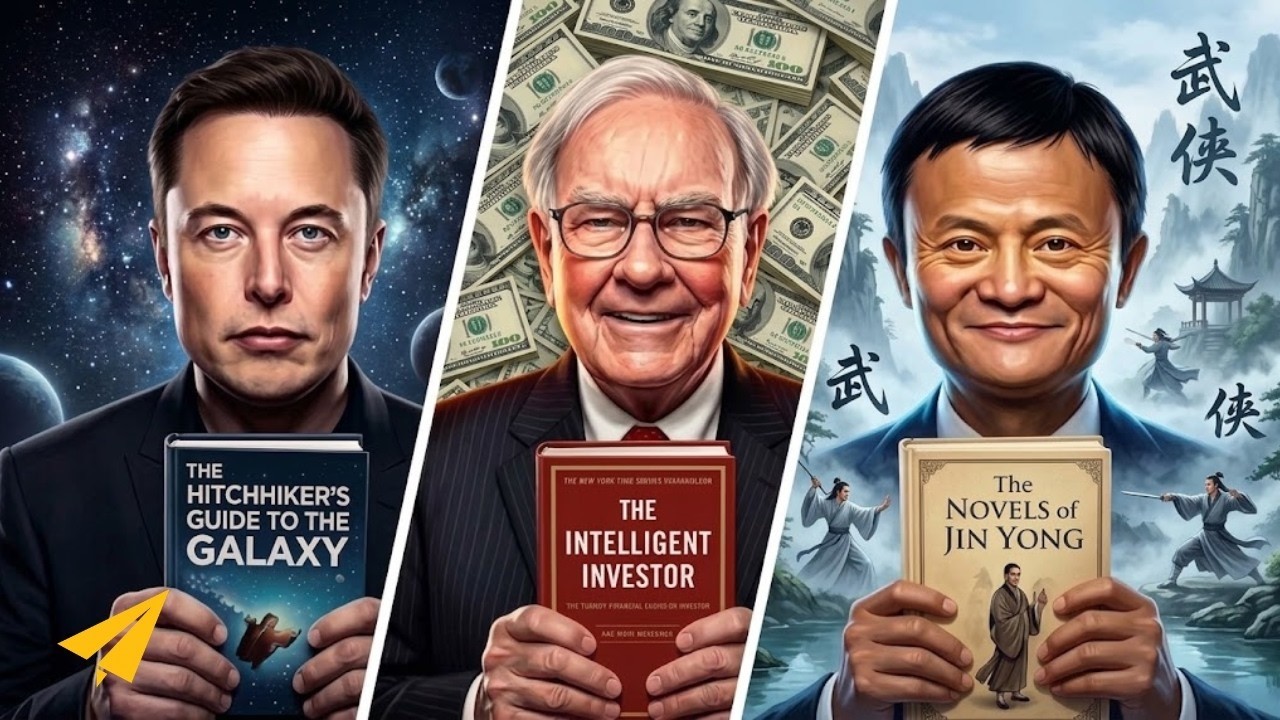
Top 10 Rules for Success From World's Richest People

Evan Carmichael presents ten success rules from Elon Musk, Warren Buffett, Jeff Bezos, Mark Cuban, Bill Gates, Oprah Winfrey, Steve Jobs, Jack Ma, Mark Zuckerberg, and Sam Altman. The principles include continuous learning, surrounding yourself with supportive people, taking calculated risks, and creating real value.
Chapters
The world's richest people built their success by following principles that shaped every decision they made. Elon Musk says you should learn at every opportunity.
I think you really want to try to learn at every opportunity.
While Warren Buffett warns that you can't afford to sleepwalk through life.
I advise students as much as possible, look for the job that you would take if you didn't need a job. I mean, don't sleepwalk through life.
Jeff Bezos says the people around you can help you move forward.
One of the precursors, one of the foundational things to being able to take risk is to have had some kind of support from somebody.
While Sam Altman says you have to believe in what you're doing.
The only motivation that I have seen work for people over a long period of time is enjoyment in what they're doing and an intense belief that it matters.
And Jack Ma says that along the way, your focus should always be on creating real value.
Leadership. It's not only about inspiring. Leadership is those people who join your company, you have to create value for him.
So today we're breaking down the top 10 rules for success from the world's richest people, featuring powerful lessons on taking action and creating lasting success. So if you wanna think bigger, make better decisions, and build a more successful future, this video is for you. Need motivation?
Watch a top 10 with Believe Nation.
If you've been here before, drop a hashtag #Believe in the comments below so I can feature you here in a future video. And if you're new, Welcome to Believe Nation, the only channel that helps you believe in yourself daily, one video at a time. Okay, let's kick it off with rule number 1, learn at every opportunity with Elon Musk.
I think you really want to try to learn at every opportunity. And, you know, it's great to read books and talk to interesting people and learn as much as possible. And, you know, I suppose it was Plato or someone who said, or maybe attributed to Socrates, if I know anything, it's that I know nothing. And so essentially, just taking that attitude that really we wish to be less Foolish over time. But I think it's actually— if you accept the premise that you're a fool, then— which we are all to some degree— then I think that if you wish to be less foolish, then I think that's a good approach. And this avoids— that maximizes your feedback loop and your ability to learn. As soon as you start thinking you know too much and people can't teach you things, that's when you start getting very dumb. So yeah, I always try to learn new things and being able to talk to interesting people. And you can often learn more by the questions that are asked than the answers that are given.
Rule number 2 is don't sleepwalk through life with Warren Buffett.
I advise students, as much as possible, look for the job that you would take if you didn't need a job. I mean, don't sleepwalk through life and don't say it's all going to be great, you know, I'll do this and I'll do that and, you know, I'm just marking time to get to be older. That, as I've told people, that's like saving up sex for your old age. I mean, it just is not a good idea. Yeah, yeah. What are your early memories? I'll explain. Guess what I'm talking about? Now, it, it, you just, yeah, you really want to be doing what you love doing, and you can't necessarily find it on your first job, right? But don't give up before you find it.
Rule number 3 is find supportive people with Jeff Bezos.
One of the precursors, one of the foundational things to being able to take risk is to have had some kind of support from somebody. You have to have some mentors. You have to have somebody who loves you. These are the kind of things that build up and allow you to kind of, you know, jump off into uncharted terrain and do something new because you know you have a support system of one kind or another. And I certainly did. So for me, I just want to point out that I feel very strongly that there's a lot— I've won a lot of lotteries. Amazon is one of the lotteries that I've won. But I had a big lottery with my parents. My dad is a Cuban immigrant. He came here when he was 16 years old, didn't speak any English. He's a great guy. And my mother had her— had me when she was 17 years old. So she was a pregnant 16-year-old in Albuquerque, New Mexico in high school, which was not cool. And she made it work. And her parents, my grandparents, helped her with that whole thing. made, made that all work. And if you don't get that kind of support somehow, it doesn't have to be your parents. Sometimes people get lucky. It's a grandparent or it's a friend or a family friend or a teacher. It can be somebody, but you need that. Somebody has to step into your life. And that's a lottery that I suspect a lot of people in this room have also won, just like me.
Rule number 4 is find your path with Mark Cuban.
My dad did upholstery on cars. So if you got a rip in your car seat, you would take it to where he worked. My mom did work odd jobs from wherever, and we, you know, we had— we lived in an okay neighborhood, but we weren't poor by a long shot, but we were truly middle class. And I, over and over— my dad didn't go to college, my mom didn't go to college, and so they would beat into me, you're going to college. And they used to make me work at odd jobs so that I would learn the value of work. And, you know, one, I'd go where my dad worked doing it with cars, and he'd make me sweep the whole— and this place was nasty— make me sweep all the time, you know. Tried to get me a job in a mill, but couldn't get me a job in a mill. My mom wanted me to lay carpet, because she was worried about me if I didn't have a trade. And so, she got a friend of hers to try to get me— to teach me how to lay carpet. And if you ever go, there's this little office in— In the back. Pittsburgh, Pennsylvania. If you trip over the carpet, that's where I learned how to lay carpet. And I was going through these things, I'm like, this is just not me. And I always had that individual spirit to say, okay, you know, I can come up with things that can make me money. I mean, when I was 9, I would sell baseball cards. When I was 12, I told my dad I wanted a pair of basketball shoes, and it just so happens he was playing poker with his buddies. Who were all probably rip-roaring drunk at the time, and I just didn't realize it. But I was like, Dad, I want a new pair of tennis shoes. You know, the new Beta Bullets were coming out, or whatever they were, and new Converse. And he's like, you see those shoes on your feet? They work just fine. When you have a job, you can go buy whatever you want. I'm like, Dad, I'm 12. I don't have a job. And one of his buddies stood up— well, not stood up, but he said, hey, I got a job for you. He had these boxes of garbage bags, and he's like, "I've got these boxes of garbage bags. I don't know what to do with. Why don't you sell them?" I'm like, "Cool." You know, what do they cost me? And they literally were a box of a hundred these blue garbage bags that he would sell them to me for three bucks, and then I would I went door to door. I was like, "Hi, my name is Mark." Do you use garbage bags? And I learned I could sell. It was just like, okay, $6, you know, I'll drop them off whenever you need them, just call me. And I made some money, bought my shoes, and, you know, and that just gave me confidence and it took off from there.
Also, if you want to take real action after this video, I made a free worksheet just for you. It covers the top lessons from today, gives you space to write biggest takeaways, and helps you build a simple action plan. It's 100% free. Just click the link in the description below to go grab it. And I'll see you there. Rule number 5 is take calculated risks with Bill Gates.
The urgency that I felt that if we didn't get Microsoft going right away, that somebody would do a great job building a software company, we won't have a chance. That probably ended up not being true, that I could have waited 2 or 3 years and the opportunity to do Microsoft still would be there. But anyway, I felt a sense of urgency. And, you know, it's not like I still get to take courses and learn things today, things like The Learning Company, and there's all sorts of great books. So it's not like I've missed some part of my education.
When you dropped out, your father and mother said, are you sure you know what you wanna do? If one of your children dropped out of college to start a company, what would you say?
Well, I'd have to say yes, but the dropping out, is not an irrevocable decision. If you try and start a company and it doesn't go well, they always let you go back. And so if you don't have kids that you need to support, it's a very low-risk thing, particularly in the culture of the United States where trying to start something and failing is not a black mark for the rest of your life.
Rule number 6 is focus on service with Oprah Winfrey.
And everybody has a different talent. And the reason we're all so messed up is because you're looking at everybody else's talent.
Yeah.
And wishing you had some of their talent. All the energy that you spend thinking about, wishing about, being jealous of, envious of anybody else is energy that you're not only putting out that's going to come back to you negatively, but you're taking that away from you. All your energy should be forced on what do I have to offer? What do I have to give? How can I be used in service? Because Dr. King's message of not everybody can be famous, but everybody can be great because greatness is determined by service. And there is not a job in here that you can do that you don't switch the paradigm to service and not make that job more fulfilling. I don't care what the job is. If you say, I'm a singer, I'm a dancer, I'm an artist, I'm a teacher, I'm a nurse, I'm a doctor, I'm a janitor, I'm a clerk. If you say, if I look at this from how do I use this in service to something bigger than myself? It no longer becomes a job. It becomes an offering to the world.
Rule number 7 is develop great leadership skills with Steve Jobs.
One of the keys to Apple is Apple's an incredibly collaborative company. And so, you know how many committees we have at Apple?
No.
Zero. We have no committees.
No committees.
We are a very— we are organized like a startup. One person's in charge of iPhone OS software. One person's in charge of Mac hardware. One person's in charge of iPhone hardware engineering. Another person's in charge of worldwide marketing. Another person's in charge of operations.
It's—
we're organized like a startup. We're the biggest startup on the planet. And we all meet for 3 hours once a week and we talk about everything we're doing, the whole business. And there's tremendous teamwork at the top of the company which filters down to tremendous teamwork throughout the company. And teamwork is dependent on trusting the other folks to come through with their part without watching them all the time, but trusting that they're going to come through with their parts. And that's what we do really well. And we're great at figuring out how to divide things up into these great teams that we have and all work on the same thing, touch bases frequently, and bring it all together into a product. We do that really well. And so what I do all day is meet with teams of people and work on ideas and solve problems to make new products, to make new marketing programs, whatever it is. And are people willing to tell you you're wrong?
Yeah.
I mean, other than snarky journalists. I mean, people that work with you.
Oh, yeah.
No, we have wonderful arguments. And do you win them all? Oh no, I wish I did. No, see, you can't. If you want to hire great people and have them stay working for you, you have to let them make a lot of decisions and you have to be run by ideas, not hierarchy. The best ideas have to win. Otherwise, good people don't stay. But you must be more than a facilitator who runs meetings. You obviously contribute your own ideas. I contribute ideas, sure. Well, why would I be there if I didn't?
Rule number 8 is create value with Jack Ma.
Leadership is not only about inspiring. Leadership is those people who join your company. You have to create value for him. You have to making sure in 3 years he will be different. Not because his job is different, because if the people are not different, the products will never be different. I told many people when they joined Alibaba, I say, guys, I don't know fortunate or unfortunate to join Alibaba. We work much longer than the others, much harder. We had more problems than most of the companies. If you can survive in Alibaba, you can survive at any company in the world because life is tough. We never promise You will be rich, you will be successful, you will promi— promoted. But we will promise you, you will be a problem, you have a wrong, you will make a mistake, you have a terrible boss. We all promised. So you set the expectation, but have a good vision. So that is the way we manage the company. And I think when you hire good people, the good people believe the vision they will get. So when I go visiting a company, whether it's a good CEO or not, I do not listen to the CEO. I listen to his people. If the people believe the vision, or the people believe this guy? If the people believe the vision. If the people believe this guy. this company has hope. A good entrepreneur can always tell good stories. I don't need to listen to stories from you guys. I can tell your people, right? If your people, any young people in your company, he can tell me the vision, he can tell me what they're doing, that is a good company.
Thank you.
That's leadership. Leadership of making sure everybody, when they sleep, when they drink, when they talk, when they go to the toilet, they talk your vision and they believe it.
Rule number 9 is try out different ideas with Mark Zuckerberg.
Companies are learning organisms, and you can make decisions that either make it so that you learn faster or you learn slower. And, you know, in a lot of ways, building a company is like following the scientific method, right? You try A bunch of different hypotheses, and if you set up the experiments well, then you kind of learn what to do. And I think that's an important philosophy. So there are all these different decisions that we make inside the company, you know, everything down to really empowering individual engineers. We invest in this huge testing framework, right? At any given point in time, there aren't— there's not just one version of Facebook running in the world, right? There's probably tens of thousands of versions running because Engineers here have the power to try out an idea and ship it to, you know, maybe 10,000 people or 100,000 people. And then they get a readout on how that version of what they did, whether it was a change to, you know, show better content in newsfeed or UI change or some new feature, they get a readout on how that version performed compared to the baseline version of Facebook that we have on everything that we care about. How connected people are, you know, how much people are sharing and how much they say that they're finding meaningful content, business metrics like how much revenue we make and engagement of the overall community. And, you know, by running tens of thousands of different experiments and putting the power in people's hands to try all these different things, you can imagine we just make so much more progress than we could if every change had to be approved by me, right? Or any— every idea had to come from management. So I do think that there's something very deep about building this, you know, learning culture. and moving quickly towards that, that just helps you get ahead over time.
And rule number 10, the last one before a very special bonus clip, is believe in what you're doing with Sam Altman.
I think if you don't actually believe what you're doing is really important, if you don't derive satisfaction from what you're doing, then you will not be able to sustain all of the bad things that happen in the incredibly long period of time that the bad things happen over. And so the, the only motivation that I have seen work for people over a long period of time is enjoyment in what they're doing and an intense belief that it matters, and ideally liking the people that they go to work with every day. But the— I think the reasons that a lot of people— and by the way, it's totally cool when people start off saying, well, I want to make money, or I want to be famous. I think a lot of people start that way, and they don't like to admit it. But pretty quickly, or at least in the first few years, I think a lot of people find a deeper mission for why they do what they do, and that drives them then for the rest of the time they work.
Can you give Japanese entrepreneurs some quick, you know, sort of advice?
I'll give them my standard advice. My standard advice to entrepreneurs is you can't be successful as a small company doing the same thing everyone else is doing. So a long time ago, I was talking to Michael Dell right at the beginning of the PC era, and I said, Michael, there must be 100 PC companies. And Michael said, no, Larry, there are 1,000 PC companies. And I said, that makes no sense to me. And it didn't, you know, of actual PC companies. His was the only survivor. Now, Apple, you call Apple a PC company. I don't. I think that's a little bit different. I mean, Microsoft, Intel, PC. Obviously, Microsoft made a lot of money from the PC, though they didn't make PCs. Intel made a lot of money from the PC, though they didn't make PCs. The only one actually made and distributed these things, I mean, everyone started, I mean, IBM, Hewlett-Packard still makes them and all that. But Hewlett-Packard was an existing company. But the only company that was really born that survived. All the rest of these— Eagle Computer, there are so many of them— went away. So if you're an entrepreneur, you have to find errors in conventional wisdom. You have to find where everyone says— when you tell them your idea, most people say you're crazy. You know, well, no one—
We love it.
And everyone says, no one's doing that. No one's doing that.
You're crazy.
No one's doing that, you're crazy. When you hear that, no one's doing that, you must be crazy, there are 2 possibilities. One is you're first with a really good idea. Unfortunately, the other is you're crazy.
And congratulations, you're one video closer to who you're meant to be. For 10 more amazing rules from the world's most successful people, check the video right there next to me. I think you'll love it. Continue to believe and I'll see you there. Some of the world's richest people didn't accept that's just the way it's done. Steve Jobs questioned conventional wisdom.
I'd always ask why you do things, and the answers you invariably get are, oh, that's just the way it's done.
More from Evan


How the Biggest Mistake in History Created A Trillion-Dollar Empire | Sergey Brin



9 Machiavelli Principles That Force People To Respect You | Machiavellian Philosophy



The First 10 Words That Instantly Ruin A Sales Conversation | Vanessa Van Edwards

The Top 1% Mindset Behind The First $5 Trillion Company | Jensen Huang (Nvidia)