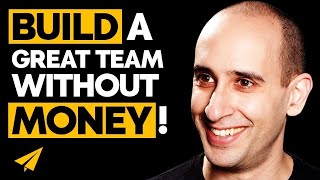
Evan Carmichael shows how to build a team on a shoestring budget. Pick one idea and focus, delegate low-value work, and hire part-time workers or interns. Joint ventures and equity splits let you bring in partners without spending cash.
Chapters
How to build a team when you don't have money. I got a great question from my YouTube viewers, Jacqueline, who wrote in. Jacqueline is a special person. She's a subscriber on the channel, comments on a lot of my videos, always leaves awesome comments. I always feel great after getting a comment from Jacqueline, so Jacqueline, thank you, and this video is just for you. She wrote in to say, Evan, I have a question. What would be your suggestion for someone who's trying to build a team with low funds but an abundance of ideas. This is a super common challenge for entrepreneurs. Entrepreneurs have EDD, EADD, entrepreneur, whatever ADD for entrepreneurs. We have ideas all the time. Nina's laughing at me as I'm making this video. We have tons of ideas, okay? Entrepreneurs have ideas. We're ideas people. We're like little arsonists. We light all these little fires, but we don't actually execute and do anything with them. And that's the problem. That's your first problem. You have to find one idea that you love and you need to focus. Like, you got to focus your time, your energy on making this one thing happen. So pick your best idea, your favorite idea, and just focus on that instead of spending 10% of your time and 5% of your time, right? Divide it up. You're too scattered. But this is common. Everybody is. A lot of entrepreneurs are. We have a hard time. We like the visionary, big picture stuff. You have a hard time staying focused, but you gotta focus. You need to have focus. When you bring in a team, remember, it doesn't have to be full-time. Okay? It does not have to be a full-time worker. The first guy I hired for my business was for 1 hour a day. 1 hour a day that freed up an hour of my time to go do other stuff. And he did a better job at it. It was stuff I didn't like doing. So you want to make sure as much as possible in your business that you're doing the higher-level, big-picture CEO stuff. You can't always do it. Especially when you're just starting up and you're a one-person show, but your highest value is going to come from doing the things that you're really good at and you love, and you want to start delegating off the low-value stuff that still needs to get done in your business, but it shouldn't be you doing it. So part-time workers, interns— I brought on high school and college interns and foreign language interns. I've brought on, again, part-time workers. I've used Websites like oDesk and Elance. oDesk is my favorite now, although they've merged, so I don't know what that relationship looks like, but I still have a team on oDesk that I love and do great work, including Christina, who does all these videos. Thank you, Christina. I love you. I've even had people who are fans. So I've done, you know, people who are active in my community and who like what I stand for, they want to find ways to help, just to volunteer. There's Arturo who takes some of these videos and translates them into Spanish just because he feels like Spanish entrepreneurs need to get this entrepreneurial education. And there's Kevin who, you know, wants to learn how to be an entrepreneur, wants to help out with some of the projects I'm working on, so he's helping out with some stuff. So when you stand for something important, when people believe in what you're doing, when it's something powerful, something that means something to them, they'll want to get involved and help out. And the last thought that I have for you is look at creating joint ventures. And so, you know, you're bringing somebody onto your team, you have to decide, is this somebody who's going to be just an employee or somebody who I'm comfortable doing a partnership with? And a lot of the stuff I've done in my business is I've partnered with people on specific projects. So I own my business 100%. I don't have investors, I don't have partners, it's just me. But I have JVs, joint ventureships, with a number of people on specific projects. And so that all works differently. It could be 50/50, 70/30, whatever ratio you think makes the most sense. It's simply going to be based on how much each person brings to the table, but you're not spending a lot of money to do this or any money to do this. They're investing their time, but you have to make sure people get paid for what they're doing, right? So if they're going to invest a lot of their time up front and not get any payment, they got to get something in return. On the end, which is some kind of joint venture in the project. I'd be hesitant to give up a percentage of your business unless you feel the person is really, really, really, really, really the right fit for your company. That's my advice. Thanks for all the comments. Believe. For those of you watching the video, please give it a thumbs up below. Let me know what you think. Ask a question. Tell me how to feel better. Leave it in the comments below. And you can click on my face to subscribe to the channel. Thank you so much. I'll see you soon. ¡Chao!