10 Skills That Will Make You Rich in 2026 : Learn Naveen Jain's Untold Secrets for Success
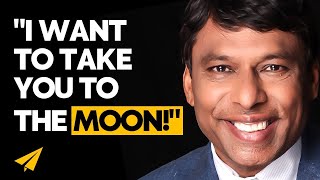
Naveen Jain, co-founder of Moon Express, shares ten principles for building wealth. He estimates a lunar mining mission at under $50 million with a potential $500 billion return. His core rules: pivot fast, execute over planning, trust instinct, learn from failure, target massive problems like water and energy, and build networks through vulnerable relationships.
Chapters
When would we be able to tell your honey that I want to take you to the moon?
10 years.
10 years. Entrepreneurs never fail. Their ideas may or may not work. And you know what entrepreneurs do? They pivot. You know, business is like a war. You have to be completely prepared. It's not about the great vision. It's always about the great execution.
He's a business executive, entrepreneur, and founder and former CEO of Infospace. He's the co-founder of Moon Express, a company that is making machine-operated spacecraft to try to go to the moon and harvest it for its raw materials. He's on track to potentially become the world's first trillionaire. He's Naveen Jain, and here's my take on his top 10 rules for success. Rule number 1 is my personal favorite, and make sure to stick around all the way to the end for some special bonus clips. Also, as Naveen is talking, if he says something that really, really resonates with you, please leave it in the comments below and put quotes around it so other people can be inspired as well.
Enjoy.
At a compound in Mountain View, California, internet billionaire Naveen Jain is hatching a plan that could make him the world's first trillionaire.
Naveen, good to see you, my friend.
So, Naveen, the team is working It's getting hard, as it usually is.
Of course.
So we're going to land on the moon somewhere around here, close to where the Apollo spacecraft landed at the equator.
How did you pick that area?
Well, it's— first of all, it's on the near side, so it's easily accessible from Earth. It's an area— the dark area are actually regions of lava plains, so they're not mountainous.
Not so long ago, it was the Soviet and America superpowers that were locked in a race to land on the moon. Now it's Bob and Naveen who are leading the competition to mine precious metals from its surface.
Are we still on We're still on track to land on the moon by 2015.
We're still on track, Naveen.
Initially, we thought the mission was going to cost us about $100 million. Do you think we can bring the cost down to, say, $50 to $60 million?
Yeah, even less.
Even less?
I think the first mission will be under $50 million, and subsequent missions may be under $40 million.
When would we be able to tell your honey that I want to take you to the moon?
10 years.
10 years.
Not only will it be a honeymoon, but I can take my honey to the moon, and I think that'll be the killer.
If you can do that, that's real business. If we can go to the moon for $50 million and the cost comes down to $20 million and we're able to bring back the things worth $500 billion, I don't care what anybody says, that's a great business. Somebody is going to create a trillion-dollar industry in space, and we sure hope it's us. When you tell somebody what you're doing and they don't think it's a crazy idea, then you're thinking too small. So when you walk up to a party and people say, what are you doing? What do you do? Well, I mine the moon. Well, that's, that's crazy. Well, I'm thinking big. As a young entrepreneur, I learned several valuable lessons, but I think the most valuable lesson I learned was trusting your own gut instinct. It's not about the spreadsheets. It's not about the numbers. It is about what you feel in your heart. Just remember, there's so many variables in the real life. A spreadsheet can never capture them. The brain only works on the logic of zeros and ones, and it doesn't know how to deal with a lot of the gray areas. Your gut, your heart, is a chemical computer. It computes things on fuzzy, fuzzy magic, fuzzy logic. That means a lot of the times you will start to feel that something doesn't feel right, even though the numbers do add up. Never be afraid to fail. Entrepreneurs never fail. Their ideas may or may not work. And you know what entrepreneurs do? They pivot, right? Pivot is a way of saying, I have found a stepping stone to even bigger success. So the way you do that is always never let the ideas that has not worked become the failure of a person. You as a person becomes better every time. And the more have you failed, the more arrows you have on your back. So after the third time, You can go to anyone and say, "Sir, I am the right CEO because I know exactly what not to do." 3 times over. I wake up about 4:30 and 5:00, and between 5:00 and 5:15, I am working on email, catching up on news, looking at the blogs, looking at the different opinions. Because people just don't sleep. I mean, they're working 24/7. Somewhere around the world, people are awake and working. So you're always constantly being bombarded with requests, information, or just sometimes news. And so in the morning I wake up and I, you know, take care of my mind. And then after that I work out and that's taking care of my body. And then I do meditate before I go to work, so that takes care of my soul. You know, business is like a war. You have to be completely prepared. And unless you have mind, body, and soul really all ready for it, you just can't fight that battle. Don't limit yourself. Go out and pursue your dreams. Even if you know nothing about what you're going to do, go out and do that. Every time you have a self-doubt, just remember that every single successful company goes through a near-death experience before they go out and become successful. It is the mindset, you know. So people talk about people are optimistic or pessimistic, so they look at whether the glass is half empty or half full. To me, that's really the wrong question to ask. The only thing you as an entrepreneur to think about is, do I want to fill this glass? And the next question you ask is, what do I want to fill it with? It doesn't matter what it looks like. Your job is to imagine and dream about what you want it to be. The biggest problems are really the social problems, and if you can solve them, it's a massive opportunity. Dream so big that people think you're crazy, and never be afraid to to fail. If you want to make $1 billion, all you have to do is solve a $10 billion problem. So go out and find a way to provide the fresh water to the humanity. Go out and find a clean solution for energy. Go out and find a solution to agriculture. Find a solution to poverty. All of these are $100 billion problem. So don't think of them as a problem. Think of it as a great entrepreneurial opportunity. And solving any of these problems will make you a billionaire. Another valuable lesson I learned was being persistent while being flexible. A lot of entrepreneurs spend way too much time writing a business plan rather than really doing things. As you continue to execute, you will find new things. You will learn new valuables. The trick is to have your business plan which only provides you the guidelines but not the roadmap. Because as you are going out and doing things in real world, you will find things will never ever turn out to be the way you expected them when you started a business. So it's not— don't try to stick to your business plan or spend too much time writing a business plan, but learn as you are executing on a business plan, and you will find yourself to be successful.
For Naveen, the billionaire formula is simple.
What makes a successful person? They go out and solve big problems. So you know how to make a billion dollars? You solve a $10 billion problem.
Having already made his billions, he now unashamedly wants to use his business brain to change our world.
Let's focus on education, healthcare, energy, shortage of water, shortage of food, and I'm going to tell you how innovation and entrepreneurship can solve each of these problems. Let's look at education. Imagine If you are able to use a $25 tablet and build some type of a game that's more effective than a private tutor and is more addictive than the most addictive video game. Think about it, one day a child is going to come to the mother and say, "Mom, can I just play one more hour of math because I enjoy it so much." Naveen has a knack of putting people under his spell, making his mission to solve some of mankind's biggest problems seem plausible.
In space and on Earth.
What if we can build an artificial intelligence system that can be used by a village girl? She'll be able to go door to door and able to diagnose the diseases where there are no healthcare, there's no hospitals, there are no doctors.
These are big ideas that could turn a big profit, but some of them seem a bit far-fetched.
What if we take a 3D printer on the moon and somebody can go out and send the DNA of a bacteria or a virus and we print it right there and leave it on and watch it grow.
These ideas, they're a bit out there, aren't they, Naveen? Don't people think you're just a bit mad?
Well, the point is that the reason they think it's mad, because it's already— they don't know it's already happening. The things that used to be science fiction are now becoming science reality. So I think in a lot of the times, and this is just, you know, it's totally off the topic, but people come to the conferences and with agenda. They have a hidden agenda. They want to get something done. They want to be politically correct. They cannot be themselves, and they are told never be vulnerable. Imagine what? You do not build the deep relationship with a person unless you can be vulnerable. Unless you can share your emotional connection with a person, you can never build deep connection. People measure their success when they leave the conference, how many business cards they gave, and how many business cards they collected. Guess what? If you ever think you have more than 5 people that you met in the conference that you think you have a friendship with, you have friendship with no one. You have to spend time. You have to connect with people. You have to give yourself to them, and you have to let your heart in their hand and say, I trust you. And when you do that, that is the time you build a deep relationship. When you leave this conference, they become your lifelong friends. So make 1, 2, 3, or 4 of those lifelong friends when you go to a conference. Find a like-minded person who is going out, going to make the change, who's going to go out on a journey with you to go out and change the world. To me, doing well by doing good is my philosophy. That means you can create a great venture, and if the venture can do good, that becomes a philanthropic venture from my perspective. So to me, you can't create a $10 billion company by solving a $1 billion problem. That means you have to go out and solve a $100 billion problem. And it so happens those $100 billion problems are massive social problems, which are education, the healthcare, the clean water, the energy. And if you can go provide access to education and healthcare to billions of people around the world. And if you happen to make a billion-dollar profit, my hat's off to you. That's a great venture. And that's what we want people to do, is not to separate becoming— doing well from doing good, because you can do both. And that's how you create scalable, sustainable change. Well, the last and the most valuable lesson as an entrepreneur I learned was about the value of execution. We're too many people Way too many people spend too much time thinking about the vision. We are taught that you have to build a better mousetrap. Every venture capitalist will tell you that to be a successful entrepreneur, you need a breakthrough innovation. Well, you have to assume none of us, or at least most of us, are not the smartest people in the world. There are lots and lots of great, great inventors out there. How are we going to be the person who's going to always build a better mousetrap. Well, to be successful, you don't have to build a better mousetrap. You just have to build a different mousetrap. And as long as you are executing well, the business always comes down to block and tackle. It's not about the great vision. It's always about the great execution. And you can always succeed by out-executing your competitors not necessarily having the best product in the marketplace. And I think Microsoft is a great example where they took a same product that other people may have had, but they executed substantially better, and today they're the market leader in the industry.
Thank you guys so much for watching. I made this video because Ali asked me to, and thank you so much because this is one of the most fun and inspiring top 10s that I think we've ever put together. At least I was extremely inspired by it, and I love all my top 10s, but this one was especially inspiring. So thank you so much for that, that ask. And if you guys have somebody that you'd like to see profiled next, a famous entrepreneur that you want to be inspired by, please leave it in the comments below and I'll see what I can do. I'd also love to know what rule had the biggest impact on you and why. What lesson are you going to apply to your life or business immediately? Leave it in the comments below. I'm going to join in the discussion. Finally, want to give a quick shout out to Mehavil, thank you so much for picking up a copy of my book, Your One Word. It really, really, really means a lot to me. So thank you guys again for watching. I believe in you. I hope you continue to believe in yourselves and whatever your one word is. Much love. I'll see you soon.
Think differently. It's not about thinking outside the box. It's about thinking in a different box. If you become an expert in your field, you become absolutely useless in your field. Because the day you become an expert, you become incrementalist. You think about incremental evolution. So if you want to disrupt something, go out in a completely different industry that you know nothing about, because then you're thinking in abstract. So never be afraid to talk about your problem to someone who knows nothing about your industry, because they will come up with the ways that you have never thought before. Making money is a byproduct of doing things that you really enjoy doing. Doing, it is never a goal in itself. And it's like having sex and orgasm— you have to enjoy the process and not focus on the end goal. People actually who focus on end goal, like getting an orgasm, never get one. As I was in college, I learned a couple of valuable lessons. One of them was passion. We have a lot of distractions in life, but there's something that are really important to us. We spend our waking hours and our sleeping time all thinking about that particular thing. Once you find that passion, you will find that it doesn't— it's no longer a work. It becomes your life. It consumes you. So find something that you're really, really excited about and devote your life to it.
More from Evan


How the Biggest Mistake in History Created A Trillion-Dollar Empire | Sergey Brin



9 Machiavelli Principles That Force People To Respect You | Machiavellian Philosophy



The First 10 Words That Instantly Ruin A Sales Conversation | Vanessa Van Edwards

The Top 1% Mindset Behind The First $5 Trillion Company | Jensen Huang (Nvidia)

