7 Boring Businesses You Can Run From Your Laptop
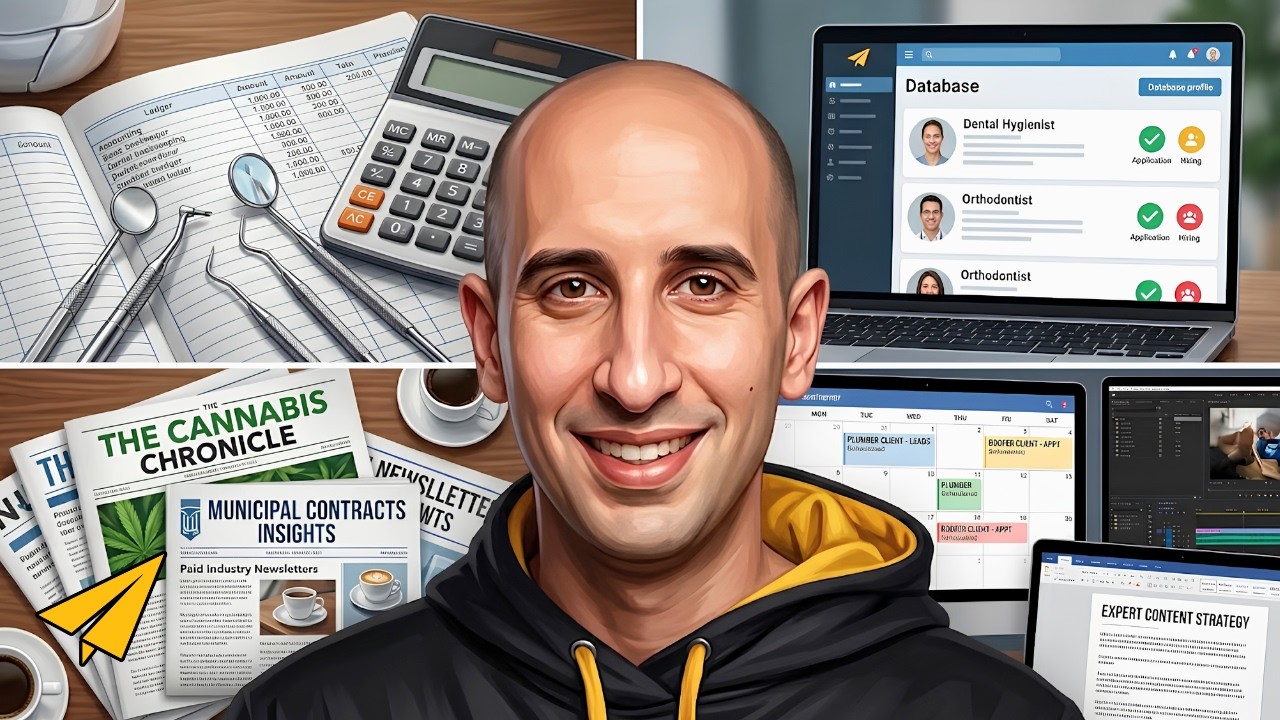
Evan Carmichael breaks down seven boring solo businesses you can run from a laptop: niche bookkeeping, job boards, industry newsletters, offshore staffing placement, white-label content, podcast production retainers, and lead-gen shows. AI now lets one founder build software products that used to need teams. The pattern across all of them: find a specific problem, price high for a few clients, and use leverage to scale.
Chapters
The most profitable businesses right now are the ones nobody wants to brag about. They are simple, boring, and make cash quietly every single day. There are 29.8 million businesses in America with zero employees, and together they bring in $1.7 trillion a year according to the Census Bureau. You can add one more to that 29.8 million this year, and then you stop needing anyone's permission for how much time you work, how much money you make, or how much time you spend with your family. So here's Here are seven boring businesses you could run from your laptop. It starts with a guy named John Jonas, who is also a friend of the channel. He lives in Utah. He runs a job board, and he works about 17 hours a week. John quit his job in 2004. He'd had it for eight months, and his biggest goal at the time was just getting out of it. So he started working from home for himself, and he did what you do at the start: everything. In January 2006, he hired his first full-time worker in the Philippines. He said the guy didn't know anything. They still joke about it today, and that guy still works for him today. But John says that one hire. changed his life because the guy would do anything John asked him to do. John stopped doing the tasks himself and started spending his time growing the company. Then his friends asked how he did it. Then their friends asked, and pretty soon John was spending his days matching business owners in America with workers in the Philippines as a favor for free. It got overwhelming for him, so he built a website to do the matching for him and called it onlinejobs.ph. It's a database of workers and a search box, and employers pay to search it and message people directly, and companies post their open jobs on it. John doesn't do the work. He doesn't manage the workers. He doesn't hold a product and doesn't ship anything. The database now holds more than 5 million Filipino profiles, and more than 600,000 businesses, including mine, use it. And John still works about 17 hours a week. Count what he had to buy to build that. No inventory, no storefront, no van, no warehouse. He had a problem he'd already solved for himself. And a laptop. Now, you might be thinking, okay, well, he started a long time ago and it's all taken now. Look at that number at the top again. 29.8 million American businesses have zero employees, and solo businesses have been growing faster than businesses with staff almost every year since 2012. Hundreds of thousands of brand new ones open every single year. And after working with thousands of clients, I found the boring industries are the easiest places to win. Far fewer people are fighting for it. Nobody's excited about bookkeeping for dental offices, and that's exactly why there's room. It just pays every month. So here are the 7 boring businesses that you can run from your laptop. If you've been here before, drop a hashtag Believe in the comments below so I can feature you here in a future video. And if you're new, welcome to Believe Nation, the only channel that helps you believe in yourself daily, one video at a time. Believe. Business number 1, do the books nobody wants to do. So every business has to file taxes and almost every business owner is behind. The Bureau of Labor Statistics puts the median pay for bookkeeping and accounting clerks at $49,210 a year, which is about $24 an hour. Add payroll tax and the benefits on top, and a company spending well over $60,000 to keep one on staff. That's why so many owners would rather just send the work outside instead. What you're selling is a clean set of books by the 5th of every month. Small operations pay $500 to $1,500 a month depending on how many transactions run through them. 8 clients at $900 a month is $7,200 a month, and you'll do most of that work in the first week. There's also cleanup work too, and it pays faster. Every accountant in your city has clients whose books are a disaster going back 2 years, and the accountant hates doing cleanup. That's a one-time project that you can charge $1,500 to $3,000 for. Do 3 of those and you brought in $4,500 to $9,000 while you build the monthly side. Better than that, a cleanup client almost always turns into a monthly client because now they felt what it's like. To be behind. Pick one industry and only serve that industry. Dentists, plumbers, gyms, trucking companies. When you only do dental practices, you learn one chart of accounts, one software, one set of problems. And by your 4th client, you're faster at dental books than almost any generalist. Then dentists start sending you other dentists because they all know each other and they all complain to each other about the same thing. You need a laptop, one accounting software login, and a certification that you can finish in a few weeks. That's the whole setup. And you already know if this is for you. If you're the person who color codes a spreadsheet for funsies, stop apologizing for that and start charging for it. Business number 2, build the list everybody in one industry needs. So this is John's business, and you can build the same thing for your own industry as well. A job board is a database with 2 sides, workers on one side, employers on the other. You charge the employers because they are the ones with the budget, and you never do the job that is actually being The mistake is going broad. A general job board has to beat Indeed and LinkedIn, and you will not outbuild them. So go so narrow that it sounds silly. Commercial HVAC technicians, ranch hands, dental hygienists in one state, marine mechanics, overnight veterinary nurses. Getting the first listings is the only hard part, and you fix it by picking up the phone. Call 20 companies in your niche and offer to post their open roles for free. It's free and it's built just for their trade, so plenty of them say yes. Once workers show up because the listings are there, you start charging. Employers years posting on niche boards run $99 to $299 each. 20 postings a month at, say, $199 is almost $4,000 a month. Get to 60 and you're over $140,000 a year. And the daily work is approving posts. Then you stack more income on top of the database. Charge the most for a featured spot, the listings that sit at the top of a page, around $500. And an employer in a hiring panic pays it without asking. Then look at the companies hiring more than once a month and sell them at $299 a month for unlimited access to search the workers database themselves. 2 separate postings already costs them almost $400, so it saves them money and it locks in your revenue. And once both sides are on an email list, one sponsored email to the employers is worth more than a week of listings. A job board also gets easier every month. Every listing you post is a page that keeps pulling in workers while you sleep, and more workers is what more employers pay for. Those pages keep working long after you post them. Business number 3, write a newsletter for an industry nobody covers. Matt Brown writes a newsletter called Extra Points. It covers the business side of college sports, not the Not the games, not the scores, contracts, budgets, conference monies, the stuff athletic directors actually get fired over. That's the model. Find an industry where the decision makers control real money and have no good source of information and become that source for them. The math is actually pretty friendly. Paid newsletters run $8 to $10 a month. 1,000 people paying $10 a month is $120,000 a year. 2,000 people is almost a quarter million. You don't need a million readers. You need 1,000 people who need this to do their job well. So here's how you can find the industry. Look at when it's regulated. Changes fast and full of big money that moves in big chunks. So insurance, municipal contracts, commercial real estate in one metro, cannabis licensing. If one thing you tell them saves them thousands of dollars, $10 a month is nothing to them. You do not need to be the expert on day one. You need to be the person who reads everything and calls people. So interview one operator a week and you'll know more than almost anyone in that industry inside of a year. That one interview also gives you the week's issue, teaches you the business, and wins you a subscriber who also forwards it to their whole team. Start free and weekly for the first 6 months, build to around 10,000 readers, then put the deep stuff behind $10 a month and leave the summaries for free. The free issues keep bringing in new readers and the paid ones are what actually pays the bills. And once the list is real, companies that sell into your industry will pay you $500 to $2,000 for a single sponsored slot because your readers are the exact people that they're trying to reach. Write it once, send it to everybody. That's the whole business and it still fits on your laptop and a kitchen table. Business number 4, place the people. So you pay a helper $5 an hour, you charge the owner $20, and you keep the $15 in the middle. That's the business. Look at what the market charges now. Placement companies like Wing Assistants start around $8.74 an hour, and you get whoever they assign you. Stealth Agents start around $15. Belay uses American Assistants, starts around $46 an hour. Boldly starts around $65. You sell that $20 with a person that you tested yourself, which is less than half of what the American agencies charge for someone who is vetted. You can hire at onlinejobs.ph. A business owner in America will happily pay $15 to $25 an hour for the same task done well because their own hour is worth far more than $25. So you're not doing any of the actual work. You're finding the good people, you're testing them properly, you're matching them to owners who are drowning, and you're then keeping the difference. Finding clients is easier than finding the workers. Every business owner that you meet is complaining about being buried in work. Ask them one question. What did you do last week that somebody making $25 an hour couldn't do? $20 an hour could have done. They'll list 6 things without pausing. That list is your business proposal. And offer a free replacement inside of the first 30 days in writing. Keep a few tested people ready and it barely costs you anything. It also kills their biggest worry, which is getting stuck with a stranger they don't know how to manage. Place 10 full-time assistants, keep $15 an hour on each. At 160 hours a month, that's $24,000 a month from placements that you already made. Also, if you want to take real action after this video, I made a free worksheet just for you. It covers the top lessons from today, gives you space to write your biggest takeaways, and helps you build a simple action plan. It's 100% Business number 5, run somebody else's content from your kitchen table. Every expert you know is sitting on content that they'll never publish, and it's for the same reason every time. A coach who has to set up lights and learn microphones and edit the footage, write the titles and upload everything is looking at a second full-time job, so he never starts. You could take that off him. He records on his phone for an hour. You do everything after that for him. Charge $2,000 a month to run one person's content completely. Business number 6, run a podcast. 4 clients is $8,000 a month, which is $96,000 a year. Your first client will eat your week because you're learning. By your fourth, you'll have a routine and each client will only take a few hours per week. Once you're full, you can hire skilled editors out of the Philippines and your margins jump again. Sell it as a fixed monthly list so nobody argues about the scope. So one recording session, 4 long videos, 12 short clips, the titles, the thumbnails, the descriptions, and the uploading for them. Everything delivered inside 5 business days. When the deliverables are that specific, they stop haggling with you. and start comparing you to just hiring somebody at $60,000 a year. Getting your first client costs nothing. Find somebody good who can't afford you yet. Offer to work with them for free on Zoom and record the session. Post it. Now you have proof. Do that 3 times and you have a business. Here's why people say yes. They get videos online every single week and they never once have to touch the software. Every doctor, lawyer, financial advisor, contractor in your city wants that, and none of them want to learn the video editing. Business number 6, sell your advice on a retainer. You know something somebody would pay for right now. The problem is you keep planning to sell it for $47 a month. Start at the top instead. My own team prices coaching for what we do at $15,000 for 4 months, and then it moves to $3,000 a month retainer after that. Even well below those numbers, the math works. 4 clients paying $2,000 a month is $8,000 a month. That's almost $100,000 a year from 4 people you talk to every week. A cheap, low-priced community sounds easier to do, but isn't. To match that $8,000 a month with a $50 membership, you need 160 60 paying members and each one of them can ask for a refund. That is a customer service nightmare you just built for yourself. What goes inside the 4 months is simpler than you guess. A call every week, every other week, a shared document with what they're supposed to do, access to you between the messages and the calls. That's it. They're paying for somebody like you who knows their exact situation and will tell them the truth about getting out of it. Your first 4 clients come from people that already know you. Write down 30 names of people who have watched you do this thing well and send them each a short message asking who they know that's stuck on it. You're just asking who they know. Send 30 messages and a few turn into real conversations. You don't need a website. Some of the most successful people I work with don't have a website. You need a Stripe link and the ability to confidently believe that your price is worth it to your clients. Stop underpricing yourself. Say it simply, my program is $15,000 for 4 months, then stop talking. Do not explain it. Do not apologize for it. Do not feel the silence. If you keep talking, they'll decide the price is negotiable. Business number 7, bring the trades. Next 10 customers. Commercial roofers, HVAC companies, plumbers, dental practices, they all have the same problem. They're good at the work and terrible at getting seen. They'll pay you well to fix that, and they'll never once ask about your logo. So start with what we call a Money 50 list. That's 50 people or companies who could each send you 6 figures of business over the next year through referrals. Break them into 5 categories and go 10 deep in each one. If you want to serve plumbers, your 50 includes property managers, general contractors, real estate agents, facility managers, and commercial landlords. Then you start a show. You call it the Denver Commercial Property Show or whatever fits. Invite the people on your list to be interviewed about their business. They ignore a cold email and they ignore a coffee invitation, but almost nobody says no to being interviewed about how good they are at their job. The show costs almost nothing to run. Zoom, a decent microphone, and 45 minutes a week. Publish it and send each guest their clip so they can also post it themselves on their social media. Every episode gives you another video, another name in your phone, and an easier Yes. From the next guest. You do the interview, you ask about their journey, and recording stops. Say one sentence. If any of your builders ever need a plumber you can rely on, I've got one. Let me make that introduction. That's it. Now that person starts sending you work and you never left your desk. Charge either a monthly retainer around $2,000 or a flat fee for every qualified appointment that you book, usually $150 to $500 depending on what a customer is worth to them. A roofer pays you $2,500 for 5 meetings and wins a $40,000 job out of He's thrilled. One property manager you interview can send you 10 jobs at once. That's one relationship doing more than a year of cold outreach and waiting. The boring ones pay the best. Every business on this list is wide open to you because none of them make a good story at a party. You do not need permission and you do not need to feel ready. Start the business now and let the boring thing pay you for the next 20 years. You know when the best time to make that first call is? Now, how about right now? And congratulations, you're one video closer to who you're meant to be. Believe. Now let's learn how you can start a one-person business with AI. One person with a laptop can now build what used to take an entire company. I think it is probably possible now to start a company that is a one-person company that will go on to be worth like more than a billion dollars. And more importantly than that, deliver an amazing product and service to the world. For the first time in over 50 years, more than 1 in 3 new startups are being built by a single founder with no co-founder at all, up from fewer than 1 in 4 back in 2019. And the startup data firm Carta credits the jump to AI tools that let one person do the work of a whole team. So the question for you isn't whether a one-person business is possible anymore— that's proven— it's whether you're going to be one of the people who finally builds a thing that you've been putting off, or whether you'll And watch other regular people do it first. Let me tell you about a guy named Mark Liu. Back in 2021, Mark hit rock bottom. He was broke, he was depressed, and he was living in his parents' house with no income and no clear way out. He didn't have a co-founder, he didn't have a team, he didn't have investors lining up to rescue him. What he decided to do instead was teach himself to build small software products and then ship them over and over again. Again on a single laptop. Now, most of them flopped pretty hard, and that's the part that people love to skip over. He built more than 20 projects that went absolutely nowhere before one of them, a simple tool that helps other builders launch their products faster, finally caught fire. Now, today Mark runs about 15 little products entirely by himself, and together they bring in roughly $85,000 every single month with almost no expenses because the whole team is just He never hired a single employee. He never raised a dollar from anyone, and he built the entire thing out in the open, posting his real revenue and his ugly failures for the whole world to watch. He went from his parents' spare room to millions of dollars in sales, one small product at a time, and he never once asked anyone for permission to start. Now, the common objection that I often hear that stops almost everyone before they take that first step is, that's great for Mark. But he's a developer who can write code and you can't. I get it. And listen, this is— I want to be honest because all progress begins with telling the truth. For most of history, that objection was actually completely fair. Building software meant you either spent years learning to code or you raise a giant pile of money to hire engineers. And if you couldn't do either one, your idea just kind of died in your head. That wall though now is completely gone. It came down recently. It's come down quietly and a lot of people haven't realized it yet. Yet with Claude, you can describe what you want in plain normal English and have it write the actual working code right alongside you, step by step, explaining as it goes. The skill that matters now isn't typing code, it's knowing which problem is worth solving and being willing to start before you feel ready. So think about what that actually means for you. The thing that used to cost $50,000 or team of engineers or 6 months of waiting, you can now sit down and build yourself in an afternoon for the price of a subscription. That barrier that kept regular people kind of locked out of building software for the past 30 years, it disappeared. And the people who move on it early are going to look back at this exact window the way people wish that they had bought into the early internet. You're not too late, you're almost too early, which is the best place in the world to be. So let me walk you through exactly how you'd build your own one-person business with Claude starting from absolutely nothing. Pick a problem you already know. So let's start with this. You pick one painful specific problem that you already understand better than Almost anyone. This is where you have an unfair advantage, and you probably don't even realize that you're sitting on a gold mine. Every job you've ever worked, every industry you've ever been around, every hobby you've ever gone deep on has handed you a private list of annoying problems that people inside those worlds would gladly pay to make disappear. So the builders that are winning right now, you're not—they're not just chasing some giant trendy idea that they read about. They're taking one small pain that they personally know inside out, and they're solving just. at one thing. So take Danny Postma. He'd already built and sold one company in the AI space, so he knew that world cold. And when he noticed people were paying hundreds of dollars for a professional headshot, he built an AI tool called Headshot Pro that does it for a few bucks. He solved the problem he understood deeply for people he understood deeply. So get killer at one thing. Don't try to build the everything app that does 50 things badly. Build the single thing that you would happily have paid for back when you were stuck doing it the slow, painful way. Your purpose here usually comes from your own pain. From the precise frustration that you live through and never want to touch again. And the range of what you can build is wider than most people think. So people are building small software tools that businesses pay a monthly fee for, simple apps that solve one annoying task, systems that watch a company's online reviews and draft the replies, dashboards that track numbers about a specific industry cares about, and automated services that run a piece of someone's business for them every day. Every one of those started as one person noticing one specific pain. So right now you can write down five problems that. That you personally understand, the ones that usually make you sigh at your old job, and circle the ones that make you the angriest. That's your business. Let Claude build it with you. So now you start the conversation with Claude and let it carry all of the technical details and weight that like you don't have. So here's how it actually feels when you sit down to do it. You open Claude and you describe your idea in regular words the way you would explain it to a friend over coffee. You say, I want a simple tool that does this specific thing for these specific Claude asks you smart questions that you hadn't thought of. It helps you lay out a clear plan, and then it starts writing the real code while explaining what each piece does and why. When something breaks, and it's absolutely gonna break, you copy the error message, you paste it back in, and Claude fixes it with you and tells you what went wrong. So you're never expected to know any of this in advance. Claude Code can live right on your computer and build the whole thing right beside you, file by file, like a patient senior software engineer who doesn't get tired, who doesn't roll their eyes at you. At you? Does it make you feel stupid for asking those basic questions? Being leads to doing here, I think, in the most literal way. The moment you start acting like a builder, even a slow and clumsy one, you actually start becoming one. And the speed comes shockingly fast after the first week. Ship the ugly first version. So now we want the smallest possible version live and in front of real people fast before you feel ready. This is where you separate yourself from the 99% who tinker forever in private and never ship a single thing. You are not trying to build the perfect product. You are trying Trying to build the slightly embarrassing first version that does one useful thing well, and then put it in front of a handful of people who actually have the problem. So builders are doing this in days now, not years. Go back to Danny Postma. He built the very first version of the headshot tool in about 30 hours, put it straight out into the world, and it made $100,000 in its first 2 weeks. He didn't sit around polishing it from private for a year. He shipped the rough version and let real customers tell him what to fix. So ready isn't real. So stop waiting to feel it. Ship the rough version. Watch closely how real people use it. Listen to what they complain about and let their reactions tell you exactly what to build next. A scrappy thing that exists and earns beats a beautiful thing that is still trapped in your imagination. So getting it live is a good start, and from there you make it 10 times better using real feedback instead of your guesses. The market will teach you more in one week of being live than one year of planning ever could. Charge real money, aim high. So now we want to charge real money from day one and aim higher instead of low. This is a mistake I watch kill one-person businesses before they even get a chance to breathe. People build something decent, then price it at a couple of dollars, which means they suddenly need thousands and thousands of customers just to put food on the table. And that requires a giant marketing machine that they don't have and can't afford yet. So we want to flip the whole thing around. As a solo builder, your sweet spot is usually a smaller number of people paying you a mean Meaningful amount each. So we can look at some simple math. If you find just 4 clients paying you $2,000 a month, that's $96,000 a year. And that is a one-person, almost 6-figure business that you can run from your kitchen table with no office and no staff if you want to. The same logic works for software. Some solo builders charge businesses around $1,000 a month for a single tool, and just a handful of clients like that changes your entire life. The whole point is to charge enough that a few good customers carry you instead of chasing 1,000 cheap ones. And look at how big this get with just one person. Danny Postman's AI headshot tool brings in around $300,000 a month, run entirely by him, and his whole solo portfolio of products clears roughly $3.6 million a year with no co-founder and no investors. Tony Dinh left his big tech job, built his own software tool on his own, and crossed more than $1 million a year all by himself. You don't need a million customers. You need a real product, a fair and confident price, and the courage to charge what it's genuinely worth. Let Claude run the business. Next, we can use Claude to run the parts of the business that aren't building. So you can stay a team of one without drowning in all the busywork. The real reason one person can pull this off now is that AI doesn't just write your code, it can handle the work that used to force you to hire people. So you can have it draft your sales emails, write articles, answer the common questions, sort and prioritize your inbox, and turn one long video into 10 short clips to promote what you built. So this is how I like to use eliminate, automate, delegate, except now you get to delegate to AI instead of people. You can eliminate the busywork that keeps you broke and keeps you tired. You automate the repeatable stuff that drains your hours, and you let Claude handle a huge chunk of the rest, not everything, but a huge chunk so that the only thing left on your plate is the high-value work that actually grows the business and makes the money. That is precisely how a single person Runs an operation that looks from the outside like it must have a whole team and an office behind it. So guard your hours. Every task you hand to AI is an hour that you get back to build the next thing. Build it out in the open. So a very cool idea is to build a whole thing out in the open because for a one-person business, attention becomes oxygen for you. The biggest fear solo builders carry is that they'll pour months into something great and nobody will ever find it. So how we fix that, and it costs you nothing, just a little bit of courage, you share the journey publicly while you build it. Mark Liu became known to a huge audience not by running expensive ads that he couldn't afford, but by posting his progress, his real revenue numbers, his wins, and his embarrassing— in quotes— embarrassing failures out loud for anyone to follow along. People don't just buy a product, they buy the story and the person behind it, and they root for someone that they've watched struggle and keep shipping Anyway, so pick one place online, post what you're building this week, show the ugly first version with no shame, ask people what they'd actually want, and let a small audience grow around your work before the product is even finished. By the time you launch for real, you're not just yelling, you know, to an empty room. You've got a group of people already waiting, already trusting you, already half sold. Your distribution and your product end up getting built at the very same time by the same one person for That's a form of leverage almost nobody uses, and it's sitting right there waiting for you to pick it up. Then stack another one. So then you keep stacking because once you build one product, the second one is far easier. And this is the part that turns a side project into real wealth. The first product is always the hard one. It's the one where you learn how to talk to Claude, how to ship before you're ready, how to charge with more confidence, how to find and keep your clients. But every single skill you build on that first one carries straight into the next product and the next and the next one. That's exactly how Mark Liu did it. He didn't build one giant company and bet everything on it. He built a long series of small products, one after another, most of them failing, each new one a little easier and faster than the last one until the winners stacked up into something most funded startups with big teams never reach. You can run the same play, build one, get it earning real money, then use the exact same playbook to build the next one and let them compound on each other, right? Brick by brick, product by product. Product. A single determined person, you, builds a portfolio that becomes lasting, life-changing wealth. If you have the ability to build this, then you have the responsibility to do it. If you can, then you must. The tools finally caught up. So here's where all of this lands. You are alive at the exact moment where the tools finally caught up to the dream that you have been carrying here. The paper airplane here that should never be able to break the sound barrier is doing it right now because impossible has always just meant nobody's done it yet. You have a problem you understand deeply. You have Claude sitting there ready to build it with you, and you have the whole world reachable from the same laptop already open right in front of you. You don't need permission. You don't need a team, and you don't need to be technical. You only need to start, and the best time to start is now. How about right now? Open Claude tonight, type out that one problem you can't stop thinking about, and let it build the first rough piece with you before you go go to bed. That's it. That's the whole beginning. Most of the people who'll be running real one-person businesses a year from now are going to start with exactly that small a step this week. So go build the thing only you can build and let the world see what one determined person is truly capable of. Now let's learn how you can actually build wealth without working forever. You could work hard every single day for the next 40 years and still never get rich because working Harder was never actually how real wealth gets built.
I went to school and what they pounded in me was the poor person. You gotta get a job, you gotta get a job, you gotta work for money, you gotta save money, and you gotta invest in the stock market and all this stuff. That's why people are poor. The idea of having a job and waiting for your 401 to save you, I think you're gonna be sadly disappointed. I was taught to use debt to get rich. Most people use debt to get poor.
The median homeowner in America is worth $396,200, while the median renter is worth just $10,400, according to the Federal Reserve. And that nearly 40-to-1 gap has almost nothing to do with how hard either of them works.
Saving money is not smart. It used to be smart. It has not been smart for 50 years. People who only work hard have limited Unlimited leverage. If you're working hard physically and not getting ahead financially, then you're probably someone else's leverage. Let that land. If you have savings sitting in a bank account, someone else is using your money as their leverage. The bank takes your deposits and lends them out at a profit. Not to you, to the rich.
Because the real secret the wealthy understand What I'm saying isn't about doing more. It's about leverage, getting your money, your time, and even other people's resources to build wealth for you while you sleep.
One of the most important things you have in your life is time. It's one of your greatest assets, or it's your liability. The rich don't work for money. So we learn to use debt to create assets, and assets keep putting money in our pocket. I cannot do my job on my own. I cannot go on the rugby field by myself. And when I go onto the field of business, I don't go by myself. Bookkeeper, accountants, attorneys, bankers, and whoever else. And that's how we play the game.
In 1985, Robert Kiyosaki was 38 years old and he was homeless. The business he had built licensing t-shirts for rock bands had just collapsed and taken everything down with it. And for a stretch, he and his wife Kim were sleeping in the back of an old brown Toyota Yoda with no income and no obvious way out. He had already lived a big life by then. He had flown helicopter gunships in Vietnam. He had been a top salesman at Xerox. He had started companies that boomed and then went bust, but broke and sleeping in a car at 38, he made a decision that changed everything. Instead of running back to a safe job to feel secure again, he went all in on the one idea his mentor had drilled into him years before. That the rich don't work for money; they buy assets that work for them. So Kiyosaki started buying small real estate, using the bank's money instead of his own, letting tenants pay his loans while each property put cash in his pocket every month. He bought one, then used what it threw off to help buy the next, and then the next after that. And by 1989, he and Kim were real estate millionaires. By the time he was 47, the income from his assets covered his entire life, and he never needed a job. again. He did not work his way there. He didn't just get lucky. He used leverage, other people's money and other people's time to build a machine that paid him whether he showed up or not. Then he wrote the whole thing down in a little book called Rich Dad Poor Dad. Now I know what you're thinking, and it's the same hesitation that often keeps people stuck where they're at. You're thinking leverage sounds like something for people who already have tons of money and that borrowing and debt are dangerous. So the safe move is to just keep your head down, try to save your way to security, And I know what it feels to feel that way. But remember that all progress begins with telling the truth. So here's the truth right now: saving alone has never made a single person wealthy, because when you only save, your time and your paycheck are the only two things doing any work, and both of those run out—one at the end of the month and one at the end of your career. Robert Kiyosaki built his entire life's teaching on this one uncomfortable idea: that the rich don't get rich by being the hardest worker in the building; they get rich by owning the systems and the assets that all the hard workers. Run. So leverage isn't reckless and it isn't only for the already wealthy. It's a skill like any other skill, and you can start learning it today right where you're standing with what you already have. So let me show you exactly how to do it step by step. Know your assets from liabilities. So we need to completely rewire how you see an asset and a liability because this single definition changes everything that comes after it. Robert Kiyosaki keeps it brutally simple and maybe almost too simple. An asset is anything that puts money into your pocket. A liability is anything that takes money out of your pocket. That's the whole thing. The reason this matters so much is that you've probably been taught your entire life to call things assets that are actually draining you every single month. The fancy car, the closet full of stuff, even the big house that you live in all take money out of your pocket through payments and taxes and insurance and endless upkeep, which by Kiyosaki's math makes them liabilities, no matter what the salesperson or the bank calls them. The wealthy become almost obsessed with buying real assets instead, things like rental properties that pay you every single month, a small business that runs without you having to stand there, shares that pay you dividends, or something that you create one time that earns for years afterwards. So your job starting this week is to look at every dollar that leaves your hands and ask just that one honest question: is this putting money into my pocket or pulling it out? Then build your whole life around owning more and more of the That's the edge of the puzzle right there. You get that one border locked in correctly and every other piece starts to find its place. Use other people's money. Other people's money is the second form of leverage, and learning to tell good debt from bad debt is where real wealth actually begins for regular people. Almost everything you've ever heard treats all debt as the enemy to be feared, but Kiyosaki splits it into 2 very Bad debt is money that you borrow to buy stuff that loses value and drains you, like credit cards, a loan on a car that's worth less every year. Good debt is money you borrow to buy an asset that earns you more than the loan costs you to hold. So the math that makes this whole thing click— say you have $100,000 saved up. You could buy one rental property in cash and earn a steady return on it, maybe around 9 or 10% a year, which is fine. Or you could take that very same $100,000 and use it as 5 separate down payments, control 5 properties with the bank's money instead of one of your own, and have 5 sets of tenants each paying down a loan for you while you collect the cash flow on all 5 at once. That move can roughly double your return on the same starting money, and it puts 5 times as much property to work building your equity. And it gets better because of something Kiyosaki calls the velocity of money. Once those 5 properties are throwing off cash every month, you don't just sit on that money. You take it and you use it as a down payment on the next asset, and then the cash from that one helps you buy the one after it. So the same original dollars keep moving and keep multiplying instead of falling asleep in a savings account. That's how a small start snowballs into something serious over time. You don't have to start with real estate at all. You just have to stop seeing every kind of debt as the enemy and start asking the only question that actually matters, which is whether the thing you're borrowing for pays you back more than it costs you to hold it. Answer that one question honestly in every purchase, and you'll already be thinking like the wealthy. Use other people's time. Other people's time is the next form of leverage, and this is the one you can start using right now. No matter how little money is in your bank account today, you get the exact same 24 hours in a day as every billionaire who has ever lived. So the only way to ever get more done is to stop being the single person doing all of it. Kiyosaki calls this buying back your time. And one of my favorite ways to do it is what I call eliminate, automate, delegate. First, you eliminate the work that doesn't move the needle at all, the busy work that kind of just fills your day. Then you automate whatever software or AI can handle for you on repeat without complaining, and then you delegate the the rest, and that can start with just one person for a few hours a week taking a small task off your plate. The hours that you free up are not just for sitting on the couch. They are for the high-value work that actually builds and buys your assets. The wealthy almost never trade their own hours directly for money for very long because they understand deep in their bones that time is the one resource they can never earn back once it's gone. So start small, start today, hand off one single task this week that someone else can do just fine, and pour those remaining hours into building something that pays you forever. Own systems, not a job. So systems are the next form of leverage, and this is the line that separates owning a real business from owning the hardest job that you'll ever have. A whole lot of people who proudly call themselves entrepreneurs have actually just bought themselves a job. With no boss and no time off, because the second they stop working, every dollar of income stops coming in with them. A true owner builds a system instead, so a set of steps and tools and people that keep producing whether the owner is in the room or somewhere on their beach. This is exactly what Kiyosaki did with his real estate. He had no interest in spending his days fixing toilets and chasing down rent, so he put property managers and simple systems in place, and the buildings kept paying him every single month whether he showed up there or not. You can. Build your own version of this with the work that you already do for money right now. So write down exactly how you do the things that earn you money. Turn it into a simple, repeatable process that anyone could follow, and then slowly hand off those steps to people, to software, to AI, one at a time until the business can run a day, then a week, then a whole month without you having to get in there and do anything. The beauty of a system is that it keeps the value even when you step away. And it's the thing that you can eventually sell or hand down because it works without you always being attached to it. A job can't be sold; a system can be. Being leads to doing here. The day you start thinking like an owner of a system instead of a worker stuck inside one, every decision you make begins to change for the better—from what you spend your evenings on to what you choose to learn next. Pick the right. Side. The wealthy understand which side of the money game they're actually standing on. And the good news is you can choose to switch sides starting today. Kiyosaki drew a famous simple map he called the Cashflow Quadrant. He gave the 4 spots simple letters. E is for employee, S is for self-employed person, B is for the business owner, and I is for the investor. On the left side, you have the E and the S, and both of them trade their time directly for money. So the moment they And if they stop, the income stops coming in with them. On the right side, you have the B who runs systems and the I who puts money to work. And on that side, the income keeps flowing in even while they're asleep, on vacation, or sick in bed. Kiyosaki said the entire game of getting wealthy is just slowly moving yourself from the left 2 letters over to the right 2, and almost nobody ever realizes there's a right side to move to. Almost everyone is taught to spend their entire life on the time for money side and to call that arrangement security when it's really the opposite. The wealthy deliberately build themselves A bridge over to the other side, piece by piece. So you don't have to quit your job tomorrow morning to do this. I don't think you should. You keep your steady income for now, and you use your nights and your weekends to start one small business or buy one small asset that earns a little without your hands on it constantly. Then you grow that. Every single step you take towards the ownership side is a real step towards a life where your money finally stops depending on your alarm clock going off. In the morning. Make money while you sleep. So the final piece that ties this whole thing together, and it's the art of making your money make money while you sleep. So Kiyosaki describes his entire strategy using the game of Monopoly, of all things. So you buy a few small greenhouses and you let them sit there and produce, and then once they've grown, you trade them up for one big red hotel. And in real life, that meant that he and his wife started by buying small properties that produce cash flow, living modestly while those built up, and then rolling the gains into bigger and bigger Bigger assets over the years. And the principle works far, far beyond real estate. You take the money your assets produce, and instead of blowing it on more shiny liabilities the second that it arrives, you reinvest it into the next asset and then the next one after that, so that each asset you own goes out and buys you the following one. That's the loop the wealthy run their entire lives on, and they even use the tax rules to keep far more of it than a regular worker ever could. They run their money through businesses and real estate, which lets them legally write off expenses and use things like depreciation to shield a chunk of their Income from taxes. So the very same dollar that gets taxed heavily for an employee gets taxed lightly for an owner. Stack that small advantage up year after year and it turns into a pretty enormous head start. Their assets pay for their nice things, so they never once have to trade away their freedom just to fund their lifestyle. I think your purpose comes from your pain, from whatever moment or being broke or stuck or overlooked you swore you'd never feel again. And that purpose is exactly what keeps you reinvesting, hopefully on the days when splurging would feel so much easier. If you have the ability to build this kind of life, then you have the responsibility to do it. If you can, then you must start your leverage this week. So here is the whole thing. Let's do it in one breath. Stop measuring your life by how hard you work and start measuring it by how much you own that works for you. Buy assets, not liabilities. Use good debt, other people's time, and real systems to multiply far beyond anything one person could ever do alone. Move steadily towards the ownership side of the game and reinvest your way up the board, one greenhouse at a time. You don't need all of it on day one. You just need to start running one of these forms of leverage this week and then add the next one when you're ready. The paper airplane here was never supposed to break the sound barrier, and yet it's happening anyway. That's what my logo is all about— the impossible getting done every day. Because doing the impossible is exactly what were built for. You don't need to be born rich, and you don't need to wait until every perfect condition is there. You need to start learning about leverage today, and the best time to start is now. How about right now? If you want to learn the 20 forgotten businesses that can make you money this year, check the video right there next to me. I think you'll love it. Continue to believe, and I'll see you there. The businesses that actually make people rich are almost never the ones that people brag about at parties. According to the US Small Business Administration, the typical self-employed family in America has a median net worth of $380,000.
More from Evan


How the Biggest Mistake in History Created A Trillion-Dollar Empire | Sergey Brin



9 Machiavelli Principles That Force People To Respect You | Machiavellian Philosophy



The First 10 Words That Instantly Ruin A Sales Conversation | Vanessa Van Edwards

The Top 1% Mindset Behind The First $5 Trillion Company | Jensen Huang (Nvidia)

