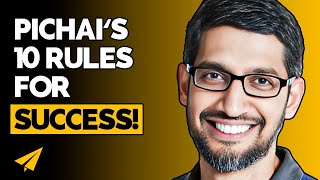
Google CEO Sundar Pichai explains his leadership approach, emphasizing the need to work with people smarter than you to create productive insecurity. He stresses innovation beyond current platforms like Android, Google's mission to make technology accessible to anyone with internet, and a culture that rewards risk-taking and learning from failure.
Chapters
So, you know, a big part of what I focus on at any given time is, you know, making sure we are innovating and building products for the future.
One brilliant invention can unleash other entrepreneurs to revolutionize industries in ways you could never predict.
We want to push the technology at times because you don't know what's possible on the other side.
You have to work with people where you feel a bit insecure, right? That's essential because that means you're working with people who are better than you.
He's an Indian American business executive. He's the current CEO of Google. He has an estimated net worth of $1 billion. He's Sundar Pichai, and here's my take on his top 10 rules for success. Rule number 7 is my personal favorite, and I'm curious to figure out which one you guys like the best. Also, as you're watching, if he says something that really hits you hard, really means a lot to you, leave it in the comments and put quotes around it so other people can be inspired as well.
From our perspective, and I think it's true for technology in particular, the world keeps changing, as I said earlier. So a big part of what I focus on at any given time is making sure we are innovating and building products for the future. It's just got to be a normal course of how you think. And so we are constantly thinking about what to do next. So Android is very popular. People are using smartphones. But I always sit and think about what is the next version of how people use computing, right?
And so we are thinking about things like virtual reality or augmented reality.
So these are all new areas, but we are constantly thinking about it.
And so you have to do that on a constant basis to push forward.
The thing which attracted me to Google and to internet in general is that it's a great equalizer, right? And so to me, I've always been struck by the fact that Google Search worked the same—
Mm-hmm.
As long as you had access to computer with connectivity, if you were a rural kid anywhere, or if you were a professor at Stanford or Harvard. And to me, you know, I want Google to strive to push to do that, not just build technology for certain segments, right? For me, it matters that, you know, we drive technology as an equalizing force, as an enabler to everyone around the world.
Growing up in India, like many of you, I got my first telephone when I was 12. In my case, it turned out to be a rotary phone, so it wasn't that great for selfies, but I still loved to call my friends, play with it, and sometimes take it apart. That telephone cemented my fascination with technology. I remember in my parents' house in Chennai reading about the invention of the transistor at Bell Labs. Of course, that initial invention helped found what became known as Silicon Valley, And out of that came companies like Fairchild Semiconductor and Intel and all the computers and software that we all use today. You can draw a direct line from that invention to the technology that powers your Twitter feed or your WeChat messages today. I remember reading about that and thinking, it's the idea that matters. It didn't matter where you come from or what your background is. One revolutionary idea, one brilliant invention can unleash other entrepreneurs to revolutionize industries in ways you could never predict.
You will have many, many opportunities to reinvent yourself. And so I think it's worthwhile taking risks on trying to do something you're really excited by. And if the first attempt you don't do it, you can try again and things tend to work out in the long run. In Silicon Valley, part of the reason so many people start up a company is, you know, starting up a company and even having failed, you know, you can wear it like a badge of honor, right? And I think that's important, you know, culturally, you know, risk is rewarded. I remember when I started working at Google, you know, if I went and, you know, people were discussing ideas, the other people who heard the ideas try to build on those ideas. They encourage you. So it's a culture of optimism, it's a culture of risk-taking, and I think that's really important.
So Are there any Jedi mind tricks that you're employing that, you know, maybe people aren't seeing that you're doing to motivate your employees?
You know, for me, it mainly is I've always been very passionate. So, you know, I'm an optimist about how technology can make a difference. And so I focus on that, and that way you kind of tend to forget about the other things. The rest is noise, so, in some ways.
We believe that software is at a stage where, you know, software increasingly is playing a more and more critical role in solving things, which it didn't before.
Okay.
So to me, when I look at cars, people spend an inordinate amount of time in cars. These are resources which are very poorly utilized. Right now as we speak, you know, you can look outside and you can see all the cars which are parked.
One of the cars we rented to get here is just sitting in the parking lot.
So they get used less than 10%. So we see these problems and we see, okay, can we solve it at scale? And does computing play a part in it? Software and computer science. And while the effort may seem ambitious or crazy, you know, we take a very disciplined approach inside, right? You know, so those are thought-through, like businesses which we are building. And it's just that we are willing to take a long-term view, but we run them in a very disciplined way. Our research can be longer term, and we do that precisely in research, you know, when we take research projects like Google ATAP or our core research. We never know whether some of them even makes viable business applications, but we want to push the technology at times because you don't know what's possible on the other side.
Being in the US, you know, I find people take a remarkably varied number of paths, and I do think it's important to follow your dream and do something which you're excited by. So I think if you follow your heart and do what you like, you will always do much better. And so I don't think it matters if you're an engineer or you're a, you know, you're in science, or it could be in any field.
What is your morning routine like? What do you do when you first get up in the morning?
You know, believe it or not, I still, you know, I read a physical paper every single morning.
Which one?
I read the Wall Street Journal every morning. I read the New York Times online. And, you know, I still am very particular about having my tea. It's very English, you know. I grew up in India, so having my tea. And I'm vegetarian, so I need to get my protein, so I always have an omelette in the morning with toast, tea, and read my paper. So I do that every morning.
What time do you wake up?
6:30 to 7:00, so that's when I do it.
Do you exercise in the morning?
No, later in the day sometimes, you know, if I get a chance, but always in the evening.
I wish I could do it in the morning.
I'm not a I'm a morning person, so I need my time with my paper and tea to wake up and kind of get going. Now you're being spoken about as a potential next CEO of Google.
Haha, I keep hearing that. I mean, Larry is very, very committed to Google for the very long term. So am I. I'm passionate about computing, and Google gives a chance for me to do what I love and do it in a way which impacts a lot of people. And so it's a good partnership I have with Larry and with the team there. So, you know, I expect it to stay the same.
You know, I would actually encourage all of you, you know, if at some point in your life, you know, you have to work with people where you feel a bit insecure, right? That's essential because that means you're working with people who are better than you and who are pushing you, right? And so I always encourage, if you actually feel very secure in what you do, you know, that means you're doing something comfortable and you're not pushing yourself. And so there are many, many times I felt working with people in a group. Am I doing enough? Are these people seem much better than me? And I think, I think that's an inherent part of learning.
Thank you guys so much for watching. I made this video because Yash Chavan asked me to. So if there's a famous entrepreneur that you want me to profile next, leave it down in the comments below and I'll see what I can do. I'd also love to know which of the top 10 rules had the biggest impact on you and why. Leave in the comments. I'm going to join in the discussion. Finally, I want to give a quick shout out to Jonathan Chu from chusjoy.com. Jonathan, thank you so much for buying my book. It really means a lot to me. Those of you watching, if you want your chance at a shout-out in a future video, make sure to pick up a copy of the book and email in your receipt so we can keep track. Thank you guys so much for watching. Continue to believe, or whatever your one word is, and I'll see you soon.