Amazon's Start! The 3 Secrets to Jeff Bezos' SUCCESS
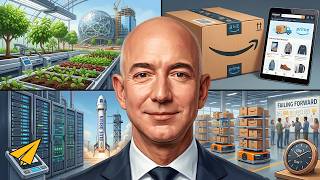
Evan Carmichael breaks down Jeff Bezos' path from Wall Street to founding Amazon in 1994 after spotting the internet's growth. Three lessons: throw away the rulebook and trust your gut, hire quality people and build a decentralized culture, and think long term over short-term gains.
Chapters
Hi, I'm Evan Carmichael, and welcome to another edition of Modeling the Masters. I believe that the fastest and most effective way to grow your business is to model the strategies of people who've already done what you're trying to do. So today we're going to look at how a man came from a single-family home, was born to a teenage mother, and turned to his love of computer science to build an online billion-dollar-plus business. This is a story of Amazon.com founder Jeff Bezos and the top 3 lessons you can learn from his success.
Jeff Bezos was born on January 12th, 1964 in New Mexico to his teenage mother Jackie. She divorced Bezos' father that same year. When Bezos was 5 years old, Jackie remarried to Miguel Bezos. A Cuban-born engineer for Exxon. The family moved to Houston, Texas, near a 25,000-acre ranch owned by Bezos's maternal grandfather. It was here where Bezos would spend most of his summers, learning the basics of everything from veterinary care for cattle to repairing bulldozers in what he now calls "just an incredible, incredible experience." Even as a young child, Bezos showed signs of being mechanically gifted. He dismantled his own crib with a screwdriver and rigged his room with an electric alarm to keep his younger siblings out. Bezos would go on to graduate from Princeton with a degree in computer science and electrical engineering. Although he toyed with the idea of starting his own company, he decided to give himself more time to learn about the business world first. So Bezos took a job with a brokerage firm on Wall Street, where he was able to use his computer skills to build networks that would help clear trades. It was the spring of 1994, and the internet was growing at 2,300% a year. Bezos immediately began looking into the top 20 mail-order businesses to try to find the one that could be conducted more efficiently over the internet. Finding no comprehensive mail-order catalog for books—it would be too big to mail—Bezos decided this would be the perfect product to sell over the internet. The very next day, Bezos flew to the American Booksellers Convention in Los Angeles to better understand the industry. There he discovered that electronic lists of inventory for the major wholesalers already existed. Bezos would just have to create a single place on the internet where consumers could go to search for and order the books they wanted. And that's what gave him the idea for Amazon. The rest is history.
By following his passion and by not being afraid to jump at an opportunity, Bezos was able to build an online billion-dollar-plus empire from scratch. To help you jumpstart your business, here are 3 action items you can learn from Jeff Bezos.
Action Item #1: Throw away the rulebook. Sometimes to be successful, you have to listen to your gut and do what you feel is right, even when the experts tell you that you're wrong. It takes a lot of courage, and you'll come up against many roadblocks, but if you keep at it, you'll be rewarded for your persistence. The industry experts might have said that it couldn't be done, but Bezos couldn't have cared less. Time and time again, Bezos ignored what the pundits were telling him to do threw away the rulebook, and trusted his own gut instincts. And time and time again, Bezos proved to be right. Amazon.com customers rewarded Bezos's instincts with word-of-mouth advertising that helped the company grow at a rate incomprehensible to most other companies. In Amazon.com's early days, it was harder for the little startup to ignore expert advice and forge its own path. Today, however, it is not so hard. Amazon.com is a corporate giant, and what Bezos says goes. The company still has its critics, and many people often still think Bezos is out on a ledge. But just like when he first started out, Bezos couldn't care less. According to Bezos, every well-intentioned, high-judgment person we asked told us not to do it. We got some good advice, we ignored it, and it was a mistake. But that mistake turned out to be one of the best things that ever happened to the company. If you're not stubborn, you'll give up on experiments too soon. And if you're not flexible, you'll pound your head against the wall and you won't see a different solution to a problem you're trying to solve. We're very comfortable being misunderstood. We've had a lot of practice. Action Item #2: Hire quality employees. A business is only as good as the people inside it. If you want to grow your company, you need to bring on people to help. Take your time and do it right. A warm body might help solve a short-term problem but always ends up costing you more time, energy, and money than if you just took the time to hire properly from the beginning. Hire slowly and fire quickly to build a quality team. One of the biggest factors behind the amazing success of Amazon.com is the people the company has behind it. From day one, Bezos has made it a priority to hire very carefully. He wanted his company to have a long shelf life. I knew that with his staff, he'd be creating an enduring culture. Bezos wasn't taking the time to hire the very best for the company so that everyone would have to check with each other before anything could get done. Instead, Bezos wanted a decentralized company where small groups could innovate and pursue their visions independently of other groups. According to Bezos, "I'd rather interview 50 people and not hire anyone than hire the wrong person." Cultures aren't so much planned as they evolve from that early set of people. For every leader in the company, not just me, there are decisions that can be made by analysis. The most junior person in the company can win an argument with the most senior person with a fact-based decision. Action Item #3: Think long term. You've got to keep the big picture of what you want to do in mind. It can be hard when you're putting out fires all day long. But you have to remind yourself of what you're trying to do. Think about why you started your business, and what you hope to accomplish. Don't let short-term problems or opportunities make you deviate from your plan, even if it's not a popular decision. From day one, much to the dissent of investors and onlookers, Bezos has insisted on taking a long-term strategy for his company. He was not interested in whether something would help sell a few books today. Instead, Bezos wanted to make sure even more books were being sold tomorrow. Whether it's selling books online or any other venture, Bezos recommends taking a long-term point of view. While he acknowledges this is something about which there's a lot of controversy, his experience tells him it works. According to Bezos, you can do the math 15 different ways, and every time the math tells you that you shouldn't lower prices because you're going to make less money. That's undoubtedly true in the current quarter, in the current year, but it's probably not true over a 10-year period, where the benefit is going to increase the frequency with which your customers shop with you, the fraction of their purchases they do with you as opposed to other places. Their overall satisfaction is going to go up. Sometimes we measure things and see that in the short term they actually hurt sales, and we do it anyway. If you're very clear to the outside world that you're taking a long-term approach, then people can self-select in.
So remember, throw away the rulebook, hire quality employees, and think long-term. To finish up this video, I wanted to share my favorite true stories about Jeff Bezos and some of his best quotes.
A lot of people don't know that Amazon.com was not Jeff Bezos's first business. While still in high school, Bezos started the Dream Institute after working for McDonald's one summer. He Bezos found out he didn't like working for others, so he started a business of his own the next summer. The Dream Institute was an educational summer camp for 4th, 5th, and 6th graders. The entire camp was built around reading assignments and the youngster's comprehension of what he or she read. He charged $100 per camper and got 6 signups for the camp. After that, he never liked working for anyone else again.
Thank you for joining me for another dish of Molly and the Masters. If you like the video and you want to see more, please give it a thumbs up below. I'd also love to hear what you have to think if you want to leave a comment under the video. So thank you, and we'll see you on the next episode.
More from Evan


How the Biggest Mistake in History Created A Trillion-Dollar Empire | Sergey Brin



9 Machiavelli Principles That Force People To Respect You | Machiavellian Philosophy



The First 10 Words That Instantly Ruin A Sales Conversation | Vanessa Van Edwards

The Top 1% Mindset Behind The First $5 Trillion Company | Jensen Huang (Nvidia)

