Andrew Huberman's Top 10 Rules for Success
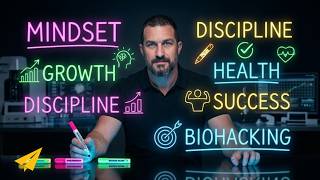
Stanford neuroscientist Andrew Huberman shares ten habits backed by brain science: morning exercise and sunlight boost dopamine and mood, cold water raises focus, boring breaks enhance memory, and quality sleep sets cognitive capacity. He emphasizes that quitting is a neural decision, not physical, and that passion activates laser focus even in people with ADHD.
Chapters
Andrew Huberman is a neuroscientist at Stanford University and one of the leading voices in brain optimization, focus, and human performance. Welcome to The Tonight Show.
Thank you so much for being here. Delighted to be here. I want to continue this conversation with Stanford neuroscientist Dr. Andrew Huberman. My guest today is Dr. Andrew Huberman. Andrew is a neuroscientist. He's a neurobiology professor at Stanford Medical School. He went from struggling with his parents' divorce right about age 13, my parents split up. But basically what happened was I stopped really paying attention to school and I got really heavily into skateboarding and kind of punk rock music.
And having trouble in school as a teenager, I got removed from high school.
I was permitted to go back to school eventually, provided that I went to therapy.
To becoming a world-renowned expert and building one of the largest podcasts in the world, reaching millions with science-backed tools to upgrade their lives. I'm a big fan and congrats.
You deserve to be number one podcast.
Need motivation?
Watch a top 10 with Believe Nation.
If you've been here before, drop a hashtag #believe in the comments below so I can feature you here in a future video. And if you're new, welcome to Believe Nation, the only channel that helps you believe in yourself daily, one video at a time. Okay, let's kick it off with rule number 1: be disciplined.
It would be wise to get some exercise early in the day, right? Jocko's right on this one. Okay, maybe you don't have to do it at 4:30, but being an early riser and getting some activity early in the day and sunlight in your eyes does a bunch of things. You have a pulse of cortisol every 24 hours, a quote-unquote stress hormone. It's not a bad hormone, it's a great hormone, but you need it released at its highest levels early in the day. How do you do that? Sunlight in your eyes increases that peak by about 50%. If you're not doing that, you start running into trouble. Exercising and getting sunlight in your eyes early in the day times that cortisol peak. We know from studies at Stanford School of Medicine by a guy named David Spiegel and the great Robert Sapolsky that if that cortisol peak is shifted later in the day, you start getting symptoms of depression, anxiety, failure to sleep, and the whole thing cascades. So when I say discipline, I could list off 20 things that one could and should do, but this mental health crisis has to be attacked at two 2 different levels and 2 very disparate sides. I'm describing the first one. You gotta get your physiology right. Get that cortisol peak early day. Sunlight will also promote dopamine, epinephrine, all of that. Get some activity early in the day. Get a rope or a jump rope and skip rope looking at the sun if you have to. Like, do— some people say burpees, then people start arguing about burpees, but some exercise and sunlight early in the day. And of course, then some hydration. Then at night, Most nights, it's fine every once in a while to go out and have a good time, but most nights you wanna try and get it dark, wear an eye mask if you need to, throw a t-shirt over your eyes if you're like me, if it's not dark enough in the room, you don't need anything fancy here, and work on getting 6 to 8 hours of sleep. Some people can get away with 5, some people can't sleep that much, some people need more, but get that right. And when people do that for 3, 4 days, It's remarkable how much better they feel.
Rule number 2: Take boring breaks.
It's very, very clear that if you have a hard time getting into a bout of work or even staying focused, there's a, there's a very good chance, I believe, that your breaks between work and what you were doing before work was too stimulating. I'm a big advocate for boring breaks, and I'm a big advocate for silence. Before and after bouts of work for a couple of reasons. Let's think about it on the back end. Let's say you're trying to learn something or read a book or just do something that you, you're not reflexively doing. You want to create this habit. It's very clear that neuroplasticity, yes, requires alertness, requires focus. You need sleep later that night. I've been beating that drum for a number of years. It's also clear that reflection on what you were doing at some later time, just kind of like post-learning reflection, walk into your car, sitting on the plane for a second, thinking about a podcast you did earlier or something you heard or a discussion strongly reinforces the memories and the ability to work with the memories of new information.
Rule number 3: Practice cold water exposure.
In recent years, there's been a trend toward more people doing so-called cold exposure, getting into cold showers, taking ice baths, exposing oneself to cold water of various kinds. Can in fact increase our levels of dopamine as well as the neuromodulator norepinephrine. First of all, some of the safety parameters. Let's, let's establish those first. Getting into very, very cold water, you know, 30°F or even low 40°F, can put somebody into a state of cold water shock. I mean, people can die doing that. So obviously you want to approach this with some caution. But for most people, getting into 60°F water or 50°F water can have tremendously beneficial results on your neuromodulator systems, including dopamine. What temperature of water you can tolerate will depend on how cold water adapted you are and how familiar you are with the experience of getting into cold water. Now, this study, Human Physiological Responses to Immersion into Water of Different Temperatures, it's a really interesting study. They looked at people getting exposed to water that was warm, moderately cold, or very cold. Upon getting into cold water, the changes in adrenaline and noradrenaline— epinephrine and norepinephrine— were immediate. But then what was interesting is they observed that dopamine levels started to rise somewhat slowly and then continued to rise and reach levels as high as 2.5 times above baseline. That's a remarkably high increase. Why would that be good? Up until now, I've basically said getting increases in dopamine are detrimental to your baseline. Well, this does appear to raise the baseline of dopamine for substantial periods of time, and most people report feeling a heightened level of calm and focus after getting out of cold water.
Rule number 4, commit to the inner work.
The big mistake that I made for a number of years was trying to find the thing that comes from outside that's gonna change things. And Lord knows I love caffeine and I love doing certain activities and learning. But at some point you realize that the ability to withhold reflexes that you don't want to have, like getting your temper sparked or something. People say no one can make you feel anything. And I say, that's crazy. People can make you feel things all the time. The ability to not speak from your first thought, but your second or your third. You hear these kind of clichés, right? All of that ability comes from inside. It's from doing internal work. And it's kind of amazing how much we can accomplish. And I'm certainly not the first to say this, how much we can accomplish by just stopping and listening and going, wow, like, my brain's crazy. It's like all these thoughts, all this stuff. Oh, too much input coming into this. Like, I've got to shut down this thought path. Also realizing that, you know, because these thoughts layer on themselves, our sensory, sensory memories layer on top and can feed— we feed our thoughts. I mean, Jenny Gross's description of how thinking works makes you think that, yeah, like if you're ruminating on something that really bothers you, you probably do want to distract yourself unless you're really going to work on that thing, that you really can feed thoughts like embers in a fire. And it's important to not do that if it's not adaptive.
Also, if you want to take real action after this video, I made a free worksheet just for you. It covers the top lessons from today, gives you space to write your biggest takeaways, and helps you build a simple action plan. It's 100% free, just click the link in the description below to go grab it. I'll see you there. Rule number 5, break the habit of quitting.
So why do we quit? Well, an experiment was done a couple years ago and was published in the journal Cell, Cell Press journal, excellent journal, showing that there's a class of neurons in our brainstem, in the back of our brain, that if they shut off, we quit. Now, these neurons release epinephrine. Epinephrine is adrenaline, and anytime we are engaged in effort of any kind, we are releasing epinephrine. Anytime we're awake, really, we are releasing epinephrine into our brain. In fact, this little group of neurons in the back of our brain is called the locus coeruleus, if you like, is churning out epinephrine all the time. But if something stresses us out, it churns out more, and then it acts as kind of an alertness signal for the whole brain. We also, of course, have adrenaline, epinephrine, released in our body, which makes our body ready for things. So think about epinephrine as a readiness signal. And when we are engaged in effort, this readiness signal is being churned into our brain. When we're relaxed and we're falling asleep, epinephrine levels are low. So our desire to continue— or put differently, our willingness to continue and our desire to quit is mediated by events between our two ears. Now, that doesn't mean that the body's not involved, but it means that neurons are critically important. So we have two categories of neurons that are important: the ones in our head that tell us, 'Get up and go out and take that run,' and the ones that allow us, encourage us to continue that run. And we have neurons that shut things off, that say, 'No more.' And we, of course, have the neurons that connect to our muscles and control our muscles. But the reason we quit is rarely because our body quits. Our mind quits. So when people say, is it— I hear that, you know, sports or effort or fighting, or it's 90% mental, 10% physical. That whole discussion about how much is mental, how much is physical, is absolutely silly. It's 100% nervous system. It's neurons. Okay, so when people say mental or physical, understand it's 100% neural. Now, what do nerves need in order to continue to fire? What do you need in order to get neurons to say, I, I will persist? Well, they need glucose. Unless you're keto and ketogenic adapted, you need carbohydrate— is glucose. That's what neurons run on. And you need electrolytes. Neurons have what's called a sodium-potassium pump, blah blah blah. They generate electricity. In order to get nerves nerve cells to fire, to contract muscle, to say, I'm gonna continue. You need sufficient sodium, salt, because the action potential, the actual firing of neurons, is driven by sodium entering the cell, rushing into the cell. And then there's a removal of potassium, and then there's a kind of resetting of those levels by something called the sodium-potassium pump. And the sodium-potassium pump and sodium and action potentials even if you don't know anything about that, is ATP-dependent. It requires energy. So you need energy in order to get neurons to fire. And it is pH-dependent. It depends on the conditions or the environment within the brain being of a certain pH or acidity. pH is about how acid or how basic the environment is. Nerves need salt, they need potassium, and it turns out they need magnesium. And you need glucose and carbohydrates in order to power those neurons unless you are running on ketones. Muscle— muscle is going to engage and generate energy first by using this phosphocreatine system. High bouts of effort, really intense effort, short-lived, seconds to minutes, but probably more like seconds, is gonna be this phosphocreatine, literally a fuel source in the muscle that you're gonna burn just like you would logs on a fire. And glycogen, which is stored carbohydrate in the muscle, they're converting that into ATP in order to generate that energy. And then there's stuff in our blood that's available as an energy source. And in blood we've got glucose, so literally blood sugar that's floating around. So let's say you have fasted for 3 days, your blood glucose is going to be very low, so that's not going to be a great fuel source. But you will start to liberate fats from your adipose tissue, from your fat. Fatty acids will start to mobilize into the bloodstream and you can burn those for energy. Now there are some other factors that are important, and those are the heart, which is going to move blood. So the more that the heart can move blood and oxygen, well, the more fuel that's going to be available for you to engage in muscular effort and thinking effort. And as I've mentioned oxygen a few times, it should be obvious then that the lungs are very important. You need to bring oxygen in and distribute it to all these tissues because oxygen is critical for the conversion of carbohydrates and the conversion of fats. So when we ask the question, what's limiting for performance? What is going to allow us to endure, to engage in effort and endure long bouts of effort or even moderately long bouts of effort? We need to ask which of those things, nerve, muscle, blood, heart, and lungs is limiting. Or put differently, we ask, what should we be doing with our neurons? What should we be doing with our muscles? What should we be doing with our blood? What should we be doing with our heart? And what should we be doing with our lungs that's going going to allow us to build endurance for mental and physical work and to be able to go longer, further, with more intensity.
Rule number 6 is calm your mind.
You need some, some tool to learn to calm your mind, right? Your mind is going to spool. Nobody has a mind that's calm all the time and focused when they want it to be and falls asleep perfectly every night. Nobody gets that. No human being gets that. Okay? So you have to put some work into it. That involves doing, maybe it's 5 minutes of meditation a day. I'm a big believer in prayer. I think that combines a number, if not all of the features of the things that we hear about, like meditation and all these other things into a practice that if you spend some time with it, I think it can be very useful.
Rule number 7, love what you do.
If you love something and you wanna learn as much as possible about it and you love the culture around it, You do have to learn how to sort out the untoward elements. Don't get yourself into trouble. But you take that energy, and I just took it to academics. I remember realizing when I got to graduate school, I found a wonderful lab to work in with a wonderful woman named Barbara Chapman. Unfortunately, she passed away. And at the time she said, listen, I'm gonna have a couple kids, but we have grants. You can— so she said, I'm gonna have a couple kids, so I'm going to be very busy, but we have grants and here's the lab. She said, don't burn the lab down, don't hurt yourself, but just do experiments, have fun. And I realized I was like, "This is the best." And I had so much energy and I thought, "I never have to go home." So I lived there a lot of the time, brush my teeth in the sink there, work out at the gym, go shower, come back. And I remember people saying, "You're gonna burn out. What are you doing?" And I'm like, "What are you talking about?" And I would work 80, sometimes 100 hours a week. I was so happy. And I realized like, this is the exact same feeling. I'm just taking my interest and I'm just pouring myself into it. I did that when I was a graduate student, I did it when I was a postdoc. And actually when I was a postdoc, I started, writing some music articles for Thrasher Magazine. I've always kept some little tie to the skateboarding industry that way, just to make some extra cash. And then when I was a junior professor, I had to really pour myself just into the laboratory, but it still worked out. And I guess the point is that, you know, earlier you and I were talking about if you have, and I'm borrowing this phrase from one of my heroes, Martha Beck, who's a wonderful person and teacher, such wisdom, and she calls it a, interest-based attention system. Some people might call it ADHD, but have you ever noticed that even people— and we know this from the scientific literature— people, kids, adults with ADHD, when they're in so-called ADHD, when they are doing something they really love, they're like a laser. They're not going to peel off that. Their attention is like level 11 out of 10. So I took that energy that I've always had in me for fish, for tropical birds, skateboarding, punk rock music, eventually it was biology. And I just went, okay, here are my chips, I'm all in.
Rule number 8, adopt a growth mindset.
Fixed mindset versus a growth mindset. You know, a fixed mindset is one in which you're trying to look smart, that you're not so focused on effort, that your response to setbacks is to give up, you know, and your academic and other forms of performance tends to be low. Whereas in a growth mindset, your goal tends to be to learn. You tend to value effort more. You tend to respond to setbacks by working harder, and your performance is higher. And I'm not trying to make light of these lists. These lists are important because they help us organize our information and differentiate between a fixed versus growth mindset, but they don't tell us why focusing on effort and engaging more effort would actually translate into higher performance. For instance, you could imagine a scenario where the exact opposite is true, Right? We could make up a just-so story where if your identity is so rigidly fixed to high performance, you're likely to outwork everybody, right? That seems like a logical conclusion as well, but that's not the way it plays out. It's when your identity is attached to your sense of ability to engage in ongoing effort, especially when you receive signals that you're getting things wrong or not performing well, that is tied to elevated performance. And the study using ERPs tells us that's likely to be the case because of how people who have a growth mindset focus their attention when they're told, "Nope, you got that wrong." Or when people think they got something right, right? They give an answer and they say, "What's your confidence level?" And they say, "90%, maybe 99%, maybe even 100%." And they say, "Mm, it's wrong." People who have a fixed mindset focus on the emotional response to that. More of their brain resources are devoted to, "Ah, I got it wrong. I thought I got it right," than the people who have a growth mindset who are thinking, "Wait, okay, then what was that answer? And how could I possibly get that answer wrong? I'm going to figure that out." Okay, now, as you're hearing this, you're probably thinking, "Oh no, I'm somebody who reflexively gets disappointed when I get something wrong." Well, fortunately, this is not just about that 100 milliseconds to 5 seconds after you're told something is wrong. You can shift from a fixed mindset to a growth mindset response. In fact, that's an important tool that we all need to learn how to implement. We all suffer from fixed mindset, all suffer from fixed mindset in certain endeavors. And when we get things wrong, especially when there's some embarrassment or shame, which often accompanies when we think we were very right, we're convinced we're right, that fixed mindset can really hijack our emotional response. But there are a lot of data that point to the fact that at those moments, if we think, okay, I'm gonna step back from that and I'm gonna just think about the error, I'm gonna think about what led to the error, and I'm gonna start devoting my attentional resources to that process, that process itself can be built up over time such that we start to outweigh the fixed mindset with growth mindset simply by devoting our attentional resources to the error, acknowledging it happened, maybe feeling something about it, maybe not. It's really hard to control our feelings. What we can control, as I mentioned before, is our effort and our attention. So focusing our attention on why we got something wrong and really digging into that, that's growth mindset in action. So you'll notice as we have this discussion about the more mechanistic underpinnings of growth mindset is that we're not talking about psychological terms as much. We're not talking about ego protection. We're not talking about identity. Now, all of those things are extremely important, but the problem with things like ego protection and identity is that when we are faced with results that we don't want and we are faced with those results in a real-world context, like we're not getting the results we want in school, in work, in athletics, in relationships, et cetera, we hear these messages and we try to, for instance, you know, set our ego aside or, you know, not attach our identity so much to what is happening, but it's really, really hard. And it's really, really hard because, statements like set your ego aside or don't attach yourself to it so much are wonderful aspirations, but there's no actual process that one can go through by oneself that allows you to immediately disentangle yourself from your ego. So when you're faced with results that you don't like, you can't simply step back, nor should you expect yourself to be able to step back and say, oh, I'm not gonna get upset about this error, right? It makes perfect sense why you would get upset about not getting the results that you want. However, once you start to understand some of the mechanistic underpinnings of what will allow you to rescue your performance, that is to start focusing on those errors from a more cognitive and a slightly less emotional stance, or even a combination of emotional and cognitive, right? Because it's very hard to suppress our emotional response to something, but oftentimes we can enhance our attentional or cognitive response to something in parallel with that. And in doing so, we can kind of rob some of the emotional response. And when we do that sort of thing, it's hard. And anytime we do hard things, we generally want to know that the doing of those hard things is working, that it's in service to something.
Number 9, get quality sleep.
But I certainly believe that our state of mind and body at any point in time is strongly dictated by our state of mind and body in the hours and days prior to that. And on the one hand, people are going to hear that and say, "Well, duh. If you're sleep deprived, you're going to feel like garbage. And if you're well-rested, you'll feel great." That's kind of the top contour of it. But when one looks at the neuroscience, for instance, of sleep, you start to realize that the amount of rapid eye movement sleep that you're going to get in any 90-minute bout of sleep, because your sleep is broken up into these 90-minute segments more or less, is strongly dictated by the ratio of slow-wave sleep, aka deep sleep, and rapid eye movement sleep that you had in the previous 90-minute bout. And then when you start to look at the research in terms of waking states, you start to find that your ability to be focused, say for a bout of work in the morning or the afternoon, or a creative brainstorm session, or I don't know, to maybe drill into some personal issue that you're dealing with during therapy or just on a walk or while journaling, is not a square wave function. None of us should sit down and expect ourselves to just drop into that state. Much of our ability to move into that state effectively, whatever effective means, whatever the target or goal of that bout, as I'm calling it, is going to be dictated by what happened in the previous moments and hours. And so when I zoom out from that, what I've doubled down on is this idea that there are just a core set of foundational things that we have to re-up every 24 hours. I think thanks to the incredibly hard work of Dr. Matt Walker at Berkeley, right? The Sleep Diplomat on Twitter, right? It's such a great name because it's so appropriate. I mean, a decade ago or so, it was like, "I'll sleep when I'm dead." That was the dominant mentality out there. And yeah, sleep's great, but getting stuff done is more important. I mean, Matt has really impressed on everybody that our mental health, our physical health, and our ability to perform is so strongly dependent on our ability to get quality sleep. Maybe not every night of our life. I mean, we have to be realistic, but that sleep is vital. So a hat tip isn't sufficient. So sleep is critical, but sleep is just one of about, I would say, 5 things that really set the buoyancy or the foundation upon which our nervous system is able to accomplish these transitions that I'm talking about at all. And those 5 things are sleep, right? In the absence of quality sleep over 2 or 3 days, you're just going to fall to pieces. In the presence of quality sufficient sleep over 2 or 3 days, you're going to function at an amazing level. There's a gain of function and a loss of function there. It's not just if you sleep poorly, you function less well. You sleep better, you function much better. So sleep, I would say, is at the top of the list.
And rule number 10, the last one before a very special bonus clip, is get your daily dose of sunlight.
The reason I encourage people to get sunlight in their eyes, especially early in the day, is that it helps wake you up, it improves your mood, improves hormone output, improves focus. It's good for so many aspects of body. But how do I do it without hurting my eyes? And it helps you sleep at night. Okay, so what you want to do— people have different levels of sensitivity. You want to look in the general direction of the sun.
Okay.
If it's low in the sky, it's no problem. You could literally look at it like this. Now, the higher it gets in the sky, the more imposing it is, and you'll wanna close your eyes. If it forces you to blink, you need to look away from it a little bit. Indirect light is fine on a really clear day. If it's very, very bright and you need to blink, blink. I'd say take your sunglasses off for doing this. Eyeglasses and contacts are fine. And after, you know, 2, 3 minutes, you're good. And if you're walking to work in the morning, it's a nice sunny morning, but the sun, you know, it's New York, so a lot of the sun's blocked by these big buildings. You just get the indirect sunlight. And that's okay too. That's okay. But through a window, these tinted windows that are everywhere here, or through a windshield, it's not gonna happen. It's just never gonna set this mechanism in the ways you need. So if you, you know, watching a sunset, you can literally watch it, right? Isla Vista, we used to watch sunsets, right? When it disappear off Del Playa with the oil rigs out there. And for the people who don't know, there are these oil platforms that sit off the beach in Santa Barbara and it seeps up all this tar, but it's very beautiful. Sunsets out there, and you can look directly at it when the sun is low in the sky. Um, when the sun is overhead is when it tends to be really bright. Don't stare at it. And what is the advantage of this? It just wakes you up or something besides that? So you have neurons, nerve cells in your eye that connect— that when that sunlight hits them, they send a signal to your brain that's a wake-up signal. Gotcha. Improves your mood, increases testosterone, it increases metabolism, it lets you focus better, and it sets a timer so that you can fall asleep fall asleep at night about 12 to 16 hours later. If you're not getting light in your eyes and if you wake up and you're just on your phone, that's fine if the sun isn't out, but if you're on your phone for the first 2 hours a day and then you get outside and get sunlight and the sun's already overhead and you go out with your sunglasses on, that kind of thing, you're, you're going to find it's very hard to fall asleep that night because you're not setting the timer. That's right. Oh, think of the morning, the morning bright light as your wake-up signal. Got you. Get as much sunlight in your eyes as you safely can throughout the day. I wear sunglasses, but not when I do this morning sunlight viewing. And then in the evening, try and catch some sun before it goes down. In the winter, obviously that's gonna happen earlier. And then at night, you really wanna try and dim the lights. I always say like the fighters at the fight last night, like wearing sunglasses. Dim the lights, dim the screens between 10:00 PM and 4:00 AM. Now look, you guys were at the fight last night. I happened to be there too. I'm sort of a new UFC fan, so I'm not very educated on this, It was really bright. It's not a big deal every once in a while to stay up late. I was up till 1:30, which for me is very late. But, you know, I would say 80% of the days and nights of your life, get some sunlight in your eyes and try and dim the lights at night. But you're in New York. Yeah. Bright lights, big city, right? So you're gonna have to do a little bit more sunlight viewing in the early part of the day. Okay. And if you wake up and the sun isn't out yet, you know, once it's out, get out there.
Okay.
Yeah, it has huge outside positive effects on your life. I'm locked in. I get it now because I've been locked in the house. You won't believe me. Like a lot of guys are like, Or, and women say, "Oh, you know, I don't feel well. I'm having trouble focusing. I'm having trouble sleeping." Before we could get into any discussion about supplements or hormone therapy or ice baths and saunas, all that stuff is great, but the number one thing for health is going to be quality sleep. And the best way to get quality sleep is to get sunlight in your eyes early in the day. And on cloudy days, when you can't see the sun, people always say, "There's no sun here." I'm like, "The sun is still there." Yeah. And you get a lot of sun through that, those clouds. Just get outside a little bit longer. Most people are primarily visual. There's an interesting study that was published recently, um, just came out, and, uh, that shows that actually memory and, uh, recall for material that's consumed on a phone is much lower than on the written page. And there's an interesting, um, reason that they, they give for this. You know, there could be a lot of reasons, I just want to point that out. But they monitored breathing and they monitored heart rate and they monitored some other physiological signals while people were either reading on a smartphone or reading paper. And what they found was that breathing was essentially normal or equivalent in both conditions, meaning people breathed the same way whether or not they were reading on their smartphone or reading from a written page. But there was a particular category of, of breath that was abolished by reading on the smartphone. And this is what is referred to as physiological sighs. I talk a lot about physiological sighs on the podcast, and my lab works on them. This is a spontaneous, innate pattern of breathing that's governed by a little subset of neurons in, in the brainstem. For those of you who want to know, this is a brainstem area called the parafacial nucleus, discovered by Jack Feldman at UCLA, who's the world expert in the neural mechanisms of respiration. And this little collection of neurons, probably only 100 neurons or so, make sure that every 3 to 5 minutes you do what's called a physiological sigh, which is a very deep breath sometimes followed by another short inhale. So, ah, and then a long exhale. And the double deep breath, or the very deep breath, reinflates the little sacs in the lungs. Your lungs aren't just two big bags of air, they actually have hundreds of millions of little sacs that we call the alveoli of the lungs. And when you don't do these physiological sighs, so in the second or third minute after not having done a physiological sigh, these little sacs collapse and they're kind of moist on the inside. So you can imagine trying to blow open a balloon that's moist on the inside. You need a little bit of added air pressure. And so those sighs reinflate those, and then on the exhale allow you to offload carbon dioxide. Now this happens even during sleep, every 3 to 5 minutes. And I've talked a lot about physiological sighs as a what I think is really a terrific real-time tool for reducing anxiety and calming oneself down. Indeed, it works very well. We have a study that's out for review now. It's a collaborative work with David Spiegel in psychiatry, but it, but it points out that these physiological sighs can be used— double inhale through the nose, long exhale through the mouth— to calm down. And it works very well because you offload carbon dioxide. Now, in this study about smartphone reading versus reading on paper, what they found is that people stop engaging in physiological sighs. During any time they're reading on the smartphone. Now, it wasn't a perfect study because they probably also should have had a tablet and a laptop condition, so it's not clear whether or not it's due only to the reduced aperture of the visual window that you're narrowing your attention, and there's this sort of app— almost like an apnea, a kind of starving of yourself for oxygen when you do this. But it's very clear, I mean, it's abundantly clear that two things— one is nasal breathing, and that the other is getting sufficient oxygen to the brain is important for comprehension. So the takeaway from this is, if ever possible, try and read from a written page, and if you, uh, or from a book or a piece of paper. And if you can't do that, then try and access whatever you're learning from as large a screen as you can manage in that particular environment, right? And I do realize when people are commuting, you know, and sometimes I'm guilty of looking at my phone and trying to read papers and passages on my phone, but it's interesting because this study highlights the the linkage between this visual attention, our respiration, and the fact that, you know, our body and our brain have these innate mechanisms for making sure that we're getting sufficient oxygen, we're getting sufficient blood flow to the brain areas that are required for learning. And so again, I don't want to de-emphasize the fact that there is a lot of legitimate clinically diagnosed ADHD out there, but for a lot of people that are struggling with attention or they feel like they just can't focus, I think we all owe it to ourselves to ask, Well, what kind of environment am I creating for myself that is depriving me of this focus? And what simple things can I do to try and enhance my ability to focus? Because I'm personally of the belief that if possible and wherever it's not hazardous to start with behavioral tools, right? Before ever moving to supplementation or prescription drugs, unless there's a real dire need, I would think that behavioral tools should be the most valuable for the simple reason that when you engage in a behavior over and over again, you get neuroplasticity, your brain circuits change and get better. Simply taking a drug or a supplement of any kind although they can have their value, isn't going to rewire your brain in the ways that you want. You are essentially dependent on that chemistry in order to access the state that you want. Right.
And congratulations, you're one video closer to who you're meant to be.
Believe.
For 10 more amazing rules from Andrew Huberman, check the video right there next to me. I think you'll love it. Continue to believe, and I'll see you there.
Double inhales followed by an extended exhale are the fastest way that I'm aware of to bring the mind and the body into a more relaxed No way. Stay. 2 inhales through the nose and then exhale slow through the mouth. 1 to 3 of those repeated.
More from Evan


How the Biggest Mistake in History Created A Trillion-Dollar Empire | Sergey Brin



9 Machiavelli Principles That Force People To Respect You | Machiavellian Philosophy



The First 10 Words That Instantly Ruin A Sales Conversation | Vanessa Van Edwards

The Top 1% Mindset Behind The First $5 Trillion Company | Jensen Huang (Nvidia)

