"ANYTHING is POSSIBLE!" - Robin Sharma (@RobinSharma) - Top 10 Rules
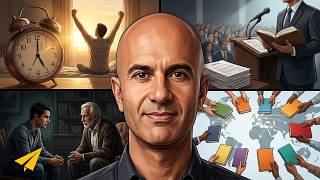
Robin Sharma, a former lawyer and bestselling author, shares ten rules for mastery including the 90-90-1 focus ritual, obsessing over details like de-seeded lemon wedges, and protecting your most valuable hours for high-impact work. He argues that expanding your "I can" mindset beyond IQ is what separates world-class performers from everyone else.
Chapters
We are good in our comfort zones, but the moment we start to go blue ocean around our next level of mastery, our fears come up because we're going out into the unknown. It's human. Victims love making excuses, and if you recite your excuses long enough, you actually think they're going to be true. Only release Sistine Chapel ceiling level products to the world.
Need motivation? Watch a top 10 with Believe Nation. What's up, it's Evan. My one word is believe, and I believe in you. I believe you have an amazing gift inside you that I want to see explode out onto the world. So let's get your motivation to a 10 and get you believing in you. Grab a snack and chew on today's lessons from a man who went from being a litigation lawyer up until age 25 to becoming a best-selling author, trainer, and motivational speaker. He's Robin Sharma, and here's my take on his top 10 rules of success. Volume 3. Enjoy! Alright, let's kick things off with rule number 1, my personal favorite: Don't fit in.
The traits that make you strange are the gifts that make you special. And so I know you're different because you wouldn't be here with me now if you didn't feel you're different. You probably don't fit in with most conversations. I sure don't fit in with most conversations. I don't know a lot about most things that most people talk about because I don't participate in the majority, right? I don't participate in the news. I don't like to gossip. I like to encourage people versus diminish people. I like to be productive versus busy. I like to be creative versus complacent. I like to create value versus take from other people. I like to move into my present and future versus get stuck in the past. I like to be fast versus move too, too, too slow. I like to be a leader versus a victim. I like to believe in possibility versus get stuck in rational thinking, because you know that instinct is so much more powerful than intellect. And all I'm suggesting to you is simply this. It's the very things that make you different that make you authentic. And if you don't fit in, I just want to share with you, I've never fit in. And the very nature of anyone who's living a visionary life— and you are living a visionary life, no matter what you're doing. Let's not get trapped in labels. Oh, I'm just a coder. I'm just a receptionist in a, at a restaurant or in an organization. I'm just a yoga teacher. I'm just a gym manager. I'm just a chef. I'm just a chef in a restaurant. I'm just a teacher. People always say this when I interact with them on the social media. I'm just an entrepreneur. I'm just a student. No, you're not. I'm just a mom. I'm just a dad. No, you're not just. You're very special. There are no extra people on the planet today. And I just want to say to you and validate for you and encourage you, those things that other people might not get, those are your gifts. You might be awkward, awesome! You see the world through a different lens. Steve Wozniak, who was on my stage at the Titans Summit Zurich, the co-founder of Apple, one of the best people I've ever met, he would not have been able to create the Apple platforms and products that he created if he didn't see the world through a different set of eyes. Steve Jobs saw the world through a different set of eyes. Travis Kalanick, of Uber saw the world through a different set of eyes. Jeff Bezos of Amazon saw possibility. Let me have an online store that initially sells books. John F. Kennedy, Martin Luther King Jr., Mother Teresa, Rosa Parks, Jean-Michel Basquiat, Beethoven, Michelangelo, who did the Sistine Chapel, and in Florence, David. Jonas Salk, Tesla, We could just go on and on and on and on. These people were misunderstood because the nature of a genius is to not fit in.
Rule number 2: Hire A players.
Bill Gates was asked what was the winning formula of Microsoft when Microsoft was really the heavyweight champion of their industry. I think they're a little lost right now. But the larger point again is he replied with this, "What made Microsoft Microsoft was not our software. What made Microsoft Microsoft was our hiring." I just want to suggest to you the second point or trait of a world-class company is their ability to hire A-players. Here is the brain tattoo I want you to absolutely hardwire into your business philosophy. As a leader. You cannot build an A-level company with C-level talent. If your company is not winning in your field right now, you likely have weaknesses in your hiring. Don't just hire people because it's the easiest move to make. A lot of companies spend very little time on hiring and then most of their time managing their hiring mistakes. And you know, if you're building a business, if you're an entrepreneur, if you're a manager, if you're a CEO like a lot of the people who watch these Mastery Sessions and come to my live events, you know I am speaking truth here. So you really want to nail your hiring.
Rule number 3, let go of your excuses.
I've been evangelizing one particular message for 2 decades and it's you can lead without a title. You know, the seduction of society is that you have to have formal power to make a difference, and that's just a lie the world has sold us. The reality is you can lead without a title, and really the difference or the defining trait of a leader is you shift from victimhood. See, victims love making excuses, and if you recite your excuses long enough, you actually think they're going to be true. I see it around the world, you know, people saying these things like, I don't have time to run, or I don't I'm not good enough to be great at my work, or this would never work, or I don't live in the right country, or life is hard. And the more you recite those excuses, you think they're true. So let go of your excuses, start getting some results done, and over time you're gonna rise to your world class.
Rule number 4: DC the lemon wedges.
One of the things about the 95%— a lot of them are complaining, they're making excuses, they want epic lives, and but they're stuck in the group of super— the cult of superficiality. The top 5%, the Titans, the Icons, the A-Players, the world builders are very different. They are not about superficiality. They are all about granularity. Literally, they have deseeded the lemon wedges. This is a metaphor that I teach. Basically, I I was at a hotel in Luzern, Switzerland, and I love fresh lemon tea. And when they brought the tray to me, I noticed that in the tray was 2 lemon halves, and someone in the kitchen had taken the time to deseed the lemon wedges. They actually deseeded them. And when I study F1 teams, and I actually had the privilege to be right with the team at a recent F1, And what I realized is F1, almost like no other sport, is really about de-seeding the lemon wedges. It was the smallest granular detail, the smallest calibration that could make the difference between a top 1 and a 10th place finish. I really want you to think about that. I really want you to think about F1. F1 is won or lost in milliseconds. Because each lap, if you get a little bit faster and you do it with the consistency— because consistency is the mother of mastery— that is the difference between first place and not even placing. And so if you look at the top 5%, they are all about de-seeding the lemon wedges. If you look at the top 5%, they're all about calibration. And people might misunderstand you when and say, "Are you obsessive? Why do the details matter?" And all you have to do is smile and say, "Because the details matter." And if you study Beyoncé, study the great athletes, you study the great F1 drivers and teams, they do deseed the lemon wedges. They do calibrate the Pomodoro. They get OAD, that brain tattoo, have become really well known across the planet for an obsessive attention to detail. O-A-D. That's what makes the best hotels, the best entrepreneurs, the best teams, the market leaders, the best restaurants, the best hotels, the best cars, the best products, the best user experiences online. They are sweating the tiniest, seemingly innocuous details to create over time a user experience that creates a global base of fanatical fans. Followers.
Rule number 5, be comfortable in the unknown.
One of my brain tattoos that I've become very well known for is, "No one will believe in you until you believe in you." And so, good people often become seduced by the chatter of their loudest fears. And what I mean by that is, we come up with a great idea. Let's say it's to start a project that will allow you to lead your field. Let's say it's an idea for a new product that will allow you to grow a new company. Let's say you come up with an idea for a new painting if you are an artist. Let's say it's an idea that will allow you to take your fitness and your wellness and your longevity to a whole new level of wow. And pretty shortly after you come up with the idea, your ego starts screaming. Because we are good in our comfort zones, but the moment we start to go blue ocean around our next level, level of mastery, our fears come up because we're going out into the unknown. It's human. You know, if you were to look at the psychobiology of it and you were to study the pure biology of it, there's a term called homeostasis. Human beings are hardwired for a steady state, and that kept us alive. So literally, our heart beats around the same amount, you know, the 72 beats per minute, and our blood pressure is within a small bandwidth, and that allows us to survive. But what happens is when we come up with a new we see a new idea and when we see a new opportunity and we start to leave our comfort zones into the zone of the unknown where greatness lives, we get scared. And the true heroes and the true titans and the true masters, those people are not fearless. Those are people who have just practiced walking into their fear and living on the razor's edge consistently to the point where they're comfortable amid their discomfort. Now that's the great opportunity for you, not to avoid fear, but to be comfortable in the unknown, to be comfortable when you're terrified. And that really is what the great artists, the great entrepreneurs, the great titans, and the great masters are very good on doing. So the first reason good people lose is their faith is not as strong as their fear, or to put it a bit more elegantly, their fears are larger than their faith. And so to be tactical for you, how do you build more faith? Well, you, you do what you're frightened to do, and it's a practice. You know, a great athlete practices every morning, and a great producer practices walking into their fears every single day. And what I'm encouraging you to do is every single day do one thing that causes your palms to sweat. Every single day start training your your brain to hunt for opportunities, to step into that unknown where possibility lives. And if you keep on doing it, you're literally going to build some new neurological hardwiring, a new mental— a new pathway in your brain where you become— it becomes easier. Because as you know so well, all change is hard at first, and it's messy in the middle, and it's beautiful at the end.
Rule number 6: Only release magic.
You want to, if you want to have a world-class company, release only magic. Another way I could put it, only release Sistine Chapel ceiling level products to the world. Steve Jobs said it beautifully. He said, I wanted the icons on the iPhone to be so beautiful, people would want to lick the screen. I had a senior leader show up at one of my leadership events and he said, "You know, Robin, Steve Jobs was like that. I actually went to his house and met him shortly before he died. And he didn't look very well, but he didn't want to talk about his physical condition. He just wanted to talk about the product we were launching. He was so monomaniacally focused on the user experience. He literally wanted everything to be flawless." That was Steve Jobs' brilliance and obsession. I saw an incredible interview with Jony Ive by Charlie Rose. And in that, Jony Ive, who you know is the design genius behind a lot of the Apple products, he said, you know, I knew Steve Jobs and I were spiritual brothers when we were in a store one day and Steve Jobs said to me, he goes, hey, come on over, Jony, you gotta see this. And I believe from the interview, I believe this is what they said, but they were looking at an arrow and Steve Jobs said, look at how the sharp point of the arrow is attached to this part and look how seamless it is and look at the engineering. And I wonder how they did that. And Jony Ive said Steve Jobs was just in the pocket. Of the engineering and beauty behind that piece of artistry they were looking at.
Rule number 7: Use the 90-90-1 rule.
So for the next 90 days, your first 90 minutes at work, make it focused on your single most important project. I'll repeat that again. For the next 90 days, the first 90 minutes of your workday, focus monomaniacally on your single most valuable project. I call it your game-changing move. So it might be, it might be creating a new piece of code that will revolutionize the marketplace. It might be a new product that when you launch it will fill a need within your industry that no peer is currently providing. I don't know what your game-changing move is, but this is your poetry. This is your magnum opus for the next 90 days. So what most people do is, you know, people who are playing at victimhood, people who are in the 95%, people who are making excuses about ordinary results in their life, a lot of them are not doing the things that would give them legendary results. And what they do is they get to the office, And rather than using prime time for A activities, they use their best hours watching Dancing Cats on whatever it is, whatever the video platform is. They spend their best hours surfing the internet looking at blogs. They spend their best hours playing with notifications, reading notifications, chatting with friends who are not really their friends, but really they're just bored, so they're just distracting themselves, which is just a form of medication because potential unexpressed turns to pain, and they're in a lot of pain, and it's subconscious, and they haven't done the work to know it. So really, they've created these drugs of choice like too much email, too much web surfing, too much chit-chatting, too much looking at funny-looking videos that make them laugh in the moment, that make them feel happy and give them a short burst of dopamine and maybe a little bit of serotonin, which is the pleasure neurotransmitter, and that's how they get through their day. And all I'm saying is there is so much distraction available to you out there that if you are not acutely careful, it will dominate your days. What I'm really trying to say is this: a ritual for you to run and dial in and hardwire to the point of automaticity— that's the word the researchers use when a habit becomes your New Normal over 66 days is the 90-90-1 Rule. And to give it to you again so you really remember it, for the next 90 days, your first 90 minutes, create a tight bubble of total focus so that no one can distract you. Turn off your devices, put them in a little plastic bag, put some reminders on your door, maybe some Post-it notes that this is my tight bubble of total focus for the next 90 minutes. Tell your team, tell your loved ones, Maybe get a— put a do not disturb sign on your door. They'll laugh, and explain it to them. That for the next 90 days, I will spend 90 minutes away from distraction, away from technology, away from interruptions, focusing on my magnum opus. Focusing on the genius project that I want to bring into the world, because I will never mail it in, I will always bring it on, and I'm going to do this for the for the next 90 minutes, and I'm gonna optimize it and iterate it every day, and I'm gonna bring my full bandwidth, because what makes a genius, they all have one trait in common, they were able to spend extended periods of time in isolation, focused monomaniacally on their most valuable project.
Rule number 8, become a valuable person.
Well, you've heard me talk about the 2x, 3x mindset. So to double your income and your impact, triple your investment, including your time investment, in two core areas: your personal mastery and your professional capabilities. You see, when you work on your personal mastery, you awaken your mindset, your heartset, your healthset, and your soulset. And when you get those four interior empires to world class, you become a force of nature out in the world and you do epic things. So you want to work on your personal mastery like you're doing here with me right now by listening to this episode. And then the second thing you want to do is you want to work on your professional capability. You want to be the heavyweight champion of your game. You want to dial in your sport, whether your sport is entrepreneurship, whether your sport is being a chef, whether your sport is being a coder, whether your sport is being being a manager, whether you're an entrepreneur, a CEO, an astronaut, a poet, I don't know what it is, but when you focus on your personal mastery and your professional capability, and you really work on those, I'm talking about hours every day if you are serious about leading the field, what starts to happen is this. You become a vastly more valuable person. You become very aware, and that's why I say, Education is inoculation against disruption. That's why I suggest to you with great love and respect, leadership belongs to the learners. Maya Angelou said it beautifully. She said, "When you know better, you can do better. With better awareness, you can make better choices. And with better choices, you're going to see better results." I mean, it's the awareness that you bring to every day based on your learning, based on your investments in training. Well, what does that do? It gives you the ability each day to make better choices, better decisions. When you look at a great life, it's just a series of beautiful choices done daily, stacked on over time. And so when you get great awareness, heightened awareness, more acute awareness of what it means to be a leader, an elite performer, an A-player, an awesome human being, an epic producer, producer, a fit human being, a loving human. It just goes on. With that awareness via your learning, you can make better decisions every day, better choices.
Rule number 9: Learn to say no.
What makes a great company is less about your good opportunities and a lot more about you having the bravery and discipline to say no to your many good opportunities. What destroys a great company is actually opportunity bloating. Too many good opportunities. So literally, you diffuse your team's bandwidth and you get distracted. And you see with so many companies right now, they sort of found their sweet pocket and they were absolutely winning in their marketplace and they decided to go, hmm, We've got this app that is really changing the game and owning the marketplace. Let's get into food delivery. Let's get into this. Let's get into that. It happened to General Electric as well, and you probably know they decided at one point, if we can't be one or two in any market, we're going to get out of that market. That's the key point I'm trying to make. Know your mighty mission, know your monomaniacal focus, and then have the discipline to say no to everything else so you can lock and load on your finest opportunity to completely change the game.
And rule number 10, the last one before some special bonus clips: make your I can larger than your IQ.
I remember being in SoHo, New York, and I walked into one of the stores and I bought a coat. And I was leaving on an airplane for home later that day, and I asked the person who who was taking care of me, I said, "Is it possible," and that's a great respectful way to ask for something, "Is it possible to get this coat hemmed and adjusted a little bit for me?" And I said, "The thing is that I'm leaving later today." And he looked at me, and I've never forgotten it, because we all have these people in our lives who say one thing or show up in a certain way, and they stay with us for the rest of our lives. Lives. And he said to me these words, he said, "I'd love to do that for you. I'd love to do that for you." And again, the whole brain tattoo I'm trying to deconstruct here is make your "I can" larger than your IQ. You know, I remember being in Prague and I asked someone on the other— again, I spent I spend a lot of time in hotels, and I said, "Is it possible to do this?" And here was the reply on the other end of the phone. I think it was someone from the front desk, or maybe it was room service. And I try to eat as clean as possible, so probably it was a request, "Could I have olive oil and fresh lemon, or lemon, as the salad dressing?" And here's the reply, just really lovingly and respectfully and hopefully fluently and elegantly really bring this leadership insight home to you. I said, "Is this possible?" And his reply was, "Anything is possible." So, it's really easy to get seduced and stuck into a mindset of can't. You know, someone says, "Let's start a new business." Someone says, "Here's a great poetic project that if we release it to the world will help us own our marketplace." And it sounds very obvious again, but ask yourself this: Is your default reply a symptom of a mindset of can't, or do you have a mentality of possibility? When someone says, "Here, read this book," do you shift into can't or can? When someone says, "Hey, you know what? I'm amped to run a marathon," do you go, "I can't"? Is that your default setting in your your neurobiological hardwiring, or do you go, "Absolutely," or, "I'd love to do this"? You know, it's really, really important, and that is one of the core distinctions of leadership, isn't it?
Now I've got two really valuable bonus clips for you from Robin Sharma around using your most valuable hours wisely and turning your pain into power, but before that, my question of the day from you is, I wanna know, have you read any of Robin Sharma's books? And if so, what is your favorite one and why? Leave it down in the comments below. I'm really curious to find out. Thank you guys so much for watching. I believe in you. I hope you continue to believe in yourself and whatever your one word is.
Much love.
I'll see you soon and enjoy the bonus clips.
Every great hero was broken. If you were to look at Nelson Mandela, he suffered more than most people. If you look at Mother Teresa, she went through incredible adversity over the course of her journey. If you were to study Mahatma Gandhi, Nelson Mandela, Rosa Parks, Shakespeare, and Tolstoy, if you look at any great artist, a Picasso, a Jean-Michel Basquiat, if you look at The great world builders, they all suffered. Let me put it to you this way, with great love and respect, they all out-suffered the majority. And what I'm suggesting to you is pain can be transformed into power with the intention to transform pain into power. You see, what most people do is— this is why most good people lose— they stumble and they fall and they become heartbroken or disappointed by life's challenges. That happens to every single one of us. I mean, just to be very authentic, as I always want to be in these Mastery Sessions episodes, I've gone through a lot of hardship in my life. When I was, you know, going through school, very few people believed in me, and I was dismissed and called very, very average. And the principal at the school I was at said, "You're not even gonna get into university." And you might know my backstory on The Monk Who Sold His Ferrari, but that was a self-published book. And I was at the American Booksellers Conference in Chicago with a cover of one of my books over my— around my neck, shaking hands with all the agents that were coming up the escalator. And when I was a self-published author, I used to go into bookstores and say, "Would you take 3 copies of my book? I'll sign them. Could you put it on the shelf?" and I was treated rudely, and I was laughed at, and I was on radio shows, and I was ridiculed. And then I've gone through a lot of personal pain in my own life, and I've been on the top of the mountain of victory. And I must tell you, I have walked the lonely path in the darkness, in the valley of darkness. But Rumi, the great philosopher, said it so beautifully. He said, allow your heart to be broken over and over over and over until it opens. And what I'm suggesting to you is really to dial into this insight. All great heroes have been broken. But rather than blaming 27 years in imprisonment, in the case of Nelson Mandela, rather than blaming his naysayers and his detractors, in the case of, um, Mahatma Gandhi. Rather than saying, "Life is hard, why isn't greatness easy?" in the case of a Mother Teresa or Martin Luther King Jr., rather than saying, "Why did this happen to me?" in the case of Rosa Parks, who refused to give up her seat to someone on a bus because she was being treated like a second-class citizen because of the color of her skin. These great ones all had one thing in common. They leveraged their pain into power. They turned their tragedies into victories. You wake up every morning with full bandwidth. That's your mental focus, your physical energy, and your willpower. But every time you check your email, you diminish your bandwidth. If you make another choice that's weak, weak versus powerful, you diminish your bandwidth. As you go through your morning when your bandwidth is at its highest, according to the research, what you start to do is if you're making weak choices, you're going to start getting weak results. So never check email first thing in the morning, never get on the social media first thing in the morning. Use your most valuable hours for your most valuable activities. So let me give you the one, one secret to happiness. One word. This is all you need to Yeah. The most important word ever. If you had to think of one word that's most important to you or that sums you up or that would be kind of like a little beacon.
Hey, Believe Nation, if you want to know what the most important one word is for Tony Robbins, Gary Vaynerchuk, Oprah Winfrey, will.i.am, and Howard Schultz, I have a very special secret video for you. Check the description for details.
More from Evan


How the Biggest Mistake in History Created A Trillion-Dollar Empire | Sergey Brin



9 Machiavelli Principles That Force People To Respect You | Machiavellian Philosophy



The First 10 Words That Instantly Ruin A Sales Conversation | Vanessa Van Edwards

The Top 1% Mindset Behind The First $5 Trillion Company | Jensen Huang (Nvidia)

