Benjamin Franklin Biography: 3 Principles For a Successful Life
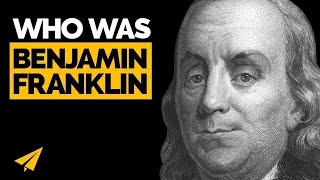
Benjamin Franklin went from being the 15th of 17 children with two years of schooling to founding a newspaper, helping draft the Constitution, and becoming a scientist. Three principles from his life: always be learning, don't waste time, and be kind to others. He changed his mind on slavery after seeing Black children's intelligence in London.
Chapters
Hi, I'm Evan Carmichael. Welcome to another edition of Model and a Master. I believe that the fastest and most effective way to grow your business is to model the strategies of people who've already done what you're trying to do. So today we're going to look at how the 15th of 17 children who only had 2 years of education went on to become an entrepreneur and one of the founding fathers of the United States of America. This is the story of Benjamin Franklin and the top 3 lessons that you can learn from his success.
Benjamin Franklin did not come from a family of prominence. Instead, his family could only afford to send him to 2 years of grammar school, and by the time he was 13, Franklin's father sent him off to apprentice at his older brother's print company. Here, Franklin helped to compose pamphlets, set up type, sell the paper on the streets, and perform other printer-related duties. Franklin also began writing columns under the pseudonym Mrs. Silence Dougood, who he fabricated to be a middle-aged widow. Dougood was an immediate hit with her writings about the problems and social conditions of women, but when James found out it was actually his younger brother writing her column, he was furious. As a result of James' ensuing harassments and beatings, Franklin became a fugitive and ran away from his family at the age of 17. Franklin tried his luck as a printer both in New York and New Jersey, but to no avail. He then moved to Philadelphia, where he did manage to find a job with a printer, but Franklin was unsatisfied with his prospects there. After a brief stint at the printer shop in London, England, Franklin returned to Philadelphia in 1726. 4 years and much borrowed money later, he had finally set up his own printing house. He began to publish a newspaper called the Pennsylvania Gazette, in which he regularly gave himself space to comment on the most pressing social issues of the time. He cultivated an image of himself as an intellectual and as a productive young man, and his writings were the beginning of what would earn Franklin significant social respect. In 1748, Franklin officially retired from the printing business, although he continued writing literature and satirical essays throughout the rest of his life. He began to take a more formal role in public life, becoming councilman, justice of the peace in Pennsylvania, and elected member of the Assembly. 5 years later, he was appointed Joint Deputy Postmaster General of North America and several other posts. In perhaps his most well-known feat, Franklin began working towards independence as part of the Committee of Five that drafted the de— Declaration of Independence. In 1787, after he had retired from public office, he attended a series of meetings that would result in the United States Constitution. He became the only Founding Father to sign all 3 of the country's major founding documents, the Declaration of Independence, the Treaty of Paris, and the US Constitution.
By believing in himself and by teaching himself, Benjamin Franklin was able to go from having almost no education to becoming one of the most prominent men in American history. To help you rise to prominence, here are 3 action items that you can learn from Benjamin Franklin.
Action item number 1: Always be learning. If you want your company to grow and become successful, you need to continue to grow as an entrepreneur. Invest time and resources into yourself and your team so that you're always learning new skills and pouring them back into your business. When you stop innovating and learning, your business will start to decline. Despite having no formal education, Franklin understood its importance and set out to satisfy his insatiable appetite for knowledge on his own. While his father couldn't afford to send him to school, He nonetheless took the young Franklin on walks to various tradesmen, teaching him about their tools and techniques. His father also exposed him to politics and current affairs, having himself been an active member of his community. By the age of 11, Franklin had taught himself English, French, and Italian, and doggedly chased down any literature he could find. Franklin's endless curiosity helped fuel his business pursuits and his scientific inquiries, and propelled him to the forefront of America's intellectual community. According to Franklin, "It has been useful to me, having learned so much by it, as to be able to do little jobs myself. From a child I was fond of reading, and all the little money that came into my hands was ever laid out in books. Genius without education is like silver in the mine. Without continual growth and progress, such words as improvement, achievement, and success have no meaning." Action Item #2: Don't waste time. How much time do you waste every day? Are you really doing the important things that you need to in order to grow your business, or are you keeping busy with email, Facebook, Twitter? Successful entrepreneurs don't waste time. When it's work time, they work. Focus your energies on the tasks that will explode your business and ignore the distractions. In his autobiography, Franklin recalls his early days of owning a printing shop, where he was just starting to get set up on his own and he would often stay in the office working past 11 7 o'clock at night. If it meant getting a task accomplished on time, Franklin would even stay overnight to do, or redo it if that was the case. It is this strong work ethic that carried Franklin through to the end of his career. As one of the most curious and ingenious of America's earliest thinkers, it was no difficult task for Franklin to find something to occupy his time with. Industrious to the core, Franklin believed strongly in seizing the moment and putting every minute to good use. However, working hard was not only a matter of profit and dollar signs to Franklin. It was a question of utilizing what was given to you. Thus, at the very bottom line of Franklin's success was the hard work he put into every single goal he decided to see through. According to Franklin, "Employ thy time well if thou meanest to get leisure. Sloth makes all things difficult, but industry all things easy." He that rises late must trot all day, and shall scarce overtake his business at night. Dost thou love life? Then do not squander time, for that's the stuff life is made of. Action Item #3: Be kind to one another. A lot of people think to be in business you have to be cutthroat and ruthless. That couldn't be further from the truth. You can have tremendous success by being kind to everyone involved with your company, and it's a lot more fun too. At EvanCarmichael.com, one of the first things we look for in a new hire is, "Is he or she a nice person?" I hope you'll consider doing the same. Even though Franklin was wealthy enough to retire comfortably at the age of 42, he continued to pursue civic projects and carry out benevolent acts throughout the rest of his life. He staunchly believed that the good life was achieved in direct proportion to one's contribution to society, and thus, from universities to hospitals to firehouses, Franklin dedicated his resources to giving back. Franklin demonstrated that you could be a successful entrepreneur and still have compassion and care for the world around you. A precursor to today's movement towards corporate social responsibility, Franklin proved to be once more a pioneer in his field. According to Franklin, "He is ill-clothed that is bare of virtue." Advance civil public purposes and at the same time support the self-help efforts of individuals. Be civil to all, sociable to many, familiar with few, friend to one, enemy to none. If you wouldst live long, live well, for folly and wickedness shorten life.
So remember, always be learning, waste no time, and be kind to one another. To finish up this video, I wanted to share one of my favorite true stories about Ben Franklin and some of his best quotes.
Benjamin Franklin had no real opinions on slavery until he went to England. His wife Deborah was not well educated and had problems even writing to him, but pressured him into visiting a grammar school for Black children while he was stationed in London. After visiting the school, Franklin found, to his surprise, that Black children were just as smart as white children. After coming to this realization, he changed his entire outlook on the way slavery was being conducted in the United States. Unknown to most people in America, Franklin is one of the first American politicians to advocate the end of slavery in the United States. He had been socially active most of his life, even creating one of the first fire departments in Philadelphia. During the end of his life, he spent a lot of time speaking, writing, and publicly admonishing other politicians that believed in slavery. He wanted to start schools for black children and offer them the same things white children had. But in the end all of his talk would be disregarded. However, his beliefs would eventually lead Abraham Lincoln to the same realization. ¡Gracias!
Thank you for joining me for another edition of Modeling Masters. If you like the video and you want to see more, please give it a thumbs up below. And I'd also love to hear what you have to think if you want to leave a comment underneath the video. And we'll see you on the next episode.
More from Evan


How the Biggest Mistake in History Created A Trillion-Dollar Empire | Sergey Brin



9 Machiavelli Principles That Force People To Respect You | Machiavellian Philosophy



The First 10 Words That Instantly Ruin A Sales Conversation | Vanessa Van Edwards

The Top 1% Mindset Behind The First $5 Trillion Company | Jensen Huang (Nvidia)

