Breaking Business Models | Discover Ben & Jerry's Secrets in 9 Minutes
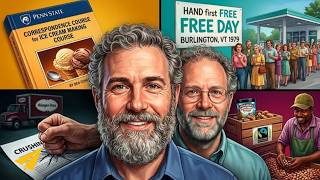
Ben & Jerry started with a $5 ice-cream course and opened their first shop in a renovated gas station in 1978. They built a $326 million company by embedding social activism into the brand, treating employees well with a "Joy Gang," and outmaneuvering giants like Pillsbury with creative marketing.
Chapters
Hi, I'm Evan Carmichael. Welcome to another edition of Modeling the Masters. I believe that the fastest and most effective way to grow your business is to model the strategies of people who've already done what you're trying to do. So today we're gonna look at how two young friends decided they wanted to start a business, so they took a $5 course in ice cream making thinking this would be their passion, and they turned that $5 course into one of the most well-known ice cream brands in the world. This is the story of the founders of Ben Jerry's Ice Cream and the top 3 lessons that you can learn from their success. Ben Cohen, a Brooklyn, New York native, remembers being fascinated with ice cream from a young age when his father used to regularly eat entire half gallons directly from the carton using a large soup spoon after dinner. The curious young Cohen would take to creating his own flavors of ice cream by combining it with various cookies and candies. In fact, Cohen's first job was working as an ice cream truck driver in his senior year of high school. Cohen attended Calhoun High School in Merrick, New York, which is where he met his future business partner, Jerry Greenfield. Greenfield met Cohen during a gym class together in 1963. The two self-proclaimed wild boys became fast friends and even double-dated in Cohen's convertible. After parting ways and bouncing around for several years, Cohen and Greenfield would finally meet up again in New York and decide to go into business together. Both Greenfield and Cohen had an interest in the food business, and after debating whether to focus on bagels or ice cream, they settled on ice cream as the product they would launch. The machinery for bagels was too expensive. Immediately, the pair began doing their industry research. They took a correspondence course in ice cream making from Penn State University for a whopping $5, which convinced them that they were on the right track. In May 1978, Ben Jerry's Homemade Ice Cream Parlour opened up in what was previously an abandoned gas station that they renovated using $8,000 of their own money and $4,000 borrowed. By creating unusual but tasty flavors like Chubby Hubby and the 14,000-calorie Vermonster, which was Greenfield's job to manufacture, and sponsoring community events, word of the store quickly spread throughout the town. By the end of 1984, Ben Jerry's had sales in excess of $4 million, double the figure from the previous year. By 1999, the company's total revenue was $237 million. Through a strategy of engaging in social activism and corporate social responsibility and using all-natural ingredients for their products, Ben Jerry's stood out in a highly competitive industry. In 2000, the company and its franchises were acquired by Unilever for $326 million. By following their passion for the food industry and by believing in their socially conscious ideals, Ben Jerry's were able to go from a $5 course and renting an abandoned gas station into building a well-known brand and being acquired for over $300 million. To help you copy their success, here are the top 3 action items that you can learn from Ben Jerry's. Action item number 1: Behave responsibly. If you look at any lasting and successful company, you'll see that they have a set of core values that they really believe in. It helps guide their decisions and also attracts employees and customers who believe the same way. One example of a core value is behaving responsibly. Do you believe that your business should exist not just to serve your customers, but also to serve the greater community? If yes, you should incorporate this message into everything you do so people know about it and will be attracted to your business. Ben Jerry's has become famous not only for its unique and delicious flavors of ice cream, but also for the path the company took to achieve its success. From day one, the two childhood friends knew that they wanted to build a different kind of business, one that approached social responsibility with serious commitment. With a business model that incorporated the principles of corporate social responsibility, Ben Jerry's demonstrated that significant growth is possible even when a company looks beyond profits in the view of the public good. According to Cohen and Greenfield, Ben and I built Ben Jerry's on the idea that business has a responsibility to the community and environment. If you open up the mind, the opportunity to address both profits and social conditions are limitless. It's a process of innovation. If we were going to have a business, we were going to have one that was consistent with our values. We measured our success not by how much we made, but by how much we contributed to the community. It was a two-part bottom line. Action Item #2: Treat your workers well. Growth comes from people. If you don't bring on people, then you'll always be limited in how much you can grow. If you want your people to give their best, come up with creative ideas, and tell the world about you, treat them well. It's not just about money. People want to feel like they're part of something greater than themselves. They want to work on challenging projects and feel like they're growing. When you treat your workers well, you don't just get more done, you also have a lot more fun. In 1987, Greenfield came up with the idea for Ben Jerry's Joy Gang. With a mission to infuse joy into everything we do. The Vermont hippies wanted to be fun and have an official part of their company culture. Initially, the Joy Gang's activities were limited to providing free pizza and 15-minute massages to staff. However, as the company expanded, so too did the range of the Joy Gang's projects. Today, the Joy Gang's approach to bringing fun to the workplace is three-pronged. Joy Gang grants awards up to $500 to employees who have an idea on how to make work more fun. From purchasing a hot cocoa machine for the company's freezer crew to a stereo for the production crew, Cohen and Greenfield were willing to fund any creative ideas that might make for happier workers, along with other incentives and benefits such as allowing workers to bring their dogs to work or wear jeans if the office workers chose to. According to Cohen and Greenfield, we thought, why don't we get together and do something fun and be our own bosses? And since we like to eat, We should do something with food. We wanted our workers to work hard but do it in an environment that was fun. No one wants to dread going to work. Our employees are what makes Ben Jerry's successful. Action Item #3: Challenge the big guys. Whatever industry you're in, there are probably big companies already dominating your market. Don't be afraid of them. Just find a different way to do things. Smaller companies are more agile, can make decisions quickly, can provide better service, and can get closer to the customers. Use those benefits as a way to challenge the big guys and start winning some market share. Kuhn and Greenfield were just a couple of hippies trying to avoid becoming simply another big company. Living through the 1960s, the two disliked business for all of its negative social and environmental effects. In 1984, big business came after the little guys. Pillsbury, the multi-million dollar company behind Häagen-Dazs, began to feel threatened by the rapid growth of Ben Jerry's. In an attempt to shut down the young upstarts, Pillsbury gave Ben Jerry's distributors throughout Boston an ultimatum: sell Häagen-Dazs or sell Ben Jerry's, but not both. Cohen and Greenfield were not about to let this corporate giant shut them down. After finding little hope in their legal options, the two decided to take matters into their own hands. Together, they launched their now-famous "What's a Doughboy Afraid Of?" campaign and began taking it as public as they could. From placing advertisements on the side of buses to renting banner planes for flying around major sporting events, Cohen and Greenfield did whatever they could to think of to gain support for their little business. It worked and only made Ben Jerry's more successful. According to Cohen and Greenfield, "We rallied people around our cause, and it worked. We started getting like 100 calls a night, most of them between the hours of midnight and 3 AM." Help two Vermont hippies fight the giant Pillsbury Corporation. We did not want to become another cog in the economic machine. So remember, behave responsibly, treat your workers well, and challenge the big guys. To finish up this video, I wanted to share one of my favorite true stories about Ben Jerry's and some of their best quotes. When Jerry Greenfield was asked to speak at the College of New Jersey for Senior's Week, discussed the decision to sell Ben Jerry's to Unilever. He said, "We sold to them because they had a good sense of humor. The same day they bought Ben Jerry's, they bought SlimFast." Thank you for joining me for another edition of Modeling the Masters. If you like the video and you want to see more, please give it a thumbs up below. And I'd also love to hear your thoughts and feedback or leave a question about your business, please leave them in the comments below. I always check those out. So thank you, and we'll see you on the next episode.
More from Evan


How the Biggest Mistake in History Created A Trillion-Dollar Empire | Sergey Brin



9 Machiavelli Principles That Force People To Respect You | Machiavellian Philosophy



The First 10 Words That Instantly Ruin A Sales Conversation | Vanessa Van Edwards

The Top 1% Mindset Behind The First $5 Trillion Company | Jensen Huang (Nvidia)

