Breaking Through the Cosmos | Neil deGrasse Tyson on You
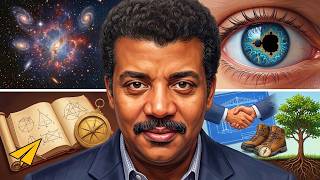
Neil deGrasse Tyson on success, curiosity, and science. He learned talk-show rhythms to explain complex ideas, argues that mortality motivates us, and says the meaning of life is daily learning. He defends scientific consensus on climate change and calls out denial.
Chapters
If everyone had the luxury of expressing the unique combinations of talents in this world, our society would be transformed overnight. There's a horizon on the universe and you can't see beyond it? Oh, there's a black hole? Oh my gosh, the star is gonna explode? I mean, this— we are— we are like mindfucked every day. My first interview on The Daily Show, I studied how many seconds He let his guests speak before he interrupted them.
He's an American astrophysicist, cosmologist, and author. In 2015, the US National Academy of Sciences awarded him the Public Welfare Medal. Since 1996, he's been the director at the Hayden Planetarium at the Rose Center for Earth and Space. He's Neil deGrasse Tyson, and here's my take on his top 10 rules for success. Rule number 6 is my personal favorite, and I'd love to know which one you guys like the best. Also guys, as you're watching, if you hear something that really resonates with you, please leave it down in the comments below. Put quotes around it so other people can be inspired by your sharing. And also, when you write it down, you're much more likely to lock it in for yourself too. Enjoy!
I've had several people come up to me and said, "What can I do to be you?" And the only aspect of me that's really doable is I can tell you what my academic pedigree is and what I did as a kid and what things interested me. But what I do day to day is not the fulfillment of some preexisting job description. It's just things that I took interest in on my own that the general public happened to also appreciate or like or want access to. And so within my job description as director of the Hayden Planetarium and as an educator, as an astrophysicist, I kept accreting other things that I did that people responded to, positively responded to. So I can tell you about the academic pedigree. The rest You have to create what it is that you do best that layers onto the formal training that may be behind it. I think the greatest of people that have ever been in society, they were never versions of someone else. They were themselves. You don't think about Michael Jordan, the basketball player, and say, "Oh, he was just like this other player." No. You don't even say he was like this player plus that player divided by 2 plus this— no. He's Michael Jordan. I think the greatest of people in society carve niches that represented the unique expression of their combinations of talents. And if everyone had the luxury of expressing the unique combinations of talents in this world, our society would be transformed overnight.
How does it feel to be an inspiration to many people who struggle with life? Does he feel that pressure?
Man.
That's an intense question, so—
He's in 8th grade?
He's in 8th grade, yeah.
Asking existential questions about how people feel or respond to me. I don't think about that actively, because it's not, I don't do what I do to have that effect, because that would imply that I wake up in the morning and say, how can I, no, I'm, a perfect day for me is when the phone does not ring, and when my inbox is empty. That's a perfect day. And I can stay home, play with the kids, watch a movie on the couch with popcorn with slightly too much butter, and just, veg. But what happens is I get called. I get called by the press, 'cause the universe flinched. I get called by a school. I get called by a city, by organizers of a theater, you know, or lecture halls. And they want to learn about the universe. And in that capacity, I'm a servant of the public's curiosity about the cosmos. And in that way, I'm not asking myself, "How am I affecting you?" I'm simply offering all that I can and all that I know of this beautiful universe in which we live. And that's what I do and why. In my field, our minds are blown all the time. You know, "Oh, the universe is expanding? What? Into what? We're not the only galaxy? There's a horizon on the universe and you can't see beyond it? Oh, there's a black hole? Oh my gosh, the star is gonna explode?" I mean, this— we are— We are like mindfucked every day, all right, in my field. And that makes us quite open to fresh ideas because we don't start the day requiring what the universe should be like. We start the day wide open, ready to receive what the universe is as revealed by the methods and tools that we develop in astrophysics. So we, you know, if you read news stories of new discoveries and they almost always begin, the journals almost always begin, Scientists will have to go back to the drawing board on this one. No, we're always at the drawing board. If you're not at the drawing board, you are not in the game. What one thing we've failed to do in the educational system is alert people that if you're doing what no one has done before, stuff goes wrong. And in fact, if nothing ever goes wrong in what you're doing, if you make no mistakes in your job, in your— in whatever task you've brought upon yourself, then you're not on the frontier. Simple. It's true in science, and I heard it applied to car racing. There's a quote that I'm told was spoken by Mario Andretti. He said, "If you are in complete control of your car, you're not in the race." Oh, wow. There's something that you're just not completely in control of. I'll take that to heart. And only then can— and that's the same thing I'm— describing for when you are on the frontier. How old are you? How old are you? How old are you?
Um, 6 and 3/4.
Okay, so wait, you have to tell everyone that because I— if I repeated it, you'd think I'm lying. Okay, go. 6 and 3/4. Love those fractions. Yes. Okay, if you're asking those questions now, you'll be the deepest thinking adult there ever was. So, so what is the meaning of life? I think people ask that question on the assumption that meaning is something you can look for, and then, oh, I found it, here's the meaning, here's what it is, I've been looking for it. Okay, and it doesn't consider the possibility that maybe meaning in life is something that you create, you manufacture for yourself and for others. And so when I think of meaning in life, I ask, uh, have I learned something today that I didn't know yesterday, bringing me a little closer to knowing all that can be known in the universe. Just a little closer. However far away all the knowledge sits, I'm a little closer. If I live a day and I don't know a little more that day than the day before, I think I wasted that day. So the people who at the end of the school year say, "The summer, I don't have to think anymore," I'm thinking, what is— like, what? What the— to learn is to become closer to nature, and to learn how things work gives you power to influence events, gives you power to help people who may need it, power to help yourselves to shape a trajectory. So when I think of what is the meaning of life, To me, that's not an eternal unanswerable question. To me, that is in arm's reach of me every day. And so for you, at age 6 and 3/4, I— may I suggest that for you, you should explore nature as much as you possibly can. And occasionally that means getting your clothes dirty because you might want to jump into puddles and your parents don't want you to do You tell them that I gave you permission. You know what else? You know what else? So I'm gonna— I'll give you more permission for more things. You ready? Okay. Um, Have you ever pulled all the pots and pans out of the cabinet before and hit them with the wooden spoon? Have you done that yet? Have you done that?
In a way.
He said in a way. What did your parents say when you did that?
Well, I did it with paper plates, but—
Oh, you did it with paper plates. That's not nearly as fun as doing it with the pots and pans. Okay, so you have my permission. To pull pots and pans out of the cabinets and bang on them with spoons and knives and things. Not knives, spoons. Okay, so here's the thing. You're still a kid, and part of being a kid is exploring the world around you and all the way the laws of nature influence that world. So take different pots and pans and hit them with a spoon, and they'll all sound different. They'll sound different with different spoons. Some pans are aluminum, some are steel, some are copper. They'll sound different. And that's kind of a fun experiment. And most parents will say, don't do that, you're getting them dirty. Stop doing that, you're making too much noise. You tell them that, why did you have me in the first place? Okay? There's no— okay? Because you have to remind them that they didn't have kids so that they could keep having a neat house. Okay? Because kids make things messy. And there's a reason why they make things messy, because they're exploring the world around them. And so you have my permission. Now, if you get in trouble, uh, I'm not going to be around, but we have witnesses here, right? Okay, so your meaning in life will be enhanced if you're given as much freedom as you can to explore the world. Then when you get older, you will become so close to how the world works that when a problem arises that needs a solution, you will say, "I know how to solve that. I've been thinking about that before, and I've been thinking about that ever since I was banging the pans on the kitchen floor, or ever since I jumped with two feet into a puddle, or ever since I walked up and down and caught snowflakes in my mouth as I walked down the street." Did you do that today when it snowed? Um, when was the last time you caught snowflakes in your mouth? Like a few weeks ago. Okay, okay, I'm gonna, I'm gonna ask a grown-up that same question, okay? When was the last time you caught snowflakes in your mouth? I don't remember. You see the problem here, okay? The grown-ups have forgotten how to embrace nature, how to think about the natural world. So you will owe it to yourself and everyone else who will be cured by some medicine you may invent one day. You owe it to yourself and to everyone else to continue to stay curious. And by doing so, you will have created the meaning in life that others think is waiting under a rock for them one day. And you would have made it happen all on your own. So thanks for your question.
What makes you so good at explaining science?
I can tell you what is kind of hard-earned over all the years. Contrary to some people who say, oh, you're just a natural. Have you asked me how hard I've worked? Can we have that conversation before you assert that what I'm exhibiting is just something that comes naturally? My first interview on Jon Stewart— I saw he was one of these guests here.
Yes, he was a Times star.
My first interview on The Daily Show, I studied how many seconds he let his guests speak before he interrupted them. And I got the rhythm of that. And I said, if I ever go on his show, I will parcel my cosmic knowledge in these bits so that I will complete a thought before he interrupts. And that way when he interrupts, there's a complete thought and then we can laugh at whatever joke he makes. So that there's a stable trajectory through that interview. I did this, okay?
Okay.
That's good. That's a good tip. Wait, wait, wait, one more. Okay. So first time I'm on the evening news. It was 1995. The first exoplanet had been discovered, a planet orbiting another star. And that was banner headlines. So they sent a camera to the Hayden Planetarium. It was my first year as director. In fact, at the time, I was interim director. And they didn't know me from a— what? What? What?
Was this before or after you banished Pluto? I just want—
Oh, Pluto. Yeah.
Pluto. Sorry.
I had to mention Pluto. Yeah, the Pluto incident. Came later. Okay. So nobody knows me from anything. The NBC sent a camera just to interview the director, who was me. So I give them my best professorial— it's 3 in the afternoon, this is for the evening news. So they say, "How did we discover this?" I give my best professorial reply. I say, "It's the Doppler shift, and planets don't orbit their host stars. The planet and the host star orbit a common center of gravity." which is not centered in the center of the star. So while the planet does this, which you can't see, it's too dim, the host star does this. It kind of jiggles like that. So I'm describing all of this. And I went home, called everybody, Mom, Pop, go watch on the evening news. I go home and I watch the evening news, and all they had of me was me doing this. So I said, "Oh, they don't want my professorial reply. They want a sound bite." And I said, "I will never be sound bitten again. I'm gonna hand them a sound bite that will fit in their time slot." So I went home and practiced. You know, you look in the mirror, you get someone that's like, bark out anything in the universe, idea, place, thing. You know, Saturn, Saturn's rings, Black holes, Big Bang, just say it, and I practice 3-sentence replies, ideally. It's got to be interesting, informative, and maybe make you smile enough to want to tell someone else. The anatomy of a sound bite. And so I practiced that. So then next time they came, I just handed them sound bites. And they didn't have to edit a thing. And they kept coming back. I came to learn. And so, there I'm tasked with serving a curiosity. The least I could do is invest some of my brain power and emotional power to do as good a job as I can. And today, I've learned even more, especially through my radio show, StarTalk, which jumped species and is now on television. First ever science-based talk show on television ever. It wasn't on purpose. It just landed that way. So I figured this out. I mean, I figured out before I look back and say, oh, was that what I was doing? You come to the table with a pop culture scaffold. You know who Beyoncé is, typically. You know who the president is. You know what football is. You know— there are things you just know.
You know she's having twins, and you name them on Twitter.
Oh, you caught—
I tried to name Beyoncé's twins, but I'll get to that in a minute.
Astronomical.
So what I found was everyone comes with this scaffold, and you are an expert in that scaffold. That's the definition of pop culture, okay? Now, I realized that since science is everywhere, I can attach the science that I'm trying to teach to that scaffold. And if you do that, they're already halfway there. And so— but that takes a huge investment of my time learning the pop culture that would be the common denominator of everyone. So I got to watch the number one show. Got to watch a few episodes of Game of Thrones. Got to see the Super Bowl. All the things that define America, I got to sort of get in the middle of that. And that helps. And that arms my utility belt in every occasion where I want to convey meaning and scientific concepts and ideas. And if I have a scientific concept, an idea that is fundamentally mind-blowing without any assistance, then I just put it out there. 'Cause it'll blow your mind without any reference to pop culture at all.
Now what about if you had the opportunity to become immortal so that you could figure out everything? Would you do that?
I worry that if I were immortal, I would lose focus on the present. Mm. I would just say to myself, "I've got time." It's the very fact that we're mortal that creates urgency in whatever it is you want and need to do in life. And I value that as a fundamental part of what it is to be human. So here's the thing about math, just to consider this. If you— no one— if you stumble upon a page in Chinese and you say, "I don't understand it because it's not the alphabet." Nothing on there can you read as you grow up. I grew up knowing English. But you're not saying to yourself, "I'm too stupid to learn it." You just say, "I haven't spent the time." And if you spend 2 weeks trying to learn it and you still don't know it, are you saying, "This is impossible?" No, you know it takes time. It takes years to be fluent in another language. I've seen people turned off by math because they didn't instantly get it in a couple of weeks or even a couple of months. That's not right. Give math a chance. All we are saying is— Neil deGrasse Tyson, the John Lennon of math. Give math a chance. Give math a chance! And once you are fluent in math, then the universe becomes transparent to you. Okay. And then the physics becomes that much more empowering for you to know. Because when you look up at the night sky, you don't say to yourself, "I wonder what's up there?" You say, "Oh, that's a star." Right. "It's burning this bright and it's at that distance and it's turning this fast. It's got these chemicals in it." Right. And all of a sudden, the world around you becomes part of your intellectual backyard. I'm often asked, occasionally in an accusatory way, "Are you atheist?" You know, the only "ist" I am is a scientist. All right? I don't associate with movements. I don't— I'm not an ism. I just— I think for myself. The moment once someone attaches you to a philosophy or a movement, then they assign all the baggage and all the rest of the philosophy that goes with it to you. And when you wanna have a conversation, they will assert that they already know everything important there is to know about you because of that association. And that's not the way to have a conversation. I'm sorry, it's not. I'd rather we explore each other's ideas in real time rather than assign a label to it and assert you know what's gonna happen in advance. In this, the 21st century, when it comes time to make decisions about science, it seems to me people have lost the ability to judge what is true and what is not, what is reliable, what is not reliable, what should you believe, what should you not believe. And when you have people who don't know much about science Standing in denial of it and rising to power, that is a recipe for the complete dismantling of our informed democracy. Let us demand that educators around America teach evolution not as fact, but as theory. An increasing number of parents showing skepticism about vaccinations. Voters have approved a ban on GMOs.
Climate change unproven science.
That's not the country I remember growing up in. Not that we didn't have challenges. I'm old enough to remember the '60s and the '70s. We had a hot war and a cold war, civil rights movement, and all of this was going on. But I don't remember any time where people were standing in denial of what science was. One of the great things about science is that it is an entire exercise in finding what is true. You have a hypothesis, you test it, I get a result. A rival of mine double-checks it because they think I might be wrong. They perform an even better experiment than I did, and they find out, "Hey, this experiment matches." Oh my gosh, we're onto something here. And out of this rises a new emergent truth. It does it better than anything else we have ever come up with as human beings. This is science. It's not something to toy with. It's not something to say, "I choose not to believe equals MC squared." You don't have that option. When you have an established scientific emergent truth, it is true whether or not you believe in it. And the sooner you understand that, the faster we can get on with the political conversations about how to solve the problems that face us. So once you understand that humans are warming the planet, you can then have a political conversation about that. You can say, "Well, should we— are there carbon credits? Do we do this? Do we put a tariff on— do we fund, do we subsidize?" Those have political answers. And every minute One is in denial. You are delaying the political solution that should have been established years ago. As a voter, as a citizen, scientific issues will come before you, and isn't it worth it to say, "All right, let me at least become scientifically literate so that I can think about these issues and act intelligently"? Intelligently upon them. Recognize what science is and allow it to be what it can and should be in the service of civilization. It's in our hands.
Thank you guys so much for watching. I made this video because Reza Zandi asked me to. So if there's a famous entrepreneur that you want me to profile next, Leave it down in the comments below and I'll see what I can do. I'd also love to know what did Neil say today that had the biggest impact on you? What clip was your favorite and why? And what lesson are you going to immediately apply somehow to your life or to your business? Leave it down in the comments below. I'm super curious to find out. Finally, I want to give a quick shout out to Russell Duvall. Russell, thank you so much for picking up a copy of my book, Your One Word. It really, really, really means a lot to me. I hope you enjoy it and thank you for your support. So thank you guys so much for watching. I believe in you. I hope you continue to believe in yourself and whatever your one word is. Much love. I'll see you soon.
The things that people ask the most: How do I become an astrophysicist? Cool. That's a good question. Yeah, that's very cool. So first you have to love it. Okay, that's a good answer. Because if you want to be something that you don't love, right, that's a, that's a world of hurt right there. And a lot of people growing up want to be things that their parents wanted them to be, and it doesn't really come from within. Right. So they want to become a doctor, lawyer, but it's not really driven by their own motivation, and they become adults and they find out that they're not really happy at the end of the day. Right. So you gotta, you gotta love it. And then, presumably you're in school, you're going back to school, you gotta take a lot of math. Right. Because math is the language of the universe. Of the universe.
Yes. The people that are skeptical of the scientific consensus about climate change, they say, well, you know, the reason we're skeptical is because scientists are always wrong. Why should we believe them this time? So now you, although, are a defender, I think, of the scientific consensus about climate change. So I wanted to try to ask you to square those two things for me.
Isaac Newton, my man. Okay.
Now you're a fan.
Just to be clear. He's my man, because he discovered the laws of optics, and the laws of motion, and the laws of gravity. And practically on a dare, he invents integral and differential calculus. Then he turned 26. OK? So are we done here with that? Do I have agreement here? All right. So he comes up with his laws of motion and laws of gravity, and they apply to everything he had ever seen or measured. Although the fastest anyone had ever moved might have been a galloping horse in his day. But it explained the moon going around the Earth and the Earth going around the sun. And it would later explain Jupiter's moons going around Jupiter. So it wasn't just a law of things that went around the sun. It appeared to be kind of universal in the literal use of that term, as opposed to how that word is used so often in our culture Miss Universe. She's Miss Earth, please. All right? Okay? So what we later learn, as our methods and tools become more and more precise— I have to slip something in. Can I slip something? Okay. So watch what happens. So we apply Newton's laws. And we apply them to— oh, William Herschel discovers planet Uranus by accident. Uranus is the planet just beyond Saturn. So, by accident. And this is after Newton's laws of gravity are published. So now we're tracking the orbit of Uranus. He says, "No, this is not following Newton's laws." It's got some deviation. So maybe we found the limits, the distance limit over which Newton's laws would apply. That'd be interesting. But other people said, "Newton was so badass, it must work, okay, even there." So instead of suggesting that his law was failing, clever people said, "Maybe his law applies, but there's yet another planet out there that we've yet to discover whose gravity is tugging on it, and we did not include that in our calculations." So let's do the math and ask, where must there be a planet of what mass to create the deviation that we measure? And those calculations were done, and they were published, and an observatory in Germany got hold of those calculations, and they looked in the exact spot of the sky that the calculation said Neptune was waiting to be discovered right there. It was a triumph of Newton's laws. And so this gives us confidence. We're not just pulling this out. We calculate this, and the observations show it. So now watch what happens. We have better and better measurements. And we find out Newton's law is failing. Mercury's orbit is not following what it should. That's the closest planet to the sun. Well, we've been down that path before. Just throw in another planet that we can't see, and that'll fix it. So, thus was introduced Planet Vulcan. This would be a planet very close to the Sun, so close it would be hard to see, it would be lost in the glare. And so there was the hunt for Vulcan. No one found it. But we knew it had to be there, 'cause that's the same problem as the discovery of Neptune. Einstein comes along, comes up with his theory of motion and his theory of gravity. The special and general theory of relativity. Out of those two theories, which are corrections to Newton's laws in these extreme regimes— if you're near the sun, the sun has very strong gravity. If you're moving around in that strong force of gravity, Newton's laws begin to fail. And no one knew this. And you look at Einstein's laws, and he says, Mercury's orbit will not follow Newton's laws, it'll follow this other path. Find out. And it exactly explained the deviations of Mercury. And so people say, "Oh, see, scientists, we thought this was right, and now we all huddle around this thing that's right." No. That is not how it works since 1600 onward. The way it works is if you have an experimentally determined result, and it's verified, and double-checked and triple-checked, that will not later be shown to be false. What you can find is a deeper understanding of the world that encloses that understanding. And that's what happened with Einstein. Einstein's theories of motion and gravity, if you put in low speeds and low gravity in the equations, they become Newton's equations. So Newton's universe is a subset an accurately described subset of a larger universe that Einstein has described. And even with Einstein, his equations can't take us to the center of a black hole, the singularity that's there, the singularity at the beginning of the universe. We know now that his theories fail. They blow up on the page. So we have a whole frontier of science. The string theorists— you've heard of them— the string theorists, We got top people working on this to try to extend Einstein's laws into an even bigger regime that can then explain everything that's in our universe, not most things.
So what you're saying is that human activity is causing the planet to warm up?
Yes. No, I— what I'm saying is emergent scientific truths. Assert this. And if you want to deny that in a free country, go right ahead. But you should not be put in control of anything that involves the Earth. So let me give you the one word secret to happiness. One word. This is all you need to be happy. The most important word ever. If you had to think of one word that's most important to you or that sums you up or that would be kind of like a little beacon, Hey, Believe Nation!
If you want to know what the most important one word is for Tony Robbins, Gary Vaynerchuk, Oprah Winfrey, will.i.am, and Howard Schultz, I have a very special secret video for you. Check the description for details.
More from Evan


How the Biggest Mistake in History Created A Trillion-Dollar Empire | Sergey Brin



9 Machiavelli Principles That Force People To Respect You | Machiavellian Philosophy



The First 10 Words That Instantly Ruin A Sales Conversation | Vanessa Van Edwards

The Top 1% Mindset Behind The First $5 Trillion Company | Jensen Huang (Nvidia)

