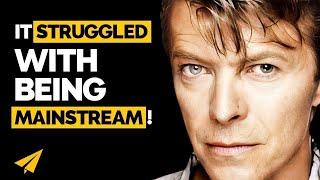
David Bowie on why he never chased commercial success, instead pursuing artistic importance. He used painting to unblock songwriting, treated all mediums as interchangeable tools, and formed Tin Machine with Reeves Gabrels to escape mainstream pressure. Bad experiences fueled his creativity; the work stays unfinished until the audience completes it.
Chapters
Damn, I really— if only I'd had a go at that.
I didn't strive for success, I strived to do something artistically important.
I'm of the impression that bad things are something that really are important to one's life.
All the mediums are rather like painting, and you can use the same tools and work within all the different mediums.
Adapting to the idea of being kind of mainstream I found very difficult indeed.
Thank God this is visual.
The possibilities are almost limitless. What can we do now?
The work is never finished now. Until the viewer contributes himself.
I don't know why, but ever since I was really young, I thought I'd never have a problem making money, whatever I did. As I get older, I get more and more selfish about what it is that I want to do that I find satisfying.
He was an English singer, songwriter, artist, painter, record producer, and actor.
He was a popular music icon for over 4 decades.
His flamboyant appearance was a cornerstone of his image.
He's David Bowie, and here are his top 10 rules for success.
When I was 18 or 19, I think I had a whole set of people that I looked up to.
I don't think I ever—
I think you're only influenced to a certain extent. I think what happens is that you look at somebody and think that maybe something you had as a small seed in your own mind, you see, maybe that person has extended that or gone quite a long way with what you think you might like to do, and you think, yeah, 'That person's doing what I'd really like to do, and that's what could happen. That's what I can do with what I've got.' And that's— so that kind of influence, I'm proud to— if I have been influential on people in that way, that's really good. Because there's a certain kind of regret that when you haven't been adventurous with your ideas, there's— when you get into a later life and you haven't even tried to do some of the things that you really wanted to do, and you can look back and say, damn, I really— if only I'd had a go at that, you know, things might have been different, or I would at least know if I could do it or not. And, uh, the people I looked up to when I was a kid, like William Burroughs and like Little Richard and like John Lennon, they did it, you know. And I thought, well, I'm gonna— I'm an absolute fool of myself, but I'm gonna, you know, go for it too.
You strive for success since you're 16, you achieve success, and now you sit in your green chair looking back on it all.
Yeah.
And what do you say?
Not true.
I didn't strive for success. I strived to do something artistically important. And success over here, I believe, is very much in the kind of material world. So can I just say that before we start? I wanted to do something artistically valid.
You can learn from tragedy, and I think you can— I'm not sure that a bad experience is— In America, they're so keen for you not to have a bad experience. They spend half their lives trying to avoid bad things happening to them. I'm of the impression that bad things are something that really are important to one's life, and bad experiences are not necessarily a bad experience. Creative juices come from bad experiences. They do, yeah, that it's, uh, you can— I don't think they should be looked at negatively at all.
If I'm writing and recording, I find I don't need to paint, but if I'm not doing very well and I can't write, then there's just, there's a kind of a block or a blank there, then I just, I revert to painting, and that kind of opens up like a watershed of ideas and associations and things. So it's kind of, it's almost a device to help me. I often find that one medium helps the other, you know, I mean, because I always go back to that analogy that all the mediums are rather like painting and you can use the same tools and work within all the different mediums. And so I can understand what I'm trying to say often by painting it first. And then I think, now I know what I'm trying to write, and I can go back and, and write both musically and lyrically.
Yeah, adapting to the idea of being kind of mainstream I found very difficult indeed, but looking at it in a fairly sober light, I felt that I could deal with it, you know. And I, I just couldn't. I was so beat by the whole three-ring circus thing about it and trying to reach a wider and wider audience. You know, without actual any kind of feelings of artistic passion at all. I didn't really believe in the material I was doing, and indeed some of it was very good material, but I just had lost the belief in myself as a creative artist. And I got introduced to Reeves Gabrels as a guitar player and just a good guy that I met, and he just very simply said, "You've just got to stop doing this, you know, there's no way out, just stop doing it." do what you like doing. I said, but you don't understand. He said, yes, I do understand.
I've read all the books.
And, and that was it really. And I just stopped doing it, you know. And I formed Tin Machine with the, uh, um, really quite clumsy idea that I could just disappear into a band anonymously.
I found my exit from all that mainstream stuff through Tin Machine.
I mean, that was my sort of my holy grail at the time.
It was, ah, this is the truth.
I don't find it very exciting anymore, generally.
I think it's got to get a lot more dangerous again.
We're working on it.
I think it's probably good to step back from one's work for a while and try something totally new. I think it does revitalize your original enthusiasm, and that's what it has been like for me over the last few years. And now that I have ventured back into something that's very personalized, it does seem that there's been a lot brewing. And it is just—
phew!
Thank God this is visual.
Whatever I go on the road with again will have to be something that I have the utmost belief in, which is a great way to start again for me, for the '90s, for my age. We have this peculiar crossroads in rock now where there's so many of us approaching 40s and will shortly be in their 50s. Um, so it's this— it's kind of a brave new world for us. So the, the possibilities are almost limitless. What can we do now? Do we do what is the usual predictable thing, which is an artist carries his repertoire with him throughout his career? But as we were doing new things when we first started, we should also continue to do new things now.
So I thought for some people, what I might consider rubbish might actually have a real strong trigger to somebody else, the way they look at it and what they need from it. You know, an artist these days, especially since Marcel Duchamp and all that, the work is only one aspect of it. The work is never finished now until the viewer contributes himself. The art is always only half finished. It's never completed until there's an audience for it.
Of course.
And then it's the combination of the interpretation of the audience and the, and the work itself. It's that gray area in the middle It's about what the work is about.
Okay.
I think.
I don't know why, but ever since I was really young, I thought I'd never have a problem making money whatever I did. So really it was a choice of what was I going to do for it, and, uh, I just had a passionate affair with music. It was a very amorous affair with music. As I get older, I get more and more selfish about what it is that I want to do that I find satisfying, and, uh, it's definitely how one should spend one's life is, is Because, you know, if you make yourself happy, a little bit of that sunshine can spread onto others.
Thank you guys so much for watching. I hope you enjoyed. I'd love to know which of the top 10 clips that you saw meant the most to you, had the biggest impact. Leave it in the comments below, and I'm gonna join in the discussion.
And if there's a famous entrepreneur that you want Evan to feature in a future video, leave that in the comments below too.
Thank you guys for watching. Continue to believe, and we'll see you soon.