Discover the Path to Success | Eddie Murphy's 8 Minute Mastery
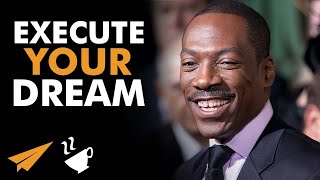
Eddie Murphy, Gary Vaynerchuk, Travis Kalanick, and Carlos Ghosn on why ideas fail without execution. Murphy warns against a fallback plan. Ghosn's rule: 5% strategy, 95% execution. One founder's lesson from a failed startup: launch fast, iterate, skip perfectionism.
Chapters
Good morning, Believe Nation. Today's message is execute your dream. Over to you, Eddie Murphy.
I wake up every morning.
Espresso keep me going.
I wake up every morning.
I knew I wanted to be in show business, and I just happened to luck out and things happened. I think you know, you know, you know what you're supposed to do deep down inside. I think everybody does. A lot of people just don't go after it. You know, like most people start out, they say, I want to be a this, but I'm going to get that to make sure I have something to fall back on. And what you're doing is you setting yourself up for failure because you're going, there's a possibility that I'm going to fall back. And when you put that out there, then you fall back. But if you just say, hey, this is what I want to do, and you go do it, you usually get your stuff the way you want it, man. That's what—
Thank you guys so much for watching. The question of the day today is, what is preventing you from executing your true big dream? What's holding you back? Leave in the comments below. I'm going to join in the discussion. I also want to give a quick shout out to Lee Jeng Yu. Thank you so much for picking up a copy of my book, Your One Word. It really, really, really means a lot to me. So thank you guys again for watching. I believe in you. I hope you continue to believe in yourself and whatever your one word is. Much love, and I'll see you again tomorrow morning for another shot of espresso.
I wake up every morning Espresso, keep me going.
What's up, Believe Nation? If you want a little more motivation on executing your dreams, stay tuned for some bonus clips.
My assistant's got a great thing now in this. Once in every 4 months, somebody sends an email saying, "I've got a huge startup that I want you to invest in, but you've gotta sign this NDA." Right? Which literally every time gets an email back that says, "Fuck you." Right? And the reason is, I'm a humongous believer that ideas are shit and that execution's the game, right? We've all got ideas. Everybody's got ideas. Do you know how many fucking ideas we all have here? We could probably sit here for the next 2 hours, draw them all out, record 'em, and predict the next 78 great startups over the next 9 years. And? So I think the thing that is another theme in entrepreneurship is there is way too much fodder brought to the idea Uber was Magic Cab 3 years earlier. Uber is not an idea. Uber existed. It was called Magic Cab. But the guys that executed it sucked. So they lost. So I think, you know, if there's any level of romance left in this room about your idea, I'd like to suffocate it. Because I think the actual situation is what you actually do with it.
The way of the entrepreneur is actually about going looking at the world and finding problems. It's actually— some people think that's a negative mindset, but actually I find it is like a— it's a curious mindset, is you're out there looking for problems, looking for things that aren't the way they should be or could be. OK, you got a good idea. Look, everybody's got a good idea.
Yeah.
You know, now the— OK, everybody has an idea. Not everybody has a good idea, but lots of people have good ideas.
Look.
Uber is a good idea. You push a button and get a ride. I don't know if we were the first person to ever think of that idea, but we were the first person to do it. And, and so you got to just go do it, then you got to just get out there and go do it. So it's easy to have the idea or straightforward, but then you've got to have enough guts to go out there and try. And that's, that's the way of the entrepreneur.
I think you famously said strategy is 5% of the answer and execution is, is 95%. So, so what does that mean? And, and how did you actually, what did you do differently?
Well, you know, the, the 5%, yeah, I said, yeah, 5% of the challenge is the strategy, 95% of the execution. This I said it as CEO of Nissan. I said it also as CEO of Renault, and I said it as Deputy CEO of Renault. When I said the first time it was mainly in France, and I was to my, to the top management of Renault in France, because there was a tendency in the company to spend too much time on strategy and leave the execution for other people. And this is where I said, yeah, strategy is fine, it's very important, but it's only 5%. If you don't go to execution after this, the delivery and the performance of the company is gonna be very weak. I really, I really believe it. Now, it doesn't mean strategy is not important, but when you establish north and you know exactly where north is for the company, you've done something very important because you're giving the direction. But if you don't start moving north, if you don't start mapping and establishing milestone, you're never gonna be getting there. You're never gonna be getting there.
Execute, and you need to execute as fast as possible. Because the thing at the end of the day is whether you feel you have competitors or not, sooner or later you're going to have someone. And if you can't move fast enough, someone's going to beat you to the punch. So make sure whatever you're doing, you get something out within a month or two. If it takes you longer than that, you're taking way too long. I created this company called Surf. And it was in Rockwall, Texas, right by Dallas. And I had this brilliant idea. Have any of you guys heard of the Media Temple grid server solution? That was my idea a year or two before it came out. And I spent $1 million on it, trying to actually do that idea before Media Temple. The funny thing is that I didn't have $1 million, so I actually had to borrow $1 million. And I spent it on business partners who moved really slow and really weren't the best at what they did. Within 12 months, we launched nothing. They also had some of the problems in my previous slide, right? Like financial instability. And they had a family and kids of I think like 6. So I even bought them a home in Rockwall, Texas that cost $200,000-something. Why did I buy it instead of renting it? I have no clue. I was stupid and young. But nonetheless, I lost over a million bucks on that of borrowed money. Not investor money, but borrowed money that I had to pay back. And it failed miserably because we never launched anything. If you can't launch something, someone like Media Temple is going to beat you to the punch, get a ton of customers, and make a lot of money. So lessons I learned from that, set deadlines. No matter what, you have to set deadlines. People have to be held accountable to them as well, right? Can't just set a deadline, it passes, nothing happens. Someone better be meeting them, if not you know, something has to change. You also need to make sure they're small. If the deadline, if the like milestones, goals are too big for those deadlines, they're not going to get met. So make them really small and tangible. That way you can see it really well in advance if they're actually going to be met or not. And last but not least, don't worry about perfection. A lot of people are like, dude, I'm going to create the most perfect version of You know, whatever it may be. That software has a lot of bugs, mine's going to be perfect. Perfection is overrated. Nothing's ever perfect. You're going to continue to have to iterate, so forth and so on. It's never going to be perfect. There's always going to be issues. Just get it out there and start trying to make money.
Well, the last and the most valuable lesson as an entrepreneur I learned was about the value of execution. Way too many people, way too many people spend too much time thinking about the vision. We are taught that you have to build a better mousetrap. Every venture capitalist will tell you that to be a successful entrepreneur, you need a breakthrough innovation. Well, you have to assume none of us, or at least most of us, are not the smartest people in the world. There are lots and lots of great, great inventors out there. How are we going to be the person who's going to always build a better mousetrap? Well, to be successful, you don't have to build a better mousetrap. You just have to build a different mousetrap. And as long as you are executing well, the business always comes down to block and tackle. It's not about the great vision, it's always about the great execution. And you can always succeed by out-executing your competitors, not necessarily having the best product in the marketplace. And I think Microsoft is a great example where they took a same product that other people may have had, but they executed substantially better, and today they are the market leader in the industry.
More from Evan


How the Biggest Mistake in History Created A Trillion-Dollar Empire | Sergey Brin



9 Machiavelli Principles That Force People To Respect You | Machiavellian Philosophy



The First 10 Words That Instantly Ruin A Sales Conversation | Vanessa Van Edwards

The Top 1% Mindset Behind The First $5 Trillion Company | Jensen Huang (Nvidia)

