Discover Top Tips From Tim Ferriss In 22 Minutes
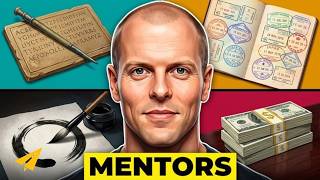
Tim Ferriss breaks down six practical tips from his book Tribe of Mentors: build a network of high-performers, say no gracefully, look for elegant solutions, ask better questions, use forced-choice ranking to make decisions, and meditate daily to reduce emotional reactivity.
Chapters
If you're looking for ways to find mentors, learn to say no, and ask better questions, then this video is for you.
You're the average of the 5 people you associate with most, which I still think physically, emotionally, financially, that's true. The emails were so incredibly well-crafted and so smart in the wordsmithing that they used that I then responded to the people who refused to be in the book to say, can I put your refusal email in the book, which I did. Much like asking yourself, what What makes me happy is not really a great question. It's too broad, right? It takes too long to search.
What's up? It's Evan. My one word is believe, and I believe in you, and I believe you have an amazing gift inside that I want to see you unleash out into the world. I started the Mentor Me series with the goal to try to hang around people who've done a lot more than us, and hopefully by being around them just a little bit longer, some of their beliefs, their mindset, their way of seeing the world seeps into us to help us become the best version of ourselves. So today we're going to learn from one of the best, Tim Ferriss, and how to build a tribe of mentors. Mentor me, Tim. Kicking us off at number 1 is our first tip: find mentors.
Talk to me about the new book. Yeah. Tribe of Mentors came about— I just turned 40 not too long ago, and it's been a big 12 months. It's been a heavy 12 months too. I had a number of close friends die unexpectedly, including one of my mentors in this book actually passed away just a few weeks ago, very unexpectedly, of complications. Terry Laughlin, who taught me how to swim. And how old was Terry? 66. So he had metastatic or metastasized prostate cancer and then had complications from that and a stroke. And I'm sorry, It's been, thank you, a good opportunity for me to just take a step back and say, all right, let me hit pause for a period of time to try to reassess priorities, look at the direction that I'm heading, look at the things I'm doing or not doing. How has planning or overplanning or underplanning helped or hurt me? How am I relating to myself, not just to the world? I mean, all these questions started to bubble to the surface. And it seemed like a good opportunity to ask a lot of questions, some of which are really tactical, some of which are more strategic, some of which are really high-level life mission type goals. And I asked myself the question, which I've been trying to do in the last couple years, which is, what would this look like, or what might it look like if it were easy, right? So if this were simple, what would the structure look like? And I journaled on it, and the answer that came back was, you should just ask other people the questions that you are having trouble answering for yourself. So I reached out to about 140 people across every possible discipline, so ranging from, say, David Lynch, the director, or Terry Crews, all the way to Kelly Slater, most decorated surfer of all time, to Ayaan Hirsi Ali, who's an incredible writer, thinker, activist, Temple Grandin, I mean, you name it. Basically every possible discipline and industry, artists, I reached out to all of them people at the top of their fields and asked them a set of 11 questions, and then compiled it into this book, Tribe of Mentors, because I've thought for a very long time, and this is borrowing from somebody else, advice I got when I was probably 14 or 15, which was, it was a, it was an older student in a martial arts class. He was an adult, and he left a voicemail on my answering machine. Remember those? And— By the way, guys, not on your mobile device. This is a machine. Machine that was attached to— Physical tape. Physical tape.
You have to put the tape in.
Yeah. And if you ran out of tape, no more messages. But his message was advice to me, which was you're the average of the 5 people you associate with most, which I still think physically, emotionally, financially, that's true. And I get asked all the time, well, what if I don't have 5 people around me that I can use to average up? Find them. Yeah, find them. Or you can do it remotely. You can do it virtually through audio, through video. Through books. And so Tribe of Mentors was intended to give people 130 of the world's best to learn from.
Up next at number 2 is learn how to say no.
The second thing that you said that I think all busy people probably need to take a lesson from is how to say no gracefully. And you came at this from an interesting perspective, even some people who said no to you to this project.
Right.
So I reached out to a lot of different people. Dalai Lama, call me. And there were a lot There were a lot of non-responses, and then there were a fair number of polite declines. And some of the emails were so incredibly well-crafted and so smart in the wordsmithing that they used that I then responded to the people who refused to be in the book to say, "Can I put your refusal email in the book?" Which I did. So a number of people said no, like Danny Meyer, Shake Shack, and so on. Then you have Neal Stephenson, incredible science fiction writer, one of my favorites, Snow Crash. And many, many others. Wendy McNaughton is an illustrator. So you can copy and paste basically the language they use to make it easier for you to say no to all those invitations. Plus it makes you feel good when you get a response. Yeah, exactly. I like them more after being rejected, which is a real Jedi trick. Give us a couple of the articulations. I'll give you a couple of ideas. And then we'll get people to buy the book to see all of them. Oh no, for sure. And there are dozens of different tools in the toolkit. What was your favorite though? One of my favorites is using the word policy or vacation to make it a blanket refusal. So for instance, I was once refused for a lunch date with a very famous tech investor, and he said, sorry, I'm just taking a— I'm on a no-meeting diet for the next month, and as a policy I'm saying no to all meetings. And I said, that's interesting, no-meeting diet. So I started using no-conference-call diet, no this, that, and the other thing, diet. And people just rolled with it. It was incredible. There was no feedback, no pushback. Uh, that would be one, because it's not you, it's me, right? And it's a way of breaking up with somebody, right? And almost inevitably what they say is, uh, I'm so busy right now and over-calendared that any response I were to give you, any time I were to give you, uh, would find me distracted. So I'd love to do it later, but anything you can get right now out of me is going to be— Later though, because that's This is the thing, you have to be careful. You have to be careful. If you leave Evan Carmichael, you have to be really careful. So there are people who take that approach, and then there are other people like Dustin Moskovitz, who's also in Tribe of Mentors, who says the first no is the cleanest and the easiest. You have to do it very clearly and very, very early. So he has a slightly different but similar approach to saying no. And the best way to say no is not to respond at all, I find. Really? Yeah. —But I thought you just said you want to get the no. You like people who say— Well, I like, as the recipient, for people to send me a very polite no. But if you have, as I do right now, 355,000+ unread email, then the act of just parsing that would take the rest of your life. And in that respect, cultivating selective ignorance and becoming comfortable with letting a lot of the trivial many slide, which is another theme that comes up a lot, is really important.
Moving on to number 3, look for ease.
I've spent a lot of my life really angry and using rage and anger, a lot of it directed at myself, as a fuel for becoming a competitor because the only— well, the only way that I felt validated or valuable was to win, period. That's it. I was an instrument for winning. And competing. And I only felt good in relationship to other people by somehow being able to tolerate more pain, work harder to be number one. And it was more a relief of not feeling terrible about myself for a fraction of a day than it was the joy of winning. If that makes sense. It totally makes sense. And so for my whole life I've been so completely brutal to myself. And I've realized through a number of different means, you know, one of which anybody can pick up, which is actually a book called Radical Acceptance by Tara Brach, which terrible title. Love Tara Brach, but a very, very helpful introduction to thinking about the potential idea that if you want to really help people or you want to really love people, you can't do it if you hate yourself. You just cannot fully do it. You cannot. I don't think it's possible. So the last few years have been, and especially the last 1 or 2 years, a process of asking different questions. And one of the questions— there are many different questions, but one of the most important, which is right up front in this book and the reason the book kind of exists in a way, is what might this look like if it were easy? Things are hard enough, or they can be. And there's so much uncertainty in the world that for Type A personalities or people who have been wounded and have become very highly competitive as a result— Or highly driven. Or highly driven. Driven we usually use as a very complimentary descriptor, but, you know, a horse that's being whipped to run faster until it dies on the track is also being driven. Yes. And that's not always a good thing and very often a bad thing. That question, what might this look like if it were easy, is a really deceptively leveraged question because you start to look for elegance. And ease instead of the path of complexity that allows you to absorb and tolerate the most pain, which some people, myself included for a long time, viewed as an indicator of doing the right thing. Or, and sometimes for me, of strength. Yeah. Yeah. It's like, oh yeah, no, I can redline for longer than all of you. Yep. It's like, wait a second. Yeah. Wait, what are we talking— yes. And this is It feels good for a second. Like— and there— don't get me wrong. There is strength and there are advantages to having endurance, but only when you're enduring things that are worth enduring as opposed to just making your life painful. So long answer, long monologue, but I do think it's very important to talk about the darkness and the failures and the hard times. And when I interview people, I always try to bring that out because it's so easy, like you said, to listen to an interview or to see someone on the COVID of a magazine and think to yourself, "Wow, I really wish I could do something like that." But I'm me and they're them and they've got it figured out. And they always wake up at 6 in the morning with like a mental karate chop to conquer the day with no insecurities. And that's just bullshit. It's not true. And I can tell you with firsthand knowledge, knowing some of the most impressive people I've ever I've come across in the world who've become my friends, we all have our demons. So I want, I make a real conscious effort to talk about those so that people can try to create a safety net against self-destruction and certainly at least self-flagellation and berating.
Next up at number 4, ask better questions.
Questions are critically important because first and foremost, Thinking, what goes on in here, is largely asking yourself questions and answering them. Secondly, if you want to get anything in life, chances are it's inside someone else's head, the knowledge, the skills, the blueprint, and the pickaxe for getting that gold is in the form of questions, all right? So there are a few things that you can do to improve questions. Number 1 is study questions. Watch Inside the Actors Studio. Listen to podcasts, whether mine or Joe Rogan's or others, so that you can borrow questions and test them on other people. And there are a few things to consider when you're formulating questions. Number one is, can it be answered relatively quickly? So for instance, if you found someone you idolize, you're in an elevator, oh my God, it's Jimmy Fallon. If you asked Jimmy a question, could he come up with a really concrete answer in 5 seconds or less? If the answer is no, find a different question for you or for other people. So, what is your favorite book, for instance? Not a good question because people have read hundreds or thousands of books in many cases. But what book or books have you gifted the most to other people? It's going to be a short list. The search query is really refined. It's fast. Click. All right? Much like asking yourself, what makes me happy? Is not really a great question. It's too broad. It takes too long to search, but let's just say, "What makes me feel most relieved after work when I get home?" or "What activities? Which people?" All right, now we're more refined. You can answer it much more quickly and it's more actionable. A few things you should not do if you meet someone who is, say, just above your weight class in terms of professional development and you want to connect with them. Don't ask them questions that you could answer on Google, number 1. Number 2, don't ask them really broad questions they couldn't conceivably answer quickly. What should I do? What advice would you give me for succeeding? These are not good terms. If you can't define success in, say, 10 words or less, get rid of it. Lose it from the question. Alright, and I would encourage you to strive to be interested in the form of good questions if you seek to be perceived as interesting. Stop talking, start thinking about questions, and then stop and listen.
Moving on to number 5, learn how to make decisions.
Another would be, and I don't know if you've ever had any interaction with Kyle Maynard. Kyle Maynard's a fascinating guy. He was born a congenital quad amputee. PT. So he has his arms end before the elbows and his legs before the knees. Nonetheless, he is in the National Wrestling Hall of Fame, like collegiate wrestling, and is the first person to ever climb Mount Kilimanjaro without prosthetics. So he military crawled the entire mountain. He's such a stud. And he was taught by a CEO at one point. The CEO used this for hiring, but you can use it for anything. This particular CEO, very successful, would have his current employees rank prospective employees from 1 to 10. And that's not interesting by itself. His rule was you can't use 7. So I want you to rank them from 1 to 10. You can't answer 7. And what, what ends up being so beautiful about that, and leveraged, is that 7 is a safe number. It's kind of like the non-offensive Switzerland of answers. It's not committal, It's not too bad, so you can wiggle out of it. Whereas if you're choosing a 6, that's barely passing. That's not good. If it's an 8, you're indicating you're pretty stoked. Like, you're vouching. He forced them to make a decision. Exactly. So you can— I love it. 1 to 10, no 7. And so I've used that, and Kyle has used it for, say, invitations. For anything. Invitation to conferences, invitations to coffee, whatever it might be. It's like decisions in life. In life.
And finally, number 6: meditate.
I want to hear your response to one of the questions that you sent all of us. Let's do it. So in the last 5 years, what new belief, behavior, or habit has most improved your life? So for everybody watching, when you get this book, this is one of the questions that many of us quote-unquote mentors have answered. Yeah, I would say for me it is a consistent morning practice before taking my phone off of airplane mode of sitting and doing a meditative practice for, say, 20 minutes. And it stuck initially by taking a Transcendental Meditation class of perhaps 3 days when I was going through a very, very difficult time. And Chase Jarvis, who's awesome and hugely successful, commercial photographer. He's worked at every big brand you can imagine and is also a very good CEO. Both he and Rick Rubin is like the most legendary music producer of all time. Just look at his discography. It's insane. It's like Johnny Cash, Eminem, Jay-Z, Metallica. You know, the list is absurd. It's like everybody you've ever heard of. And he also said to me at one point, because I was going through a really rough time and I was very tightly wound, he said, "Have you ever considered TM?" And I'm like, "Ah, mantra? Like you pay them to give A mantra? It's a cult. Like, I don't want to be part of a cult. And on and on and on and on and on and on. They're like, no, it's actually really secular. And I know there's like a little bit of weird stuff, but you can just ignore that. It's like the first hour of the talk. Just ignore it. What do you have to lose? And I was going through such a difficult period at one point. I was like, you know, that's a good point. So I did it, and that kickstarted the meditation. And then I experimented with other things like Headspace, which I have no vested interest in. So you start with 10 minutes a day for 10 days as a proof of concept. And the way I'd encourage people to think about meditation, because it can sound very woo-woo and I certainly was repelled by it for a long time, is you are sitting down, say on a couch, to practice observing your thoughts and feelings and emotions for a very short period of time. So that for the rest of the day you are less emotionally reactive. What this means is you are rehearsing, you are training. It's like going to the gym. So let's say you're training for a sport. All right, so you're an athlete in X, you go to the gym to do squats, to do this, this, and this, so that when you get on the playing field you can perform better. It is exactly the same. You're rehearsing and training for your day, and then when you run into something that normally would trigger you, whether that's a certain type of email, whether that's an employee who has a habit that drives you insane, or you being behind in your schedule and then the line at Starbucks is longer than you would like, whatever it happens to be, the things that would normally cause you to get really tightly wound or explode or berate yourself or other people, you will then start to spot before you have the reaction. And then you say, okay, half a second of breathing. Let me choose my response instead of being held hostage to these loops and triggers that we all have. So that has been enormously, enormously helpful for me.
So thank you guys so much for watching. I hope you enjoyed. I'd love to know which of the tips had the biggest impact on you, what you're going to you can immediately apply somehow to your life or to your business. My personal favorite was number 1, which was find mentors, and I love that idea of asking people questions that you were trying to solve for yourself. So he's turned that into a podcast, and basically he books his guests off his own interests, and they become coaching for himself— free life coaching for himself based off of people who he really looks up to. And I really like that concept, and, uh, it's something that we're doing here pretty soon on episodes of Unlocking Lily, where she's reaching out to people to get some questions that she wants answered for herself. The one that really was a question mark for me was number 6, meditate. Lots of people have talked about meditating. I've tried meditating at least 30 different times in different ways, different programs, and nothing has stuck. I've never felt it. I've never felt the feeling that people feel when they say like, this has been the biggest benefit to me for the past 6 years, or whatever the question was about that Marie asked him. And I think Headspace is a tool that Tim mentioned. I've tried and, you know, didn't work for me. I did the 10 days. I did, I just kept going. I did 30 days. I did more. It was good. It's just the rigorous practice. Here we go. But I never really left it feeling so much better or more relieved. One thing that was super interesting that he said was it makes you less emotionally reactive. Was that it? Less emotionally reactive? Yeah. And I'm not really emotionally reactive in general. I don't say things that I regret. I'm pretty careful with my words. I can get excited and passionate and come out when I'm talking to you guys on YouTube and making videos, but I've thought through a lot of these issues and the passion is from a good place, I think, not a negative one. I don't berate people. I don't, I don't say things that I regret. And so maybe because I'm not seeking to be less emotionally reactive, maybe that's why meditation hasn't quite worked for me. Or maybe I'm just trying to find a reason. Excuse. I will not give up on my meditation journey, and I'm open to other opportunities. Anyway, those are my, those are my quick thoughts. I'd love to hear which rule again had the biggest impact on you and why. Leave it down in the comments below. I'm looking forward to hearing what you have to say. Finally, I want to give a quick shout out to Michael Patrick from StillFeel21. Thank you so much, Michael, for picking up a copy of my book, Your One Word, and doing the review on your YouTube channel. I really appreciate the support, man, and and I'm so glad that you enjoyed my book.
Evan Carmichael is someone I need to get familiar with.
Thank you guys again for watching. I believe in you. I hope you continue to believe in yourself and whatever your one word is. Much love.
I'll see you soon. Raise your standard. Apple at the core, its core value is that we believe that people with passion Action can change the world for the better. Not one drop of my self-worth depends on your acceptance of me. I don't ever give up. I'd have to be dead or completely incapacitated.
Hey, Believe Nation! If you want to see my all-time favorite top 10 rules of success, I have a very special secret video for you. These are the individual clips that I have personally learned the most from and applied to my life and my business. Check the link in the description for details.
More from Evan


How the Biggest Mistake in History Created A Trillion-Dollar Empire | Sergey Brin



9 Machiavelli Principles That Force People To Respect You | Machiavellian Philosophy



The First 10 Words That Instantly Ruin A Sales Conversation | Vanessa Van Edwards

The Top 1% Mindset Behind The First $5 Trillion Company | Jensen Huang (Nvidia)

