Dyslexia Is a Curse… Until You Learn This
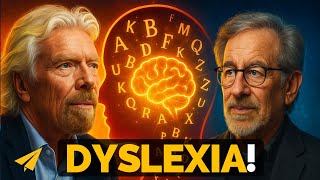
Richard Branson, Steven Spielberg, Keira Knightley, and others with dyslexia share how they turned early struggles into strengths. They describe learning to delegate, simplify communication, and build resilience. The shift from seeing dyslexia as a curse to a superpower comes down to mindset and finding the right support.
Chapters
At age 15, I decided to leave school. I just, you know, couldn't do any exams. I was hopeless.
I never felt like a victim. I think movies really helped me, kind of saved me from shame.
Take this obstacle and make it the reason to have a big life.
I felt horrible growing up. I always felt on the outside.
It makes you so emotional. Why is that?
We all have these limiting beliefs that hold us back from success in our lives. We believe that we can't go out and accomplish our goals because of this one particular reason that we feel is holding us back. But what I found with, with a little bit of a perspective shift, a mindset shift, you can turn that negative limiting belief, the thing that you thought was holding you back, and turn it into a superpower that helps propel you forward. You can live life with no limits. So today we're going to look at the dyslexia advantage.
When I was at school, I would look at a blackboard and I would not understand anything on that blackboard. And at age 15, I decided to leave school. I just, you know, couldn't do any exams. I was hopeless. When I went out into the real world and I came across things that I was interested in, I think I could get a better grasp on it than most people. And because I was a dyslexic, I was also very good at finding other really good people, surrounding myself with good people who could compensate for my weaknesses. And it taught me to be a very good delegator, which is very important if you're running businesses. And I think the advice I give to mothers who've got dyslexic children is don't force them too hard on the things they find are difficult, but they will exceed, excel on some other areas and push them into those other areas. And a lot of the most successful people in the world were once or are dyslexic.
From my 20s, I started talking about the fact that I've discovered that I was dyslexic. And I did it on purpose, because I think I think it's important for other, you know, especially young kids who've been told that they're dyslexic to see that, you know, that successful people can get through it and that, you know, if they follow their particular dreams, they follow what they're good at, that, you know, that they could be— they can be even more successful at what they're good at than others.
So—
and there are so many people like myself who've excelled in their individual professions who have been dyslexic. So I think it's really important that people who are dyslexic get out and talk about it.
Yeah, I mean, I am dyslexic, and therefore I think I've been very good at keeping things simple because, you know, as a dyslexic, I need things to be simple for myself. And therefore Virgin, I think, you know, when we look a financial service company or a bank, you know, we do not use jargon. Everything is very clear-cut, very simple, and I think people have an affinity to the Virgin brand because we don't talk above them or talk down to them.
As having been dyslexic for my entire life, which explained a lot of things, it was like the last puzzle part, and a tremendous mystery that I've kept to myself all these years that basically started with just things that happen when you're a kid in school and you're a slow reader. And in my case, I was actually unable to read for at least 2 years. I was 2 years behind the rest of my class. And of course, I went through what everybody goes through, is teasing. And I had to go through that for a long time. And so the teasing led to a lot of other problems I was having. In school, but it all stemmed from the fact that I was embarrassed to stand up in front of the class and, and, and, and, and read. But I never felt like a victim. That was the important thing. I never felt like a victim. I think movies really helped me, kind of saved me from shame, from, from guilt, from putting it on myself when it wasn't really, you know, you know, my own burden. It wasn't my burden. And I think making movies was my great escape. That's really how I was able to get away from all of that.
And you think that can kind of show through your movies you showed how you felt or just what you felt about the world or what you felt about people teasing you, I guess, or what you were going through?
Not really. My first movies didn't do that. My first movies were just basically imitations of movies I was going out to theaters to see. So they were pure genre movies, war movies, westerns, science fiction. And there were no statements. I made no statements. I'm talking about my 8mm movies. I'm going way back before I became a director. And I'm just saying that in light of feeling a little bit like an outsider, movies made me feel inside my own skill set. And the other thing is, I'm in a business right now where reading is very important. It's of critical importance to me that I read books and scripts. And so I've been able to overcompensate. And I just basically, with never feeling ashamed of myself, will take— 2 hours and 45 minutes to 3 hours to read 120 pages. Takes me about 2 hours, 45 minutes to read what most people can read in about an hour and 10 minutes. And I just know I'm still slow at reading, but I've learned to adjust. I just don't— I read often, but I'm very— and here's a great thing also. I have great comprehension in what I read because I do read slowly. I retain almost everything I read. I don't just skip over things. And I'm able to appreciate the writing. I'm able to kind of really savor good writing because I really take my time going through a book or a script.
If you had any advice to give for young kids who have dyslexia and who are just finding out what they're going through now, what would you tell them?
Just that it's more common than you've ever could imagine. And that you're not alone. And that there are ways to accelerate your reading skills, to accelerate your comprehension, and there are ways to deal with it. It's not an incurable thing. It's something you're gonna have the rest of your life, but you can sort of, you know, dart between the raindrops to get where you want to go, and it will not hold you back.
Do you think your dyslexia got you to where you are today?
I'm sure it had a large, a large hand in it, yeah. And the fact that since I was born, I've always known I wanted to pretend to put myself in other time periods, to be able to pretend to be another species. I mean, that stuff to me is interesting and it helps my mind Escape.
Yeah, it's our way of escaping the real life. And I think normal people can't really do that. They have a harder time.
I think they have a very hard— I feel bad for them.
I kind of do too.
You know, I think the advantage is my brain sees and puts information in my head differently, sometimes more interestingly, I think, than, than if I saw like everyone else. I think it's less challenging now because we have some idea about it. But I think the challenge will always be how we see ourselves, not as folks with a handicap, but folks with an interesting perspective on everything.
Sure.
Just hold on to your dreams and, you know, never ever think that you're not that you're not good enough or that you're stupid. You know, never let anyone tell you that you're stupid or that, you know, you're not capable because it's a human issue, isn't it? It's like, it's mostly a human issue, you know. We are all the same, we're all equal and, you know, and we deserve a shot. And I would just say, you know, take this obstacle and make it the reason to have a big life. Because if you can climb and if you can overcome that obstacle, you're going to be that much further ahead than anyone else. Because it takes having obstacles to, you know, to learn and grow and be better. You know, it's like if it was smooth plain sailing, you know, what do you become? If you're a straight-A student, maybe that's great. But I'm sure there are plenty of straight-A students who end up smoking pot taken out, you know what I mean? But, but the obstacle, the, the mountain that is that, the challenge of climbing that dyslexia is, is something that you can make your own and make it a reason to be a winner in life.
Found out that you had what, you had dyslexia, but way later on in your life, right?
I found out when I was 31. You know what inspired me? Here's the thing, I felt horrible I always felt on the outside. I always felt like I was stupid, like I couldn't figure out concepts. And what I— my message is, you have greatness in you. Not one of the children sitting here does not have greatness in them. And it is really important that they know that and that school is the law. Maybe school is difficult. But when you get out, you soar like an eagle. It is not the money. It's just the way you see the child as an individual and what it is they need. And it's not a matter of coddling. It's not a matter of spoiling. But if a heard child, to me, is a powerful child. If a child feels like somebody is paying attention, they feel differently about themselves. About themselves, and that's just the truth. So let me just say to all the children that are listening, every one of you is powerful, and school does not define you. You define yourself.
I'm not kidding.
You're wonderful.
What was it like being here and not being the smartest kid in the class?
You know, We didn't call it dyslexia then. It was called smarten up, smarten up, smarten up.
Jay was dyslexic and, you know, spent a lot of his time in the principal's office for pulling pranks or laying rubber in the parking lot. And I think his parents were very concerned about what was going to happen to him.
You know, I had a wonderful teacher, an English teacher named Mrs. Hawks. She said, you know, I always see you telling stories and making jokes. Why don't you take my creative writing class and I'll give you a credit in English for that, and you write some of these stories down. Maybe you could read them to the class.
Did that change you at all?
Yeah, it did, because it was the first time in my life I actually focused on something. I was— when I would do homework, it would be, okay, 16 times 5. What's that, a fly? Oh, I wonder where he's going. You know, I mean, I would just never focus on anything. So that was the first time in my life I think I really focused on something.
He turned out to be the famous one. The rich one. The, um, and he— and I think he did that because he worked so hard.
Did they try and encourage you to be better, or did they just sweep you to the side?
Uh, no, I went into special needs classes, which is about 4 kids that went up, had special extra classes and stuff. And yeah, my teachers were lovely, but, um, I don't think that we were as strategically as advanced as we are now. I think we're much better at it now, but also we didn't recognize dyslexia. It was like an on/off button. You're either dyslexic and you had to literally be looking through 2-inch glasses, or you're not. And I think, you know, now we know there's many forms of it, and I don't think I'm deeply held back by dyslexia, but I mean, undoubtedly I've got it. But, you know, I think I was given all the support for the time. And it just wasn't my place to shine, really. I had a kid come up to me the other day, and, um, you can't— sometimes you read about stuff like this, but you don't exist that it's a real emotion. And this kid must have been about 10, and, um, he came up to me and said, I heard you're dyslexic. I said, yes, I am. And he said, have you ever felt that you're worth nothing? And, um, I'm like, no, why? Why do you think? Do you feel that? And he's like, Yeah, that's the stage when you've got to start worrying because it doesn't, you know, being dyslexic or having any special needs is not an excuse or a reason for you to not prosper. It's just that you're not going to be good at the predictable things. But, you know, I mean, there's wonderful people in business and architecture and art and music that have had learning difficulties. And, but I think what that kid was tapping into is, is that every single one of us need to feel like we're good at something, otherwise we feel like, you know, and he obviously did. So I I had a little pep talk with him anyway for sort of 10 minutes, and hopefully, hopefully it made a difference. I told him to come and see me when he was 16. I said, I'll give you a job. Really what I'm talking about is self-esteem, and that, you know, that can be relevant to anyone regardless of dyslexia or not, really.
After I started to talk about this being dyslexic, and as I researched it, I have to really look at it and say, It's an asset, and I think the asset is that when I had to read something, I had to read it 5 times. When, you know, I saw the opportunity of co-op to go to school one week and work the other, I went to work. I always just visualized and concentrated on things because maybe the theory is we're not getting, you know, dyslexics don't get caught up reading books and reading how it should be done and go out and execute how it should be done, right? And it's funny, you know, I'll walk in a room, especially I'll do a speaking engagement for 5,000 people, I'll say, how many people in here are dyslexic?
Nobody.
4 people raise their hand, right? And it's usually the CEOs and very, very powerful people that raise their hands, but people that work within environments, they're ashamed and they're afraid And they don't say it. And then I start to give them the stats about Will Smith and Tom Cruise and myself and the 4 Sharks, and then all of a sudden everybody in the room is dyslexic, raising their hand. So, but I just want obviously to bring this awareness to people.
And it's nothing to be ashamed of.
Absolutely not. And, you know, we want to make sure that people get, you know, get tested if they feel that, you know, there's a challenge, there's a learning challenge.
Okay, so dyslexia, you might have this. And teachers, you might see kids who might be suffering from this. You can look this stuff up, you can find out about it, you can get help, and stuff gets better in life. So if you're having a tough time with it now, don't worry about it too much, but reach out, talk to parents, talk to friends, talk to your teachers, talk to everyone. And there's a hashtag, you can look this up. Dun-da-da-da-da-da-da. #YouKnowADyslexic, #YouKnowADyslexic. Now you're gonna have to spell that, they have to spell "know" with a— this is tricky, It should just be ping. It should be #ping, but it's #YouKnowItIsLectric. Anyway, there's the hashtag. Put that in and you win a sausage and you can get your life back. And stuff will come up, yes? Stuff will come up on that which will help you. There it is. Things can get better and will get better, but you have to take action upon it.
Action.
Do things to make this change. And then you can be a crazy person like me and have painted fingernails and living, talking with the words that were the problem in the spelling. And you've been given this thing which looks like a negative, but you can turn it into a positive. That's my message to you. So take this, stick it in your pipe, and smoke it. Thank you. Goodbye.
You're dyslexic.
Yes.
You learned that at a really, a pretty young age.
I was dyslexic, and very, very much so. It was very challenging for me. I couldn't read in the early ages, and it really affects your reading score and gets you pushed back. But there was a woman named Marjorie Gallik who's very famous. Out of University McGill with Sam Rabinovich, and I became part of an experimental class. They were testing an idea at the time, and it was my mother that got me in that class. She kind of made sure that I got in there somehow, and I thank her so much for it. Their thesis went like this: you feel so weird when you're dyslexic because— and I can still do this, I can read upside down, I can read in a mirror— and what Marjorie said was, look, this is not a fault. You have a superpower. And when you're that young, you buy into that. It gives you the confidence you need. And that's what occurred to me. She gave me that confidence.
And that carried you a long way.
Yeah.
It makes you so emotional. Why is that?
Exactly.
Oh, excuse me. I just, I think of those days.
I think people only see your hard shell.
Yeah.
And they probably think that you never ran into challenges like that.
Those were tough times.
They were very tough times because I was really wondering if I was ever going to make it. It was, you know, those were very tough times. Failing. There was a lot of panic in my own family. My teachers weren't sure, and I knew it was a— it was— I was very lucky. I was very lucky. And I meet lots of dyslexic people today, and I give them encouragement because it's— it is a superpower.
Thank you guys so much for watching. I hope you enjoyed. I'd love to know what you thought of this video. It's part of a new series that I'm thinking about creating called No Limits, where we look at limiting beliefs that people have around certain issues that they feel are holding themselves back, and then showcasing people who have those same issues and yet go on to achieve massive success. So this one looked at dyslexia, and we're potentially looking at, looking at other issues in the future. So let me know what you think. Should we continue this series? What did you think about this one? Leave it down in the comments below. I'm going to join in the discussion. Thank you guys again for watching. I believe in you. I hope you continue to believe in yourself and whatever your one word is. Much love.
I'll see you soon.
Well, I always tell dyslexics I talk to that dyslexia is actually a gift because it gives you talents that other people don't have. It's now very clear that dyslexics excel at some kinds of occupations. For instance, there are more artists who are dyslexics than you'd expect. There are more architects than you'd expect. There are more entrepreneurs than you'd expect. There are more engineers than you'd expect. Now, all those things have something in common. That is to say, they mean you have to have a holistic outlook on life rather than being good at sequential things. Reading requires sequencing—sequencing the letters and the words and making sure you know where they are in the right order—whereas artists require really to see a whole scene and see how all the bits fit together. Now dyslexics are much better at that than they are at these sequential things. It's clear that there are more dyslexics among artists, architects, etc., but it's often argued that that is because people who are dyslexic are bad at reading, and therefore they are diverted away from things that demand a lot of reading into things like artists being an artist, etc. But the balance of evidence now suggests that actually dyslexics are not just forced into these kinds of pursuits, but they are actually more talented in them. And you can test that in the lab by testing things like their ability to see— spot figures in cluttered scenery, or their ability to discriminate colors. A lot of what we call holistic kinds of visuospatial tasks dyslexics are better at, and that's absolutely clear. So that suggests very strongly that they do have superior talents. That's only to be expected, actually, from a genetic point of view or evolutionary point of view, The fact is that dyslexia is extremely common, about 10% of people have it, particularly boys. That means that there must be compensating advantages, because if it was all disadvantage, that gene or genes— we now know there's at least 7 genes involved— those genes would have disappeared, because one of the things we know is is that many dyslexics have poor motion discrimination, poor ability to pick up motion. And if you had a really serious deficit in that regard, you wouldn't see the oncoming saber-toothed tiger and you wouldn't live to procreate your genes. So it's quite clear there must be some balancing advantage of being dyslexic. And it's quite clear from what I've just said that it is this holistic talent, this ability to see things in the round, that dyslexics have much more than ordinary readers. Well, I always tell dyslexics I talk to that dyslexia is actually a gift because it gives you talents that other people don't have. And I'm sure that both things are true. That is to say, children who are dyslexic tend to take up pursuits that don't demand too much reading. I would anyway if I couldn't read. I mean, it's very, very frustrating to be trying to read a book and not be able to when your peers can do so. So you tend to do the things you're good at. And you're good at these things that require holistic visuospatial abilities. And as we— I've just said, we actually find that dyslexics are very good at those kind of pursuits. So it's a combination of the two. It's both the, the ability to see things in the round and also the fact that people are driven towards those sort of pursuits because they're not very good at reading. Nobody says they're in opposition. They actually are a happy marriage, I would say. The first dyslexics I met when I was first introduced to the whole subject was somebody who was a first wrangler, senior wrangler at Cambridge, i.e., an extremely good mathematician, came first in the maths Dreybos, and he was extremely dyslexic. And when I discussed it with him, he said, well, the thing was that he was really bad at things like arithmetic and adding and subtracting numbers, but as soon as he began to see there were patterns in, in mathematics, he could see patterns that other people couldn't. And Einstein said the same, that he saw things in pictures. He didn't— he couldn't work it out sequentially, and Einstein's a well-known dyslexic, or was a well-known dyslexic. Well, I'm sure you're right, because one of the things— and this has never actually been published— but one of the things I observed in working with a primary school teacher was that the dyslexic children were remarkably good at drawing three-dimensional objects, because most children say, well, a three-dimensional object looks like this, and therefore they draw, let's say, the top, and then they don't know what to do about the bits underneath. Whereas a dyslexic will see how it actually looks, not how it should look, and so they get it right. It's noticeable there are many dyslexics among architects, and The reason probably is, is that architects need to be able to visualize how their buildings are going to look when they're completely built, and it's very difficult for most people to see that from plans, for instance, flat plans on a piece of paper. But dyslexics are notoriously good at seeing things in 3 dimensions and extrapolating from 2 dimensions into 3 dimensions because of this holistic ability they have. Richard Rogers, the famous architect who is himself dyslexic, says that he prefers to have dyslexics in his drawing office, or in his architect's office, because they could visualize how a building is going to look, and he needs that to be able to know that the building's going to look as he wants it to. This is highly controversial, but there seems to be evidence that dyslexics have more activation of the parts of brain that are known to be important for creativity. And so in functional magnetic resonance imaging experiments where you get dyslexics compared with good readers to exhibit creativity, there's there's a thing called the Torrance Test of Creativity, for instance. You could show that there's more— or some people have shown that there's more activation in a particular part of the brain, in this part of the brain in the frontal lobe. There's more activation of that area in dyslexics, particularly in the left hemisphere, than in good readers. And that correlates with their better creative It means being able to sequence things in time, sequence your life, as it were. And they are notoriously bad at it. Dyslexics I've dealt with, you know, notoriously fail to turn up on time or turn up 2 hours earlier, that sort of thing, because they don't have that absolutely embedded sequencing style that most of us get through education early in life. But that has its good side as well, because it means that they're open to new suggestions, new ideas, and that's probably one of the things that contributes to their artistic talent. Another aspect of this is because they have such a bad time trying to learn to read, if they survive their schooling, they will have developed means of getting over this, plus a great deal of determination. Yeah, what, one of the things I'm convinced that explains why, among entrepreneurs, dyslexics are 10 times overrepresented than you'd expect, and it's because through the knocks of life, particularly during education, they've had to become very resilient. They've made lots of mistakes, and they've had to work ways around these mistakes. And as a consequence, they are extremely determined and successful because they don't give up.
More from Evan


How the Biggest Mistake in History Created A Trillion-Dollar Empire | Sergey Brin



9 Machiavelli Principles That Force People To Respect You | Machiavellian Philosophy



The First 10 Words That Instantly Ruin A Sales Conversation | Vanessa Van Edwards

The Top 1% Mindset Behind The First $5 Trillion Company | Jensen Huang (Nvidia)

