Elon Musk's Top 10 Rules for Success
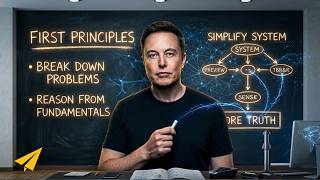
Evan Carmichael breaks down ten success principles from Elon Musk's own words and experiences. Musk worked 20-hour days and slept 6 hours while building his companies. He emphasizes aggressive deadlines, staying curious, embracing failure, and trusting your ideas over what others think.
Chapters
Elon Musk is a billionaire CEO of SpaceX and Tesla, co-founder of PayPal, founding chairman of SolarCity.
The determined engineer's big dreams transformed 3 industries.
And one of the most influential innovators in the world.
Elon Musk built a reputation for changing the game by ignoring the rules.
He went from being bullied as a child in South Africa.
I was, you know, bullied quite a lot. I did not have a sort of happy childhood, to be frank. It was quite, quite rough.
Teaching himself to code at a young age, When Elon was 10 years old, he got tested by IBM and he was found to have one of the highest aptitudes they'd ever seen for computer programming.
I tried to take some computer classes, but I was way ahead of the teacher.
To building companies that are reshaping space travel, electric cars, and the future of humanity.
I'd really love to go to Mars, and that's the overarching goal of SpaceX.
Becoming the richest person in the world with a net worth of over $800 billion.
Tesla could give Elon Musk the chance to become the world's the first trillionaire.
Need motivation?
Watch a top 10 with Believe Nation.
If you've been here before, drop a hashtag #believe in the comments below so I can feature you here in a future video. And if you're new, welcome to Believe Nation, the only channel that helps you believe in yourself daily, one video at a time. Okay, let's kick it off with rule number 1: ask better questions.
Earth turns out to be this computer to understand, to get to figure out the answer of the meaning of life. And it comes up with the answer 42. And, but then it's like, what the heck does 42 mean? And it turns out, well, actually the hard part is the question, not the answer. And for that you need a much bigger computer than Earth. That's, so basically what Douglas Adams was saying is that we actually don't know how to frame the questions properly. And so I think by expanding the scope and scale of consciousness, we can better understand what questions to ask about the answer that is the universe.
Rule number 2, set aggressive deadlines.
On the deadlines front, I mean, I generally actually try to aim for a deadline that I at least think is at the 50th percentile. So it's not like an impossible deadline, but it's the most aggressive deadline I can think of that could be achieved with 50% probability, which means that it'll be late half the time. And, but whatever, like there is like a law of gases expansion that applies to schedules. Like whatever given, whatever schedule you, like if you said we're gonna do this something in like 5 years, which to me is like infinity time, it will expand to fully available schedule and it'll take 5 years. You know, there's like this, there's a physical limit. Physics will limit how fast you can do certain things. Scaling up manufacturing, there's a rate at which you can move the atoms and scale manufacturing. That's why you can't instantly make a million of something, million units a year or something. You've got to design manufacturing line, you've got to bring it up, you've got to ride the S-curve of production. Yeah, I guess like, I'm trying to think, what can I say that's actually helpful to people? I think generally a maniacal sense of urgency is a very big deal. So, and you wanna have an aggressive schedule and you wanna figure out what the limiting factor is at any point in time and help the team address that limiting factor.
Rule number 3, invest in what you believe.
If it's long-term for a company, then you can say, well, does that, is that, do you like the products or services of that company? And is it likely to, do you like the product roadmap? Do you like, it seems like they make great products and they're likely to make great products in the future. If that's the case, then I would say that's probably a good company to invest in. And I think you also want to believe in the team. So if they're, well, that's a talented and hardworking team, they make good products today, they seem to be still motivated to make things in the future, then I'd say that's a good company to invest in.
Fair point.
Yeah.
And now that won't solve for the daily fluctuations which happen and sometimes are pretty extreme. Over time, that is the right way to invest in stocks because a company is just a group of people assembled to create products and services.
So you have to say, well, what are the—
how good are those products and services? Are they likely to continue to improve in the future? If so, then you should buy the stock of that company and then don't worry too much about the daily fluctuations.
Rule number 4 is be curious.
The reason for XAI's mission is to understand the universe. So now that's actually very important. So you say, well, what things are necessary to understand the universe? Well, you have to be curious and you have to exist. You can't just, can't understand the universe if you don't exist. So you actually want to increase the amount of intelligence in the universe, increase the probable lifespan of intelligence, the scope and scale of intelligence, I think actually also as a corollary, you have humanity also continuing to expand because if you're curious of trying to understand the universe, one thing you're trying to understand is where will humanity go? And so I think understanding the universe actually means you would care about propagating humanity into the future.
Also, if you wanna take real action after this video, I made a free worksheet just for you. It covers the top lessons from today, gives you space to write your biggest takeaways, and helps you build a simple action plan It's 100% free. Just click the link in the description below to go grab it. I'll see you there. Rule number 5, build with a team.
Just going back to the consideration of a human, we all started out as one cell, but now we are over 30 trillion cells. Mm-hmm. And, but I think most people would like feel like they're one, one body, like, you know, usually your right hand's not fighting your left hand type of thing, you know?
Mm-hmm.
So, to sort of cooperate. Your mind is, you know, just a vast number of neurons, but most of the time it doesn't feel like there's, you know, a trillion voices in your brain. Hopefully not. So there's clearly more that happens when you have trillions of cells working as a cellular collective than, say, one cell or a small, you know, small multicellular creature. There's clearly something different that happens. Like, you can't talk to a bacteria, you know.
It's very silent.
They just sort of wiggle around and, you know, from their perspective, I don't know. I was sort of, what is life like from the perspective of an amoeba, you know? But I know you can't talk to amoeba, like they don't talk back, but you can talk to humans. So there's just something obviously qualitatively, fundamentally different for, Humans, once you have a large number of cells and, you know, sufficiently large brain type of thing, there's— you can now talk to humans. And they can say things, they can produce things. But bacteria are not going to produce a spaceship, for example.
But humans can.
So I think there's something qualitatively different that also happens when there's a collection of humans.
In fact, it's safe to say that a single human cannot make a spaceship.
I cannot make—
a spaceship by myself, but with a collection of humans, we can make spaceships. So there's something obviously qualitatively different about a collection of humans. In fact, it would be impossible for me to learn all of the areas of expertise. There wouldn't be enough time in one lifetime to even learn all the things before I was dead.
So—
So you really fundamentally have to have a collection of humans to make a rocket. Then I think there are probably some other scaling, qualitative scaling things that happen when you have groups of humans. And then if the quality of the interaction or the quality of the information flow is, The better it is, the more the human collective will achieve. And I, like I said, I'm just curious about the nature of the universe. And I think if we— it's safe to say, like, if we increase the scope and scale of consciousness, we're much more likely to understand the nature of the universe than if we reduce it.
Rule number 6, don't fear failure.
If you don't succeed with your first startup, it shouldn't be a sort of a catastrophic, career-ending thing.
Exactly.
It should be— I think generally you should be like, well, you gave it a good shot, and now try again. Exactly.
Yeah.
So one thing I was going to mention is, obviously, creating a company is sort of a high-risk, high-reward situation. And I don't know quite how it works in the UK. I think it's probably better than continental Europe.
But the stock options are—
very difficult in most parts of Europe. I'm not sure how it is in the UK, but if somebody's basically going to risk their life savings, and the vast majority of startups fail.
So I mean, you hear about the startups that succeed, but most companies are—
most startups consist of a massive amount of work followed by failure.
That's actually most companies.
It's a high risk, high reward.
And so the high reward part does need to be there for it to make sense.
Rule number 7: Balance your life.
How do you balance your life? I mean, with this stress, with so many different, you know, you're on so many different companies parallel. How do you balance it?
Well, I mean, I should point out that a 20-hour workday is relatively unusual and rather painful. But I do sleep 6 hours a night.
So.
And if I sleep less than 6 hours a night, I find that I am— I might be awake longer, but I get less done. So, but I do have work a ridiculous amount, I think, relative to most people, and that it's pretty much 7 days a week and mostly from when I wake up to when I go to sleep. I'm not suggesting this is good for everyone.
And I think, frankly, I would like to work a bit less than that.
So, um, I think, you know, if I look at, say, Tesla— Tesla went through some very difficult times where it was on the ragged edge of survival. And, and, uh, really, if I didn't give it everything I got, I think the company could have easily gone bankrupt.
It was really on the verge of bankruptcy for quite a while.
Um, I don't mean to suggest complacency at this point, but, you know, it does require much less work to operate Tesla now versus, say, in the 2017 to 2019 timeframe. And it's not at mortal risk of survival. It's achieved economies of scale that make it, you know, not on the ragged edge of survival. And then SpaceX also has a strong team and is able to make a lot of progress even if I spend less time there. It does help if I spend time there, but, you know, it keeps making progress even if I don't. Twitter is still somewhat of a startup in reverse. And so there's a lot of work required here to get Twitter to a sort of a stable position. And like I said, to really build the engine of engineering, of software engineering at Twitter, and have it, you know, really have, like I said, a great product roadmap and the people in place to implement that product roadmap. And so it is not my intention to work like crazy, you know.
I mean, I think I still—
I, I got comfortable with a mere 80-hour work week would be fine. All right, uh, uh, that's what I would aspire to.
Rule number 8: Take big chances.
I don't really like risk for risk's sake or anything.
It's—
and I do think that, um, a lot of things are, are very risky with a low chance of success. But if you want to try to come up with an innovative breakthrough, that's kind of— that's going to be how it is. Anything which is significantly innovative is going to come with a significant risk of failure.
And—
but, you know, you've got to take big chances in order for the potential for a big positive outcome. And, you know, just—
and if—
I mean, if the outcome is exciting enough, then taking a big risk is worthwhile.
That's really how I approach it.
But then once executing down a path, I actually do my absolute best to reduce risk, you know, because— or to improve the— another way of saying it, to improve the probability of success because when you're try to do something that is very, very risky, you have to spend a lot of effort trying to reduce that risk as you embark down that path. I mean, when I started SpaceX, I thought the odds of success were very low. I thought we'd most likely fail. But I thought, well, we should give it a try.
Number 9: Trust your ideas.
I had a lot of friends of mine try to talk me out of starting a rocket company because they thought it was crazy and it wouldn't work. A friend of mine made me watch a video of rockets blowing up. And, you know, there were just lots of people thought it was a really crazy idea and there was some people that had tried to start rocket companies, not succeeded, and they tried to talk me out of it. And— but the thing is that the premise for talking me out of it was, well, we think you're going to lose the money that you invest. I was like, well, that was my expectation anyway. So I don't really mind if I lose, you know, I mean, I might, but I mean— It's not like I was trying to figure out the rank-ordered best way to invest money and on that basis chose space. It's not like that. I thought, wow.
You weren't looking at money market bonds, AAA bonds, rocket company. You weren't like—
I could do real estate.
I could invest in shoemaking, anything.
And whoa, space is highest ROI. That is not what I— It wasn't the premise.
I just thought that it was important that humanity expand beyond Earth, and we weren't doing that, so maybe there was something I could do to kind of spur that on.
And number 10, the last one before a very special bonus clip, is ask the right questions.
When I was in high school, I thought I'd most likely be doing physics at a particle accelerator. So that's what I was— physics and computer— I mean, I got distinctions in two areas, in physics and computer science, and those were Those were my two best subjects. And then I thought, okay, well, I want to figure out what's the nature of the universe. And so I'd go try to work with people banging particles together, see what happens. And then things went along and the Superconducting Collider got canceled in the US.
And that actually was like, whoa.
What if I am working at a collider, I spend all these years and then the government just cancels it?
Wow.
And then that would—
I was like, I'm not going to do that.
So it's like— well, we roll back a little. I was trying to figure out when I was a kid, I had this existential crisis. I was about 12 years old or something. And I was like, "What does the world mean? What's it all about? Are we living some meaningless existence?" And then I made the mistake of reading Nietzsche and Schopenhauer, and I'm like, "Whoa, don't do that. Not until you're a little older, I think." And actually lately, these days, I sort of reread it. You know, actually it's not that bad. He's got issues, he's got issues, no question about it. But then I read "Hitchhiker's Guide to the Galaxy," Douglas Adams, which is really quite a good book on philosophy, I think. And I was like, OK, we don't really know what the answer is, obviously. But the universe is the answer. And really, what are the questions we should be asking to better understand the nature of the universe? And so then to the degree that we expand the scope and scale of consciousness, then we'll better be able to answer the— ask the questions and understand why we're here or what it's all about. And so we should sort of take the set of actions that are most likely to result in us understanding what questions to ask about the nature of the universe.
When I started the first internet company, Zip2, with my brother and another person, Greg Curry, it wasn't really with the thought of being wealthy. I've got nothing against being wealthy, but—
We'll get back to that later, too.
But it was just from the standpoint of wanting to be part of the internet. And I figured if we could make enough money to if we could just get by, it would be— that would be okay. And when we started off, we literally only had, like, one computer, and so it would be our web server during the day, and I'd code at night. And we just got a small office in Palo Alto back when rent was not insane. And I think it cost us, like, $450 a month. It was cheaper than an apartment, so we actually just slept in the office and then sh— And then shower at the YMCA on Page Mill, El Camino. So we'd walk over there and shower. And that was— actually, I think that was when I first met you, by the way. And so I don't know how many people— probably not many people know this, but we actually pitched Steve in, like, January '96 on the Zip2 business plan. And actually, I thought— Steve was actually one of the most up to speed on what actually was in our business plan. Most of the people we met did not actually read our business plan. In fact, a lot of people, a lot of venture capitalists we met at the time didn't even know what the internet was. They'd never used it. That's true.
A lot of people still do.
Yeah, right.
Yeah, I'm talking like, you know, sort of well-known people on Sand Hill. It was like, wow, okay. But at the time, nobody had made any money on the internet, so I guess that's— it wasn't really clear evidence that there was a business.
And congratulations, you're one video closer to who you're meant to be. Believe. For 10 more amazing rules from Jensen Huang, check the video right there next to me. I think you'll love it. Continue to believe, and I'll see you there.
The question is determination and commitment versus stubbornness. And that line is fuzzy. Look, I gut-checked against
More from Evan


How the Biggest Mistake in History Created A Trillion-Dollar Empire | Sergey Brin



9 Machiavelli Principles That Force People To Respect You | Machiavellian Philosophy



The First 10 Words That Instantly Ruin A Sales Conversation | Vanessa Van Edwards

The Top 1% Mindset Behind The First $5 Trillion Company | Jensen Huang (Nvidia)

