Empathy is the Engine | How Meryl Streep Turned Vulnerability into Power
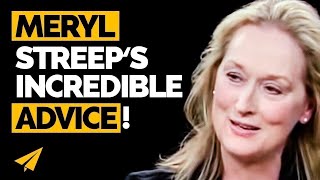
Meryl Streep explains how empathy and vulnerability power her acting. She talks about listening to people, taking risks in roles, and the craft of becoming someone else. Evan Carmichael frames her insights as rules for success.
Chapters
I never imagined in my wildest dreams that I would be successful. You live where you are. I think actors live exactly where they are. The really good ones. Empathy is the engine that powers all the best in us. I don't really have a bag of tricks to go to and know, or a method, you know? I don't. There are some days when I myself think I'm overrated.
She's an American actress cited in the media as the best actress of her generation. She's known for the versatility in her roles, adaptations in the characters that she plays, and being able to take on multiple accents. She's one of only 6 actors to have won 3 or more competitive Academy Awards for acting. She's Meryl Streep, and here's my take on her top 10 rules for success. Number 10 is my personal favorite, and I'm curious to find out which one you guys like the most.
I never imagined in my wildest dreams that I would be successful. Marker. Roll plate. Action. The fear is always there with actors that you'll never work again. Help. Help me. Help me. That goes with the territory. Oh, geez. Where am I gonna go now? You have that fear, the second job, third job, fourth job. You have it all the way down the line. So each happy event as it's happened has been a surprise. I'm not out of date, am I? Picking flowers for a woman as a sign of appreciation? No, not at all. Except those are poisonous. I'm Damocles with the sword, you know. I really think it's up there by us. By a hair. And every day it doesn't happen, I'm just thrilled. I never thought it was going to happen to me. You can't if you're an actor. I'm really freaking here, Johnny. Why is he here? Some people do, I guess, go in saying, I'm going to be a star, and they are. But for all those people that say that, I bet there are hundreds of thousands who say that and are still struggling. Where are you going? I don't know. I know a lot of my success has to do with luck. I've also poured a lot of hard work into it, so I feel in some way that I can justify myself, you know. But I'm just happy that things have happened this way. I know about you and Thelma Rice. I know everything. It's all here. Shit. You didn't even have the decency to hide the evidence. You just threw it in a drawer. Hotels, motels. Oh, shit. You couldn't even pay cash like a normal philanderer. You charged everything. I mean, look at this flower. Look at all these flowers that you bought for her. And you occasionally brought me home a bunch of wilted zinnias. How can you do this? If I'm such a bitch, then tell me. Is what you do an art? Is it a craft? Is it a job? You mean, is it highfalutin or midfalutin or a paycheck? Yeah, I don't know. There— when other people do it, sometimes when I watch other people do it really well, I think it's beyond an art, you know. It's like making music. But at its best, for you, at its best, it's like flying, you know. It's great. It's great. And that's the part I wouldn't give up, and that's the part I won't give up, even though I love my children and being home and doing what they need me to do. I certainly also need to express myself in this way. I don't expect you to understand, but you must know that Jonas has become dangerous. He must be stopped. He must not get beyond the Triangle of Rocks. What do you want me to do? You know, Jonas. I want you to find him. And then I want you to lose him. How are actors different than the rest of us? Well, they live a Zen life. It's everything. It's very uncertain. And all lives are uncertain, but actors know it. And actors, because you're unemployed so so often, and you live so intensely in the moments that you are working, that when you come back to earth and look around and, you know, that balloon has gone and there's no other one on the horizon, so you live where you are. I think actors live exactly where they are. The really good ones. And that's why they seem kind of crazy. We all should be there. Isn't that where we should all want to be? But they're really— yes, I think so. I think it's an authentic way to live. I am an optimist. I believe in the future. And people who do, the ones who make history instead of just sitting around watching it, no, they're willing to take the big risks. Yes, I made a decision. Oh God, where are all the men anymore? My father told me Tyler Prentiss never asked, "Is this okay? Is this okay?" You know what I'm saying, Mark? He just did what needed to be done.
You said that when you—
that in trying to find a character, you look for what comes out of the eyes. I think I meant that in connection to working. I don't feel like I exist until I'm with someone else. Yeah.
How important is listening?
It's everything. And it's where you learn everything. And I always think of acting— I mean, when I was applying to law school and thinking, well, this is stupid. Acting is a stupid way to make a living. And it doesn't do anything in the world. But I think it does. I think it does. I think it's the I think there's a great worth in it. And the worth is in listening to people who maybe don't even exist. Or who are voices in your past. And through you, come through the work, and you give them to other people. And I think that giving voice to characters that have no other voice. that's the great worth of what we do. Because so much of acting is vanity. So much of this is— I mean, this feels so great to come out here and sit here and have everybody clap. But the real thing that makes me feel so good is when I know I've said something for a soul. You know, I've presented a soul. Yes! No! Oh, damn! This is pointless! Wait a minute, wait a minute, this is ridiculous! We can't even hurt each other! We can't even inflict pain! Pain? I'll tell you about pain! I've thought a lot about the power of empathy. In my work, it's the current that connects me and my actual pulse. To a fictional character in a made-up story. It allows me to feel pretend feelings and sorrows and imagined pain. And my nervous system is sympathetically wired, and it conducts that current to you sitting in a movie theater, and to the woman sitting next to you, and to her friend, so that we all feel that it's happening to us at the same time. It's a very mysterious and valuable resource of the human species. And women, I think, access it most effortlessly. We cry at sad movies. We don't feel we lose face or stature or position doing it. We see a news story that enrages us and we write letters through tears, our hearts pounding. I've often— I used to wonder why human beings developed these inconvenient and embarrassing responses, this sniffling, choking, wet obstruction. You know, the thing that physicians and soldiers and stock traders and journalists and fashion models and politicians and news commentators and venture capitalists all must suppress in order to work most efficiently. I thought, what possible value, function, could it serve in the Darwinian scheme of, you know, survival of the fittest and the strongest and the most heavily armed? No, seriously, I thought, why and how did we evolve with this weak and useless passion intact within the deep heart's core? And the answer, as I've formulated it to myself, is that empathy is the engine that powers all the best in us. It is what civilizes us. It is what connects us. Every woman needs makeup. Don't let anybody tell you different. The only woman pretty enough to go without makeup was Elizabeth Taylor, and she wore a ton. Shoulders are all slumped and your hair's all straight. You don't wear makeup. You look like a lesbian. Do you continue to learn? Yes. Do you really? Yeah. In other words, having done— had this experience, you are a better I don't know. I don't know. This was so fun and sort of effortless that it didn't— I think you learn more from the challenging things, the things that are tougher to do. What was the toughest? What was the toughest? Oh. I mean, Sophie's Choice or— No. No, no. No, there have been tough things that I care— I probably won't go into, but just because they— my molecules change in me according to how happy I am, and whether— and my creativity gets— you know, what I learn every time out is how to wrangle all the elements that make me love what I do and make it sort of happen effortlessly. And when that doesn't come easily, I don't really have a bag of tricks to go to, or a method, you know? I don't. So I come unmoored, and part of that is a very good thing, because you have to reassemble. Nobody knows what I'm talking about. No, we do. I'm sitting here thinking— Actors do. But so, no, no, no. And so it's very good to have to start blank and figure out how to begin again. How to begin again. It's very good. Methinks the right honourable lady doth screech too much. If the right honourable gentleman could perhaps attend more closely to what I am saying rather than how I am saying it, he may receive a valuable education in spite of himself. Many, many of my friends woke up at 3 years of age and said, I have to be on the stage, and I never, never had that. I've always been I've always been an omnivore, interested in way too many things, and I actually found the one profession that fed all my appetites. What is it that you really like to do? Eat. That's what we like to do. I know, I know, I know. And we are so good at it. Look at you. And I reached a point senior year when my adjustment felt like me. I had actually convinced myself that I was this person, and she me. Pretty, talented, but not stuck-up. You know, a girl who laughed a lot at every stupid thing every boy said, and who lowered her eyes at the right moment and deferred, who learned to defer when the boys took over the conversation. I really remember this so clearly. And I could tell it was working. I was much less annoying to the guys than I had been. They liked me better, and I liked that. This was conscious, but it was at the same time motivated and fully, fully felt. This was real real acting. I got to Vassar, which 43 years ago was a single-sex institution like all the colleges in what they called the Seven Sisters, the female Ivy League. And I made some very quick but lifelong and challenging friends. And with their help, outside of any competition for boys, my brain woke up. I got up and I got outside myself and I found myself again. I didn't have to pretend. I could be goofy, vehement, aggressive, and slovenly, and open, and funny, and tough, and my friends let me. I didn't wash my hair for 3 weeks once. They accepted me like the Velveteen Rabbit. I became real instead of an imaginary stuffed bunny. This is your third parish in 5 years. Call the pastor. Ask him why I left. It's perfectly innocent. I'm not calling the pastor. I'm a good priest. Go after another child. Add another child until you are sick. Stop! What nun did you speak to? I won't say. I've not touched a child! You have! You haven't the slightest proof of anything! But I have my certainty! May I ask what you're writing down with that ballpoint pen? Oh, nothing. It's an idea for a sermon. You had one right now? I get them all the time. Unfortunate. Sister Aloysius is quite an unpleasant character. How did you prepare for that role? Yes, she's an unpleasant character, but for me the process has to do with, um, being her and being in her life. And I imagine events in her life that might have affected her, events that led her to marry early to get out of the house, events that after her husband died led her to the convent. I look at the time in which she lived. This takes place in 1964, when for very smart, ambitious women there were very limited opportunities. This will not do. It's just till June. I'll throw your son out of this school. Why would you do that if it didn't start with him? Because I will stop this. I had very brilliant women teachers. Who now would not be teachers because the salary's too low. They'd be lawyers or doctors or businesswomen, just because those opportunities weren't there for women then. So I imagined— I just imagined the whole context of where she exists, how she came to be here. But I don't know how anybody can possibly believe that I have less of a stake in mothering that little boy than Mr. Kramer does. I'm his mother. I'm his mother. How thrilling not to have it be about me. Charlie Kaufman's acceptance speech which he just faxed. Thursday night, February 20th. It's been suggested that I write a speech in case I win the BAFTA Award. I've been told Meryl Streep has been kind enough to offer to accept on my behalf should I win. I feel some pressure to come up with a speech that Meryl won't mind reading aloud. I feel pressure to give her a joke, but simultaneously the great fear that I might give her inadvertently a bad joke and it will bomb and it will be as if I have spit on Meryl Streep from across the ocean, and this after she has been kind enough to offer to accept on my behalf. This man is out of his mind. I don't want to do that. After all, she is just great in Adaptation, a truly amazing performance. Oh God, I'm going to kill him. I should reiterate that this is Charlie saying this, not Meryl Streep, who I find exceedingly modest, maybe one of the most modest, nicest people ever. Oh, I'm being set up. Again, that was me, Charlie. To be safe, I'll keep it simple and straightforward. I would like to thank BAFTA for this wonderful honor. I would like to spank— thank Spike Jones. I want to thank Meryl Streep, who I understand is here tonight. Looks into the crowd. He's giving me direction. And Nic Cage and Chris Cooper, whom I understand are not. I am not here either. I wish I were. Thank you very much. Oh boy, thank you. You know, there are, there are some days when I myself think I'm overrated, but not today. Now take back the the soul of Dennis George Finchhutton, whom you have shared with us. He brought us joy, and we loved him well. He was not ours. He was not mine.
Thank you guys so much for watching. I made this video because Maggie Taruto asked me to. So if there's a famous entrepreneur that you want me to profile next, leave it in the comments below and I'll see what I can do. I'd also love to know which of Meryl Streep's rules meant the most to you. What advice struck you the hardest? What impact is gonna have on your life? Super curious to find out. Leave it in the comments below and I will join in the discussion. Thank you so much for watching. Continue to believe and I'll see you soon.
More from Evan


How the Biggest Mistake in History Created A Trillion-Dollar Empire | Sergey Brin



9 Machiavelli Principles That Force People To Respect You | Machiavellian Philosophy



The First 10 Words That Instantly Ruin A Sales Conversation | Vanessa Van Edwards

The Top 1% Mindset Behind The First $5 Trillion Company | Jensen Huang (Nvidia)

