"Fail Again, FAIL BETTER!" - Benedict Cumberbatch - Top 10 Rules
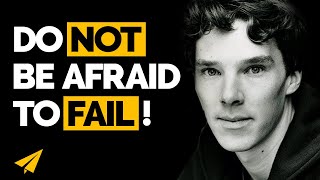
Benedict Cumberbatch shares lessons on acting and success, emphasizing that disappearing into a character is a learnable skill, not a gift. He discusses the demands of roles like Sherlock and Doctor Strange, the importance of total commitment, and how classical training shaped his work ethic.
Chapters
You can never perfect what we do. There is no way. I've never met anyone who goes, "That's perfection." I'm not a typical beauty, so basically I've got a long neck and a long face. That's usually period. That's usually some kind of inbreeding weirdness.
Immediately when he came on set, it was on. And like everyone just was on their A-game at all times.
Hello, Believe Nation. It's Evan. My one word is believe, and I believe in people more than they believe in themselves. And my sincere hope is that if you see in yourself what I see in you, you'll be able to change the planet. So to help you on your journey today, we're gonna learn from actor Benedict Cumberbatch and my take on his top 10 rules for success. Rule number 2 is my personal favorite, and I'd love to know which one you guys like the best. Also, as you're watching, if you hear something that really resonates with you, please leave it down in the comments below and put quotes around it so other people can be inspired by it as well. And if you leave it within the first couple hours of this video going live, you have a chance to win one of 2 daily prizes.
You can never perfect what we do. There is no way. I've never met anyone who goes, "That's perfection." I mean, to an audience outside of your work, people can think that that's the only way they'd ever want to see that part played or that moment done, whatever. But as an actor— and this isn't mock humility, I think it's just, it just goes for all art forms, really— the whole point is Perfection is unachievable, so it's that constant pursuit of the unobtainable which is kind of magic, really, you know, and should keep us kind of motivated to try better. You know, it's the Beckett thing, you know, fail again, fail better.
There isn't a better actor, certainly for this role, but perhaps period, than Benedict Cumberbatch, who was remarkable to work with.
Enjoy these final moments of peace.
Immediately when he came on set, it was on, and like everyone everyone just was on their A-game at all times. Like, no one was slacking because it was— there was something about Benedict's, you know, focus and his presence that really just helped challenge everyone to do the best possible job. It was awesome.
I am better at what?
Everything.
You fully commit to every role that you play.
Yeah.
So I was thinking, when you do fully commit to a role, what are the sacrifices you have to make to fully commit to a part like this?
That's a very interesting question. I mean, a lot. I think specifically when you're working, you have to— wow, that's such a good question. That's such a good question.
Sorry.
So, no, I mean, logistically, obviously, just the business of acting, the fact that you're doing certain hours and sometimes you're working all night and doing weird antisocial days at weekends, you forget about your social life. That's the sort of sacrifice to commitment. It's nothing quite on the level that Julian sacrifices, but you don't get to see your family, you don't get to see friends, you are removed from the reality of your life to pursue a given goal. So there is a kind of comparison. I guess you, you sacrifice a part of yourself because you're exposing either, either end of the spectrums of acting, whether it's just variations of who you are or whether it's completely descending into a different character persona. Equally valid in my opinion. I don't think there's really a distinction to draw other than people who are good or bad at it. But I think then you do have to give part of yourself no matter what you do. And that you don't lose, you sometimes gain actually by doing that, but you have to suppress and control certain instincts that you have in order to actually be true to a character that may not be the same as you, or be driven by the same things as you.
You were offered an opportunity to go to Broadway with a play that you'd already been a part of, and made a very— it was a very difficult decision for you, but you elected not to do that because of sort of an idea of where you wanted to take things, so—
It was a very selfish decision as well, because it affected a lot of other people. I did do it 8 months before we were supposed to go, but apologies to Nancy Carroll and Adrian June Scarborough and Thea Sharrock. I just wanted to mix it up all the time. I really wanted— I wanted to— I mean, my theatre training at Lander was a classical theatre, classical English theatre, 1-year course and a postgraduate course, which I really enjoyed and got a lot out of. But that was it. That was the main focus. Because I thought, a little bit old-fashioned in my kind of understanding of it, I thought that what I do, what the great actors that have been ahead of me had done and inspired me to do was the idea of starting out in the classics, then maybe a modern play or two, then a few roles in television, and then, you know, getting a film role but keep going back to theatre. And that is what I've done. That is kind of what I've tried to do. The unhappy accident of that play being such a huge success was it came at a point where I thought, Christ, I've actually got some momentum in a medium where it's much more of a closed door. There's very little long-term memory. It's much more immediate. Your currency's something you really have to kind of work on in film quite fast. To a degree, I'm saying this in contradiction— everything I say tonight is contradictory, I know that, but it's just, I guess that's what a personal conversation is really. It's just a point of view. But, um, I am— every time I say anything, I'm thinking, yeah, but the opposite is also very true. Um, that's the kind of— yeah, that's my head. You're getting into my head. Um, It's great being me. So yeah, I was really lucky to have just had a few breaks, obviously with Sherlock, but also with Tinker Tailor, also with Frankenstein, and being cast in War Horse. And that all came at the same kind of point where we were supposed to be coming here to do this Broadway production of After the Dance, which might still happen. It might be a film. We don't know. There might be some life left in it. It was a wonderful experience in London. But I felt that I'd had that experience there. And selfishly, I wanted to make some capital out of this momentum that was building. I'm glad I did because I got Star Trek and 12 Years a Slave and also Sage County. And yeah, it worked out well for me. But, and The Fifth Estate. So I kind of, I was very, yeah, I took a gamble and it paid off.
I'm really glad you didn't leave college.
I really am. I mean, I really enjoyed my further education. I made some of my greatest lifelong friends in those moments and had some fantastic experiences. And we all really worked incredibly hard on the productions we put on. So in a way, it was like my version of theater rep, which was the old system in England, which I'm sure you know. But, you know, it was this very arduous, very difficult weekly rep system where you'd be doing a show, you'd be rehearsing one, and you'd be sort of getting ready to stage the other. I mean, 3 different characters and 3 different worlds and involvements in those. It was a great stretch and training for actors in the old days. So My schedule at the moment is a little bit like that, but also, you know, I think we all experienced that in my group at university. We put on a ridiculous amount of plays, sort of 3 a term. What drives me is having a challenge and meeting that challenge in a way that will hopefully make my peers, my family, and my friends proud. Part of it is a thrill-seeking as well, although I think you're in a lot of danger if you just become an adrenaline junkie. But you need stability, you need stamina, and you need to be able to keep your perspective and feel grounded and secure. Secure in what you're doing as an actor.
Why is there a man in that torpedo?
There are men and women in all those torpedoes, Captain. I put them there.
Who the hell are you?
A remnant of a time long past. Genetically engineered to be superior so as to lead others to peace in a world at war. We were condemned as criminals, forced into exile. For centuries we slept, hoping when we awoke things would be different. But as a result of the destruction of Vulcan, your Starfleet began to aggressively search distant quadrants of space.
My ship was found adrift.
I alone was revived.
I looked up John Harrison. Until a year ago, he didn't exist.
John Harrison was a fiction created the moment I was awoken by your Admiral Marcus to help of advance his cause. A smokescreen to conceal my true identity. My name is Khan.
Why would a Starfleet admiral ask a 300-year-old frozen man for help?
Because I am better. At what?
Everything.
Alexander Marcus needed to respond to an uncivilized threat in a civilized time, and for that he needed a warrior's mind— my mind— to design weapons and warships.
You are suggesting the Admiral violated every regulation he vowed to uphold simply because he wanted to exploit your intellect?
I wanted to exploit my savagery. Intellect alone is useless in a fight, Mr. Spock. You, you can't even break a rule. How would you be expected to break Bone. Marcus used me to design weapons to help him realize his vision of a militarized Starfleet. He sent you to use those weapons, to fire my torpedoes on an unsuspecting planet. And then he purposely crippled your ship in enemy space, leading to one inevitable outcome. The Klingons would come searching for whomever was responsible, and you would have no chance of escaping. Marcus would finally have the war he talked about, the war he always wanted. No.
No.
I watched you open fire in a room full of unarmed Starfleet officers.
You killed them in cold blood! Marcus took my crew from me.
You are a murderer!
He used my friends to control me. I tried to smuggle them to safety by concealing them in the very weapons I had designed, but I was discovered. I had no choice but to escape alone. And when I did, I had every reason to suspect that Marcus had killed every single one of the people I hold most dear. So I responded in kind. My crew is my family, Kirk. Is there anything you would not do for your family?
Proximity alert, sir. There's a ship at warp heading right for us.
Klinant?
At warp?
No, Kirk.
We both know who it is.
I don't think so.
It's not coming at us from Qo'noS.
There are certain, obviously, recurring things that you say, but also that interviewers or profilers would say. And one of the things in terms of a complimentary adjective is that there's sort of a sense that you're timeless. There's something about you. You could have just as easily been dropped into a movie with Trevor Howard or, you know, Peter O'Toole or somebody as, as you are today.
And the blessing of having a weird face somewhere between an otter and something that people find vaguely attractive, or just an otter, which is vaguely attractive. Um, yeah, it's— I mean, I, you know, on these hottie lists, I just kind of go, what? It doesn't make any sense because I was nowhere near the thousandth hottest face, uh, when I started out. So I know it's— I know a lot of it's projection, which which is kind of flattering about the work, I suppose. But what I'm saying all that for is, you know, I started out and went, "Yeah, no, you know, I'm not a typical beauty." So basically, I've got a long neck and a long face. That's usually period. That's usually some kind of inbreeding weirdness. So I'll run with that. I'll wear some high collars and get on a horse or two. I'm fine with that. But not all the time. Not all the time.
Not all the time.
Sometimes I'll just get a collar in a 21st-century drama and turn it up, as you'll notice I did in Sherlock. So, yeah, no, it's— I kind of— the otherworldly— I mean, I had a great, great English teacher called Martin Tyrrell. Oscar, you remember him. And he said, "It's weird, you remind me of William Blake." And I went, "What? The hallucinating visionary poet of the Romantic era?" He went, "Yeah, well, no, it's just you're quite an old soul." And I went, "Oh, I kind of like that." And it kind of— an old soul. Did someone say what? As in not a new soul. An old soul. Old, smelly, leather soul. And I kind of— And I kind of ran with that because I was fortunate enough to grow up in England. And you're surrounded by your heritage there. And it's a very deep, very long, very kind of old— I mean, not my heritage, but like the heritage of the land and the culture. And I went to school where there were buildings that were 400 years old. And those were the new ones. It was kind of inspiring. And it meant that whatever I was doing in my context, in my time, I could always— see what the past had evolved into and realize that we're not all that far away from that. We really aren't. And we, you know, it's important to be able to recognize it and to be able to honor it and, and learn from it as well.
You've got an incredible fan base for your work in Sherlock.
Yeah.
And working on Star Trek obviously opens you to an even bigger one.
Yeah.
Did it intimidate you to work in a film franchise with such rich history, high expectations, and a vocal fan base?
That's a good question. I Yes and no, but basically the first film, J.J.'s first outing with Star Trek 2009 made me realize that the franchise was in very safe hands and that, to be honest, he's such an extraordinary filmmaker and human being. If I was pleasing his idea of what he wanted my character to be within our version of Trekdom, then that was the only concern or preoccupation I had to have with expectations. Because otherwise that way madness lies. You're never gonna be everyone's meat. Someone's gonna be throwing up in the corner going, "This guy is horrendous." And that's fine, that's allowed, that's what the world's about. But, you know, I'm very aware, of course, of how possessive, and rightfully so, Trekkies are. You know, there's a huge deal of respect I have for them because it's not just a name for a group of fans. It's actually about a level of knowledge and understanding of the subject matter. But it's a strange thing because it actually then takes ownership what it is, which originally was a creative process and received by them as an audience, and now the audience is sort of taking control of it. So there's good and bad with that. There's knowledge which I completely bow to and would love to, you know, immerse myself in, have done since doing the film. So yeah, I think I was— my fears, which were rightfully there obviously because of their kind of presence, I have to say a lot of A lot of them are incredibly benevolent. I mean, however vocal they may be about what they like or don't like, it's their opinions. They're not gonna kill me, I hope. But, you know, it's just— it's like— they're normal human beings who just have a real enjoyment of quite an exceptionally rich, you know, materially rich genre and cult that is Star Trek.
I wanna see how many imitations you can do. Put 60 seconds on the clock. The Imitation Game. With Benedict Cumberbatch. John Malkovich.
Well, I don't know that I—
Alan Rickman.
Uh, dying to see it, can't wait.
Sean Connery.
Oh, it's a very good film. I think it'll be phenomenal. I think I'm very excited to see what young Benedict does.
Jack Nicholson.
Why can't we all see The Imitation Game?
Tom Hiddleston. Yeah, yeah, I think you've got to go and see The Imitation Game. It's going to be great.
Owen Wilson.
Well, I don't know. I mean, um, it's kind of interesting. I don't—
30 seconds left. Michael Caine.
I want to see The Imitation Game, don't you?
Christopher Walken.
I want to see the— oh my God, I've gone Jamaican or something.
15 seconds left. Can you do Bane?
I want to see The Imitation Game. McConaughey. Well, it's— I don't know, imitation?
5 seconds left. Can you do Taylor Swift?
Um, I wanna see the imitation game. Nailed it. Christopher Walken probably was like, how?
What?
Uh, yeah. You see this film? I wanna see this film. This film's been up my ass.
Thank you guys so much for watching. I made this video because Siddhant Tripathi asked me to. If there's someone you'd like me to profile in a future top 10, please check out the link down in the description below and you can cast cast your vote on who we should do next. I also wanna give a quick shout out to Devon. Thank you so much for picking up a copy of my book, Your One Word, and posting it on Instagram with all those other books that you have on your to-read list. Hopefully you'll put Your One Word at the front of that to-read list and let me know what you think about it. I hope it has a big impact, and again, thank you for the support. Thank you guys again for watching. I believe in you. I hope you continue to believe in yourself and whatever your one word is.
Much love. I'll see you soon.
Is there ever any pressure? Because I imagine the budget on this film is not small. Do you ever mess up and you're like, oh God, this is a bit embarrassing, I shouldn't have done that first?
You have to treat it like most other jobs. You really do. Otherwise, yeah, that would get to you very much so. But you just have to— you're facilitated all the way as well. So for me anyway, I find that a real privilege.
What makes me such a big fan of yours is the fact that you seem to completely disappear in the roles, in the characters you play. No matter if it's Sherlock or Julian Assange or whoever you play, we don't see you anymore.
Thank you.
Is it something you would say that one could learn, or is that something— I don't know, I don't want to say a God-given gift or something which you just have to have?
Oh, I think you could. No, I think you could definitely learn that. I mean, some of it you, you start to have to feel, but even that sort of of an emotional kind of feeling. You can learn that by practice. I think you know when something's working, you know. And the rest of it, yeah, no, absolutely. I'd never say that this was some kind of exclusive gift for— I think it's rather like saying that I do believe that everyone has a painter or a drawer in them or a musician as well as something as— I mean, all of us role play, all of us sort of disappear to a varying degree in different forms our lives, you know, whether it's the private or public face that we have. And yeah, I think that makes us all capable of being actors. I don't think it's the exclusive preserve of those of us lucky enough to call it a living, you know.
Is there like pressure when you're doing a superhero and such a loved superhero? And do you, do you like— is it an immediate yes, or do you like call anyone and do you, do you ask like your friends and family, like, can I be?
Well, I completely— because, and I know people that know this world and also this particular character far better than me said, yes, you can. And it's It's a fantastic character. You should relish it because there's loads of challenges that you'll enjoy within the kind of story, and especially if it's an origin story. And also, Scott Derrickson, the director, and Kevin Feige, the papa, you know, real sorcerer supreme of Marvel Studios, he— they do the heavy lifting when it comes to what that world is about, the Marvel Cinematic Universe. And there's nothing they don't know about the comics. There's nothing that they haven't seen as well. So they're the first people to get bored as well as to reference what should be there and what shouldn't be there. I kind of let them guide me.
Yeah.
More from Evan


How the Biggest Mistake in History Created A Trillion-Dollar Empire | Sergey Brin



9 Machiavelli Principles That Force People To Respect You | Machiavellian Philosophy



The First 10 Words That Instantly Ruin A Sales Conversation | Vanessa Van Edwards

The Top 1% Mindset Behind The First $5 Trillion Company | Jensen Huang (Nvidia)

