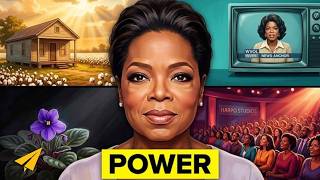
Oprah Winfrey shares how being demoted from news anchor to talk-show host became her true calling. Evan Carmichael adds his own failures: losing a $40 million deal at 22, quitting a business partnership, and fearing rejection in Paris. The lesson: failures are redirections, not reasons to quit.
Chapters
Good morning, Believe Nation! It's Evan. My one word is believe. I believe in you, and I want to see that awesome thing that you have inside you explode out into the universe to have a major impact. So to help you on your journey, today's message is turn your wounds into wisdom. Over to you, Oprah Winfrey. I wake up every morning, that's right, so keep me going. I wake up every morning Turn your wounds into wisdom.
You will be wounded many times in your life. You'll make mistakes. Some people will call them failures, but I have learned that failure is really God's way of saying, "Excuse me, you're moving in the wrong direction." It's just an experience. Just an experience. Just an experience. I remember being taken off the air in Baltimore, being told that I was no longer being fit for television and that I could not anchor the news because I used to go out on the stories. And my own truth was, even though I'm not a weeper, I would cry for the people in the stories, and which really wasn't very effective as a news reporter to be covering a fire and crying because the people lost their house. And it wasn't until they— I was demoted as an on-air anchorwoman and thrown into the talk show arena to get rid of me that I allowed my own truth to come through. And the first day I was on the air doing my first talk show back in 1978, it felt like breathing, which is what your true passion should feel like. It should be so natural to you. And so I took what had been a mistake, what had been perceived as a failure with my career as an anchorwoman in the news business and turned it into a talk show career that's done okay for me.
Your wounds and your failures will teach you some of the most important lessons that you will ever learn in life if you are willing to listen to them instead of complaining about them. What often happens when we have a failure, when we have a setback, when things don't go our way, instead of trying to learn from them and say, how how can I do better, what can I learn from this so that the next time it doesn't happen again? We often shut down. We often say, well, that didn't work out, and so this sucks, and it's this person's fault, and I'm never gonna be a success. And you start blaming other people and start complaining instead of taking responsibility and saying, what can I learn from this? How can I make this better? And quite often, from the lowest lows that you'll have ever in your life come the highest highs because you've changed, because you've grown, because you've broken the mold, because you've, You're that phoenix rising now. And you see that over and over and over again in success stories. Their greatest heights came as a result of some deep, dark place. And so don't stay down in that hole. Use that as leverage to learn and grow into something new. Grow into that better version of yourself. If I think about all the big failures that I've had in my life, it's always led to one of the most important lessons that I've used for the rest of my life. And so as an example, when I was afraid to ask this girl out in Paris, That led me to not having any more regrets. That led me to live a life of not having regrets because I don't want to feel that pain of wondering what if again. When I told my business partner that I quit on him, when it was too difficult, too challenging, I said, "I quit, I'm done, I want to feel valuable." The next day I woke up and said, "I have to keep going." And how do I do it? By modeling success. When I lost out on a $40 million deal when I was 22 years old, I realized that I needed to stop being a perfectionist and start getting work done. And so those 3 lessons I learned early in my life, 18, 19, and 22. I'm now 37, and those are still the lessons that, that are the most important to me. I still try to live a life of no regrets. Whenever I don't know how to solve a problem, I always look at how can I model success, and it's a big part of what this YouTube channel is about. And I stopped trying to be a perfectionist and just get stuff out there because otherwise nothing happens. And so if you are in that deep dark place, if you've had some major setbacks and major failures, try not to let it be permanent. You know, it's only a real failure if you let that define you, if you let that be the point where you say, "I can never go on and do more than this because I tried once and it didn't work out." Whenever you fail, just ask yourself, "What can I learn from this to be stronger?" And if you can adopt that mentality, then you'll be doing what the most successful people do in the world, they turn that rejection and they turn that failure and turn that fear and they create amazing things as a result. So the question of the day today is, I'm curious, what was one of your biggest failures and what did you learn from that to grow stronger? Leave it down in the comments below. I'm really curious to see what you have to say. I also want to give a quick shout out to Lene. I hope I pronounced that okay. Thank you so much for picking up a copy of my book, Your One Word. I really, really appreciate the support and I hope you enjoyed the read. Thank you guys again for watching. I hope you have an amazing day. I believe in you. I hope you continue to believe in yourself and whatever your one word is. Much love, and I'll see you again tomorrow morning for another shot of espresso. I wake up every morning, espresso keep me going.
With respect to failure, uh, it's terrible. But necessary. If you are going to try something hard, if you're putting yourself out there in some way, there are going to be times where you screw up or you don't succeed. Or there are times where you do everything right and you still don't succeed. But that's not just true of politics or running a non-for-profit. That's true— some of you talked about being entrepreneurial. If you're starting a clothing line, that's a It's a cutthroat business. I'm sure you— I have every confidence, Ayanna, that you're going to succeed at some point, but you'll go through some failures. And I think that the most important thing— and this is a little bit of a cliché, but sometimes clichés are true— is to learn from those failures. And to have a sense of resilience and be able to examine what is it that I did not succeed at, why didn't I succeed, and what do I need to do better. That's with respect to the failure issue. If, if you're focused on giving of yourself to accomplish something, then even when you fail at a particular objective, you're still succeeding in learning about how you can accomplish those goals.
I read this quote during an obituary for Floyd Patterson, the boxer, and he said he only learned from losing a fight. He said, you don't go and watch video from when you win, you watch video from when you lose. And it is the failures that build the character, that make you smarter, stronger, tougher. I always tell people we're scarred but smarter, and I think that is a really good thing to be. You can build on all of that accumulated knowledge in a way that can serve you and your clients and your company very, very well. But there have been, you know, numerous moments of great pause and reflection where I've sat and say, and I say to our team and I say to myself, what is the universe trying to teach me?
What do you do when you start a business but it fails? Well, hopefully you can learn from all the mistakes. All the good things and all the bad things and reapply it to your new business or reapply it to your new job or your new career destination. Look at Apple. Apple is one of the most prestigious, bankable companies in the world, and they had a lot of failures. They had a lot of launches that didn't work. They had a lot of things that just didn't click with the audience and their customers, but that didn't stop them from having a thriving business. You learn way more when you fail than when you succeed. That's something I can guarantee you on.