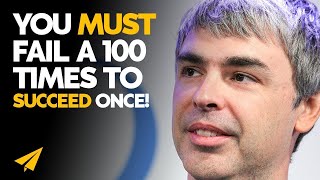
Sylvester Stallone, Elon Musk, Mark Zuckerberg, and others share how failure shaped their success. Stallone's early writing was terrible before Rocky. Larry Page says to fail fast and repeatedly. Diddy turned a low point of being fired and broke into self-improvement.
Chapters
Failure.
Failure.
Failure.
Failure.
Fail.
Failure.
Failure.
Failure.
Failure.
Failure.
Give up something to get something. And I thought— I didn't have any money, so I had no phone. I painted my windows black, so I didn't know if the sun was up or the sun was down. All I knew is I had to write. And I wrote and I wrote. It was very bad. It wasn't good at all. But every day it was getting better and better, like a machine, like a muscle, until finally the idea for Rocky came. So the idea is you must fail 100 times to succeed once.
It's—
that's part of it. No one succeeds the first time. It's learning how to not get disappointed with failure, to understand failure. You only learn when you fail. You don't learn when you succeed. You know, you're too—
something like that.
But when you fail, that's when you learn. So that's how I learned. By lucky, I was a failure in New York, and that is the reason I started writing, which made me successful.
One of the things that I'd been through as a student was some leadership training, and one of the things they taught us was to have— to not be afraid of failure, and instead to have the goal to fail a lot quickly, and then eventually you'll succeed. And I sort of took this to heart, and they also had a slogan called "Healthy disregard for the impossible." And they actually made you write down sort of the things you would do that were kind of impossible, but you thought you might really accomplish. And that's really stuck with me in everything that I've tried to do. And I think, you know, it was very, very close that we wouldn't have started the company. And I think there are many of you out there in sort of similar situations. You know, do you wanna take a little bit more risk? Do you wanna try something out? And, you know, even if you don't succeed, we actually tried many things that didn't work. You know, Google happened to work pretty well. But there are many things that we did that didn't, but we don't worry about those, right? Because we tried many things. So I just encourage you to take a little more risk in life, and I think if you do it often enough, it will really pay off.
But through all the occupations I've had, I've experienced successes and, as you know, failures. I'm asked what it felt like to lose to President Obama. Not as good as winning. Failures aren't fun, but they are inevitable. More importantly, failures don't define who you are. Some people measure their life by their secular successes— how high on the corporate ladder they got, how much money they made. Did they do better than their high school classmates? If that's the kind of success you're looking for, you're bound to be disappointed. Life has way too much chance and serendipity. To be assured fame or fortune.
You cannot achieve success without failure. Some of my biggest successes come from some of my biggest failures. In the early '90s, when my friends were graduating from Howard, I got fired from that first job that I got with Andre Harrell. I know a lot of you know this story, 'Cause some of you may not know how scared I was. See, I was scared to death. I didn't have a degree. My girlfriend was 8 and a half months pregnant with my first baby. I bought a brand new house in Scarsdale that I could not afford. So I found myself sitting alone in my bedroom and asking myself the question that sometimes we all ask each other. What are you going to do now? What are you going to do now? You should have kept your mouth shut and shut up and just did what Andre told you to do. But you wanted to act like you was making the hit rankings. Now look at you. What are you going to do now? So I had two choices. Either I was gonna sit in that failure and give up, or I was gonna make a decision to step out of the darkness. You see, when you in that darkness, you want to sit there and wait for the light to come. When you in that darkness, it feels uncomfortable, but you can't wait. And sit in that darkness. The only way out is to step forward, to face your fears, to become your own light. I had to make a decision. I had to decide to become my own light. I had to believe in myself like never before. I had to find my inner power. Now, I'm not gonna lie to you. There's gonna be a lot of times y'all about to fail. I'm still failing every day. We are all a work in progress. And one day, you'll be sitting in the dark like I was, and you gonna be asking yourself, what am I gonna do now? You ask yourself again and slow it down, "What am I going to do now?" But in that moment, I want you to remember the power of you.
Now here's an important point. Nothing works the first time. When you try something new, it probably won't work. When you try something new several times, it probably won't work. And the turning point in my life came when I would hear good ideas and I was so eager to be successful in selling, I would run out and try the ideas and they wouldn't work. I try a way of getting an appointment or answering an objection or closing a sale, it wouldn't work. And my natural response, ah, and I think, just be disappointed. And then I realized nothing works, at least the first few times. So I decided I would try a new idea 5 or 10 times before I passed judgment on it. I would not just try it once and quit like most people do. And that changed my whole life. It was a turning point in my life because I realized from then on, if you've got a good idea and you've got a good goal and you want to double your income and improve the quality of your life, and you have to try new things in order to get new results, it's not going to work the first time. So you say, "Well, that didn't work." Try something else and try something else and try something else. Now, if you try, only two things can happen. What are they? Succeed or fail. If you succeed, you do more of it. If you fail, you learn from it, get smarter, and try it again. So you cannot lose by taking action. You can only lose by not taking action.
Failure is a part of the learning process, right? What's the risk of failure? What, you'll be embarrassed? Or risk of failure— how do you distinguish failure from learning? In your whole life, you know, failure implies that it's stopped, that the game stops, right? If it's part of a— you're failing and then you learn, then that learning is part of the moving forward, right? So that is what the process is like. Fail, learn, move forward, and constantly do that because you're cutting edge. You're going where people haven't been before in inventiveness.
I mean, I've got a real belief, and this is a true belief, and if those of you— everybody's got kids out there— if I ever hear my kids say the word failure, I lock them in a room for a week. I would request, if we have any power in this country, that we could take that out of our English dictionary and replace it with the word feedback. Because that's all failure in our words is, isn't it? It's feedback. We learn from mistakes.
When we have had failures, those have ultimately resulted in some of the greatest successes we've ever had. You talk about those, particularly when someone comes to see you and they say, "Yeah, feeling really bad because this didn't work out." Okay, well, let me tell you about some other things that didn't work out that we learned a lot from. And, you know, let's pick ourselves back up and let's Let's figure out what we learn from this and how we go apply that next time. When you're in the zone of doing things that no one's ever done before, if you're only succeeding, you're not taking enough risk.
You have bad days. And from the outside, people may look at my life and think that everything's good all the time. And it's really just not the case. You can have dark days. It doesn't matter. How well your career is doing. There's all kinds of things that happen in life. But as far as creative dreams go, I remember we had released the first song off our second album and it bombed. It did terribly. It was called "Attack." And— [SPEAKING IN FOREIGN LANGUAGE] Yeah, well, you should have requested it on the radio more, buddy, because nobody else thought so. And maybe there were other forces working at that time against us. But I thought it was a decent song as well for the time. But it bombed. The record company wanted to drop us. They actually did. They called our management and said, "We're dropping the band." Somehow, they convinced the head of the record company, Jason Flom, the guy was in there, to come and see us one more time at Madison Square Garden. We were opening for Audioslave. And the crowd hated us, right? They hated us. It was just a— but it was a— but the crowd was largely there, it was made up of Soundgarden and Rage fans. A lot of older people and they just were like, "Who are these weirdos on stage? Will they get out of here?" But anyway, we played that show and the president of the record company who had wanted to drop us, he decided to give us one more shot. But that time was really brutal, you know. It's our second album. We knew if we got dropped, it would be very difficult to ever find a way to make music and share it again. This was way before iTunes. It was way before Facebook. And it was way before YouTube. It was way before it was so easy to make and distribute music and share your work online. So it was a challenging time and really dark. But I decided to direct the video myself. It was for a song called "The Kill." They released it and it changed our lives. So, you know, and that story has kind of happened more than a few times in our careers. You know, and it's happened to me as an actor. It's happened to me as a director. I've looked at things so many times, videos that you guys see now and think, "Oh, that's pretty good," and just wanted to like rip my eyeballs out, it was so bad. So I think the thing that we don't teach each other and remind each other enough of is that failure is oftentimes more important than success, and success is the thing that can actually make us fail. It's really important to note what the lessons are to learn in failure. And it happens a lot. It doesn't feel good, but it's a necessity.
You know my story back in 2005 when I was stuck with all these bad habits and I couldn't make any changes. I kept trying to change them all at once. I would change my entire diet, which, you know, diet is actually a series of habits. I would change my entire exercise routine. I would try and quit smoking, try and be productive and stop procrastinating, wake up early, and I would do all of these at once. I kept failing. I couldn't understand why. It wasn't really that it was me. A lot of times I would internalize it. Actually, all of the time I would internalize it and think I have no self-control. I'm not disciplined. I'm not good enough. I'm not strong. I'm just weak. So I would feel bad about myself and develop this negative self-image. And basically destroy any trust that I had in myself. But really it wasn't a problem with me, it was a problem with the method. So what I'm proposing is instead of failing over and over at creating a whole bunch of habits at once or one really big habit instead of a small one, instead of failing at that, change the method. If you failed, don't keep doing the same thing over and over. You got to make some changes. What I'm proposing is take that failure as a lesson and adapt your habit change and be smarter. Do it, do it in a smarter way.
So what do you think about failure?
I think that the best way to deal with failure is to focus on why you did the thing in the first place. So you look at the big picture, right? Because one failure doesn't mean that you failed in all. And then you look at the small details of where you could have improved improved, and next time you do better.
I think people get too caught up in failure. Failure is going to be part of the process. Uh, if you're doing something big, something new, something different, you're going to fail. You fail your way to success. If you have zero failures in your life, it's because you're playing life so safe that you haven't taken any single risk. And so failure is not this big thing that you need to avoid. It's normal, it's natural, it's going to happen, and you will fail your way to success. So thank you guys so much for watching. I'd love to know what you think of the video. Leave it in comments below and, uh, continue to believe, and we'll see you soon.
More from Evan


How the Biggest Mistake in History Created A Trillion-Dollar Empire | Sergey Brin



9 Machiavelli Principles That Force People To Respect You | Machiavellian Philosophy



The First 10 Words That Instantly Ruin A Sales Conversation | Vanessa Van Edwards

The Top 1% Mindset Behind The First $5 Trillion Company | Jensen Huang (Nvidia)

