Financial System Explained in 60 Minutes Like You're 5
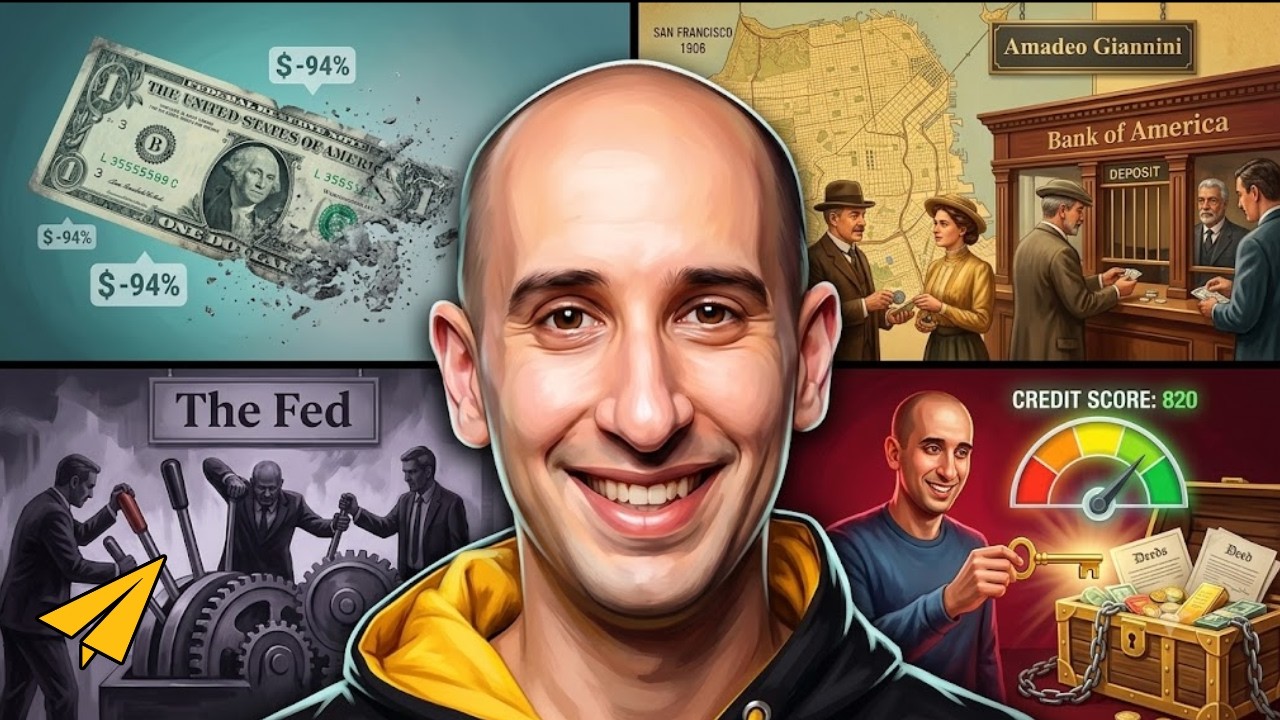
Evan Carmichael explains how money works, from fiat currency and fractional-reserve banking to how the Federal Reserve sets rates. Then he covers five high-income skills for 2024-2025: AI automation, data analytics, digital marketing, persuasive communication, and cybersecurity.
Chapters
The money sitting in your bank account is quietly losing value every single day, and the whole system is set up so you barely even notice.
The best investment against inflation is to improve your own earning power. The value of the dollar since I was born has declined by 94% to 6 cents. So inflation is a very cruel tax on people who believe in fixed dollars.
The purpose of central banks like the Fed is to protect the banks, not you.
Cash is not king. There is a king, and it is not cash. Cash is garbage, okay? Only 27% of American adults can correctly answer 5 basic questions about money, according to the FINRA Foundation, which means almost everyone is playing a game nobody ever taught them the rules to.
Person with money meets a person with experience, the person with experience ends up with your money. I mean, that's how it works. Thinks finance is so complex because, frankly, the industry tries to make it sound complex. They use words that you don't know, so you don't know what to do. You know, what does this mean? And so what happens is we just give them a and say, "Deal with it." There is financial misinformation in the marketplace.
It's almost like we've been hypnotized with the wrong set of rules.
The reason financial education isn't working in our school systems is they're teaching financial education for these people and these people, but to really become rich, you have to focus on this side here.
And here's the part that hopefully wakes you up. The people who understand the system end up owning it, and the people who don't end up working for it their entire lives.
Big opportunities in life have to be seized. We don't do very many things, but when we get the chance to do something that's right and big, we've got to do it.
Those who are only word literate will always work for those who are financially literate. After 1971, two sets of rules were born. Rule set number one for workers: save your money, trust the system, work hard, be patient. Rule set number two for owners: use debt as a tool, buy assets, let inflation work for you, let other people's money build your more wealth. Same economy, two completely different games.
Let me take you back to 1906. A massive earthquake rips through San Francisco, and the fires that follow burn down more than 500 city blocks. The whole city is in chaos. Every big bank slams its doors shut, locks its money in vaults buried under the hot rubble, and tells terrified people there's nothing they can do. But one man, my favorite entrepreneur of all time, a banker named A.P. Giannini, does the exact opposite. He rushes to his little bank, loads all the gold and cash he can carry onto a wooden produce wagon, and hides it under crates of oranges and vegetables so looters won't find it. And then a few days later, while every other bank is still locked tight, Giannini does something nobody has ever seen. He sets up a plank of wood across two barrels right on the streets in the North Beach neighborhood, puts a bag of gold on top, and announces that he's open for business. He starts taking deposits and handing out loans to ordinary people who want to rebuild their homes and their shops. He didn't ask for fancy paperwork or big collateral. He gave loans on a face and a handshake, some as small as $25 and home loans as small as $375, trusting the calluses on a person's hands more than any other form. And the incredible part is, within just 6 weeks, more money was being deposited into his bank than was being pulled out because people trusted him. That tiny street bank built on a plank and a handshake eventually grew into what you know today as Bank of America. Giannini proved something powerful and simple. At its core, the entire financial system is really just this: Trust, deposits, and loans. Right now you might be feeling overwhelmed, a little bit hopeless. Uh, you might be thinking the whole system is just rigged against regular people and there's nothing you can do but just get crushed by it, right? And I understand it's complex and the fear is, is completely normal. I think all progress begins with telling the truth. So here's the truth: the system isn't some evil machine built to destroy you. It's actually pretty simple once somebody explains it without a ton of confusing jargon, and almost nobody ever bothers to. The reason it feels rigged is that you were never handed the guidebook, the instructions, but AP Giannini just showed you the whole thing on a plank of wood. So for the next few minutes, let's release that fear and let me walk you through every piece of the money machine one simple step at a time, like you're brand new but very smart.
And by the end, you won't be the one getting played anymore.
If you've been here before, drop a hashtag #believe in the comments below so I can feature you here in a future video. And if you're new, welcome to Believe Nation, the only channel that helps you believe in yourself daily, one video at a time.
Belief.
Money is really just trust. So let's start with the most basic question of all. What even is money?
Pull a $20 bill out of your wallet and just look at it.
It's a piece of paper. You can't eat it, right? You can't build a house with it. It has almost no value on its own. So why does the whole world work hard to get it? Here's the secret. Money only has value because everybody agrees that it does. That's it. Way back in the day, your dollars were backed by gold sitting in the vault, and you could actually walk in and trade your paper money for the metal gold. But in 1971, the United States stopped doing that. Today, the dollar is what's called fiat currency, which is just a fancy way of saying it has value for one reason only: the government says it's money and everybody trusts it enough to accept it. So when somebody hands you a bill, they're really just handing you a little piece of trust. The entire financial system, every bank, every loan, every paycheck that you'll ever learn is built on top of that one simple idea. Once you understand that money is really just trust, everything else starts to click into place. Your bank does not keep your money. Now, here's something that genuinely shocks most people. When you put your money in the bank, the bank does not lock it away in a giant pile with your name on it. The second you deposit it, the bank turns around and lends most of it right back out to somebody else. This is called fractional reserve banking, and it's the engine of our entire financial system. So let me try to make it simple for you. Say you deposit $1,000. The bank is only required to keep a small fraction of that on hand, maybe $100. It takes the other $900 and loans it to your neighbor to buy a car. Your neighbor spends that $900 and it lands in someone else's bank account, which keeps $90 and then lends out $810, and on and on it goes around and around. But the wild part of the chain is that banks actually create brand new money here out of nothing. A bank started with just $50 million in real reserves can end up supporting a around $5 billion floating around the economy. So your bank isn't a safe with your cash sitting in it. It's more like a giant lending machine, and your deposit is just the spark that keeps the whole thing going. And that's not necessarily a bad thing, but you should know what's happening with your money. How banks actually make money. So if the bank is busy lending out your money, how does it get rich doing it? And the answer is one simple word: interest. When the bank lends money to your neighbor, it charges them a fee for borrowing it, and that fee is called interest. But here's the clever part that I want you to see. The bank pays you almost nothing to hold your deposit, maybe a tiny sliver of interest if you're lucky, and then it charges the borrower a much bigger interest rate on the loan. That gap between the little it pays you and the lot it charges them is called the spread, and that spread is how banks make billions of dollars. So think about it like this. You hand the bank your money for almost free. They rent it out to someone else at a huge markup, and they quietly pocket the difference. This is exactly why understanding the system matters so much for you. When all you ever do is deposit and borrow, the bank wins every single time. But when you start to understand how money really moves, you can finally flip it and start making money work for you instead of the other way around. The banks are not exactly your friend here, so it really pays to know the game that you're playing. The giant IOU that runs the world. There's one more huge piece of this puzzle, and it's the one almost nobody explains to beginners. It's called a bond, and a bond is really just a fancy word for an IOU. Here's how it works. When the government or a giant company needs to borrow a massive amount of money, way more than any single bank could ever give them, they don't go take out a normal loan. Instead, they sell bonds to the public. And when you buy one of those bonds, you are basically the one lending them your money, and and in return, they make you a promise. They'll pay you back the full amount at a certain date, plus a little extra interest along the way for the favor. That's it. A bond is just you getting to be the bank for once. Now, here's the part that often blows people's mind. The bond market is actually even bigger than the stock market that everyone always talks about. It's where governments raise the money to build roads and run the country, and where huge companies raise cash to grow. And remember those interest rates that the Fed sets? They ripple straight through the entire bond market, which is exactly why it's such a powerful lever. So the next time you hear about government debt or bond yields on the news, just remember it's all built on the same simple idea that Giannini used. Somebody needs money, somebody else lends it, and trust holds the whole thing together. Also, if you want to take real action after this video, I made a free worksheet just for you. It covers the top lessons from today, gives you space to write your biggest takeaways. And it helps you build a simple action plan. It's 100% free. Just check the link in the description below to go grab it. I'll see you there. Meet the most powerful bank you've never walked into. Okay, now let's talk about the boss of all the banks. The one quietly pulling the biggest levers is called the Federal Reserve, or the Fed for short, and it's the central bank of the United States. Here's a quick bit of history that explains everything. So remember Giannini and all that chaos in the early 1900s? Back then, banks used to collapse all the time and drag people's life savings down with them. After one giant financial panic in 1907, the government created the Federal Reserve in 1913 to act as the referee that keeps the whole banking system stable. So think of the Fed as a bank for the banks. Regular people like you don't keep an account there, but every big bank does. The Fed has two enormous jobs that Congress gave it called its dual mandate. Job one, keep as many people employed as possible. Job two, keep prices stable stable so your money doesn't go crazy. To pull all this off, its main tools is setting the interest rate, which is basically the price for borrowing money for the entire country. In early 2026, for example, the Fed set the rate between 3.5% and 3.75%. So when you hear on the news that the Fed raised or cut rates, that one single decision ripples straight into your mortgage, your car loan, your credit card, and even whether your boss can afford to give you a raise or not. That's how powerful this one bank you've never even visited truly is. Why everything keeps getting more expensive. So here's a piece that quietly hits your wallet every single day. Inflation. Inflation just means that prices slowly creep upward over time. So the same $20 buys you less this year than it did last year. Why does that happen? Let me explain. So imagine there's 10 people in a room and only one pizza for sale. Now imagine everybody in that room suddenly gets handed a big stack of fresh cash. What happens to the price of that one pizza?, it shoots way up because a lot of money is now chasing very few goods. That right there is inflation in a nutshell. When there's too much money floating around compared to the actual stuff you can buy, prices go up. The Fed actually aims for a little bit of inflation on purpose. Around 2% a year is the goal because a slow, steady rise is much healthier than prices suddenly crashing. But here's why this matters so much to you personally. If your money is just sitting in a bank account doing nothing, and earning almost nothing, inflation is quietly eating it alive in the background. You're not losing dollars. The number on your bank statement stays the same, but each one of those dollars buys less and less each year. That's exactly what I meant at the very start where I said your money is being drained while you barely notice. Inflation is a slow leak in your financial bucket. How the whole machine moves. Now let's pull it all together because this is where I think it actually gets beautiful. The economy is just one giant machine. And the Fed has its hands right there on the controls. When the economy is slow and people are scared to spend money, the Fed lowers interest rates. Cheaper rates means loans get cheap. So people and businesses, they borrow more. Banks create more money through that lending chain and everybody spends and new jobs, they get created. The machine goes faster. It speeds up. But if everyone borrows and spends way too fast, you end up with too much money chasing too little products and prices spike into painful inflation. So the Fed does the exact opposite. Raises interest rates. Now loans get expensive. People borrow and spend less. Businesses slow down their hiring and the whole economy cools off. So prices stop climbing so quickly. Up and down, faster and slower. The Fed is constantly tapping the gas pedal and the brake to keep the entire thing from crashing.
It's not perfect and they definitely don't always get it right.
But hopefully now you can finally see the logic behind all those scary headlines. When you hear that rates are going up, you'll know exactly why it's happening. And exactly what it means for the money in your pocket. Your reputation now has a number. Remember how Giannini handed out loans based on a look in someone's eye and the calluses that are on their hand? He was measuring trust the old-fashioned way. Well, today the system does the exact same thing, except it turns trust into a number. It's called your credit score. In the easiest terms, your credit score is just a grade for how reliably they think you're gonna pay the money back. So every time you borrow money and pay it back on time, your score goes up, and the system trusts you a little bit more. Every time you miss payments, your score drops, and the system trusts you a little bit less. Here's why this one little number means so much of your life. When your score is high, banks see you as safe, so they offer you loans at lower interest rates, which saves you a small fortune over the years. When your score is really low, they now see you as risky, so they charge painfully high rates, and you end up paying way more for the exact same house or car or purchase. So this single number quietly decides how expensive your whole life is going to be. The good news is that you're completely in control. Pay your bills on time. Don't borrow more than you can handle. And your reputation in the eyes of the entire system just keeps climbing. It really is just trust turned into math. How to stop being the one who pays for it. So what do you actually do with all this? Here's the single most important takeaway, I think, from this video. Once you understand that money is just trust, that banks lend out your cash, and that inflation slowly drains anything left sitting still, you hopefully stop just being a passenger watching and you, you take over. You start doing something. You don't leave your money just parked in an account where inflation quietly eats at it every year. You put a portion of it to work. You put it into things that grow faster than the prices rise. So the system starts working for you instead of against you. Learn how interest really works so you borrow smart and never let quietly bury you and keep getting just a little bit more educated about money every single week. Because the people who understand the system are the exact ones who end up owning the things everyone else just rents. You do not need a finance degree to do any of this. You just took the first step by understanding the machine by watching this video right now. You know when the best time to start using it is? Right now. How about right now? If you have the ability to learn this and you clearly just did, then you have the responsibility to actually use it. Being someone who understands money is what leads to actually building it.
You just learned what most adults never will.
So here's what I really want you to hold on to before you go. In these few minutes, you came to understand the entire financial system, something the vast majority of grown adults will go their entire lives never truly grasping. You are not behind anymore. You are ahead. And just like Giannini standing at his plank of wood, you can now see that this whole giant thing really comes down to a few simple human ideas. And congratulations, you're one video closer to who you're meant to be.
Believe.
Now let's learn the 20 laws of wealth every entrepreneur must master.
There is a simple reason some people build wealth faster than others. They play a different game. They understand how to pick the right businesses, how to price with confidence, and how to talk in a way that creates trust and action. This video right breaks down the core rules behind success, money, and growth in a way that anyone can apply. You will see why effort alone is not enough and what actually separates struggling entrepreneurs from consistent winners. If you are tired of working hard without seeing real results, this is your reset point. Imagine this: you're a consultant or coach who hasn't signed a new client in months. Revenue swings wildly— one month $10K, the next month $45K, then nothing. In desperation, you consider launching cheap courses or ebooks, hoping a low-price offer will bring quick cash. Stop right there. This spray-and-pray approach is actually a trap driven by fear, and you're not alone. Studies show that fear makes people choose safe diversification that don't create real value. In this video, I'm going to share a focused strategy to break out of that feast-or-famine cycle and consistently land high-ticket clients. You'll learn how to leverage two tactical content plays, a biz dev interview show and buyer breakthrough videos to generate $30K+ deals backed by data and real examples. No chasing vanity metrics, no endless low-ticket hustle, just actionable steps to grow your business. Let's do this. Don't let fear derail your strategy. Keep the main thing the main thing. When business dries up, fear kicks in and whispers, Lower your prices, create a cheap offer, cast a wider net.
It feels safe, but it can sabotage your success.
Research confirms that fear-based decisions often lead to conservative moves that don't actually drive growth. In our case, it's like abandoning your premium service, the real solution you offer, to chase a low-ticket product you think more people will buy. Creating low-price offers is not easier for an expert like you. You'd need to sell hundreds or thousands of cheap units to match just a few high-ticket clients. High-ticket programs lets you focus. One industry expert explains that high-ticket offers bring significant income per customer, so you don't need a huge audience or tons of leads to hit high revenue goals. Fewer clients, less complexity, but higher value delivered to each. That's a winning formula for a small team or solo business. You can pour your energy into what you do best instead of juggling funnels and ads and support issues for a low-priced product. As another Coach puts it, high-ticket success isn't about luck. It comes from clarity and connection, whereas low-ticket ventures often devolve into endless tech tweaks and refund headaches. That's the not-so-glamorous side of selling at scale. High-ticket beats low-ticket. Here's the proof. Still on the fence about focusing on high-ticket? Let's back it up with some evidence. High-ticket services are not just anecdotal wins. They're economically smarter for many experts. Consider profitably selling a $30,000 con— consulting package once can net more profit than selling a $300 course 100 times. In fact, business strategist Evan Carmichael observed that just 5 high-paying clients can outperform 100 low-paying customers in revenue with far less stress on you and your team. High-ticket models often mean higher profit margins per sale, a small or no team, and simpler delivery. Meanwhile, low-ticket models rely on sheer volume and complex funnels. One sales expert bluntly calls low-ticket offers a hamster wheel hustle that drains your energy and steals your time. Ouch, but true.
Think about it.
With low-priced products, you'd need robust marketing to reach masses of buyers. If you're not already an online marketing whiz with a huge audience, that's an uphill battle. As entrepreneur and friend of the channel Jenna Kutcher noted, to make $50,000 from a $50 product, my marketing would have needed to be a lot broader. Meaning a big ad budget, affiliates, or viral content. That's essentially building an entire marketing machine— webinars, email sequences, customer support for all those buyers, maybe even handling refunds. Do you really want to manage all that? Probably not. And you likely don't have to. Now, on the flip side, high-ticket consulting or coaching lets you laser target a handful of ideal clients. Your marketing can be more personal and direct. In fact, many high-ticket service providers stay fully booked just from referrals. No flashy marketing at all. You can deliver great results to a few clients and generate case studies and word of mouth that bring the next clients in. It's the classic quality over quantity play. But here's the key: to sell high ticket consistently, you must build trust and relationships. High paying clients rarely buy impulsively or from a random click on an ad. They buy when they trust you. As a business coach on Medium put it, high ticket clients don't buy on impulse. They buy from trust. So how do we quickly build that trust with the right people? Let's dive into the first big tactic. The Biz Dev Show. Turn content into relationships and clients. One of the fastest ways to build trust with high-value prospects is what I call the Biz Dev Show strategy. Here's how it works. Instead of chasing clients through cold calls or generic ads or hoping a video goes viral, you invite your ideal clients or key referral partners to be interviewed on a content-rich show.
The magic is in the format.
You're giving them a platform to share their expertise, not a sales pitch. It's disarming, it's flattering, and it starts with a genuine relationship.
Why is it so powerful?
Because referrals and relationships drive business. Approximately 65% of all new business comes from referrals and recommendations, and a staggering 84% of B2B decision makers say their buying process starts with a referral. Not a Google search, not a cold email, but a referral. By hosting a biz dev show, you're essentially manufacturing referrals and warm introductions at scale. You spend 30 to 60 minutes talking one-on-one with someone who could either hire you or refer you, all under the friendly pretense of content creation. It's networking on steroids. Now, a few pointers to make this work effectively for you. Number 1, target the right guests. These should be people who either are your ideal client or have access to many of your ideal clients. For example, a VP in a company that could use your consulting or well-connected individual in your industry. We call them your Money 50. Make a list of 50 high-impact people you'd love to build a relationship with. Next, keep topics safe and valuable. If your guests are C-suite executives or experts with sensitive information, don't ask them to spill company secrets. Instead, discuss general but insightful topics around their leadership, their vision, industry trends. For example, if you're talking to VP Sales, ask, what's your philosophy on building visionary teams? These kinds of questions let them shine without any NDA worries. They'll appreciate that you're highlighting their expertise and you sidestep any confidentiality issues. Remember, the interview is about them, not you. You're showcasing them as an expert. Next, build rapport and listen. During the interview, be genuinely curious. People can tell if you're just waiting to pounce with a sales pitch. Instead, actually enjoy the conversation. Compliment their insights. Dig deeper into their stories. This is where your trust is formed through authentic human connection. By the end of the 30-minute conversation, you'll be amazed how much goodwill you can earn by simply listening to people well. Next, sneak in one strategic question about your domain.
This is a pro tip.
Midway through the interview, ask a question that relates to the problem that you solve. For instance, for that VP of Sales, you can say, I often help companies develop their next generation of leaders. In your experience, what's a common challenge in grooming new leaders? The guest's answer will likely reveal a pain point or at least get them thinking about that need, and it suddenly establishes your expertise. You mentioned that you help companies in that area after all. Next, the off-air ask. Once the recording is over and you've thanked them, don't just say goodbye. This is the crucial moment. Transition to a casual conversation about the topic they touched on that intersects with your services. So, uh, for example, you mentioned struggling to groom new leaders. That's exactly what I specialize in. Listen, I'd love to offer a few ideas or even hop on another call to discuss how we could tackle that if you're open to it. It's a soft invitation framed as a helpful follow-up, not a hard sell. Since you've spent time providing them value and showcasing them, you've earned the right to ask. Often they'll be receptive either to explore your services or to introduce you to the right person at their company. Next, ignore the vanity of views. This strategy is about quality, not quantity. Maybe only 10 people watch the interview on YouTube. It doesn't matter. The one person who mattered was your guest, and now you have a warm lead. Plus, you can repurpose the interview clips for social proof or marketing later. But that's the cherry on top. As a general rule, don't obsess over likes and views at this stage. They are vanity metrics that can distract you from your real goals. As one marketing expert put it, every minute and dollar spent on chasing vanity metrics is a missed opportunity to focus on metrics that matter. In our case, the metric that matters is how many genuine conversations you're having with potential $30K+ clients, not how many random people liked your YouTube video. Now, if you're worried, won't a longer interview bore people? Shouldn't I make it super short? Think again. When the content is valuable to the right person, they will absolutely engage, even if it's long.
Podcasts are a great example.
93% of people who start listening to a podcast episode stick with most of it or all of it. These can be 30, 60, 90 minutes long. It's not about the length, it's about relevance. If your interview is insightful, your guest and any genuinely interested viewers will be hooked. So don't cut a great interview short just for the sake of making it snackable. The more time you spend building rapport, the stronger the relationship will be. By the way, doing this weekly, say one interview per week, means 52 warm connections a year with exactly the people who can grow your business. So ask yourself, what's the likelihood that yields at least a few high-ticket clients or deals? If you're still hesitant, remember that referrals and personal connections outrank any other lead source in closing big deals. You're engineering those connections systematically. Many consultants running high-ticket businesses rely on exactly this method. We've taught many of them. It works because it's human and it's direct. And because trust is the currency of high-ticket sales, you're essentially printing money by investing time game in relationships. Buy a Breakthrough Video. Content that converts, not just content for content's sake. Now, while you're executing the biz dev interview for proactive outreach, there's a second tactic that covers the inbound side. I call these Buyer Breakthrough Videos, BBVs. Think of BBVs as your on-demand sales assistant. These are focused videos that answer key questions and objections your high-ticket buyers have before they hop on a call with you or your team. They break through the mental barriers that might stop someone from contacting or hiring you. Here's why buyer breakthrough videos matter. Potential clients are likely checking out your website or YouTube, quietly doing their homework on you. When they land on your site and see generic buzzwords like innovative solutions or a list of services with fancy names, they might think, huh, I'm not exactly sure what that means. If they're confused or unsure, they leave, right?
Bye-bye lead.
We don't want that. We want to capture and convert that interest while we have it. Here's a quick stat for you. Adding a video to your landing page can boost conversions by 86% on average. Why? Because video engages visitors and makes your message clear and memorable. Viewers retain about 95% of a message when they watch it in a video compared to just 10% when reading text. So if you need to explain a complex service or build trust, video is your best friend. To create buyer breakthrough videos, follow these simple steps. Number 1, identify your buyer's top questions or hesitations. Think about the past sales calls or client meetings that you had.
What did people ask?
What did they need clarified? Maybe it's, how exactly does your process work? Uh, what kind of results have you achieved? Or what does What does whatever jargon word really mean in practice? Also, look at your website services or programs page. Every bullet or term there is a candidate for a buyer breakthrough video if it's not self-explanatory. For example, if you list Knowledge Accelerator program as an offering, you must have a video that says what that is in plain language and why it's awesome. Don't assume a clever name just speaks for itself. Next, keep each video focused. You're not doing a full webinar or giving away the secret sauce. The goal is to educate and intrigue the viewer enough that they think, this person really knows their stuff and I understand how they can help me. Maybe I should talk to them. For instance, a consultant could record a video called How to Smooth Out Volatile Monthly Revenue, where you explain common causes of feast and famine income. If that's the pain your prospect has, you've just hooked them. Next, place these videos where your warm prospects will see them. Your website is number one. Embed the relevant video next to the text about that service or the topic. If someone's reading about your leadership coaching program, have a video of you describing the program's approach and outcomes. Also consider sending bio breakthrough videos directly to leads. Let's say someone downloads your PDF or inquires by email. In your follow-up, include a link. By the way, I made a video answering this common question. I think you'll find it useful. It feels personal and adds a human touch. Next, Next, leverage YouTube strategically. Upload these buyer breakthrough videos to YouTube as well. The reason is you can easily embed them on your website and share links, and you can start building a content library. Over time, some will get discovered by people searching for that exact question, bringing you bonus organic leads. But again, view counts here are not the goal. Conversion is. If a video only gets 300 views, but 10 of those viewers schedule a call with you, that's a huge win. Let me give you a real example to illustrate the impact. I reviewed a consultant's website for our Movement Makers program, link to check it out in the description below, and he listed services like knowledge accelerators as a bullet point. Impressive term, but to a new visitor, they'd be scratching their head. What does that mean? So we recommended he turn each of those concepts into a video explanation. Why? Because if a potential client spends even 5 minutes watching him clearly explain his unique approach, that client is far more likely to trust him and reach out. Right now with just text, text, people were likely bouncing off the page confused. We're losing money every time a qualified prospect leaves the site unsure about what we offer. A video fixes that. It's like having a mini consultation with every site visitor 24/7, and it can dramatically increase your lead-to-client conversion. The data already told us videos make people convert more. And beyond just the stats, it just makes sense. People feel like they know you after seeing you speak on video, and that familiarity breeds trust. So brainstorm your buyer breakthrough video topics. A good rule of thumb is to have videos for the big outcome or the value prop you deliver, the key components of your methodology or services, and any major objections that you frequently hear. For objections, maybe it's, uh, I don't have time for this. Make a video, how to get ROI from leadership coaching, even if you're busy, or is it worth the investment? Uh, maybe a video, why high-level leadership coaching pays for itself. With some data or examples. You get the idea. One more thing: quality. Do you need fancy production? No. Use a decent webcam or smartphone, ensure good lighting and clear audio. Speak as if you're talking to one client, not reading off of some script robotically. Authenticity and clarity matter more than your slick production. In fact, um, conversational tone can build more trust than a perfectly polished corporate video. Video because it feels personal. As long as you address the question head-on and show you understand their problem and how to solve it, your job is done. Focus on what counts and avoid the shiny objects. By now you can see a theme: focus. Focus on your best clients. Focus on building relationships. Focus on content that directly leads to sales. In practice, this means tuning out a lot of noise and vanity that can sidetrack entrepreneurs. Don't obsess over social media followers, viral videos, or posting every day. These are nice-to-haves eventually, not need-to-haves to land high-ticket clients. Case in point, many consultants quietly making 7 figures have tiny online followers. They're not TikTok stars or YouTube celebs, and they don't need to be. They double down on direct relationships and targeted value. Remember, referrals built the business world long before likes existed. If 84% of big B2B purchases start with a referral, referrals, your energy is better spent cultivating referrals through biz dev conversations and stellar results than chasing internet fame. Next, phase 1 versus phase 2 mindset. I often tell clients in our Movement Maker program to separate what I call phase 1 and phase 2 in their growth plan. Phase 1 is all about getting revenue, getting that consistent $30K, $50K, $100K per month coming in. These tactics we've, we're discussing biz dev interviews, buy breakthrough videos focused on conversion, those are phase 1 tactics. They might not make you internet famous, but they will make you money and build a foundation. Phase 2 can be the broader thought leadership, starting a big YouTube channel, launching that online course, scaling to a much wider audience, right? Being the face of your industry. Those are great goals, but only tackle them after phase 1 is stable. Trying to do both at once usually means doing both poorly. As the saying goes, chase 2 rabbits and catch none. It's okay to say no. There's certain projects metrics right now. You're not killing your dream, you're sequencing it for maximum effectiveness. Next, track meaningful metrics. Since we're being tactical, here's what I suggest you actually measure in this strategy. One, how many biz dev interviews are you doing per month?
Two, how many of those turn into follow-up sales conversations or proposals? And three, your close rate on those.
Also track, four, how many buyer breakthrough videos have you created?
And five, any uptick in inquiries or conversion on your website after adding them.
These are metrics that matter. If you see your number of meaningful conversations going up, that's a clear leading indicator your revenue will follow. Vanity metrics like website hits or video views are often misleading. 10,000 views from random people in the wrong niche and wrong country mean nothing on a video. 10 views by CEOs who need your service means everything.
Keep that perspective and you won't get discouraged by the wrong numbers.
Finally, quick note on mindset. Don't let fear creep back in during execution. Fear might show up as a, maybe I should also do a $100 course for those who can't afford me, or I got a low response on my video. Maybe this isn't working. Remember the research. Fear makes us pull right back when we need to push forward, leading to half measures that don't create actual value. Commit to this path for a few months and give it a chance to bear fruit. Plant enough seeds and the garden will grow. High-ticket growth simplified and supercharged. So here's a quick recap of your game plan to land high-ticket clients consistently. Number 1, focus on your core high-ticket offer. Don't dilute your value out of panic. As data and experience shows, a handful of big clients can out-revenue a heap of small ones, and it's a path that preserves your sanity and your impact. Next, build relationships through a biz dev interview series.
Position yourself as as a peer and promoter of your ideal clients.
It's the fastest way to create trust, and trust is what makes high-ticket deals happen. Aim for one quality conversation a week. Over a year, this network effect is enormous. Next, create buyer breakthrough videos to convert lurking prospects. Capture those visiting your site or checking you out by answering their burning questions via videos. This can dramatically increase your lead conversion. Remember, video can boost landing page conversion by 80%. And people do watch content that educates them, even long content, as long as it's valuable. Next, keep it simple and metrics-driven. In phase 1, all that matters is revenue generation activity, conversations, and conversions. Drown out the siren song of vanity metrics and shiny new tactics that don't serve this immediate goal. As one article noted, every minute chasing vanity metrics is a missed opportunity to focus on what truly drives your business. So zero in on those relationships and conversion metrics. By making these shifts, you'll avoid the low-ticket hamster wheel and instead build a streamlined, high-impact business. No more random revenue swings due to luck or referrals falling from the sky. You'll be engineering a steady pipeline of high-paying clients. How would that feel to wake up each month knowing roughly where your $30,000 or $50,000 or more is coming from and knowing knowing you don't have to frantically launch something new to make it happen. This approach is evergreen. It works today. It'll work 5 years from now because it's built on timeless fundamentals: solving real problems, connecting with real people, and communicating value clearly. Whether you're an executive advisor or consultant or any expert selling high-ticket outcomes, these tactics apply. I've seen it transform businesses that were on the brink of burnout and failure into businesses that are enjoyable and profitable, and I believe it can do the same for you. Remember, high-ticket clients are not elusive unicorns. They are people with big problems that you can solve. Reach out to them strategically, show up with value, and ask for the business. You'll be amazed at how many say, "Yes, let's talk." Now let's learn the top 5 high-income skills to get you wealthy.
Ready to discover the skills that could skyrocket your success this year? These aren't academic theories. They're practical, in-demand abilities that you can learn without a formal degree. Each skill taps into emerging market needs, offers entrepreneurial leverage, and has scalable impact. Let's dive in and imagine the possibilities each one opens up for your business and income. Skill number 1, AI integration and automation, turning intelligence into income. Okay, so what is it? Here we're gonna leverage AI and automation tools to streamline operations create smarter products, or even launch AI-driven services. It's using machines to do the heavy thinking or doing for you, from chatbots that handle customer inquiries to AI systems that optimize your marketing or inventory in real time. Here's why it matters this year. The AI revolution isn't coming. It's right here now, and it's rewriting the rules of business. By 2024, 78% of organizations reported using AI in some capacity, up from just 50% 65% the year before. Companies are pouring investments in the AI at record levels, over $109 billion in the US in 2024, with nearly $34 billion globally into generative AI. And they desperately need people who can make it work.
The catch?
There's a huge talent gap. 94% of business leaders say they face AI-related skill shortages on their teams, with 1 in 3 reporting massive gaps in critical AI roles. What does that mean? Demand is way demand is bigger than supply, and that means opportunities for you. Entrepreneurs who are AI savvy can step in and command premium prices for their solutions. This isn't just for tech companies either. From healthcare to finance, AI is being woven into daily operations. Even the FDA has approved hundreds of AI-enabled medical devices, and self-driving cars are logging thousands of rides right now. The world is racing to adopt AI, and those who can ride that wave stand to reap huge Rewards. So how can entrepreneurs profit? Think of AI as a force multiplier for your business. An entrepreneur with AI skills can automate super boring processes, freeing up time to scale faster. You can make smarter products with better features. You can offer AI consulting and integration services to companies who are willing to pay for help. Uh, so for example, a small e-commerce founder might use AI to personalize their shopping experience for each customer automatically. Automatically, leading to happier customers and higher sales. Or maybe you're launching a micro SaaS tool that uses AI, like an AI scheduling assistant or content generator. Even a one-person business can serve thousands of customers when AI is doing most of the work. The evidence is everywhere. Companies using AI report higher productivity and lower costs, and many have seen AI-driven projects boost their bottom line. Why don't Karchmanner created an AI-powered copywriting service and landed hundreds of clients globally, essentially earning money 24/7 as the AI works for them. The key is that AI is practical and learnable. With countless online courses and tools, you can start applying AI even if you're not a programmer. Many AI platforms are actually plug and play. So this year, knowing how to harness AI is like having a superpower. It's not just about efficiency. It's about unlocking new income streams. From automating your marketing to building the next ChatGPT-like app for a niche industry, AI integration is a skill that can pay off almost immediately.
So embrace it and you ride the biggest tech wave of our era straight towards profit.
Now, AI might be the brains, but data is the backbone. So next, let's look at the skills that turn raw numbers into gold. Skill number 2: data analytics and business intelligence. Business intelligence, profiting from big data. Okay, so what is it? It's the skill of collecting, analyzing, and drawing smart insights from data to drive business decisions. So data analytics is like having X-ray vision for your business. It lets you see the patterns and trends that normal people's eyes would miss. So business intelligence, or BI, goes hand in hand, focusing on those who are using insights to make strategic calls. This skill isn't about math genius. It's about knowing which numbers matter and how to translate them into action. So why it matters right now in this year, we live in a world that has tons of data. Every click, every purchase, every interaction, it can be tracked, but few people know how to turn that ocean of information into actual real value. And that's where you can come in. Companies have realized that gut instinct isn't enough. 81% of businesses now believe data should be at the heart of all decision-making, and they're willing to pay handsomely for those who can deliver results. Why? Because data-driven businesses simply perform better. They're more productive and more profitable on average than their less data-savvy peers. Companies that truly embrace analytics have seen efficiencies boost as high as 60 to 80% in operations. It's not just about giant corporations. Even small startups benefit when they can quickly identify which product feature is a hit or which marketing channel brings the best ROI. And this is a very clear trend. The global big data analytics market is massive. It's over $100 billion. Over $270 billion in value and still growing. And there's a shortage of professionals who can wrangle data effectively. Executives are literally hungry for insights. A recent survey found 88% of business leaders rank data analytics as a top priority for upskilling in the organization. So this year, being fluent in data is like having a secret weapon in your market. You base decisions on facts, not guesses, which is a recipe for meaning. So how can entrepreneurs use it? Data analytics can make you rich in two ways. First, by applying it to your own business, you can pinpoint your most profitable customers. You can find inefficiencies to cut. You can test pricing strategies with actual hard evidence. For example, Netflix famously used data analytics to save $1 billion a year by recommending exactly what viewers wanted. So imagine bringing that kind of insight into your business decisions. Secondly, you can sell this skill as a service to others. Many companies, especially smaller ones. They drown in data but have no idea what to do with it. You could come in as a freelance analyst or consultant, turn their data into a clear action plan, and charge premium fees for delivering growth or savings. So picture telling your client, I found a way to boost your sales 20% by analyzing your customer behavior, and then actually doing it. There are real case studies of entrepreneurs doing just this. One startup founder used business intelligence tools to optimize her inventory and eliminated over $100,000 in annual waste waste, directly padding her profits. Another built a consulting agency that helps local businesses set up simple dashboards and KPIs, and within a year he was booking 5-figure contracts regularly. The bottom line is data analytics is practical and learnable. There's tons of online courses, YouTube videos, tools that are now drag and drop. Master it and you can either supercharge your own business or become the go-to data guru who turns others' confusion into cash. So in this year Data, it's a new oil, and knowing how to drill for it is an extremely high income skill. Now, having great data is pointless if you can't attract customers. That's where our next skill comes in. It's time to cash in on the art of getting noticed. Skill number 3: digital marketing and growth hacking. Scaling visibility into wealth.
So what is it?
Digital marketing is a skill of getting customers for people's businesses online through channels like social media, through search engines, through email, through LLMs and more. Growth hacking is a trendy way to say creative, fast-paced marketing experimentation, right? So finding clever, low-cost tactics to drive growth or sales for your business or other people's. This skill is about making your business impossible to ignore on the internet and turning that attention into revenue. So covers everything from running targeted ads, optimizing a website to rank on Google or GPT, crafting viral content, analyzing campaign data to tweak for better results, making YouTube videos to spread your message. Why it matters this year is you could have the best product or service in the world, but if nobody knows about it, you don't make a dime. This year, digital marketing remains one of the highest skills for entrepreneurs because online attention is the currency of our kingdom. Just look at the numbers. Global digital ad spending is projected to hit $843 billion. Yes, with a B. Companies large and small are pouring money into Facebook ads, Google searches, TikTok videos, wherever their audience Audience lives online and they need experts who know how to navigate this landscape. The job outlook also reflects that demand. Marketing roles are expected to grow by 10%, faster than the average for all careers. And in particular, there's surging demand for people skilled in areas like marketing analytics, content creation, and SEO, SEM, because every business wants to rank number one on Google and decode the algorithms of ChatGPT. The beauty of digital marketing is that it's practical and learnable. No MBA required. Word, just practice, creativity, and keeping up with the trends. We're also seeing new frontiers like AI-driven marketing. Over 50% of businesses are already using generative AI to improve their operations. All this means that entrepreneurial marketers who stay sharp can out-hustle their bigger competitors. So in this year, if you know how to get the right message to the right people at the right time online, you basically have a license to print money. So how can you use it as an entrepreneur? Digital marketing is often the make-or-break skill that determines if you scale or if you stay stuck. And so if you master it and you can acquire customers on demand, you can enter new markets quickly. You can even build a personal brand that multiplies all of your opportunities. Take, for example, an online fitness coach who leverages social media marketing by mastering YouTube and Instagram. She grows her audience to hundreds of thousands and launches a fitness app that earns 7 figures online. Or think of a small local business owner who uses savvy Google search ads and SEO to dominate local search traffic, right? Their store goes from unknown to the go-to place in town. And these aren't hypotheticals. These things are happening right now all around us. As an entrepreneur, you can also sell digital marketing expertise. If you're great at, say, SEO or Facebook ads, you can freelance or start an agency. Businesses are eager to pay because they've seen the ROI. For every dollar spent on email marketing can yield $36 in return. As various studies have shown. So a skilled email marketer is worth their weight in gold. Another real-world use case: an entrepreneur growth hacked his startup by creating a referral program that went viral. So think Dropbox's free storage for referral strategy, acquiring millions of users without a massive ad budget. That's growth hacking in action. So digital marketing lets you scale up quickly. An ad campaign can reach millions of people overnight. A piece of content that catches fire can bring in floods of You're not limited by your local area, your storefront. And with analytics tools, you can measure every penny and double down on what works, like truly data-driven marketing. And the emotional side, it's pretty thrilling to see your business blow up because of a campaign that you created. The control is right here. It's in your hands. With consumer attention shifting every year, today it might be YouTube or LinkedIn newsletters. Tomorrow, who knows? Entrepreneurs who have the skill will ride each wave and outpace pace their competition. Digital marketing and growth hacking are high-income skills because they directly drive revenue, and mastering them means you can virtually write your own success story in this digital age. So now you've got the customer's attention. Now we need to convince them to open their wallets. The next skill is all about the art of persuasion, and it's one of the oldest and most profitable tricks in the book. Skill number 4: persuasive Communication and storytelling, selling anything to anyone. So what is it? This is the skill of conveying ideas in a compelling way. So that's through sales pitches and marketing copy or even everyday networking conversations. It includes sales and negotiation, right? Convincing a customer or partner to say yes. Copywriting, which is writing words that sell from ads to landing pages and storytelling, crafting a narrative that hooks people in emotionally. It's how to talk or write so people listen, trust you, and feel motivated to act, like clicking the buy now or signing a contract. Why it matters this year is no matter how advanced technology gets, the power of a good story and genuine connection never goes out of style. In fact, as automation rises, those human-centered skills become more valuable. This year's marketplace is hyperstimulated. Consumers see thousands of ads and posts a day, so the ability to cut through that noise with a resonant message is pure gold. 68% of consumers say that a brand story influences their buying decisions. People remember stories up to 22 times more than plain facts. That's huge for entrepreneurs trying to build a memorable brand or pitch to investors. And yes, we see evidence that storytelling and communication translate to better results. Marketing campaigns built around a narrative can boost conversion rates by 30% or more. On the sales side, companies are actively looking for leaders with strong strong social influence and communication skills. Even the World Economic Forum highlighted leadership and social influence as a top skill for the future.
Why?
Because a person who can rally a team, win over a client, negotiate a profitable deal, they are invaluable. Also, let's talk money. Jobs like sales executives or copywriters are often high-paying because they directly bring in revenue. A top-performing tech sales rep, for example, can earn a six-figure base salary plus another six figures in Copywriters who crack the code of persuasion are similarly rewarded. Many freelance copywriters charge $100+ an hour, and businesses happily pay because one killer sales page or email sequence can generate hundreds of thousands in sales. Words are powerful, and this year, those who can wield that power expertly will find that it translates into serious income. So how can you use it as an entrepreneur? You're always selling, not just your products, but your vision, your brand, even selling yourself as a trustworthy partner. Persuasive communication turns this into a superpower. Mastering storytelling means you can craft a brand narrative that makes customers feel something and remember you. So for example, instead of just saying, uh, our shoe is comfortable, you share the story of a customer who, thanks to your shoe, ran their first marathon pain-free to honor a loved one, right? Now you're not just selling a shoe, you're selling Inspiration. You're selling identity. That's the difference that makes people lifetime fans. On a more practical side, entrepreneurs skilled in communication, they'll just close more deals. So imagine you're negotiating with a supplier or an investor. If you can clearly articulate your value and persuade them effectively, you'll likely get better terms, maybe tens of thousands saved or gained in one conversation. If you sell services or high-ticket products, strong sales techniques like consultative selling or solutions-based selling is key. Today's customers expect you to understand their needs and tailor your offer. Being able to do that can literally double or triple your closing rate. So for example, you can monetize a skill by offering freelance copywriting or sales consulting. Great copywriters are in short supply, even with AI writing tools around, because someone has to give the AI the right emotional direction. Businesses will pay top dollar for emails and ads that actually convert. One excellent sales page can be worth millions to a company. So paying a writer $10,000 a craft, it's a no-brainer for some companies. Skilled copywriters routinely earn over $150,000 a year once they built reputation. And don't forget content creators and influencers. They are essentially storytellers too, turning authentic communication into followers and income from ads and sponsorships or product sales. Emotions drive decisions, and if you can tap into emotions with genuine communication, you can drive decisions in your favor. So this year, mastering persuasive communication and storytelling isn't just a nice to have. It's often the difference between a business that just fizzles out and one that actually becomes a phenomenon. We've covered brains, data, marketing, charm. Our final skill might not sound as glamorous, but it's a massive moneymaker in today's world. It's all about protecting the wealth that you're building, and it's an area where demand is exploding. Skill number 5: cybersecurity and data protection. Guarding the digital gold mine. Okay, so what is it? Cybersecurity is the skill of keeping data, software systems safe from hackers and breaches. It's being the, uh, digital bodyguard for businesses. This includes understanding how to prevent attacks— so think malware, phishing, ransomware— knowing how to plug vulnerabilities in networks or websites and making sure that companies follow best practices so sensitive information like consumer data is not stolen or compromised. It's deeply technical for those who specialize, but at a high level, it's very learn-by-doing, problem-solving field, and you don't need a PhD to get good at it, just solid training and experience and a curious mind. Data protection goes hand in hand, so think dealing with proper handling and compliance, like the laws of the land. So for an entrepreneur, having cybersecurity skills means that you can both protect your own venture, but also potentially offer security solutions to other people as a business. So why does it matter this year? One word: risk. As businesses digitize every aspect of their operations, the risk of cyberattacks have skyrocketed, and so have the costs. The average cost of a single data breach hit an eye-watering $4.9 million globally. So for a small or mid-sized company, that kind of hit can be fatal. That's why firms are desperate for cybersecurity expertise and why it's become a high-income skill, high-demand skill. We're in a situation where there aren't nearly enough cybersecurity pros to go around. The global cybersecurity workforce is millions short. One recent study showed about 4.8 million cybersecurity roles are unfulfilled worldwide. There are millions of openings and not enough people with the skills, a gap that widened by 19% in in just one year. So talent shortage is actually the number one obstacle companies face in securing their systems. This kind of supply-demand mismatch is exactly what drives up incomes for those who have the skill. So companies have even started to prioritize this in budgets because they simply cannot afford the alternative. Companies without adequate security staff end up paying on average $1.76 million more per breach due to slower response and damage control. But just beyond like corporate IT departments, Every entrepreneur with an online presence needs at least basic cybersecurity savviness. Cyber threats this year are more sophisticated. Yes, hackers are using AI too. So on top of that, customer trust and regulations require more solid data protection. You don't want to be that startup that leaked user data and lost credibility overnight. So from ransomware attacks shutting down hospitals to small businesses getting scammed from phishing, the threat is universal. This urgency is driving a huge market for cybersecurity products and consultants. Global spending on cybersecurity is rising every year, tens of billions of dollars annually, as businesses effectively say, please take our money and keep us safe. If you can step in with the skills to do so, you will be richly rewarded. So as some evidence, top freelance cybersecurity experts report rates of $200 to $300 an hour, and experienced security consultants can make over $500,000 a year by serving multiple clients. So it's no surprise that when the stakes are this high, companies are willing to pay for peace of mind. So how can entrepreneurs use it? If you're building your own company, cybersecurity skills are like an insurance policy and a selling point. You can save a ton of money by implementing security measures yourself instead of hiring some expensive firms and avoid disaster that could derail your business. But also, being more security-minded from day one can be a competitive advantage. You can use in your marketing. Customers and partners will feel safer dealing with you. So for example, uh, e-commerce entrepreneur who knows how to secure their payment systems and protect customer data not only avoids costly breaches but can market their store as ultra secure, which gains more customer trust and extra sales in an era of privacy concerns. On the other side, cybersecurity is also an amazing service and a business opportunity. So given that huge talent gap, you You could start a consultancy or freelance as a virtual CISO, as Chief Information Security Officer, for multiple small companies that can't afford one in-house. They get your expertise part-time, you get a hefty paycheck. Some entrepreneurs are launching cybersecurity startups. So whether that's developing a niche security software tool or you're offering specialized training, there's even demand for things like ethical hackers who companies pay to test their defenses. We've seen solo consultants charge retainers in the thousands per month per client just to be on call for security incidents. And with new data privacy laws popping up all the time, like Europe's GDPR and others, businesses are scrambling for guidance, which is another avenue for advisory services you could offer if you're well-versed in compliance. So the key point is this: threats are growing and talent is scarce. If you equip yourself with this skill, you become part of a highly sought-after elite group of people. Not only can you command higher fees because preventing a multimillion-dollar breach is essentially worth a high payout, but you also carry the confidence that you can protect the empire that you're building too. In a time where a single hack can wipe out years of effort, the entrepreneurs who understand cybersecurity will safeguard their wealth and even turn security into a profitable service for others. It's truly a high-impact, high-income skill for today's age. So each of these 5 skills— AI integration, data analytics, digital marketing, persuasion, persuasive communication and cybersecurity hits the sweet spot of being practical, learnable, and immediately valuable this year. They align with the biggest technology shifts and market needs that we are seeing right now. AI is everywhere. Data is the king. Online growth is non-negotiable. Human connection still seals a deal, and security underpins it all. The best part is you don't need a fancy degree to get started with any of these. There are YouTube videos, bootcamps, online courses, communities for each skill that you can start learning right now. Entrepreneurs who invest time in mastering even one or two of these will position themselves to generate wealth in the short term. We're talking within a year or two, not decades. And it's all backed by trends and numbers that I've already cited throughout this entire video. The market is hungry for these abilities. So ask yourself, which of these skills speaks to you right right now. The entrepreneurs getting rich this year aren't necessarily the ones with the most funding or the fanciest ideas. Often they're the ones who have the right skills at the right time and execute relentlessly. Now you know 5 of those right skills. It's time to choose, learn, and leap. Here's to your success, because this year might be the year your hard work and high-income skills make you the next great success story. To learn how to stop sabotaging your own success, Check the video right there next to me. I think you'll love it. Continue to believe, and I'll see you there. You are sabotaging your own business without even realizing it. Do you feel like you're working hard but not getting results? It's time to find out if you're making one of the 5 huge mistakes
More from Evan


How the Biggest Mistake in History Created A Trillion-Dollar Empire | Sergey Brin



9 Machiavelli Principles That Force People To Respect You | Machiavellian Philosophy



The First 10 Words That Instantly Ruin A Sales Conversation | Vanessa Van Edwards

The Top 1% Mindset Behind The First $5 Trillion Company | Jensen Huang (Nvidia)

