Fired. Broke. Rejected. The Walt Disney Story You’ve Never Heard!
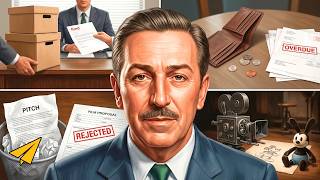
Walt Disney was fired from a newspaper, lost his first studio to bankruptcy, and faced over 300 bank rejections before Disneyland opened. He created Mickey Mouse after losing Oswald, bet everything on Snow White, and survived a devastating animators' strike. His path from broke to empire shows what persistence through failure looks like.
Chapters
Walt Disney was fired for lacking creativity, lost his first company to bankruptcy, and got rejected 300 times trying to fund Disneyland.
But he refused to quit.
At 22, Walt worked as a newspaper artist dreaming of bigger things, but his editor fired him saying he wasn't creative enough. Determined to prove himself, he started Laugh-O-Gram Studios, his first animation company. He hired a team, made cartoons, and poured everything into it. But bad business deals left him broke, in debt, and sleeping on his office floor. The company went bankrupt. With just $40 in his pocket, Walt moved to Hollywood. There, he created Mickey Mouse. But every studio told him it would fail. Then, he pitched an even crazier idea: Disneyland. He went to 300 banks for funding. They all said no. But Walt never stopped believing. He finally secured funding, built Disneyland, and turned Disney into a multi-billion-dollar empire with movies, theme parks, and a legacy that still inspires the world today. Walt Disney was fired, broke, and rejected, but he kept going. If 300 rejections didn't stop him, what's stopping you?
If you've been here before, drop a hashtag #believe in the comments below so I can feature you here in a future video. And if you're new, welcome to Believe Nation, the only channel that helps you believe in yourself daily, one video at a time. Early struggles in Kansas City. Disney's story begins far from the glamor of Hollywood. Born in 1901 in Chicago and raised in Missouri, young Walt had a tough childhood. His father, Elias Disney, was a strict and sometimes abusive man who struggled to make ends meet. Walt found escape in drawing cartoons, nurturing a vivid imagination despite the hardship at home. By his late teens, Walt was determined to turn his love of art into a career, a decision that would soon test his resolve. At only 18 years old, Walt took a job as an artist at the Kansas City Star newspaper. He dreamed of making it big as a cartoonist. However, that dream hit a wall when his editor fired him for not being creative enough. Imagine being told you lack imagination, the very talent you believe in. This harsh dismissal could have crushed Walt's spirit, but instead it motivated him to prove his former boss wrong. Determined to succeed on his own terms, Walt teamed up with his older brother Roy in 1920 to launch Laugh-O-Gram Studios, a small animation company in Kansas City. Walt poured his heart, soul, and savings into creating animated short films and advertisements. For a time, it seemed like his creative vision might pay off, but running a business at 21 years old was difficult. Bad deals and financial mismanagement caught up with him. Within just a couple years, Laugh-O-Gram went bankrupt, leaving Walt with nothing. He was penniless, in debt, and even had to sleep in his office before the company finally folded. A humbling failure for the young entrepreneur. Rather than give up though, Walt saw this failure as a lesson. In 1923, with only $40 to his name, he packed small suitcase, jumped on a train, and headed for Hollywood. It was a bold move born out of desperation and hope. Walt originally went to Los Angeles thinking he might become an actor. That was another dream that didn't pan out. But in California, he noticed a new opportunity. There were no animation studios in Hollywood at the time. Sensing his moment, Walt convinced Roy to join him on the West Coast to start fresh. Together, the brothers set up a tiny cartoon studio in a borrowed garage. Walt was effectively starting over from scratch, armed with nothing but his creativity, determination, and the lessons learned from his Kansas City failures. From Oswald to Mickey: Creating an Icon. In California, Walt Disney finally tasted success, then almost lost it all again. By 1927, his fledgling studio landed a deal to produce a cartoon character named Oswald the Lucky Rabbit for a New York distributor. To Walt's delight, Oswald became a hit, drawing nationwide audiences and giving Walt his first major success in animation. For a moment, it looked like Walt's bad luck had finally turned around. However, another crushing setback was on the horizon. In 1928, when Walt traveled to New York to negotiate a better contract, he was blindsided. He discovered that his distributor not only took the rights to Oswald but had even poached Walt's team of animators out from under him. Overnight, Walt lost his most popular character and most of his staff. It was a devastating betrayal. Many people would have become bitter or given up right there, But Walt refused to quit. Instead of fighting over Oswald or falling into despair, he chose to walk away and start over yet again, a pattern that would define his career. On the long train ride back to California, Walt's resilience kicked in. He began sketching a new cartoon character, a cheerful mouse inspired in part by a pet mouse he had back in Kansas City. Walt originally named him Mortimer, but his wife Lillian thought Mickey sounded better. Thus, Mickey Mouse was born on that train in 1928. Back in Los Angeles, Walt and his small team, including legendary animator Ub Iwerks, worked tirelessly to bring Mickey to life. Mickey's first two cartoons had trouble finding distributors, but Walt struck on a groundbreaking idea: making animated cartoon with synchronized sound. The result was Steamboat Willie, Mickey's debut with sound in late 1928, and it became an overnight sensation. Yet even Mickey Mouse's road to fame faced doubt and rejection. Walt struggled to find financiers and distributors willing to back his talking cartoon idea. In fact, bankers rejected the concept of Mickey Mouse over 300 times before one said yes. It's almost unbelievable. Walt pitched his cartoon hundreds of times to skeptical investors who told him a talking mouse would never, ever work. Finally, one distributor took a chance and Mickey Mouse quickly skyrocketed in popularity, proving all the naysayers wrong. By the early 1930s, Mickey had made Walt Disney a rising star in Hollywood. At just 27 years old, Walt had gone from bankrupt artist to the proud owner of a successful cartoon studio on the strength of a little mouse with big round ears. However, success brought its own stresses. Walt was a relentless worker, constantly pushing for better animation quality and new ideas. He poured all the Mickey profits into expanding his studio and creating new cartoons. Before long, Walt became overworked and deeply in debt again as he developed more ambitious projects. The pressure caught up to him in the early 1930s. Walt's top animator and close friend, Ub Iwerks, the one who helped design Mickey, was lured away by another company. Facing that loss and exhaustion from non-stop work, Walt suffered a nervous breakdown. His doctors advised him to take a break, so Walt and his wife took a much-needed vacation. For the first time in years, he stepped back from work to recuperate and reflect on what to do next. Little did he know, his biggest breakthrough was on the horizon. Rested and recharged, Walt came home with an audacious new dream, one that many would call crazy. Disney Folly: Snow White and the First Golden Age. By the mid-1930s, Walt Disney had a successful studio thanks to Mickey Mouse and a series of cartoon shorts. But he wasn't content to just make short, funny cartoons. Walt had a grand vision. He wanted to create the world's first full-length animated feature film. This idea became Snow White and the Seven Dwarves. When Walt announced he was going to spend an unheard-of sum, over a million dollars in the 1930s, to make a feature-length cartoon, Hollywood insiders mocked the project as Disney's folly, believing no audience would sit through an 80-minute cartoon. Even Walt's wife Lillian and brother Roy were worried this gamble would ruin the company, but Walt's belief in the project was unshakable. Walt spent 3 years, from 1934 to 1937, and practically every dollar the studio had on Snow White's production. He even had to mortgage his house to finance the film toward the end. He invested heavily in improving animation, developing new techniques like the multiplane camera for depth, and training his artists in lifelike human animation, all to make Snow White a quality cinematic experience. The pressure was immense. Partway through production, Walt actually ran out of money. Facing bankruptcy yet again, he showed an early cut of Snow White to bankers to convince them to loan him more funds. He was all in on this dream. When Snow White and the Seven Dwarfs premiered in December 1937, the response proved Walt right and the skeptics very wrong. The film received a standing ovation at its Hollywood premiere. Critics and audiences were astonished by the emotional depth and artistry of the movie. Famed director Sergei Eisenstein called it the greatest film ever made. Snow White became a global smash hit and the highest-grossing film of all time up to that point, before Gone with the Wind came out. The movie earned millions, about $66 million in that era, roughly $1.3 billion today and adjusted for inflation, and gave the Disney studio a huge financial windfall. Walt had silenced his doubters, his so-called folly had revolutionized animation and made history. With the success of Snow White, Walt Disney entered a golden age of creativity. He immediately started production on more animated features: Pinocchio, 1940, Fantasia, 1940, Dumbo, 1941, and Bambi, 1942. But new challenges arose. The high cost of these films, combined with World War II cutting off international markets, meant that several of Disney's follow-up films struggled financially. Pinocchio and Fantasia, though now considered classics, failed to turn a profit by their initial release. By 1944, just a few years after the triumph of Snow White, the Disney studio was again in serious financial trouble, even nearing bankruptcy. Then in 1941, during the production of Dumbo, Walt faced a very personal setback. His animators went on strike, feeling underpaid and seeking to unionize. Many of Walt's employees walked off the job. The strike deeply upset Walt. It was a blow to his family-like vision of the studio, and it halted production for weeks. The distribution, along with the wartime economy caused the company's debt to soar to $4 million by the mid-1940s. Walt Disney, the man who had created Mickey and wowed the world with Snow White, was once again on the brink of ruin. Yet true to form, Walt looked for a creative solution. During the war and its aftermath, he shifted focus to new avenues. Disney produced training and propaganda films for the U.S. government to stay afloat. After the war, Walt embraced the emerging medium of television, something other Hollywood studios avoided. In 1950, Disney launched a TV special, and soon after, the immensely popular Mickey Mouse club television show. These ventures not only generated revenue, they also kept Disney's characters in the public eye and endeared new generations of kids to the Disney brand. Walt's willingness to innovate and diversify during hard times paid off. By the early 1950s, the Disney studio had regained its financial footing, and Walt was ready to pursue his next most ambitious dream of all. If you want to take real action after this video, I made a free worksheet just for you. It covers the top lessons from today gives you space to write your biggest takeaways, and helps you build a simple action plan. It's 100% free. Just click the link in the description to go grab it. Let's start building real momentum in your life and business. I'll see you there. Disneyland, 300 rejections and one big dream. By the 1950s, Walt Disney had conquered cartoons and feature films, but he was dreaming even bigger. He envisioned a theme park like no other, a place where children and adults could experience magic firsthand, stepping into the world of his films. This dream would become Disneyland. But at the time, the idea sounded outrageous. An amusement park without the dirt and seedy reputation, one that was immaculately clean and immersive. Bankers and investors were extremely skeptical. Building Disneyland would cost tens of millions of dollars, and no one had ever seen a park quite like what Walt imagined. When he pitched the concept to financiers, over 300 banks and investors said said no, refusing to fund what they saw as a risky fantasy. Even Walt's own board of directors at Walt Disney Productions weren't fully on board initially. They thought the project could bankrupt the company. But Walt's passion for Disneyland was unshakable. He later said, I could never convince the financiers that Disneyland was feasible because dreams offer too little collateral. In other words, the bankers couldn't see the vision, but Walt could. Determined to bring his dream to life no matter what, Walt decided to finance the park in unconventional ways. He partnered with the ABC television network. In exchange for investment money to build the park, Walt agreed to produce a weekly TV show, Walt Disney's Disneyland, which also cleverly promoted the future park. He also quite literally bet on himself. He borrowed $50,000 against his own life insurance policy and even sold his vacation home to raise funds. These moves, combined with securing a few loans from more open-minded banks and investors, gave Walt just enough capital to start construction on Disneyland in Anaheim, California. After years of planning and a hectic 1-year construction schedule, Disneyland opened on July 17, 1955. The opening day, however, was anything but the fairy tale Walt had imagined. In fact, it was so disastrous that the press dubbed it Black Sunday. Huge crowds showed up with counterfeit tickets, overwhelming the park on that hot 100-degree day. The freshly paved asphalt on Main Street melted the high heels off women's shoes. Rides broke down. Water fountains weren't working. A plumber's strike meant Walt had to choose between fixing toilets or fountains. He chose toilets, leaving some drinking fountains dry. Nearly everything that could go wrong did go wrong that day. Walt was embarrassed and deflated as critics savaged the chaotic opening. But if there's one thing we've learned from Walt's story, it's that setbacks never stopped him for long. Walt immediately addressed Disneyland's opening problems. Within weeks, the kinks were ironed out, and the public's curiosity turned into genuine excitement. Families flocked to the park in droves. Disneyland became a colossal success, drawing over a million visitors in its first 2 months and turning Walt's multi-million dollar gamble into a thriving enterprise. The profits from Disneyland even cleared the remaining debts from his film studio's difficult 1940s period. In the end, Walt's crazy dream wasn't so crazy after all. He had created the happiest place on Earth. Standing on Main Street USA with smiling crowds around him, Walt Disney had proven once again that perseverance and imagination could overcome any obstacle. Miracle. The man who had once been told he lacked creativity was now literally building worlds sprung from his imagination. And he wasn't done yet. Even as Disneyland succeeded, Walt was already dreaming up new ideas. From plans for Disney World and EPCOT in Florida to exploring educational TV programming, he kept pushing boundaries until his final days. Walt Disney passed away in 1966, but by then his legacy was secure. He had changed entertainment forever. Walt Disney's legacy of perseverance. Walt Disney's life reads like a Hollywood script full of dramatic twists. Fired from his job, bankrupt by his early 20s, laughed at by critics, betrayed by partners, and rejected over and over, yet ultimately victorious. His story is a testament to the power of resilience and vision. As Walt himself once said, all the adversity I've had in my life, all the troubles and obstacles have strengthened me. You may not realize it when it happens, but a kick in the teeth may be the best thing in the world for you. Every failure taught him something and fueled his next attempt. So let's recap some of the astonishing setbacks Walt Disney overcame on his road to success. Fired for lack of creativity. Walt's newspaper boss in Kansas City fired him, claiming Walt wasn't imaginative enough. It turns out the young artist just needed a different canvas for his creativity. First company went bankrupt. Walt's Laugh-O-Gram studio collapsed within a couple of years, leaving him broke at the age of 21. This failure forced him to leave home and start anew in Hollywood, a gamble that eventually paid off. Lost his early creation. After finally achieving success with Oswald the Lucky Rabbit, Walt had the character and his staff snatched away due to a contract loophole. Rather than fight a losing battle, he let go and conjured up Mickey Mouse, an even bigger star. Hundreds of rejections. Disney struggled to find support for his ideas. His concept for Mickey Mouse with sound was rejected by more than 300 bankers and distributors before someone agreed to help. Years later, over 300 banks rejected his plans for Disneyland as well. Walt simply kept pitching his vision until he found believers. Disney's Folly. Nearly everyone thought Snow White would fail and bankrupt the studio. Even Walt's wife thought he was overreaching, but Walt persisted, and Snow White's success proved it was a genius move, silencing the haters and earning him an Oscar— actually, one normal Oscar plus 7 miniature ones for his achievement. Financial Turmoil and Strikes. Walt saw his studio go deeply into debt in the 1940s and endured a painful strike employees. He navigated through by reinventing his business into television and other projects rather than giving up. Disneyland's rough start. The chaotic opening day of Disneyland could have spelled disaster. Critics are ready to write it off as a giant mistake, but Walt's tenacity turned it around, and within a short time, Disneyland became a resounding success. Each of these hurdles might have stopped a lesser person. So what was Walt Disney's secret? In part, it was his unwavering optimism and imagination. He truly believed in his dreams even when nobody else did. But he also matched that dreamer's vision with hard work, adaptability, and grit. He was willing to risk failure again and again, learning and innovating each time until he achieved his goal. Walt famously said, it's kind of fun to do the impossible. For him, impossible was just a challenge waiting to be conquered. Today, the Walt Disney Company is a multibillion-dollar empire spanning movies, merchandise, resorts, and theme parks around the world. It's easy to see the shiny surface of success and forget its rough beginnings. But Walt's story shows that every great success story may have chapters of failure. Disney's legacy isn't just Mickey Mouse or Disneyland. It's the reminder that perseverance can transform your setbacks into stepping stones for success. Walt Disney was fired, broke, and repeatedly told no, but he kept moving forward. He turned each setback into an opportunity to start something new. Because he didn't quit, the world has been enriched with his beloved films, characters, and places that have inspired joy in millions of people. So the next time you find yourself facing rejection or failure, think of Walt Disney. Remember that even the man who created Mickey Mouse had doors slammed in his face hundreds of times. What kept him going was belief— belief in his ideas and in himself. If 300 rejections couldn't stop Walt Disney, what stopping you. In Walt's own words, all our dreams can come true if we have the courage to pursue them. Believe and keep pursuing your dreams with that same persistence and creativity that Walt showed, and who knows, you might just create some magic of your own. And congratulations, you're one video closer to who you're meant to be. Believe. To see the incredible story of Colonel Sanders from KFC, check the video right there next to me. I think you'll love it. Continue to believe, and I'll see you there. At 65 years old, Colonel Sanders had nothing He'd lost his restaurant, was living off a tiny Social Security check, and felt like a failure.
Most people would have given up, but not him.
More from Evan


How the Biggest Mistake in History Created A Trillion-Dollar Empire | Sergey Brin



9 Machiavelli Principles That Force People To Respect You | Machiavellian Philosophy



The First 10 Words That Instantly Ruin A Sales Conversation | Vanessa Van Edwards

The Top 1% Mindset Behind The First $5 Trillion Company | Jensen Huang (Nvidia)

