From PTSD To $2 Million A Year: The Ultimate Comeback Story
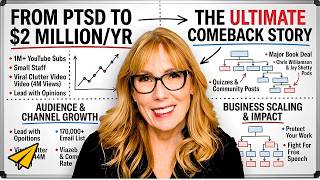
Anna Runkle went from complex PTSD to a million-subscriber YouTube channel and $2 million annual revenue. A writing exercise sparked a viral video with 4.8 million views and $70,000 in ad revenue, which she scaled through courses, a membership program, and a book deal with Hay House. She now uses AI tools to publish daily videos.
Chapters
One of our clients, Anna, just crossed 1 million subscribers on YouTube, and her story will absolutely blow your mind.
I was 53, you know, by the time I started my channel. 53. People are like, "I'm too old." It's like, "No, you're not." I have some techniques that are very helpful for reregulating your nervous system. I had my life saved in February 1994 when somebody showed me these techniques.
She went from surviving massive childhood trauma to building a multimillion-dollar business.
I grew up in a commune with drug addict, alcoholic hippies. And I was walking back from a coffee shop with a friend and these 4 guys jumped out of a car and beat us unconscious and broke my teeth and my jaw. And I got terrible PTSD.
And instead of worrying about the fancy gear and short-term trends, she shared her real story about complex PTSD and connected deeply with her audience.
I was a professional comedian in my 20s. I was a data analyst in my early 30s. So I was amassing all this experience, but once again thinking I've really botched it. I really have made a mess of my career doing 100 different things. It's all going nowhere until I started my YouTube channel. Complex PTSD is a thing and the symptoms, everything that I'd suffered with are textbook. It's totally normal.
In this presentation from my YouTube mastermind, she is sharing her exact strategies so you can build a massive evergreen channel of your own.
Wrote a little bullet point script. This video has had 4.7 million views. After this video came out, we were pulling in $2 million with a staff of like 3. Being successful on YouTube, it's not intuitive, all of it.
And to support her with her fight against the state of California, connect with her in the description link below.
The state of California is trying to shut me down, which also takes a lot of bandwidth to sort of fight that and deal with it psychologically. They're not gonna win. I will win. I wanted to tell you, hi. How the business operates. And my, I have something a little different than many of you where you guys had a business and you're adding YouTube as a way to market the business. And I just started a blog and YouTube channel. My business was a video production company. That company was killed soon after I met Evan when the lockdown began. [LAUGHTER] It was a good business. I had 10 people working for me. It was really good preparation to be a YouTuber. And I had already been making videos then and blogging, but I was doing it like occasionally. I was doing it, oh, when I— I think I started in the fall of 2016. Actually, the first thing I did, I went to Brendon Burchard's Experts Academy. I knew I wanted to write a book about my techniques. I have some techniques that are very helpful for reregulating your nervous system.— that I learned 32 years ago when there was no word dysregulation, when nobody thought nervous system was a thing when you were feeling crazy. And I had my life saved in February 1994 when somebody showed me these techniques. So I have to tell you a little bit about myself. I grew up in a commune with drug addict, alcoholic hippies. [LAUGHTER] It wasn't the principled kind of commune. It was Berkeley in the '60s and early '70s. And I was very neglected. I was a smart kid. I was very resourceful. I would go to make friends and go to their moms and say, "Do you think you could take me to the doctor? I have a fever." And that's— you know, in those days, people could take other people's kids to the doctor, and people did. And everybody would sort of quietly make it work. And because I could do that, I didn't turn out like my siblings. My brother died of drugs and alcohol in his 30s. I have another sibling who is a little younger than me, but deeply lost on meth and oxy and all, you know, very, very, very damaged. So every once in a while, I remember, like, it was not very likely that I would turn out to be okay. And so being resourceful as a kid, asking for help was one thing that helped me. The other thing that helped me The next thing that helped me was that somebody showed me these techniques. And it was— it was this night 32 years ago. I had just seen my mother for the last time. She was dying of cancer. She wouldn't say "I love you." Everything was just, like, weird and awful. I came back home to the Bay Area, and I was walking back from a coffee shop with a friend, a male friend who was a black belt in taekwondo, and these 4 guys jumped out of a car and beat us unconscious and broke my— teeth and my jaw, and I got terrible PTSD. And I used to go to therapy all the time in my 20s. I was always sad. I was like a sad young woman and always messed up in relationships. And when this happened though, I guess this was right before I turned 30, I got active PTSD. And when I went to the hospital, they said, "Well, were you raped?" And I said, "No." And they said, "Well, you're fine then. We're gonna fix your jaw. Go get your teeth fixed. You're okay." But I had very, very bad PTSD.
Mm-hmm.
I went to a therapist and she said, "You should come 3 times a week and talk about your trauma." And so I did, I did what you're supposed to do. But we now know why that pushed me almost to the brink of killing myself. Talking about trauma is very dysregulating for a lot of people, and it was for me. And the more I talked about what had happened, my mom, my past, the assault, the more I started to break down and couldn't function. I was at work, I had to go back to work very— they said take 3 months off. My job said you can't. I needed the job. I went back after a week. And I was just shooting my mouth off and saying really inappropriate stuff. Almost getting fired. And I was scared. And then friends were just like leaving in droves because I was acting very weird and hostile and erratic. And I thought that I was some kind of a bad person. Now culturally, I suppose you all know, I had PTSD. I had really normal symptoms. Mm-hmm. Symptoms of PTSD. But so I really had made the decision that I would have to, like, end my life. And the night before my plan, I happened to tell this woman I barely knew what I was thinking, and she just, like, very casually said, You want me to show you this thing? 'Cause I've felt that way before, but you might like this. And she just taught me this really simple thing that she had learned from a very unusual person in AA. Not everybody in AA does it. And it was to write your fearful, resentful, "Thoughts and feelings on paper and ask God to remove them." She said, "And then go meditate afterwards." She said, "Go learn TM." So I did that. But the first time I wrote was the first time I had felt relief in like, I don't know how long, years. Relief from— this is— if you want to know what it felt like to be me, it was like all the time inside, if I were to vocalize it, it would be like, "Ugh." All the time, just all the time. There was never peace inside. And I looked very high-functioning. I was pretty. People would go on a first date with me. Things would soon collapse because, you know, I was weird and angry, very angry. They'd say, "You're a very angry woman." [LAUGHTER] People would say that. So I felt hopeless. So she showed me this. And I sat there at her little warehouse writing until 5:00 in the morning. She said, "Go home. Go get some sleep. Call me tomorrow if you want to read what you wrote." So I did. I went home, and I woke up, and I just felt like, I woke up. I was like, "Ah! I feel good!" I felt good. And I called her, and I read all these horrific fears and resentments I had about being worthless and needing to die. And she goes, "Oh, yeah, honey, we do that. Oh, yeah. Oh, yeah." And she understood me. She had just sort of been through the same feelings. And before you know it, I was laughing with her. And for the first time, like, I felt like somebody got it, what it was like to be like, "Ugh!" inside. I wasn't the only person, but I didn't know that. And so what my whole life mission has been since then is to put this out there, to teach the techniques, and to be the person who talks about what it's like, and so people know, like, it's not just you. And it wasn't until 2014, 20 years later, that the book "The Body Keeps the Score" came out, and some books came and defined what is complex PTSD, what is nervous system dysregulation, and the first time I read it, I was reading because my husband had canceled our wedding because I had had an emotional outburst that was unacceptable to him. He said, "I can't marry you if you can't deal with this." This was just 2014. It wasn't that long ago. Or 2013. 2013. So 5 weeks before our wedding, we lost all the deposits and everything. He moved out. I was devastated, but I read these books, and I read the description of what it was. So even though I had been using these techniques to, like, manage all this time, I found out that it's a thing. Complex PTSD is a thing. And the symptoms, everything that I'd suffered with, are textbook. It's totally normal. If you went through what I went through, it just looks like this. And I also found out they had— like, the mental health world sort of has quasi-solutions for it. I think they have a lot of misunderstandings about it. Mm-hmm. But they— but I knew that my writing technique worked like a charm. And so I finally put it together, and that's when I started. I started having people to my living room. As soon as I announced it, people would fill my living room. Soon I was— I had a living room full of crying people, and it was really out of control. So I set some boundaries on it. I'm like, "We're not gonna talk about trauma. We're gonna talk about the book." I started to learn how to do the job I do now, but it was very organic. And, uh— Thank you. It became something that I could not keep up with. It was about 20 hours a week, and I was a newly married— we did get married. We got married, like, you know, 7 months after that, because I changed. I changed like that. I changed. And— but I was newly married, which is kind of stressful. I was going through menopause. I was 53, you know, by the time I started my channel. 53. People are like, "I'm too old." It's like, "No, you're not. You're not." And so this thing that I had been teaching people one-on-one— I used to go to Al-Anon. It's a 12-step program for families. Families of Alcoholics. I definitely qualified. But I sponsored about 300 women there, and I got really good at what I do that I now call coaching and you pay money for, because it's not in that context. So it turns out my whole life had been preparation to be Crappy Childhood Fairy. People call me Crappy or Fairy. [LAUGHTER] But Crappy is meant to modify the childhood, not the fairy. Just saying. [LAUGHTER] Or they call me Anna. But my whole life has been preparation for this. A lot of jobs I did— I was a professional comedian in my 20s. I was a data analyst in my early 30s. Later in my 30s, I was a consultant who went around and improved clinic performance by teaching customer service. And through all of it, I was creating online education for doctors and clinical professionals. So I was amassing all this experience, but once again thinking, "I've really botched it. My— you know, I really have made a mess of my career doing 100 different things. It's all going nowhere." until I started my YouTube channel. And it turns out I was so qualified to be the YouTuber I am right now. Like, everything I've done, everything I've done has been really useful. If you're a YouTuber and you're coaching people and working with people, you need to be funny, you need to understand data. Oh, and I started— since 2007, I had a video production company. I made corporate videos for— Zoom was my big client. I made all their videos. Kaiser Permanente, they're very big. I didn't make all their videos, but quite a few. So I had good clients. I thought I was really getting somewhere. It was okay. It was fun, but it wasn't like what I have now. It wasn't meaningful like that. And I always knew when you're in video, for example, and you're 53, like, you're not gonna get hired for long. They don't think of women who are that old as like the hot person to hire, even though I was quite good at what I did. And so it all timed out perfectly. And so I had this little channel, this little video channel going. I found out in 2019 that I had 2,000 subscribers there. The blog had 60. That's the, that's kind of when I woke up and I went, "Oh, I should do more of this." So I started making, I don't know, a video every 2 weeks, something like that. And then I made, I made maybe one a week. And then I started, and then I made a course. And then I started, I think at the point when I went down to Puerto Rico, I was making, $27,000 a month doing this. Like, it was a lot of money to make as your side gig. So when the pandemic came, I knew exactly what to do. And, you know, there was no video production. All my stuff was on location. And I got serious about it. But what Evan said in the hallway, it won't be news to you, but it was the first time I'd ever heard it. I grabbed him in the hallway. We were like standing there under some staircase. And I was like, okay, I was taking notes. I'm— I'm listening. 'Cause he had made a presentation, but I think I was the only person in the room who was like hardcore YouTuber. The other people that, it's not really Brendan's thing. He recommends a lot of things, but YouTube wasn't his thing at that time. So I was like, me, me, talk to me. What do I do about this? What do I do about that? And the big thing he taught me, and I showed him a little video, and my early videos, it's a little logo. There's some music. It holds for 10 seconds or something like that. [LAUGHTER] And then it's a title. And then I come in, I go, "Hello, I'm Anna Ronkle, also known as the Crappy Childhood Fairy." Evan's like, "Okay, first off, you have to just like chop this off." And I was like, "What?" And he said, "Yeah, chop it off. Nobody cares. Nobody cares. You need to come in and lead with a strong opinion." And I was like, "Well, I can't do that. You don't know, like, the mouth on me when I have so many opinions. I'll get canceled so fast. I can't do that. I have to like pretend I'm somebody." And he was like, "No, you be you. Like, nobody cares." about the fake version of you, you be authentic you and start talking about what it's like. And so the tenor of my videos shifted then to a little more, what am I experiencing right now, and not just like, research shows that da-da-da-da-da, many of us find— I was like that, you know? And then I shifted into— well, my video today, my video today, it's crush— it's going really well today. I've been publishing every day. I'm back to every day, up to every day. Thanks to AI, it's really easy to do for me now. The video today is about female bullying. And I think the thumbnail says, "Middle-aged Mean Girls." [LAUGHTER] That's such a good title, right? And it's a relaunch of a video from 9 months ago or something that's about female bullying. And I tell the story of this neighborhood I lived in where all the other moms like ganged up on me and started, They would, like, block us from trick-or-treating with them, and it was a cul-de-sac in the country. Like, if my kid couldn't trick-or-treat with their kids, my kids were all alone. It was really cruel. And they told people that I was dangerous with kids, and then they told people, I found out later, that I killed cats. They said, "Oh, yeah, she's killed, like, 4 cats." And I don't know where they got this. I had a cat. It was just this weird thing. And so I never knew. So I told the story on YouTube. Mm-hmm. And then I said, "I don't know what it means." So I looked at ChatGPT. It's the first time I mentioned AI. I said, "I looked up on it," and ChatGPT said a bunch of stuff like, "They were probably threatened or jealous or da da da." And I read what it said, and that was the video. And that video was just like hundreds of thousands of views and so many comments. Like, so many people came out and they had had that experience. And so then that became like a new pivot for me. I was just talking about like, how much women struggle with other women. And how there's all that talk about how sisterhood and if women ran the world. And it's like, not so fast, you know? So a lot of people had suppressed rage about this. And they were loving the videos, right? Right? So that's the kind of thing that ended up taking off. My biggest video, the thumbnail is Clutter is a Trauma Symptom.
Oh, wow.
I just thought of that. I just thought of it one day. It's kind of a trauma symptom, isn't it? Oh, let's talk about that. So I wrote a little bullet point script. And this video has had— You won't be depressed and stuck anymore. 4.7 million views. Oh, it's 4.8 now. Okay, $70,000 off one video. It's great, right? And a whole bunch of subs and watch time and everything. But I'll tell you what, that bought me like a really nice house because I have a downstream pathway where if people watch my videos, I say, "You know, you might want to take this quiz about this," or, "I have a list of red flags to look for on a first date, and you can get that down in the top line of the description section below." And I always promote at least 2 things. And I have more in the description, but I drive home these lead gens. I have about 25 of them. So that's one thing I really want to tell you. I have pictures of them. And because everybody gave me their email address, to this day, I have 170,000 people on my email list. Wow. And that turns out to make a ton of money. Just, I go on online summits and they give me a share of revenue. Or, you know, this, like, I have this trading card of having a huge email list that I can participate with. So that's been huge. But the other thing is I sell courses. I have a membership program, webinars. And I have found that the, like, views dictates how much, how many people click on stuff. It's not one for one.
Mm-hmm.
So if I— and my YouTube channel's kind of low right now. I've been going through a period where I couldn't give all my energy to it. But I'm back. I just came back. It's getting better. But if I— let's say if I were getting, you know, 40,000 views and then it went up to 80,000 views and doubled, it wouldn't double the revenue. It would maybe like— the revenue would go up maybe 20%, 30%. It's like a smaller portion of the growth of views. And probably, you know, what I should be focusing on is the conversion, the conversion over once they click on stuff. So if I double the number of views I'm getting, it— I get— right now I get like 200 leads a day. I've had like as many— over 1,000 leads a day. That is so much. And they're leads who liked my video and wanted my stuff. So they're like great leads. So as everybody knows, then you have to convert them to buy your thing. And that's probably the weakest thing in my business is the conversion.
The products are good.
You know, so we're— but still, it's really good. So it got up to— after this video came out, we were pulling in $2 million with a staff of, like, 3. And it was gangbusters. It was so crazy. It was so fun. And everybody was, like, calling me and inviting me to participate in stuff. And right after that video came out was when I dropped my book proposal. At agents. And first, if you're doing book proposals, you're very lucky there's an agent here. I couldn't get an agent for the life of me, even though at that time I had 500,000 subscribers. I mean, it just— it went up so fast. So I wrote to these agents, literary agents. I had always wanted to write a book. This was the book. This was the first book. My agent got me a 2-book deal, so there's 2 books. But this is the book that's my manifesto. This is how to heal. This is how it works. Mm-hmm. This is what happened. And it covers all the details. It's in 7 languages. It's been out a year and a half. 7 languages. It's coming out in paperback in the fall. It's much beloved.
Mm-hmm.
And my books, like, audiobooks sell more than any other format of them. So it's been this, like, wonderful ticket. And Hay House is my publisher. They're very kind. I couldn't even get agents to take me with half a million subscribers. I couldn't even believe it. I've heard you have to have 30,000, but I was like, with half a million, I couldn't get anybody to do it. I don't know why. But then somebody came to a retreat that I led. She's like, I have a friend with an agent. She referred me to that agent. The agent signed me immediately. Like, it's, you know, you kind of have to know somebody. It's not easy to just get somebody sight unseen, right? And so she signed me immediately. She got me in front of a few publishers. And I had told her Hay House I thought was probably ideal for me. And they— we got a meeting. And they signed me immediately. And they— she said, "How about a 2-book deal?" They said, "Yes, sure, okay." And so, like, I'm set for life to publish with Hay House if I want to. I don't know if I want to write books again. It's really hard. It was really hard. And it's really hard to, like, run a business and a channel and— Mm-hmm. Do that, do all of that stuff. Many of you have heard the state of California is trying to shut me down, which also takes a lot of bandwidth to sort of fight that and deal with it psychologically. They're not gonna win. I will win. It's gonna take time. But I've talked to some of you, and I talked to Evan about this. It takes a certain amount of bandwidth, and you know how it is when you're running a business. Like, it takes everything you've got. You know? All that creativity and that ability to— have a fresh idea when you're tired or when everything's gotten really hard, to have that fresh idea. And so I'm really happy to say that even though I had a rough hearing back in February, I rebounded and I'm having so many ideas. So I'll talk about, I'll talk about that in a minute. But so there were the books. I have a membership program that's been the bread and butter of income, but not now. But bundling all my courses and you can come to my webinars and you can come to these calls I do. I do these I used to do big free public calls. Now I don't because I want to get terms of service signed by everybody I talk to because somebody reported me and started this whole thing. And the person who reported me, who came to my free call, said that she felt triggered. I remember her. She was disruptive. She was harassing people in the chat. And I DM'd her and said, "You have to stop this or I'm gonna have to remove you." And she was like, "Bleh, bleh, bleh." So I removed her. So she went to the website— [LAUGHTER] of the State Department of— the Board of Psychology, and reported me and said I was really mean and she felt triggered. And now, you know, now for years I have to fight in court that somebody was triggered. It's just so dumb. So I'm mentioning this. I wasn't sure I wanted to tell everybody this, but I can't stop talking about it. I'm just telling you, like, have lawyers look at all your agreements for anything that, you know— don't think that YouTube is special or coaching is different or anything. You have to have lawyers look at it. And even then, I have that. I have lawyer contracts. But even then, be aware of this. This case may go quite high, and I will fight it. I'll fight it. I'm not gonna give them a precedent that they can come after anybody else if I can help it, you know? And so we'll try to do that. But what it's a sign of is that as influencers, we're starting to have a huge impact. And there are powers that be that are very scared of— Mm-hmm. How much we influence, how much we affect the culture, how much, in many cases, we're replacing the old systems of doing things. Now, I don't think any of us lives in a place where mental health is all taken care of, right? So it kind of makes me mad, but to them, they're like, "This is dangerous." You know, I'm not a therapist, so, you know, I'm not a therapist, that's the point. But they just think that's really dangerous, you could be telling them anything, and really, I think what's bothering them is they can see, like, the million subscribers. They can see the positive comments. They're— so— And they know you're not, right? Everyone knows you're not a— That's the accusation. You're not a therapist, but you're pretending to be one. I'm like, no, I'm not. So that's why I say I'll win. They really don't have a case here, but at the lower level, they can do that. They're just gonna throw spaghetti at the wall and try to make trouble. And I think they drive a lot of people into underground and out of business. By doing this. They do this in a lot of industries. It's a growing trend. They come after people who help you with remodels. They come after, you know, restaurants. They come after— they came after Suze Orman back in the day. She made a package about how to prepare a will and trust. And she said, now, you know, here's your preparation. Now go to a lawyer. They're like, you're pretending to be a lawyer. And she was like, no, I'm not. I'm telling them, here's some preparation work. Go to a lawyer. But you can see, like, why would the state— be threatened, the people who license trust lawyers, you know? Why would they be threatened? So they're like, they're basically like the mafia is how I think of it. And they're about as fair as the mafia. And, but I'm sorry Canadians and Swiss citizens, but this is America and I do have a right to free speech. And I, yeah.
Yeah.
Yeah. Yeah, so sometimes you get picked by fate, and you're just going to have to stand up for it. But it's not going to be federal. It's just state, right? No, right now it's state. But should I lose, then I appeal to a federal court. And a whole bunch of pro bono firms, national pro bono constitutional law firms, whose whole thing is suing the government against infringement on citizens and businesses, that they're waiting in the wings to do it. So as long as they think they can win it, they'll take it. I don't know, but I don't, you know, we don't, at the state level, they don't tell you like, what is this really about? And the evidence wasn't there. And I didn't even know why this was happening to me. They told me in October 2024. I only got my hands on evidence a year later to find out what it was. And I'll tell you, like getting that first letter, I thought it was phishing. I was like, no way, this isn't real. You know, I'm not doing anything wrong. Then when I saw the evidence and it was really vicious and it was dishonest, it said I was a fraud, that I was pretending to be a therapist and that I was charging money and speaking with authority like that's a crime. It was very upsetting and I got very sick. I got really sick. I put on 30 pounds in 6 months. I could barely make videos. My confidence got so hurt, like, "I better not say anything." It took me some time to come around and go, I'm not gonna live that way. I'm not gonna live that way. I'm not willing to just, like, go quietly into premature old age and say nothing. And, you know, that's just— this is what I do. This is my calling. I have this huge community. And if you care to, go to the channel sometime and read the comments. The comments are extraordinary. The people there are so passionate about this. There's so many people whose lives have been changed. I can't think of a better way to change people's lives. If you ha— like Evan says, if you— have something that you know how to do, do not underestimate how valuable that is to other people. It's a beautiful and good thing to be able to share it. And sometimes when I think about if I get hit by a bus, am I OK? Have I done what I need to do? I've taken care of the finances for everybody. I've made good on any broken relationships I ever had. I've done everything right.
And?
And? I wrote it down, and I was allowed to write it down and have it published, like, you know, it's there in the Library of Congress. I got that because I had a bunch of YouTube subscribers. And Hay House at that time, they were signing YouTube people like mad. They were just like, "Oh, this—" 'Cause it's really hard to sell books these days. And they want people with a following. And you've probably heard that before.
Mm-hmm.
That also, then the book opened a bunch of doors. I started getting invited on all these podcasts and Hay House paid for a marvelous publicist. So I think I did 70 podcasts last fall and some of them were high level. One of them that came organically was Modern Wisdom with Chris Williamson. They called me up one day and they're like, "Can you come on next week and talk about limerence?" And I've just become the de facto expert on obsessive love. Addiction-level obsessive love. And so I talked to him. And it was like as natural as can be. When you do YouTube every day, it's so natural to just go and talk to somebody, even if they're like a movie star in your universe, which he was to me. He still is. I went over to Jay Shetty's house. I was on his wife's podcast. Everybody was hanging out. And it was like, oh, hey, you guys. Yeah, OK. I'm out in the driveway, pshh. Pshh. "Look at me!" So I got to do all kinds of cool things because of that. And then I have— there's a Hay House author in London who has a big business, and we're starting to partner up, and he is a psychologist. And so he puts on— he's experimenting with all these new formats where we can leverage our mailing lists. And his business has 4 branches. There's like, you know, he trains He trains therapists and coaches. He provides direct clinical services. He puts on online summits and some other thing. And he has a mailing list the same size as mine. Like, that's how big my list is. Because I get the views and because I get their emails. So I really want to leave you with a strong feeling about that. So let me show you what that looks like. YouTube, the community posts. Do you guys talk about that? Yeah. In your mastermind? Community posts. It's the most underutilized thing. You can put a little, like, you can make a little thumbnail and a little bit of text with a Bitly link there and send people to a form or a landing page that leads to a form and then deliver a download. And I have, like, tons of downloads. I just make so many, you know, I've had, I've got stuff about so many topics. So whatever the video's about, I pick two things. We do one every other day. I think we do 4 a week. And if I've got an— I do a webinar every month, and if that's coming up, I might insert that in one of the empty days. But this is like my core quiz. Don't tell the state. They probably won't like this. [LAUGHTER] But they never looked at my website. And they only looked at YouTube titles. I don't think they watched any. All of this is about so little, but— So there's the Bitly. It's got some text. I actually am gonna revise it so the Bitly's up above the— That's in your comments? No, it's in the community posts.
Oh.
They can comment on it, but they—
Huh?
You go to content posts and you can post there. I think you can do like a poll or something. And you can post something like this with some text. It's basically like doing Facebook or something. So you put that there. Big— you know, the whole thing is clickable. Well, no, you have to click on that. And then they go to that. That's the landing page. And, you know, I have this many subscribers now, but, you know, they flush all the time. Like, so many people have gotten into fairy over the last 10 years because of this quiz. And it's a quiz that has, I don't know, 16 things like, "Do you feel like you have to hold on to people for dear life even if you hate them because you're afraid of being alone?" Do you get really discombobulated under stress? It's just like some basic things that I'd experienced and that are— they're in the literature. And then the third page, when you click the button, it's a form. And you give your email, and then you get an email from us, and it's like, "Thank you for doing this. We think you'll like it." Ha ha, now you're in a funnel and you're gonna get a bunch of emails from us selling stuff. [LAUGHTER] But don't— we don't tell them that on the first day, but— But they do consent to— we do all the things right. And it's just a form. It has a copyright on it. It has a caveat on it. "This is not therapy." It's really simple. It was so easy to make. So now I just make them all the time. I have a thing, "How connectable are you?" And "Signs of limerence." "Signs of a great partner." "How to get ready for a great relationship." "Friendship Red Flags." And they just go like hotcakes. People love them. So people get on our mailing list and then they unsubscribe if it's not for them, which is fine. But the list is like, the list has turned out to be almost as big of an asset as YouTube. It's a really big asset. When I think about can they shut me down, I don't think it would ever occur to them to seize my email list. And that's how I would just start right over again, you know? [LAUGHTER] I would just do it again. I have a list of people who are people who are into it. It's an uncommonly high list for somebody who does something I do at this scale. So that's the business model. And then it goes downstream. And our staff, when they came after me a year and a half ago, already there was a thing happening to the channel somewhat. I was like, 5 years ago, I was— if you search CPTSD online on Google, I would come up first. Now I'd probably be low on the second page. Like, it's so popular, so many people have come in about that and dysregulation. So I've had to kind of pivot. I talk about it, I'm definitely respected as an expert. This is a brag, they— the Royal College of Psychiatry has adopted my content, some of it, for teaching all psychiatrists in the UK and Australia and New Zealand about what it's like to have complex trauma. Mm-hmm. That, like, that's my gift. I'm really good at describing what it's like, and I can talk about it in a way that makes people feel seen and understood. That's the special knack that I have.
Mm-hmm.
But this is how I turned it into a business. So we were making a couple million dollars. It fell when I got hit with this case. And there was an underlying thing where stuff was dropping some because of the saturation of my topic. So gradually, I've found ways to expand on it. And like the video today, I did one recently about how people talk to you. When people are rude to you, when they put you down, how do you— how can you respond to that and hold your dignity and not, like, dive into a big argument with them? I've just found that I— you know, it's— when you've saturated your own audience and you're not getting subs anymore, you can get a new audience by finding somebody adjacent. Mm-hmm. And so my husband— okay, so my husband was a software engineer. And in the pandemic, he quit and he came and worked for my company. And he loves AI. And it's so great because he's a genius at creating— he can, like, listen to a problem and go, "Okay, I know what to do." So he only— this is only, like, 3 weeks old. He changed my life. He made me this thing he calls— here's Script Fairy. This is— Oh, wow. Claude, thank God for Claude. I've been listening about Gemini here, but I was banging my head against the wall with ChatGPT all years. And I was just hating my job. I was hating making videos. It was so hard. It makes everything in the same voice. Have you noticed that? You can always, then I was like, oh, that person's doing ChatGPT. I just already know 'cause they're going, you're not this, you're that, you're not this, it's not that, it's this. It's not this, it's this. Yeah. One sentence, one sentence, three words.
Mm.
Mm. And I just got where I just wanted to throw up when I saw that. It was like I would yell at it. I'd be like, "Stop it! No! That's not me. That's not my voice." And it had all my stuff in there. I have books. I have, like, 1,400 videos. I have 6 courses. It couldn't do it. And we went to Claude, and, like, in one day, it was making first-draft scripts that I could read, and it sounded like me, and it worked, and it was pretty true. I spend time. I tweak it. I like to speak in metaphors, and that's got to be me, and I do that. And I put in stories. ChatGPT, when my format said, put an insert personal story here, it would always make a story up. I remember when I lived in New York City, and I was— And I was like, don't ever make things up. I was so mad. So I was losing all this emotional energy. That's like the worst thing to do. As an entrepreneur or a creative person to just like get all emotional about stupid stuff, right? So Claude, I'm just really happy right now. So this, he made a Script Fairy for me and it's got features that I asked for. Like, could I just highlight a little phrase and talk to it about that phrase without it changing everything? And then he made Tube Fairy. He made a little logo with my glasses and my pink pencil. I answer letters. People write me a lot of letters like, "Dear Abby," they want my advice. "about something." And I go, "I've got my pink fairy pencil here, and I'm gonna circle what I wanna come back to in a second reading, but let's see what's going on in Jennifer's life today." And people tell me their problems. And that's a really easy kind of video for me to make. So there's the logo he made for me. He just made this for me, like, a few weeks ago, and now we're managing our whole workflow. I have an editor. I have Rob. And then we have another person who publishes the podcast version of everything. And so this is just a— it's a little thing, but he's put in all the bells and whistles we need to upload the raw file, to put the script, to put the final version. And then we list all of our lead generators here. And you click on them to choose which ones in which order you're gonna— we're gonna show in that— those precious top 2 lines of real estate in their description section. So we do that. And then you save it. Submit to team. And here's where I put my thumbnail titles. And I choose from a library of images. And your husband did this for you?
Yeah. Amazing.
I know. He's not totally the best at things like keeping things tidy and putting tops on toothpaste. But damn, can he make an AI app for me. He's redeemed. Sounds like he's the husband fairy.
Yeah.
He's awesome. He's really great. He used to come to BrandLytics too. So he's gotten this— like bringing AI into it has made YouTube really exciting for him. Like you have to keep it interesting for him really to— for him to really give you his best. So now he's working on an app for me. And we don't have it perfect yet, but it's still pretty good. I'm using it to come up with titles. 'Cause I said my biggest challenge is to try to find titles that are just gonna kill and that are gonna bring me to an adjacent audience with new people. And so he's setting it up to pull from specific sources, both my analytics on YouTube, my competitors' analytics on YouTube, trends out there. And I think this is gonna be hard, right? It's a pretty big world of stuff. But already it's coming up with stuff as good as anything I could think of. And so to be continued. I'll keep you posted about that. Thank you. It's a— he's working on the right problem for me. So we'll see about that. So that's what we're doing. It offsets my fear of AI. I feel really excited about it. Like, the positive idea of AI is, OK, sure, robots are going to do everything and no one will have a job and we're going to starve. But our time will be available to do something different. This is the moment that I'm in in my life right now that, like, I've just been liberated from the horror. Like coming up with like 4 videos a week even was so onerous and running the company and just being Anna Runkle and having a body and having to take it to the gym and make food and everything. I was just like, "This is too much." And all of a sudden it just like got easy. And so now I'm up to every day. My videos are, they're doing really well. Today's video was number 1 on the 10 ranking. I just feel good about it.
Yeah.
Yeah. Yeah. And YouTube is speech protected, my fellow Americans. They can't get you on that unless YouTube cooperates with them, which is not guaranteed that they won't. But it's speech protected. It is speech. California considers it therapy, but that's because they're really dumb. When one person can't talk, it's not therapy. So there's that. Also, books are speech. You can't touch them. They're safe. Online courses are mostly safe unless they involve interaction with people. So there's a trend right now to come after people who are not licensed but are talk— in a particular thing, who are talking about things that licensed people are accustomed to owning, like a union or like the mafia. [LAUGHTER] If they own it. And I don't— actually, therapists love me. It's just the state. It's just these fusty people up in Sacramento. You know? Therapists love me. And many of them have come to my age. So it's a lovely world. And people are— people who want the best for everybody are very excited for YouTubers who are ethical and thoughtful and do their research and try hard and work hard. And they're generous with their audience. People are very happy for the life to get better for the people we serve. So that's what we want, right? That's what we all want. That's what we all want. So I guess I'll leave a little time here for questions with you. So you said it got easier to come up with titles for doing videos every day. What became easy? Oh, well, the titles are not the hardest part. It's like scripting. Well, no, no. I mean— I do— and for the record, I do scripted videos and read them on a teleprompter.. And I'm just really good at it. Nobody knows. I'm just good at reading on a teleprompter. And I can do improvised videos and I do them on the letters. But scripting, I'm a very good writer and I write for my voice and I like to land my points. You script it so that you can land the point. Like I find the videos are more effective when I go, "Taka taka taka taka taka, pasham." You know? And it's got, it's like music. You know, you wanna just like land the point, hang out there with them and just be like badass for a second. Furthermore, duh-duh-duh-duh-duh-duh-duh-duh. And so I want to land those points and not be kind of like rambling on the videos. I like to script.
Yeah.
And also because talking about trauma is very dysregulating and some of my videos involve mentioning trauma. I don't go deep into it, but even mentioning it would kind of make me very discombobulated. So if I write it and read it, it works. I'm using my own science, you know, to just— I write it and I read it off the prompter. It's PromptSmart. It's voice activated. It's $60 a year. You run it off an iPad if you want or a phone and it's great. I love it. I've had it for years. But you were asking, your specific question was what got easier. Claude can sound like me. Yeah, how do you do that? So I give it a title and I'll say, "I'm thinking of a video called female bullying and it's about female bullying and I wanna tell the story of," Well, the story one's not a good example. Female bullying, and I wanna talk about how common it is and how many people, how it contradicts some of the mythology that if women ran the world, they'd just be so nurturing and great all the time. And then I hit the button, and then a couple seconds later, it's got a script. And I, on ScriptFerry, I hit the button, it goes into my big thing, and I look at it, and it's like 90% there. It's really good, and it does sound like me. Yeah. Me, but I give it some details. But it's got a whole body of work in there. You have a body of work. You have all those sales emails and stuff. I've gotten to know your work a little bit this weekend. So if you have a body of work in there, it just does a much better job than ChatGPT, certainly, of interpreting the material and reading your tone. I just can't— it's almost uncanny. Like, I can't even believe it's real, but it sounds like me. And it's measured in the way that I'm measured, and it's reckless in the way that I'm reckless. Yes, that's like pretty hard. I can't even believe it. I've gone through 10 copywriters over the years wishing I had somebody who could write my stuff. I'm barely on Instagram. I just like, okay, just YouTube and emails. Those are my things. Yeah. What's the next thing on your list of things you wanna accomplish? I wanna win this damn case. And then I'm gonna make videos all about it. And I'm gonna take this State of California down! Yeah, that's my next thing. I'm just like, I'm just in holding pattern right now, you know? Yeah.
We chatted yesterday. I have a couple comments and then a question at the end. I think you're an extremely engaging person.
Oh, thank you. You really lure people into your orbit with your kindness.
I thought that was a very interesting observation. Thank you. And finding out everything I didn't know anything about your story until today, and that's amazing that you were able to do it, what you've done. So kudos to you.
Thank you.
My question to you is, what's your number one red flag on a first date?
Oh.
Ask your girlfriend.
He's separated, and he's going to get a divorce.
Oh. That's a good one.
Yeah, do not date him, don't date him. That's how I met my wife. Yeah, yeah, no, another one is watch how they treat the people who serve the food or the people with a leash that gets underfoot or something. Watch how they treat that. If you see them snap at those people, there you are. Also, if they—
She's a good actor.
My worst, my, the thing about complex PTSD is you end up with like red flag blindness. And so you have to write lists and tell yourself what to do. And that's been one of the things I think I've done a really good job at in my life is learning. But twice in my life, I got together with guys where well into the relationship, I found out they were using hard drugs.
Mm-hmm.
Yeah. And that's like a real, like, "What's a nice girl like me doing in a situation like this?" where I had to take very seriously, like, "I have a screw loose. I have a way that I can't see that." But here's another red flag. You feel like you can't tell your friend. About them very much, or you tell cover stories about them, but you don't really want your friends to meet that person. That's— or if they treat you like that, they don't want your friends, their friends to meet you, then—
Yeah.
So I teach people how to get married too, which is unusual these days. Not how to cut people off, how to have a relationship with difficult parents, how to structure your dating so that it leads to marriage. I'm like this strange old-fashioned person, but— I'm like, you need all the love you can get in your life. Get married. Don't cut people off unless they're clearly abusive. So that's kind of what I'm known for. Yeah. I love that. My question was, when did your YouTube channel take off? Like how many videos did you put out? What would that look like when you first took off? See if I can find it. It was 2019.
I think it was right after you met me.
Yeah. To get to 23,000, you get, You're having some liftoff. So when I met you— oh, did we look at the chart? We haven't looked at the Evan chart. Here we go. Let's look at that. I'll tell you a story. Somebody wrote on my comments a couple weeks ago and said, Anna, you got a shout out on the Graham Norton Show.
Oh.
In Britain, it's like the really big funny talk show. And everybody was on. You got a shout out. And I was like, me personally? And it was like, yes. And it was this pop star named Jacob Elan. And he just got the Brit Award for the biggest rising star, and then Rolling Rolling Stone just elected him like the biggest promising artist. And every interview he does— he did an album called "In Limerence." And everywhere he goes, they go, "What's Limerence?" And he goes, "Well, there's this—" and he's Scottish and he's really beautiful. And he goes, "There's this YouTube channel called Crappy Childhood Fairy and she's a diva. She's brutal. She slaps you. And it hurts, but you need to hear it." And she goes, "You cannot keep having magical thinking." And he says it on every interview he does. So I wrote to him, and now he's a buddy, and he did a little video for my million thing, and we're gonna meet. And some movie stars have become friends over this. This is the other, like, the backdoor perk of being a YouTuber is, like, you— do you know who Alain de Botton is?
Oh my God, he's my favorite author.
Yeah, he wrote to me. He wrote to me, like, a couple— he's like, "I just love you, crappy childhood fairy." And I was like, Me?
I'm never a fanboy in my life.
You see, Nina, this is why you need to be on YouTube. Yeah. Yeah. He did that. He's just like, "Next time you're in the UK." And I'm just like, "Maybe I should just go to the UK." I've got Jacob Allon. I've got Alain de Botton and all these people over there. And yeah, it's really cool. I would like to know, you were talking about how the book, how having this subscribers and having YouTube helped you get the book deal.
Yeah.
Did, after you got the book, you mentioned a few things, but did it help you get subscribers? Did the book help anything in any other way but just to— I'm not sure. I'm not sure that the book helped the channel. But one thing, like what I was able to do for the book is get 5,000 people to pre-buy it before the release of the book and the whole publishing world, like Amazon responds to that. Do you know about this, people? You get people to preorder the book and then the day the book comes out, there's all these sales that process. And if it's a certain number and New York Times likes you, you could be a New York Times bestseller. I always knew they're not gonna like me.
But—
And 5,000 isn't quite enough. But I just was like doing like free webinars for people who bought the book. And so they would do that. So Amazon elevated the book. And my second book, Audible, there's an Audible editor and they made it like one of the books of the audiobooks of the month, the month that it came out, "Connectability." And then she, I wrote to her and she's just like, "Oh, I'm just such a fangirl." And that happened. When I walk around in Los Angeles or San Francisco or something, this doesn't really happen. But when I go into any tiny town, like every door I walk in, somebody's like, "Are you the Crappy Childhood Fairy? Oh my God. Oh my God." Oh my God. Like in California, people know not to bother you. But it turns out, like, I'm really famous. But you don't know it when you just work in some, like, shit room, you know, with the lights and everything. You don't know. You're just always there, like, on your laptop in your sweats or whatever. And so I was like, "Really?" And they get all nervous. And this is a phenomenon now. So many people have had such a change in their life because of watching my content that they— when they bump into me on the street sometimes, they come up, they find out it's me, then they get— starstruck and then they get nervous and then they start crying. And then I say, "Do you wanna hug?" And they're like, "Ugh." Then we hug and it's like this beautiful part of my life. It doesn't happen so much that it's ever a nuisance. It's just beautiful of knowing like just walking down the street, you know, I'm starting to make a difference now. Like I've put so much love into the bank that it's just like leaking out into the universe all the time on YouTube. It's just— Yeah. It's going all night and all day and it's affecting people.
So back to this Evan graphic.
Yeah, the chart.
We didn't really talk enough about, you know.
Okay.
It's just on the screen, it's distracting me, that's all I see. I mean, what I found, there's two things. I mean, one, you had your channel for a couple years.
Yeah.
And, you know, meeting me, whatever, it's more like asking for help, right? Just not doing it yourself and asking for help and joining programs. But, and then I guess joining Mover Makers in 2020. And also you had a moment, I guess it's not on here, where it's like you, depressed might be the wrong word, but like you took the summer off or like you felt like quitting on the channel. No, earlier, like you—
Did I? I don't even remember that, but you—
You had another one where it's like you met and then it was like, Got Evan's advice and then like didn't post all summer and then started to take off or something?
To be honest, I don't know what you're talking about. I busted my ass the whole time.
Okay, well—
I took it very seriously when I met you. But you know, like didn't this happen to you? Like you start doing it, it doesn't take off right away. It's a momentum thing. It's continuous. Also, when you have the clutter video showing there, that's clutter. We reckon that made us $1 million. You know, it was $70,000 in ad revenue, but because of downstream everything, and it got the book. And the book, I got like an unprecedented advance on that, which means I'll never get royalties now. But they, but here I always go, this is gonna be like East to West reversed, but it's like, here we are in Kansas, right? Going along, we're going along. I meet Evan, I was like, "Ooh." Ooh. There's a little mountain there. And I know what that was. That was a video called "These CPTSD Treatments Don't Work. Here's What Does." But I started leading with a strong opinion, and that's how long it took to get a spike after I met Evan. And then it was like— summer doesn't tend to be my best time usually, but who knows. But this is actually probably like 3 times bigger than here, right?
Mm-hmm.
You can't tell. It's all out of proportion 'cause of down there. And then it started to take off. I got into the— what was it called? Thought Leadership Academy. Basically what's going on here.
Yeah.
And look at that. That happened. Because I was there like every 2 weeks learning it. And I was in Movement Makers too. I was just like soaking it in. And it was just like twisting— it was like turning me around. Like it's not— being successful on YouTube, it's not intuitive, all of it. Somebody— that's like so much of what you teach. It's not intuitive. I wouldn't have never figured it out myself. Of like lead with a strong opinion. And then you got me into quantity. And quantity, to get there, I did, I answered 2 letters a week. So I do 1 thought leadership, 2 letters, and a mashup. And I did that. That was like a holding pattern for me for a while. And all of this happened with that going on. And then it got harder. It got harder. And this is, let's see, where's October 2024. The state comes right there. The state comes and sends, gives me that terrible letter. And then that same month my stepdad died.
Mm-hmm.
And he was a pretty good stepdad, but he was a hoarder. And I went down there and I saw the drug addict sister and I found out that both my sister and I were disinherited. It was very surprising. We were told like all 3 of us. So my brother got everything. And the other thing is he was a hoarder and he only wore flip-flops with duct tape. And we thought, well, we're not gonna get anything, but we're gonna have to go deal with his stuff. But he had like millions. [LAUGHTER] And I got disinherited. So that happened like 2 weeks together. And I gotta tell you, like I have some core trauma that like nobody cares about me and I never get credit for anything and I never get what I deserve. And both of those things happening together like activated some core stuff that paralyzed my, ability to make good work. And I got sick and then I got diagnosed with chronic fatigue and then, you know, this weight gain and then tiredness, tiredness, and stressed all the time. But as those things can sometimes be, it's like your opportunity to like figure out your next act. It's like, just like, screw that. You cannot live like that. And so a lot of changes have happened and I have— Thank you. I have space in my being to make my best work again, even though this is all going on. So here's now. So that was 2024. And then I got things going again. And then I had a relapse on the chronic fatigue in November and December. I couldn't get out of bed. And it just has a lot to do with stress from the case. But I've had to go a lot deeper to understand mindset, you know, to understand, like, I have really good tools for a lot of things that have been hard for me in my life, but now I'm learning some new things. Mm-hmm. And so in a weird way, I embrace this. I embrace what's happening. It's actually like, I feel really good. I'm full of energy. I'm healthy. I'm strong. I had these terrible blood tests for a while. They're all good now. And I'm making good work again. And I'm just really excited about the future, whatever happens. Because even if I lose, I'm going to be this like, I'm going to be on Substack just like, fuck things up.
All right, Anna Runkle, everybody. Hey. To see how another one of our members landed a $13 million deal from his YouTube channel, check the video right there next to me. I think you'll love it. Continue to believe and I'll see you there. One of our YouTube Mastermind members, Marshall, built a YouTube channel that landed his business a massive $13 million partnership deal. One of the things I'll talk about is that $13 million deal with one of our partners, Vetcom.
More from Evan


How the Biggest Mistake in History Created A Trillion-Dollar Empire | Sergey Brin



9 Machiavelli Principles That Force People To Respect You | Machiavellian Philosophy



The First 10 Words That Instantly Ruin A Sales Conversation | Vanessa Van Edwards

The Top 1% Mindset Behind The First $5 Trillion Company | Jensen Huang (Nvidia)

