He Was WORKING OUT for HOURS Before the GAME! | Unreal Work Ethic of Kobe Bryant
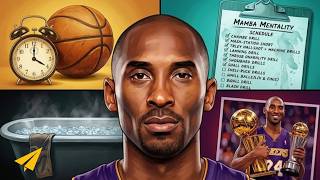
Evan Carmichael breaks down Kobe Bryant's work ethic through six rules, including Jay Williams' story of watching Kobe work out for hours before a game. Kobe woke at 4 am to train while others slept, driven by genuine love for basketball and a methodical approach to building his game.
Chapters
So I worked out for a good hour, hour and a half, and when I came off after I was done, I sat down and of course I still heard the ball bouncing. I look down like, this guy's still working out?
I truly love what I do, and that's where the passion comes from. That's where the will to get better comes from.
Oh, Kobe Bryant!
Woo-hoo-hoo!
Just a kid who would never take a night off. Even if it wasn't going well, it was always gonna be trying to slay the dragon.
What's up, Believe Nation? It's Evan. My one word is believe, and I believe in you. I believe you have an amazing gift inside you that I want to see explode out onto the world. Now, I started the Mentor Me series to try to hang around people who've done a lot more than us, and hopefully by spending a little more time with them, some of their beliefs, their mindset, their work ethic sinks into us to help us become the best version of ourselves. So today we're gonna learn from one of the best, Kobe Bryant, and how to develop an insane work ethic. Mentor me, Kobe. Okay, let's kick things off with rule number 1: Be driven.
My journey began in Philadelphia, Pennsylvania at the age of 3 years old. My father putting a basketball in my hands and me taking it from there.
Basketball was in Kobe's blood. His dad is Joe "Jellybean" Bryant. He played 8 years in the NBA before uprooting his family to take his career overseas.
As I grew older, we moved to Italy.
While Joe was getting used to playing in Europe, his son was also making an adjustment. In Italy, not many kids were perfecting a jump shot, but Kobe Bryant was.
Soccer was a big sport, so he had goalposts underneath the baskets on concrete courts, um, where kids used to play soccer all day, and I would be one of them. And then after soccer, I'd stay there for another 3, 4, 5 hours Just playing basketball.
It was a different country with a different language. Even though he had his family, he was essentially alone. So Kobe looked inward and developed the relentless drive to work on his game. When his family moved back to Philadelphia, that time spent alone on the court paid off as Kobe announced his arrival to the basketball world. He was the top high school player in the country, breaking Wilt Chamberlain's scoring records, becoming becoming a celebrity at 16. Kobe's next step may have seemed ambitious, but with his basketball pedigree and work ethic, it was an easy decision.
I, Kobe Bryant, have decided to take my talent to, uh, take my talent to the NBA.
Rule number 2 is work helps you grow, featuring Jay Williams.
You know, look, I always try to outwork people, right? That's just how I made my mark. So the game was at 7. I was like, you know what, I'm gonna come to the Staples Center because we're playing— this is when the Lakers had Kobe and Shaq, okay? This is, this is like the championship Lakers. I was like, you know, I'm gonna get there at 3 o'clock and I want to make sure I make 400 made shots before I go back into the room. And then I sit in the sauna, I get ready for the game. Who do I see? I see Kobe Bryant already working out. So once I set my foot across that line, I started working out. And so I worked out for a good hour, hour and a half. And when I came off after I was done, I sat down, and of course I still heard the ball bouncing. I look down, I'm like, "This guy's still working out?" He was working out, like, it looks like he was in a dead sweat when I got here. And he's still going. And it's not like his moves are nonchalant or lazy. He's doing, like, game moves, you know? I sit there and I unlace my shoes. I'm like, "I wanna see how long this goes." I sit out there and watch. Another 25 minutes. And they got done. I said, "Okay, I think I've seen enough." Go play, you know?
Come back, get in the sauna, get ready for the game.
Game.
That game he drops 40 on us, okay? And after the game is over, I'm like, I have to ask this guy, like, I have to understand, like, why, why he works like that, right? So after the game, I'm like, hey, Kobe, like, why, why were you in the gym for so long? He's like, because I saw you come in and I wanted you to know that it doesn't matter how hard you work, that I'm willing to work harder than you.
Wow.
You just, you inspire me to be better, right? And it was the first time I started to see this level of competitiveness where I said, I need to start doing more.
Wow.
But you, you never get better if you're not willing to put in the time. And basketball is very similar to the game of life. There's gonna be ups and downs. It's not always going to be easy. There are going to be challenges. There's still going to be curveballs thrown at me. But if you put in the work and you constantly put in the work, that's the only way you're going to grow.
Rule number 3: Outwork everyone.
All season I was just waiting and waiting for my opportunity to come. I wanted to prove that I was better than they thought I was. You know, I wanted to prove to myself that I'm better than they think I was. And I was mentally preparing myself and visualizing the moment that would come where, you know, I'm, uh, I lead the Los Angeles Lakers to a victory.
I've been with you for a long way. The one moment that stands out out of— we've done, I don't know how many, we've done what, 800 events? The one time was 4:00 AM. We went out to practice at 4:00 AM. And that was your idea to do it. And then all these Nike people are like, no, no, no, no, no, let's not do that. And then you're like, let's do it at 4:00 AM. So you got security, you got brand marketing, sports marketing going, no, no, no, no, no, no, no, let's not do it. You're like, let's do it. Because that's your sustenance.
I mean, to me, it just makes complete sense.
Not to us.
But I don't—
OK, so see, we—
All right.
Usually— I'm sleeping at 4 AM. You're working out. So talk about that.
Okay. So if, if, if your job is to try to be the best basketball player you can be, right? To do that, you have to practice. You have to train, right? You want to train as much as you can, as often as you can. So if you get up at 10 in the morning, train at 11, right? 12, say 12, train at 12, train for 2 hours, 12 to 2. You have to let your body recover. So you eat, recover, whatever. You get back out, you train, start training again at 6:00. Train from 6:00 to 8:00, right? And now you go home, you shower, you eat dinner, you go to bed, you wake up, you do it again, right? Those are 2 sessions, right? Now imagine you wake up at 3:00, you train at 4:00, go 4:00 to 6:00, come home, breakfast, relax, so-so, blah, blah, blah. Now you're back at it again, 9:00 to 11:00, right? Relax. And now all of a sudden you're back at it again, 2:00 to 4:00. And now you're back at it again, you know, 7 to 9. Look how much more training I have done by simply starting at 4. All right? And so now you do that. And as the years go on, the separation that you have with your competitors and your peers just grows larger and larger and larger and larger and larger. And by year 5 or 6, doesn't matter what kind of work they do in the summer, they're never going to catch up because they're 5 years behind. Right? So it makes sense to get up and start your day early because you can get more work in.
Is that genetic, or is that something you ingrained and trained yourself?
No, it was just—
who taught you that?
For me, it was just common sense. Like, I can— if I start earlier, I can train more hours. And I know the other guys aren't doing it because I know what their training schedule is, right? So I know if I do this consistently over time, the gap's just going to widen and widen and widen and widen and widen, and they won't be able to get that back. So to me, it was just common sense. I'm like thinking, how can I get an advantage? Oh, start earlier. Yeah, let's do that.
When did you start doing that, man?
High school. High school. We start— my first class in high school was 7:00. At 7:45, I used to get to the gym around 5 AM, and I'd play before school, and then school would start playing with you at 5 AM. My coach— so my coach would show up and we'd do all these basketball drills, right?
So just you and your coach?
Just me and my coach. And sometimes it would just be me and the janitor. Who's still there today. And, um, and, um, and then I play at lunchtime.
I should get a medal.
I, I hooked him up with a few things. Um, but I played during lunch and, and then practice after, and then, you know, go home, do my schoolwork, and then watch a bunch of game film and games on TV and study, study film.
How do you develop that, or what do you, what do you learn that from?
Well, I think it's just, you know, it's just a matter of what's important to you and what's important to you. For whatever reason, you know, I felt like, um, I didn't feel good about myself if I wasn't doing everything I could to be the best version of myself. If I felt like I left anything on the table, um, it would eat away at me. I wouldn't be able to look myself in the mirror, right? So The reason why I can retire now and be completely comfortable about it, because I know that I've done everything I could to be the best basketball player I could be. And so that's where it comes from for me. You can't leave any stone unturned.
Rule number 4: Love what you do.
How would you explain that mindset of just trying to continuously improve? I enjoy what I do. You know, this is fun for me. You know, I truly love what I do and I'm That's where the passion comes from. That's where the will to get better comes from, is just because I truly enjoy it. I enjoy the preparation. High school coach Greg Donner says that you might actually be a little embarrassed by how much you love basketball. Yeah. Is that true?
Probably, yeah.
I mean, it's like— well, I mean, it's like anything, you know. I just so happen to be playing basketball. Like, if I was a computer kid, you know, in high school, people would have probably made fun of me, you know what I mean? And it just so happened to be basketball, what I'm passionate about. And my passion knows no bounds. But it embarrasses you? Well, I mean, it's just a little weird, a little strange. I mean, when you're around, like in the Olympics, I'm around other athletes who kind of share that same, that same mindset. It's fun to be around them because you can have conversations about those things.
Rule number 5: Make one move at a time.
Once you have the passion, the thing that you're passionate about, now you can look at other people or other entities or other things or works of art, and you can draw things from that to help you be better at what you do by looking for those common denominators. Johnny wanted to know, how do I prepare? How do I prepare? How do I study? How do I view the game? How do you build your game? And my response is much like the way he builds products. You think sequentially. Yeah, you look at this, the end result of what you want to create, but in order to create that, there's so many other little things that go into this massive entity or device. It's no different than building my basketball game. You start with, what do you want your game to be? What would make your game most unstoppable or hard to deal with? And now you work backwards from there. And you start building it one piece at a time, one move at a time, one counter at a time. So there's a lot of similarities there.
And rule number 6, the last one before the special bonus clip, is achieve greatness.
Kobe Bryant, now he's gonna be retiring.
I remember season 1, he said, who is this kid?
His 20th season, all the greatest careers in basketball.
The body just will not allow him to be what what he once was any longer. No one understands what it takes to be great. The force that drives you to do what others don't. The sacrifices made, all with one purpose in mind: push yourself to become better. The extra seconds, minutes, hours of work put into perfecting one's game. Lifting yourself above the rest. To make sure your name will forever be synonymous with one word: greatness. What does it take to be great? Work ethic, determination, drive. Takes ability, it takes a desire. Baylor moves on Russell again, turns and puts up a tremendous field goal. I think it takes years of players relying on you to take the big shot, make the great play. You know, do the things that bring success to the team. That's what it's all about. It's getting out and measuring yourself against others. And I think that when you have an attitude like that, that's what— I think that's part of greatness. At first I met Kobe, Kobe was just out of high school, was out here for a workout, and I've never seen anyone work out as hard as Kobe. I've never seen anybody that prepared. He was 17 years old and was ready to play NBA basketball. That's, uh, that's pretty amazing. I think Jerry West was the one who said this. He said, I want this kid because this kid has more talent than anybody I have playing for me right now. And he had a great team. This kid would never take a night off. Even if it wasn't going well, it was always going to be trying to, uh, slay the dragon. If you don't have that type of work ethic, you don't get to enjoy the benefits.
Oh, what a way to finish!
Now I've got a very special bonus clip on how to have a schedule like Kobe Bryant that I think you're gonna enjoy. But first, my question of the day: what was the single greatest Lakers Kobe Bryant team? What year? Leave it down in the comments below. I'm really curious to find out. Thank you guys so much for watching. I believe in you. I hope you continue to believe in yourself and whatever Your one word is much love. I'll see you soon and enjoy the bonus clip.
Can you walk us through like in a 24-hour stretch the regime you put your body through? I mean, it's intense. Yeah, well, since, you know, since I started kind of picking up the training to go through a schedule of my day, I get up at 6 in the morning and I start— I do a training for about an hour or so. Uh, from 6 to about 7, 7:15, and take my kids to school and then go straight to the practice facility and lift weights for about an hour, and then go out on the court, do a little extra shooting for an hour, and then practice starts. And then after practice, do some more shooting and go back home. And on this particular day, I'd run the track and then come back home and do another recovery therapy session, um, end the day with an ice bath. So it's a full day. Not much sleep. Not much sleep. But then you gotta, you know, you also gotta mix in there, you know, club soccer and stuff like that.
Right.
You know, so it's a full day. So let me give you the one word secret to happiness. One word. This is all you need to be happy. The most important word ever. If you had to think of one word that's most important to you or that sums you up or that would be kind of like a little beacon, Hey, Believe Nation!
If you want to know what the most important one word is for Tony Robbins, Gary Vaynerchuk, Oprah Winfrey, will.i.am, and Howard Schultz, I have a very special secret video for you. Check the description for details.
More from Evan


How the Biggest Mistake in History Created A Trillion-Dollar Empire | Sergey Brin



9 Machiavelli Principles That Force People To Respect You | Machiavellian Philosophy



The First 10 Words That Instantly Ruin A Sales Conversation | Vanessa Van Edwards

The Top 1% Mindset Behind The First $5 Trillion Company | Jensen Huang (Nvidia)

