Here's Why MOTIVATION is GARBAGE! | Mel Robbins | Top 10 Rules
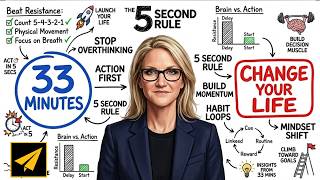
Mel Robbins says motivation is a myth. Your brain blocks you from acting by triggering stress signals when you hesitate. Use the 5-Second Rule: count down and move before your brain sabotages you. Follow curiosity into concrete steps like Google searches and online courses.
Chapters
Our minds are designed to stop you at all costs from doing anything that might hurt you. If you notice that you daydream about being a writer, if you notice that you daydream about starting a tech company, if you notice you daydream about building bridges, follow your curiosity. So if it were easy to get what you wanted in life, Google would have already figured out an app.
She's an American speaker, TV personality, coach, and author. Her TEDx talk on how to stop screwing yourself over has over 10 million views. Views on YouTube. Her book Stop Saying You're Fine is a business bestseller. She's Mel Robbins, and here's my take on her top 10 rules for success. Also, guys, as you're watching, if you hear something that really resonates with you, please leave it down in the comments below. Put quotes around it so other people can be inspired by your sharing. And also, when you write it down, you're much more likely to lock it in for yourself too. Enjoy.
We bought into this complete falsehood that at some point you're gonna have the courage, at some point you're gonna have the confidence, and it's total bullshit, frankly. Are we allowed to swear on this show? Absolutely. Okay. It's complete garbage. And so there are so many people in the world, and you know, you may be watching this right now, and you have these incredible ideas, and what you think is missing is motivation. And that's not true because the way that our minds are wired and the fact about human beings is that we are not designed to do things that are uncomfortable or scary or difficult. Our brains are designed to protect us from those things because our brains are trying to keep us alive. And in order to change, in order to build a business, in order to be the best parent, the best spouse, to do all those things that you know you want to do with your life, with your work, with your dreams, you're going to have to do things that are difficult, uncertain, or scary, which sets up this problem for all of us. You're never gonna feel like it. Motivation's garbage. You only feel motivated to do the things that are easy, right?
Why do you think that is?
Oh, I know exactly why that is. Because I've studied this so much, because for me, one of the hardest things to figure out was why is it so hard to do the little things that would improve my life. And what I've come to realize, and what we'll talk a lot about today, is that the way that our minds are designed is our minds are designed to stop you at all costs from doing anything that might hurt you. And the way that, that, that, that this all happens is it all starts with something super subtle. That none of us ever catch. And that is with this habit that all of us have that nobody's talking about. We all have a habit of hesitating. We have an idea. You're sitting in a meeting. You have this incredible idea. And instead of just, you know, saying it, you stop and you hesitate. Now, what none of us realize is that when you hesitate, just that moment, that micro-moment, that small hesitation, it sends a stress signal to your brain. It wakes your brain up and your brain all of a sudden goes, oh, wait a minute, why is he hesitating? He didn't hesitate when he put on his killer spiky sneakers. He didn't hesitate with the really cool track pants. He didn't hesitate with the NASA t-shirt. Now he's hesitating to talk? Something must be up. So then your brain goes to work to protect you. It has a million different ways to protect you. One of them is called the spotlight effect. It's a known phenomenon where your brain magnifies risk. Why? To pull you away from something that it perceives to be a problem. And so you can truly trace every single problem or complaint in your life to silence and hesitation. Those are decisions. And what I do and what's changed my life is waking up and realizing that motivation's garbage. I'm never gonna feel like doing the things that are tough or difficult or uncertain or scary or new, so I need to stop waiting until I feel like it. And number 2, I am one decision away from a totally different marriage, a totally different life, a totally different job, a totally different income, a totally different relationship with my kids. Not like one decision I'm divorcing you in the marriage example, but one decision on, you know, you could be having a conversation with your spouse and you feel your emotions rise up and within a tiny window, those emotions can take over and can impact how your marriage goes. Or you can learn how to take control of that micro-moment and make a decision to act in a way that actually shifts your marriage. Your life comes down to your decisions, and if you change your decisions, you will change everything. When I was 22, right after I graduated from Dartmouth, I was so focused on making everyone happy that I almost chose the worst possible career for my personality. It's not a bad career, it just would have been horrendous for me. I was interested in the environment, so I decided, "Oh, you know, I'll go get a law degree, and then I'll go work in Washington, and I think maybe I'll work on environmental policy," and I'd probably end up in some cube farm. And everyone was thrilled with the plan. Everyone, it turns out, but me. So here I am, I'm driving a U-Haul across country to go to law school and to get a degree in environmental law. And something started to gnaw at me. And with every single mile that I drove, my thoughts were getting louder. And doubts were starting to pour in. My gut was telling me, "Mel, turn the damn U-Haul around." But the problem was that everything was already in place, right? I mean, I'm already in the U-Haul, the thing is already packed, I'm already 10 miles into my drive, The tuition had been paid for the first semester. I had signed a lease. I mean, I could not undo these things. Isn't that why it's so difficult for you to make changes in your life? Because you think that things can't be undone? The fact is, any excuse that you come up with, you can undo. Tuition can be reimbursed. Apartments can be leased. Plan B can be invented. So I got up, I repacked that U-Haul, and I drove out of town. I let myself make a U-turn in life. If you ever find your gut battling your head, save yourself the drama. I guarantee you your gut is right. Guarantee you your excuses can be undone. And I guarantee you, you can make a U-turn in your life right now if you want to. You can be asking for assignments that are above your level. So there's work that you do at your level, and then there's work that you do above your level. And the only way that you're gonna be promoted to do work above your level is A, if you can demonstrate that you're capable of doing the work at your level, and B, if you are proactive in seeking out opportunities that expand your capability and give you a— give you a chance to work above the level that you're at. Nothing's gonna happen unless you take that initial action. Nothing's gonna happen, nothing's gonna change unless you put down that pen in the meeting and you sit up and you pay attention and you listen for your opportunity to speak. Nothing's gonna happen unless you push yourself to go in and make the ask for that assignment that scares you to death. One night, Chris had gone to bed. I had been struggling, struggling, struggling. We still had all the same problems. We still had a lien on the house, still facing bankruptcy, still fighting like crazy. I was still unemployed. He still— they still hadn't figured out, like, the solution yet for the business. And I was about to turn off the TV, and there on the TV, there was this rocket launching, and I thought, "Oh, my gosh. That is it. I am gonna launch myself out of bed like a rocket ship, like NASA right here had launched me out of that bed, and I'm gonna move so fast that I don't think. I'm gonna beat my brain." Now, here's a really interesting point. I talk a lot about your instincts and inner wisdom, and we can get into this a little bit later, but a lot of us talk about the fact that you have a gut feeling. But what all this research that I've done for the book and all the speaking that I do, what I've discovered that's fascinating is actually when you set goals, when you have an intention on something that you want to change about your life, your brain helps you. What it does is it opens up a checklist And then your brain goes to work trying to remind you of that intention that you set. And it's really important to develop the skill, and I say that word purposefully, the skill of knowing how to hear that inner wisdom and that intention kicking in and leaning into it quickly. So for me, my brain saying, that's it right there, move as fast as a rocket, Mel. I wanted to change my life. And I think most people that are miserable or that are really like dying to be great and dying to have more, we want to change. We want to live a better life. We want to create more for our families. We want to be happier. The desire is there. Again, it's about how do you go from knowledge to action. So the first thing in this story that's important is realizing that the answer was in me. And my mind was telling me, pay attention. Could have also been the bourbon. I had a couple of Manhattans that night. Anyway, the next morning the alarm goes off and I pretended NASA was there. It's the stupidest story. I literally went 5, 4, 3, 2, 1. I counted out loud and then I stood up. And I'll never forget standing there in my bedroom. It was dark. It was cold. It was winter in Boston. Mm. And for the first time in 3 months, I had beaten my habit of hitting the snooze button. I couldn't believe it. And I thought, "Wait a minute. Counting backwards? That is the dumbest thing I've ever heard in my entire life." Well, the next morning, I used it again, and it worked. The next morning, I used it again, and it worked. The next morning, I used it again, and it worked. And then I started to notice something really interesting. There were moments all day long, all day long, just like that 5-second moment in bed where I knew— knowledge— what I should do. And if I didn't move within 5 seconds, my brain would step in and talk me out of it. Every human being has a 5-second window. Might even be shorter for you. You have about a 5-second window in which you can move from idea to action before your brain kicks into full gear and sabotages any change in behavior. Because remember, your brain is wired to stop you from doing things that are uncomfortable or uncertain or scary. It's your job to learn how to move from those ideas that could change everything into acting on them? I think you have to be really in tune with your impulses and with your natural state of curiosity. And your curiosity and the things that you're naturally drawn toward, that's the guide. If you could spend hours singing, if you could spend hours baking, if you could spend hours writing, if you could spend hours learning code, that's a huge signal that that's something that you're really are innately interested in. And so if you're curious about something, if you notice that you daydream about being a writer, if you notice that you daydream about starting a tech company, if you notice you daydream about building bridges, follow your curiosity. And you can do that a number of ways. First of all, Google it. There are millions and millions of pages out there on the web that are related to what you're interested in. Secondly, find an online course. Most of the major universities are offering their courses online Third, buy a book about it. Put yourself in a collision course with the thing that you're curious about, and you will get closer and closer and closer to figuring it out. What about when someone can't realize or identify their own negative feelings? Someone that has been conditioned to live in negative feelings and believes that that's normal. This question comes from Vasoana Denegada. Um, it is your normal. You're right. It's a really— first of all, I'm sorry that that's been your experience of life because that really stinks and it doesn't have to be that way. But here, here's where I want you to go. What's interesting about what you said is the fact that these feelings are normal, okay? Normal just means you're used to them, but you don't have to live with them. So even though you're so used to these negative feelings and these feelings of doubt, you still don't like them. You still have the ability to stop that. So I want you to think of a moment in time when you were really happy. Like, it could be a memory from being little, it could be something that you dream of doing, and I want you to come up with something really specific about that moment, okay? Like, think about what you were wearing, or think about the, the blue sky. That is going to be what I call your anchor thought. Every time from this moment forward that you wake up or you find yourself drifting to those normal feelings of I'm a loser. I'm worthless. I'm never going to find love. They may be things that you're used to thinking, but that doesn't matter because you can change them. The second that you feel that you've drifted over into that thought— and I keep coming over here because when you start using the rule, you're going to start to literally feel which part of your mind you're using. The worries kind of happen here. I want you to 5, 4, 3, 2, 1, and then I want you to insert this vision of yourself. This vision of yourself where you felt really good. And if you can't think of one, invent one. How would you feel if you were in love? How would you feel if you loved yourself? How would you feel if you did that thing that you're scared of, that you keep talking yourself out of? That's your anchor thought. Now, when you first start using the rule, particularly when you're breaking a habit, a habit of thinking negative thoughts. When you first start doing it, you may need to use the 5 Second Rule 73 times in one day. That's okay. I had to do it like that when I was first using the rule to cure myself of anxiety. When I would start to worry about anything, I'd start to worry about, you know, my kids, or I'd start to worry about money, and I'd feel my thoughts drift, and then I'd start to feel my heart race, I would stabilize my thoughts— 5, 4, 3, 2, 1— I'd activate my prefrontal cortex, lower the, the worries, you know, on the other side, and then I would start to think about something that actually made me feel really calm or excited. That is the battle of your mind. And, you know, the other thing about normal that I just want to say is that the reason why it feels normal to doubt yourself and to have low self-worth worth is because you've thought this so long. It's become a pattern. Just like chewing your nails becomes a pattern of behavior that you don't think about. Well, the cool thing is, is that based on science, you can actually change any pattern, even a thinking one. So use the 5-second rule every single time you catch yourself thinking the nasty stuff, and then activate your prefrontal cortex and force yourself to think something positive. Every single morning, Monday through Fridays at 9 AM, I host a live call-in radio show on Sirius Satellite Radio. It's called Make It Happen with Mel Robbins. And the thing that's been so crazy about that show is every single person that calls me on that show, they call in because they're feeling stuck in their lives. And they're resigned about their ability to change their lives. And I'm not talking about people that are nuts. I'm talking about successful people like you and me that just somehow got stuck in their lives. And I'm not talking about people that are looking for cheesy self-help. I'm talking about people that really want to figure out how to move themselves forward. And, you know, I find that so many of us think that our dreams are unreachable or unrealistic, and it's just so sad. I mean, People think that their dreams disappear. And if that's what you think, congratulations, you're officially stuck. And the truth is that our dreams are always there, and they don't ever give up on us. We give up on them. But here's the secret. If you just force yourself, and I mean force, because I know damn well none of you want to do anything about this, and I also know you're sitting there like, "Yeah, this self-help crap." Oh crap, this isn't for me. But if you just force yourself to take a couple small steps, there's always a surprise. So let's talk about Starbucks. Starbucks in 2008, very interesting thing happened, and many of you, if you were in the financial services market then, probably know this, that their net income decreased by about 28% that year. And at the time, they had, 16,000 stores in 44 countries, and they had gone through this massive explosive growth segment in terms of going from going public in, I think it was like 1992, they only had 125 stores, and now here we are, 2008, they've got 16,000. So what ends up happening is Howard Schultz, who was the chairman of the board, comes back in as the CEO. Very complex situation, right? You've got operations in 44 countries, you've got massive reduction in terms of the profits that you have. You've got the stock market and Wall Street screaming at you. You've got customers that are going to Dunkin' Donuts because there's a recession that's hitting. So what do you do? Well, he was very clear. Again, back to the two rules: what do I stand for? Like, what is it? What is— what am I doing? And what do I want the outcome to be? So he was very clear that what he stood for as what Starbucks should stand for is the Starbucks experience. He wanted to go back to the beginning and reintroduce people to the romance of having a cup of coffee, because you know that's how Starbucks launched in the beginning, that he was traveling and was over in Italy and was like, God, why don't we have places like these great stops to have a little cup of coffee over in the United States? Boom, Starbucks, an idea, it's born, it's launched. So he decides he's going to do whatever he can to get the romance of having a cup of coffee back. In life, in any situation, whether you're talking about growing your company, growing your bank account, getting in a relationship, getting out of a relationship, getting something done at the school system that your kids are going to on behalf of your kids, whatever it is that you're up to in life, this is the only question that you need to ask yourself: well, what is it that I want? Because the truth of the matter is If you can answer that, you can have it. So if it were easy to get what you wanted in life, Google would have already figured out an app. You would just type in, "Okay, I'm a student and I want to go from being a student to being successful," and Google would tell you, "Go to college, then you get your master's, then you land this killer job, and then you put in a bunch of face time while you're checking Facebook, then you get promoted to manager, and then you realize managing people kind of sucks," stinks, and then you keep climbing the corporate ladder, and then you start to wonder, well, how did I end up here? And then you wonder, is this what success looks like? You're like, no, I'm going to go to Jay Hilburn. That's what success looks like. So keep this in mind. If there's something that you want, like 7 people or a trip to Africa, or you're going to make it to Mexico— in the pink shirt, I'm looking at you again. Sorry. I'm watching you. And rooting for you. Keep in mind this: here you are. This is what you want. I spent a lot of time on lacrosse fields, although they don't really look like this. You tend to think that what you want, you just march right towards it. But if, in sports, you march right towards the goal, what happens? The defenders come in. And what the defenders are is it's your brain saying, "Ain't gonna happen." So the second you start moving toward that thing you want, Be ready. You're gonna tell yourself you don't feel like it, you're gonna have to force yourself, it's happening. There's no way to get around it. So what you're gonna have to do is you're gonna basically get bounced around a lot. All over the place. And there are gonna be a lot of times that you feel like this was a really dumb idea to start this business, because it's gonna get hard. And I wanna remind you about something. Unlike a sports field where there's an in and out of bounds, The great thing about life is there actually aren't any. And it's usually in those moments where you feel like you can't do it that you're closer than ever to having everything that you wanted. And I wanted to show you this so that you keep it in mind, because I think a lot of times when you look back, it's the darkest moments where you realize, "Holy cow, that's what projected me forward." We live in the most amazing moment in time. So that thing that you have up here, whatever it may be— you want to use healthy eating to cure your diabetes, you want to figure out how to take care of the elders and start a new hospice center, you want to move to Africa and build a school— guess what? You could walk into a bookstore right now and buy at least 10 books written by credentialed experts on how the hell you do it. You could Google it and you could probably find at least, I don't know, 1,000 blogs documenting the step-by-step-by-step transformation that somebody else is already doing. You can find anybody online and cyberstalk them. You can just walk in their footsteps and let them— you know, just use the science of drafting. Follow what everyone else has done because somebody else has I was already doing it. So why don't you have what you want when you have all the information that you need, you have the contacts that you need, there are probably free tools online that allow you to start a business or join a group or do whatever the heck you want? It all comes down to one word. Shut the front door, you know what I'm talking about? The F-bomb. It's everywhere. You hear it all the time, and I honestly don't understand what the appeal is of the word. I mean, you don't sound smart when you say it, and it's really not expressing how you really feel. It's sort of a cheap shot to take. And of course, you know I'm talking about the word "fine." "How you doing?" "I'm fine." "Oh really? You are? Dragging around those extra 40 pounds, you're fine? Feeling like roommates with your spouse, and you're fine? You haven't had sex in 4 months, you're fine? Really? I don't think so." But see, here's the deal with saying that you're fine. It's actually genius. Because if you're fine, you don't have to do anything about it. But when you think about this word "fine," it just makes me so angry. I mean, here we are at a conference about being alive, and you're gonna describe the experience of being alive as "fine"? What a flimsy and feeble word. If you're crappy, say you're crappy. If you're amazing, say you're amazing. Tell the truth. And this not only goes for the social construct, "Oh, I don't want to burden you with the fact that I hate my life," or, "Hey, I'm amazing, but that would make you feel terrible." The bigger issue with "fine" is that you say it to yourself. That thing that you want, I guarantee you, you've convinced yourself that you're fine not having it. That's why you're not pushing yourself. It's the areas in your life where you've given up, where you've said, "Oh, I'm fine. My mom's never gonna change, so I just can't have that conversation." "I'm fine. You know, we gotta wait until the kids graduate before we get divorced, so we'll just sleep in separate bedrooms." "I'm fine. I lost my job, I can barely pay my bills, but whatever, it's hard to get a job." And, you know, one of the reasons why this word "also" just annoys me so much is scientists have calculated— oh yeah, I'm coming down. Scientists have calculated the odds of you being born. That's right. They've crunched the numbers. I see you up there. They have crunched the numbers on you. Yeah, I know you guys standing up, you want to sit down for this. They've crunched the numbers on you being born, and they took into account all of the wars and the natural disasters and the dinosaurs and everything else. And do you realize that the odds, the odds of you Yeah, right here. Put your computer away. Stand up for me. Doug. So the odds of Doug here— turn around. Say hi to everybody. The odds— yeah, of Doug, Doug being born at the moment in time he was born to the parents you were born to with the DNA structure that you have, 1 in 400 trillion. Isn't that amazing? I'm so lucky. Yes, you're not fine, you're fantastic. You have life-changing ideas for a reason, and it's not to torture yourself. Thank you, thank you, Doug. You know, Christine was right when she said all of you could be on stage because all of you were all in this category. One and $400 trillion. All day long you have ideas that could change your life, that could change the world, that could change the way that you feel. And what do you do with them? Nothing. Hopefully I won't moon you. You didn't pay for that.
Thank you guys so much for watching. I made this video because Francesca Sugar Art asked me to. So if there's a famous entrepreneur that you want me to profile next, leave it down in the comments below and I'll see what I can do. I'd also love to know what did Mel say that had the biggest impact on you? What was your favorite clip? And what are you going to take from this video and immediately apply somehow to your life or to your business? Leave it down in the comments below and I'm going to join in the discussion. Finally, I want to give a quick shout out to the guys from VNR Media. Thank you so much for picking up a copy of my book, Your One Word, and for the fun interview that we did on your channel. It was a blast and I'm excited to see where your channel goes, guys. Our guest today is Evan Carmichael, and Evan, he was recognized by Forbes as one of the world's top 40 social marketing talents. Inc. magazine rated him as one of the top 25 social media keynote speakers you need to know, and he had recently published a book called Your One Word. So thank you guys so much for watching. I believe in you. I hope you continue to believe in yourself and whatever your one word is. Much love. I'll see you soon.
I have a pad of Post-it notes— yes, Post-it notes— next to my sink in my bathroom.
Why?
Well, because after I brush my teeth, haven't looked at my phone yet, I take a Post-it note out and I write the 3 things I need to focus focus on today. And then you know what I do with it? I stick it on the back of my phone. Now why would I do that? Because I have my phone with me all the time, and so if it's on the back of my phone, I'm going to get a visual cue to remind me and keep it top of mind so I stay focused on it. How is it that you see something larger for yourself? Well, the first thing that you have to do, the very first thing, is you have to get out of the weeds. Successful people are all in the weeds. The busier you are, the more you have going on. You know that old saying that everybody says, "Don't work in your business, work on your business"? But we are all in the weeds. And the key to seeing something larger for yourself is getting out of the weeds. I mean, don't you feel like this dude? I know I do. You know, you wake up, brush your teeth, make the coffee, feed the kids, pack the lunches, put them on the bus, get in the car, text your friends, get some coffee, arrive at work, feign interest, answer emails, update Facebook, make cold calls, avoid the meeting, look busy, crunch some numbers, update Facebook, Get in the car, go to carpool, feed your kids, feed the dog, check email, update Facebook, kiss your husband, climb into bed, fool around. Are you kidding? I'm exhausted. Turn off the lights. I mean, I live in a two-household— thank you— entrepreneurial family. I'm exhausted. I'm busy. How the heck am I going to see something larger for my life when I have a business to run, when I have kids to take care of? Well, you have to get out of the weeds. And you know, the truth is there's some good news. And the good news is I heard about this pill that's in development. Yeah, I know, I'm waiting for it too. And you know, the problem though is I think that they're going to have naming Forget-it-all, it seems like a kind of a bad name for a pill, even though I might take it now and again. So I thought before we jump into how you see something larger, I need to yank you out of the weeds first. So I'm gonna give you my advice for what I do in order to keep myself out of the weeds. And you guys don't need remedial personal development, I got that. I just feel obligated to give you some actionable things to do. Because if you don't plan your week out, before the week starts, you're going to be in reactive mode. You're going to be running around. You're going to be chasing down the biggest thing that's happening in your life. You're going to be constantly responding. This is one of the most important things that you can do. If you're not married, if you're not living with somebody, do it for yourself. Plan your week. You know this already. The first thing that you need to do is you define what success looks like for you. And it's not $10 million in the bank. I'm sorry. It needs to be something bigger, a bigger purpose. What if somebody says it is $10 million in the bank to me? Well, I mean, the problem with saying it's $10 million in the bank is that when you finally get to the $10 million, typically those people feel pretty bankrupt because they're broke.
And that's what you're seeing in your walk also.
Absolutely, absolutely. And so, you know, once you define it for yourself, I think the key is how do you then trick yourself, Donnie, into feeling successful every single day? You know, I've got a daughter that plays lacrosse. She's 9 years old. If I said to her, I'm only cheering for you when you score a goal, how do you think she'd feel during the game? She wouldn't play very well, that's for sure. So you've got to figure out how do you cheer for yourself and how do you feel successful while you're playing the game, because it's not all about the goal.
Okay, are there any tools to cheer for myself?
Give me it today.
I want to feel better inside. I'm at home, I'm watching. I'm either somebody that's got the millions of dollars and it's I'm not feeling good, or I don't have those millions of dollars and it's not feeling good, and I'm worried about the economy around me.
So give me the chance to— I know exactly what you need to do. What you need to do is you have to decide, okay, this is where I'm going. I'm going for the big vision of what success is. Now do a head fake with yourself and say, okay, let's just say that I'm actually already there. I have the $10 million in the bank. I'm, you know, saving the world, whatever it is that your version of success is. What are 3 things that I would change about This day, today, how would I live it today if I already had all that stuff? What time would I wake up? Who's my first phone call to? What did I eat for breakfast? Start living as that success vision now.
More from Evan


How the Biggest Mistake in History Created A Trillion-Dollar Empire | Sergey Brin



9 Machiavelli Principles That Force People To Respect You | Machiavellian Philosophy



The First 10 Words That Instantly Ruin A Sales Conversation | Vanessa Van Edwards

The Top 1% Mindset Behind The First $5 Trillion Company | Jensen Huang (Nvidia)

