How Accountability Transforms Your Life | Learn from Jordan
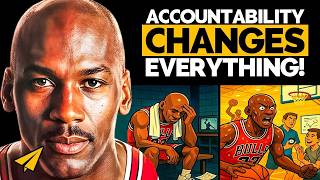
Evan Carmichael argues that accountability, not talent or luck, drives success. He cites Michael Jordan, Barack Obama, and George Lucas as examples of people who stopped making excuses and took responsibility for their lives, then asks viewers to share their biggest excuse in the comments.
Chapters
Good morning, Believe Nation. It's Evan. My one word is believe, and I believe that you have something special that when you unleash it, it will be able to change the world. So to help you on your journey, today's message is stop making excuses. Over to you, Michael Jordan.
Maybe it's my fault. Maybe I led you to believe it was easy when it wasn't. Maybe I made you think my highlights started at the free throw line and not in the gym. Maybe I made you think that every shot I took was a game winner, that my game was built on flash and not fire. Maybe it's my fault that you didn't see that failure gave me strength, that my pain was my motivation. Maybe I led you to believe that basketball was a God-given gift and not something I worked for every single day of my life. Maybe I destroyed the game. Or maybe you're just making excuses.
One of the most common things that you'll find for any of the people who are Michael Jordan-level talent at their field, right? Whatever, whatever they are good at, whatever they are the best in the world at, they have Michael Jordan-level success at whatever they're doing. They don't complain. They don't make excuses.
It's consistent.
If you look at the people who are complaining and whining the most, they're a lot less successful because it's easy just to blame somebody else, right? You're not successful because of the president or because of the economy or because of your parents or because of your education or because of whatever, right? As long as there's a reason to blame, then it's not your fault, and then you don't have to make any changes. It's not your fault that you're not more successful, right? It's the government's fault. So that means you are a success, you just have these circumstances, and so you can't do anything, and so you won't do anything. Where the real change happens is when you realize you are accountable for your life. You may have been dealt a certain hand, You play that hand. You can win with that hand if you work hard, if you hustle. There's never been more opportunities than what we have existing today. It's never been easier to win if you're willing to be passionate about something and work hard and commit to it than at any point in human history. And so the big change will happen for you when you accept responsibility for where you are in life. One of the things that I find easiest to remember and to relate to is understanding that there are people who have done way more than you. There's people who've done way more than me, who came from way worse than what I already have right now. People who have done way more than me, than you, who started off with way less. So if they could do it, why can't I? Why can't you? And then the small thinking, the little man's gonna be, oh, well, they were lucky. They were lucky. They were lucky. They had lucky breaks. They had this luck. They had this luck. As long as you prescribe things to luck, as long as you are making excuses and blaming other people, you will never get to where you want to go. It just will not happen. Get rid of luck, get rid of your complaints and excuses, take responsibility for your life, and start taking action. And when you embrace that, that's when magical things start to happen. You deserve everything that you have right now. If I look at my YouTube channel, I could say I can't believe PewDiePie is number 1. I can't believe the Logan Pauls of the world come onto YouTube and instantly have millions of subscribers, and I'm here grinding out to get to my first million by the end of the year, right? It's easy to complain and look at the people ahead of me and say, listen, I'm making better content. I'm trying to inspire people with a positive message. A lot of the people ahead of me might be having super negative content or just trying to create drama and controversy and negativity. And that sucks, that's not fair, that's unfair, it's unfair that these guys are having success and I'm not as successful. If I adopted that mindset, I would lose. I would be worse off than what I'm— where I'm at right now. I deserve everything that I have. I'm grateful and super appreciative for the 800,000+ subscribers that we do have on the channel right now, and I deserve those, and I've worked hard for those, and my team has worked hard for that. But I also don't deserve to be at 8 million or 10 million or 15 million or whatever they're at. It's not good enough, not providing enough value, and so we need to get better at it. And that's my fault. I need to do better. I need to create better content for you. I need to be better on camera. I need to bring my team up and inspire them more. I need to have better clips. I need to do a better job all around. It's not my team's fault. Right? It's not PewDiePie's fault. It's my fault. And so I deserve everything I have, and I don't deserve to have any more until I work harder to get there, until I provide more value to get there. And you'll find that that's what successful people do. They accept accountability and responsibility for where they are in life. They stop blaming their lack of success on their lack of resources. They understand that it's never about the resources you have, it's the resourcefulness that you have to go off and create amazing things. And if you look at any self-made person, look at the people who've had the most success, the most successful people in the world who've built massive fortunes, who've had a huge impact, they're not usually the children of successful people. Almost never. They started from nothing, less than what you have right now. And if they were able to do it, they were able to take accountability for their life they were able to stop complaining, stop blaming luck, and turn something amazing out of it, then you can too. So the question of the day today is, I'm curious, what has been the biggest excuse that you've been making that maybe stops today that's been holding you back? The biggest single excuse that you've believed that is now holding you back and you're gonna shed. I'd love to hear from you. Share it in the comments below. I think it also could inspire the other members of Believe Nation watching and reading as well. I also want to give a quick shout out to Jaron Brown. Jaron, thank you so much for picking up a copy of my book, Your One Word. It means a lot to me, and I hope you're enjoying the read. So thank you guys again for watching. I believe in you. I hope you continue to believe in yourself and whatever your one word is. Much love, and I'll see you guys again tomorrow morning for another shot of espresso.
We know that too many young men in our community continue to make bad choices. And I have to say, growing up, I made quite a few myself. Sometimes I wrote off my own failings as just another example of the world trying to keep a black man down. I had a tendency sometimes to make excuses for me not doing the right thing. But one of the things that all of you have learned over the last 4 years is there's no longer any room for excuses. I understand there's a common fraternity creed here at Morehouse: Excuses are tools of the incompetent, used to build bridges to nowhere and monuments of nothingness. Well, we've got no time for excuses. Not because the bitter legacy of slavery and segregation have vanished entirely—they have not. Not because racism and discrimination no longer exist—we know those are still out there. It's just that in today's hyper-connected, hyper-competitive world, with millions of young people from China and India and Brazil, many of whom started with a whole lot less than all of you did, all of them entering the global workforce alongside you. Nobody is going to give you anything that you have not earned. Nobody cares how tough your upbringing was. Nobody cares if you suffered some discrimination. And moreover, you have to remember that whatever you've gone through, It pales in comparison to the hardships previous generations endured, and they overcame them. And if they overcame them, you can overcome them too.
I decided to go to film school because I loved the idea of making films. I love photography, and everybody said it was a crazy thing to do because in those days nobody made it into the film business. I mean, just unless you were related to somebody, there was no way in. So everything else— silly, you're never going to get a job. But I wasn't moved by that. I set the goal of getting through film school and just then focused on getting to that level. Because I didn't, you know, I didn't know where I was going to go after that. I wanted to make documentary films, and eventually I got into the goal of, once I got to school, of making a film. One of the most telling things about film school is you got a lot of students in those days especially, it's not quite so much today, but wandering around saying, oh, I wish I could make a movie. I could make a movie. You know, I can't get in this class, I can't get any— you know, first class I had was an animation class. It wasn't a production class. Um, I had a history class and an animation class, and in the animation class they gave us 1 minute of film to put onto the animation camera, to operate it, to see how you could move left, move right, make it go up and down. And it was a test. To see, you know, and then the teacher would— you had certain requirements that you had to do. You had to make it go up, you had to make it go down, and then the teacher would look at it and say, oh yes, you maneuvered this machine to do these things. And I took that one-minute film and made it into a movie, and it was a movie that won like, you know, 20 or 25 awards, you know, in every film festival in the world. And kind of changed the whole animation department. And, and, and meanwhile, all the other guys were going around saying, well, I wish I could make a movie, I wish there was a production class. And so then I got into another class, and it wasn't really a production class, but I managed to get some film, and I made a movie. And I made lots of movies while I was in school while everybody else was running around saying, oh, I wish I could make a movie.
We're having this conversation about when he plays in sports or when he does something about, do you go full out or do you not? And I see sometimes in him that when he's out on the field or doing something, he doesn't play full out and he'll have an excuse like, my leg hurts or my arm hurts or something happened. The coach was unfair, whatever. You know, the referee was unfair. And what happens with people is we tend to go out into the world and we look for those sort of excuses about why things aren't the way we want them. And when you do that, you lose all your power in life. When you start focusing on the external, on the excuses, you lose your power. Here's the way people really think. I will tell you, I can go out on stage and bomb. You go out there and you just bomb, right? And people will respect you for going out there and trying your hardest. It's not how you actually perform that earns you the respect of your peers. It's the fact that you went out and actually did it. That's the difference.
More from Evan


How the Biggest Mistake in History Created A Trillion-Dollar Empire | Sergey Brin



9 Machiavelli Principles That Force People To Respect You | Machiavellian Philosophy



The First 10 Words That Instantly Ruin A Sales Conversation | Vanessa Van Edwards

The Top 1% Mindset Behind The First $5 Trillion Company | Jensen Huang (Nvidia)

