How Elon Musk Created Tesla and SpaceX: 7 Essential Strategies!
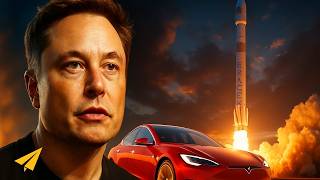
Elon Musk explains how he built Tesla and SpaceX, prioritizing exceptional ability over credentials and using first-principles reasoning to drive innovation. He sees a 10% startup success rate as acceptable, emphasizes rapid iteration and cost reduction through scaling, and believes education should work like video games: interactive and self-paced.
Chapters
When we first unveiled the Roadster in 2007, yeah, I mean, it was just basically, starting a car company is crazy, you're gonna lose all your money. I was like, I think I probably will lose all my money, I agree. Like, I thought it would be successful. I thought we had maybe a 10% chance of success. So then people would say, it's gonna fail and you're gonna lose everything. I was like, yeah, probably true, yeah. What else is new?
Need motivation?
Watch a top 10 with Believe Nation.
Hey, it's Evan Carmichael and I make these videos because you are probably the most ambitious person in your circle but you know you're capable of more, and you get that push by surrounding yourself with the best. So today, let's learn from one of the best, Elon Musk, and my take on his top 50 rules for success. Enjoy.
I think just generally the path to leadership should not be through, you know, basically MBA business school situation. It's like it should be kind of work your way up, do useful things, and And there's a bit too much of the, somebody goes to a high-profile MBA school and then kind of parachutes in as the leader, but they don't actually know how things work. They could be good at, say, PowerPoint presentations or something like that, and they can present well, but they don't actually know how things work because they do not, they parachute in instead of working their way up. [Speaker] Yeah, they never went through an apprenticeship, for lack of a better word. Yeah, they're kind of like just not aware of what's really needed for, you know, to make great products. So I mean, I don't want to trash MBAs too much here and I actually do have a dual undergrad, Wharton undergrad and physics at UPenn. So, you know, it's not like, you know, I have direct exposure to, you know, to business school and I went, you know, to do undergrad business school with physics. But, and I was a teaching assistant for 2 semesters and I graded MBAs and undergrads. So, but I think it's just a little bit too much, like people look at MBA school as like, I wanna parachute into being the boss instead of earning it. And like, I don't think that's good. What do you look for in the people you hire, especially the engineers? I really just look for evidence of exceptional ability. So it's not— or at least aspirationally, like sometimes these things get messed up in recruiting, or the recruiting filter ends up being wrong. Like I sometimes wonder with Tesla, if Nikola Tesla applied to Tesla, would we even give him an interview? It's not clear. You know, this guy came from like some weird college in somewhere in Eastern Europe. He's got some odd mannerisms. Now we don't know if we should give him an interview. Like, I worry that that's actually what we do instead of like, the reality is you'd be like, man, Nikola Tesla, this kid's super smart. What does he want? We'll pay him anything. That should be the reaction if Nikola Tesla applies, you know, to Tesla, ironically. But I can tell you the intent is we're looking for evidence of exceptional ability, And it really doesn't matter if you went to graduate high school or college or anything. We're just looking for evidence of exceptional ability such that it would be a good predictor for doing exceptional things at SpaceX. Is it going to be a business kind of tourism in orbit, or is it more a kind of Plan B if things on Earth do not develop as well? It's not exactly a Plan B. It's more that I think, I think there's two aspects to this. One is that we want to have a future that is inspiring and exciting. And what are the things that you find inspiring and exciting about the future? I think one, a future where we are a spacefaring civilization and out there among the stars. I think that's, every kid gets excited about that. You don't even need to teach them. They just get it. It's like instinctive. And so it's very important for us to have reasons to Reasons to be excited about life. Like when you wake up in the morning, it can't just be about problems. Okay, I know everyone in this room deals with a lot of tough problems. But you know, it's got to be more than that. So, you know, I think a future where you can say, hey, even if it's not you, there's going to be people out there, we can have a base on the moon, we're going to have a city on Mars, maybe go further, moons of Jupiter and everything. I think that's a very exciting future.
Also, to make sure you're actually taking action after watching this video, I've designed a special free worksheet just for this video. The worksheet will highlight all the lessons learned in this video, as well as pull out our 3 favorite learnings and quotes that will inspire you to actually do something. The worksheet will also give you space to write down what your key takeaways are and your specific plan of action to make sure you're getting results. If you want the worksheet designed specifically for this video absolutely for free. There's a link in the description below. Go click on it and start building the momentum in your life and your business.
I'll see you there. This was— X.com was a precursor to PayPal. Basically, you merged with Confinity and it became PayPal. Major success. Yeah. So it worked out better than we expected. Yeah. So yeah, Confinity— so initially, Confinity and X.com started out from slightly different directions and then converged to the same point. With X, the thought was to create an integrated set of financial services so that you could go to one place and do all of your financial anything. And then as a feature, we had the ability to transfer money or securities or anything simply by entering a unique identifier. Email address or phone number or something like that. And when we demo the system, the hard stuff which was the integration of all the financial services, people would not be interested in. But they'd be really interested in being able to transfer money using an email address. You know, that was actually quite easy. And so we focused our energy on that. And although it's easy in principle, what gets really hard is adding security while still keeping it easy to use. So because, you know, it's like the Willy Loman quote, like, why do people— why do you rob banks? Because that's where the money is. So why do people rob PayPal? Same reason. And so you can dial up the security to a really high level, but then you're going to make it very hard to use. And so that was one of the toughest things we wrestled with. You first have to say what is the goal. And once you have what is the goal, you can then measure various designs against that goal. Otherwise, you're saying how are you evaluating why is one design better than another? What's your goal? It's got to be a goal. So the goal is get enough tonnage to Mars to— and enough people to make Mars self-sustaining as quickly as possible. So then you say, okay, let's back up the math on this. We're going to need a lot of tonnage. Maybe, I don't know, 100,000 tons, maybe a million tons. So you can't be faffing around with these expendable rockets. They're a joke. The key to making things affordable is like designing— it's like design and technology improvements as well as scale. So if you think of like, say, phones, like the very earliest, like the earliest cell phones, like, I don't know if you remember, I'm probably like dating myself here, but like the original Wall Street, where the guy's like walking down the beach and he's got like the giant phone. He's carrying it like a briefcase kind of thing, they're massive. Like massive, massive phone. Yeah. And like all it could do is phone. Yep, yep. And like had like 30 minutes of battery life and that kind of thing. Now, at that time, in the absence of technology improvements, like no amount of money, no amount of scale could have made that phone affordable. That's a lot of engineering iterations, a lot of design iterations. And we're probably, I don't know, on the 30th version of a cell phone. And with each successive design iteration, you can add more capability, you can design, you can integrate more things, you figure out better ways to produce it. So it actually gets better and cheaper. But it's like a natural progression of any new technology. That it takes multiple versions and large volume in order to make it affordable. Other car companies just really want to outsource battery technology, not even making the— like this battery module and cell, but they're obviously outsourcing the cells, but even outsourcing the modules and the packs. And it's like they're really not thinking about fundamental chemistry improvements. And so I should say a bit about like electric vehicles and sustainable energy in general. It's pretty obvious to not just me, but to a lot of people, even go back 30 years or longer, that we must have a sustainable energy solution. In fact, it's sort of logical. If it's not sustainable, we must at some point find an alternative to it. Even if there were no environmental impact to a fossil fuel economy, then we would run out of them, and then we would have economic collapse. Civilization would fall apart. So, so that was actually my initial motivation for electric vehicles. It's like, okay, we've got to have a solution that does not require mining hydrocarbons, that, that, that is sustainable in the long term. It was not actually initially from an environmental standpoint because I had not realized the gravity of the environmental situation at that time. And I thought actually for sure by now we'd have electric cars. We're focused on— like I said, it is important to have that— have the objective be right. Um, that's why I was talking so much about the importance of making Mars a self-sustaining— building a self-sustaining city on Mars. Um, if that's the objective, then obviously, you know, just putting some satellites in orbit or— there's not that— that's not important. You have to achieve full and rapid reusability. I emphasize full and rapid. Reusability is only relevant to the degree it's rapid and complete. And, and then you also have to do orbital refilling. This is essential as well. And, and then propellant production on Mars, also essential. So, you know, with that as the goal, then That means that creates, I think, a good forcing function for radical innovation because in the absence of radical innovation, we have no chance of meeting that goal. Whereas if our goal was simply defeat Lockheed and Boeing or something like that, we would probably achieve that goal. We've already done it. That really wasn't even a thing. Yeah, I wish it was. We got like, they're not really trying to do, not even trying to do reusability, which is bizarre because they make planes that are reusable. So I mean, if they, if they talk to the, you know, if they talk to one of their customers who buys a Lockheed fighter jet or Boeing aircraft, like, hey, we're going to sell you a 737, it can be used once and it's not 737 MAX. But that was, that turns out that was the single use airplane at times. But it really, uh, it would be an absurd thing for them to sell a single-use aircraft, but they feel quite comfortable selling a single-use rocket. Um, anyway, but if I thought was simply we're going to have to be the leaders in launching the conventional satellites that exist, uh, we would probably approach that in a sort of a logarithmic basis where you know, you'd get there and you'd sort of slowly make progress towards doing 10 launches a year, 12 launches a year, while they do 6 or something like that. Um, but since the goal is, hey, we need to make life multi-planetary before it's too late, um, and time really matters, so we're— our state's awesome. It's like we're shooting for Mars, not just the moon. It's not much to shoot for the moon, shoot for Mars. And then, you know, these competitive things are kind of small things along the way. Unless somebody else is shooting for Mars, they will not be competitive with something as pedestrian as launching a few satellites into Earth orbit. Why is music so important for you? Techno music in particular? Well, it's pretty fun. I think it's, you know, you want to, I don't know, feel maximum human. And so I think when people have like sort of a rave and good music, it can be like, hey, maximum human. You want to really feel, it's like, where it really gets you to feel. And I think that having fun with friends and just crazy dancing is fun. Perhaps your love for techno music is the secret reason why you are building big projects in Berlin. Honestly, that's a significant factor. Innovation comes from questioning the way things have been done before. And if in the education system you're taught not to do that, that will inhibit entrepreneurship. Being able to question what you're being taught. Being able to— Yeah, I mean, just saying, well, is there a better way? Yeah, you know, to ask that question. Things that I've chosen have not been— I've not been trying to optimize on a risk-adjusted return basis. So there are— like, I would not say that I went into the rocket business, the car business, or the solar business thinking that it's a, it's a great opportunity. I just thought that, that something needed to be done in these industries in order to make a difference, and that's why I did it. So, but in general, I do think it's worth thinking about, like, what you— whether what you're doing is going to result in disruptive change or not. If it's just incremental, it's unlikely to be something major. It's got to be something that's substantially better than than what's gone on before. If you want to do something really innovative, you have to apply a sort of first principles analysis, and don't reason by analogy. Analogies are referencing the past. So first principles means you look at the most fundamental truths in a particular arena, and the things that really are almost indisputably correct, and you reason up from there to a conclusion. And if you see that that conclusion is at odds with what people generally believe, then you have an opportunity. Now, you can't operate like that on all things because it takes too much mental horsepower. So most of your life you have to operate by reasoning by analogy. But if you really want to innovate, you must reason from first principles to identify the problem. If the output is more valuable than the inputs, which is really— that's profit. Like, the output's more valuable than the input. That says you have a useful company. So, but now in a high-growth scenario, you have a lot more inputs for future outputs, so that you have negative cash flow and lack of profitability, which we currently have at Tesla. But in the long term, of course, that has to be fixed. There can't be negative cash flow in the long term, and that there needs to be a net positive output, which is sort of profits in the long term. But in the short term, when there's high growth, that isn't the most sensible. I think it is definitely true that, I mean, maybe there are occasionally companies that get created where there's not an extended period of extreme pain, but I'm not aware of very many such instances. And so, but I do think that, you know, new great entrepreneurs are born every day, and we'll continue to see amazing companies get built. So, yeah, but I would definitely advise people who are starting a company to expect a long period of quite high difficulty. I think that the way that we currently do education is wrong, and we're— when you see something like the Khan Academy and so forth, I think that's probably going in the right direction. I mean, generally you want education to be like as close to a video game as possible, like a good video game. Like, you do not need to tell your kid to play video games. They will play video games on autopilot all day. So if you can make it interactive and engaging, then you can make education far more compelling and far easier to do. So I think that's how it should be, and it shouldn't be that you've got like these grades where people move in lockstep, and so everyone goes through, you know, goes like normally, you will go through English, math, science and so forth from like 5th grade to 6th grade to 7th grade like it's an assembly line. But people are not objects on an assembly line. That's a ridiculous notion. People learn and are interested in different things at different paces. So you really want to disconnect the whole grade level thing from the subjects. Allow people to progress at the fastest pace they can or are interested in in each subject. You want to make something beautiful. I mean, you want to trigger whatever fundamental aesthetic algorithms are in your brain. You have, I think, some intrinsic elements that represent beauty and that trigger the emotion of appreciation of beauty in your mind. And I think that these are actually relatively consistent among people. I mean, not completely. Some people like— not everyone likes the same thing, but there's a lot of commonality. And yeah, but I think It is important to combine aesthetic design with functionality. Like, the thing that's, like, if you say, like, what was really hard about, say, the Model S or the Model X was to combine aesthetics and utility. So, to balance the two. You can make a car look very good by giving it sort of certain proportions. Making it sort of low and slim, and, but if you do that, the utility is significantly affected. How do you keep your focus on the big picture when you're constantly faced with, we could be out of business in a month? Well, it's just a very small percentage of mental energy is on the big picture. Like, you know where you're generally heading you're aiming for and the actual path is going to be some sort of zigzaggy thing in that direction. You try not to deviate too far from the path that you want to be on, but you're going to have to do that to some degree. But I don't want to diminish the— I mean, I think the profit motive is a good one if the rules of an industry are properly set up. So there's something fundamentally wrong with profit. In fact, profit just means that people are paying you more for whatever you're doing than you're spending to create it. That's a good thing. And if you're not, if that's not the case, then you'll be out of business, and rightfully so. You're not adding enough value. Just in general, critical thinking is good. You know, examining whether you have the correct axioms, or the most applicable axioms, Does the logic necessarily connect? And then what are the range of probable outcomes? Outcomes are usually not deterministic, they're a range. And so you want to figure out what those probabilities are and make sure ideally that you're the house. You know, it's fine to take, it's fine to gamble as long as you're the house. You celebrated your 30th birthday with a masked ball in Venice. 40th. 40th birthday, I was told you had a fight with a samurai sword fighter. What is your plan for your 50th birthday next year? Well, so my 40th birthday was in Venice. It was technically a post-apocalyptic masked ball. Because after the apocalypse, how much clothing do you really have? You know? It's probably going to be a little ragged, a little burnt. So— No plans for the 50th? Yeah, 50th. The half-century party. I'll have to think of something. Usually go with some kind of crazy theme. The party where I ended up wrestling with the world champion sumo wrestler, which by the way also caused me to burst a disc in my neck. So, 5 minutes of glory for 5 years of pain. That really hurt. So that party was Victorian Japanese steampunk. So that was cool. I have to think of something for the half-century party. You have a little time to think. Hey, being on Earth for a half-century, that's like, hey, I'm still alive. Wow. Cool. You want to make something beautiful. I mean, you want to trigger whatever fundamental aesthetic algorithms are in your brain. You have, I think, some intrinsic elements that represent beauty and that trigger the emotion of appreciation of beauty in your mind. And I think that these are actually relatively consistent among people. I mean, not completely. Some people like— not everyone likes the same thing, but there are— there's a lot of commonality. But I think it is important to combine aesthetic design with functionality. Like, the thing that's— like, if you say, like, what was really hard about, say, the Model S or the Model X, was to combine aesthetics and utility. So to balance the two. You can make a car look very good by giving it sort of certain proportions, like making it sort of low and slim, and, but if you do that, the utility is significantly affected. To make a sports car look good is relatively easy, but to make a sedan look good or an SUV look good is quite difficult. Really pay attention to the little details, the nuances of design and shape and form and function and the way it looks in different lights. When something's off, the little thing, how do you experience that? It drives me bananas. Yeah. I mean, the problem is like, if you— you can train yourself to pay attention to the tiny details. I think almost anyone can. Although this is very much a double-edged sword, because then you see all the little details. And then little things drive you crazy. So— but like most people don't— they don't see— they don't consciously see the small details, but they— they do subconsciously see them. Like, you sort of, your mind takes in a gestalt of the overall, you know, an overall impression, and you know if something is appealing or not, even though you may not be able to point out exactly why. And it's a summation of these many small details. So most of us experience it as a, oh, I think that's ugly, or I think that's beautiful, or like, wow, that's elegant. But yeah, I can't break it down. You mentioned something in passing, like you can train yourself in this though? Yeah, you can train yourself, I think. You can make yourself pay attention to why— you essentially bring the subconscious awareness into conscious awareness. God, I wish I could do that. How do you do that? Just pay really close attention. Almost like a meditation on the object and trying to find the the details? Like, why do I not like this? Is that what— yeah, just look closely and carefully. The physics training is a very good training where it's a good framework for reasoning, where you're trained to think about first principles and reason from there. And that means boiling things down to the most fundamental truths and then connecting those truths in a way to try to understand how reality Because, you know, physics has this problem where they're trying to figure out things that are totally counterintuitive. And so they had to have a framework for getting there. Like quantum mechanics is incredibly counterintuitive, but it's true. And so you had— so physics developed a framework for figuring out things that aren't obvious. And that's why I think it's— it's a lot of advice, but it's the right framework. If you think about the future, you want a future that's better than the past. And And so if we had something like the Hyperloop, I think that would be cool. You'd look forward to the day that that was working. And something like that, even if it was only in one place, from LA to San Francisco, or New York to DC, or something like that, then it would be cool enough that it would be like a tourist attraction. It would be like a ride or something. Some of the initial assumptions didn't work out and the economics didn't work out quite as one expected, it would be like cool enough to be like, I want to journey to that place just to ride on that thing. That would be pretty cool. And so that's, I think, how if you come up with a new technology, it should feel like that. You should really— if you told it to an objective person, would they look forward to the day that that thing became available? And be like, it would be pretty exciting to do something like that. Like that, or an aircraft. Like, I thought it was really disappointing when the Concorde was taken out of commission and there was no supersonic transport available. And of course, the 787 has had some issues. But the thing is, the 787, even in the best-case scenario, is only a slightly better version of the 777. And it's like, OK, not that exciting. I was just saying that, you know, you want to take a moment to appreciate things in life and the sensations. Food's incredible. And like, there's just so many good things that you can experience. Some of them cost nothing, really. You know, have a walk in nature or just a nice meal and it's like, "Wow, that's pretty great," you know. And we should take a moment to appreciate these little things, the big things, the things that move your heart. I think that's probably the meaning of life, or as close a definition as I can think. Just in general, critical thinking is good. Examining whether you have the correct axioms, or the most applicable axioms. Does the logic necessarily connect? And then what are the range of probabilities probable outcomes. Outcomes are usually not deterministic, they're a range. And so you want to figure out what those probabilities are and make sure ideally that you're the house. You know, it's fine to take, it's fine to gamble so long as you're the house. I don't think everyone needs to go, you know, try to solve like some big, big world-changing problem. I mean, I think that like if I really think like we should just think like, are we doing something that's useful to the world? Like if you're doing something useful, that's great. I just think that like, you're sort of a usefulness optimization is like, that's like a really good thing. You know, if you've done something that's useful to your fellow human beings, that's, you've done a really good thing. And people should feel for you. I'm proud of doing that. It doesn't always have to be something that's going to change the world. I mean, sometimes the world should just keep going in a particular direction. It might be going in the right direction. In a lot of ways, the world is, we are in great shape in that if you look at, say, violent crimes per capita in the world. It's at an all-time low. We're actually quite prosperous and, you know, compared to history. And, you know, I think there's a lot of things to feel good about in terms of how the world is today. Access to information is incredible. I mean, anyone with like a $100 device has access to basically all the world's information, which is an incredible thing. And yeah, so I honestly, I just think like the best thing for people to try to do is say like, hey, what is something I can do that would really be useful to the world? And just do that, you know, it's great. First of all, my goal is not disruption for the sake of disruption. I really think there's, okay, there's some important things we have to solve in order for the future to be be good. I would say my algorithm or optimization is like, okay, what set of things do we need to do to ensure that the— increase the probability that the future is going to be good? And so if we have to solve sustainable energy, this is tautological. If we do not solve sustainable energy, then we have unsustainable energy. Then it's just a matter of time before things go— before civilization collapses. We must— but even if there was not an environmental issue. Since the availability of oil is limited, this is not something we can sustain long term. My original interest in electric vehicles was actually not environmental. It was out of concern, just, you know, studying physics. And I'm like, wait a second, we need to transition to solar electric or we're going to have a problem and we run out of oil, civilization collapses. That's a problem. Now, of course, The environmental concerns have added to the urgency because the more CO2 we put in the oceans and atmosphere, the more we increase the probability that something will go wrong. Like I said, like things are much more probability as opposed to certainty. But I think it's an unwise experiment to dramatically increase the CO2 in the atmosphere and oceans. Given that we know we need to transition anyway because we'll run out of oil. Yeah. So why run that experiment? It's not— it doesn't make any sense. We know we have to transition to a sustainable energy economy. Then let's just get on with it. Yeah. You know, let's just get on with it and not run the crazy experiment and see if that— what happens if the atmosphere has 2,000 ppm CO2. This is crazy. I wanted to spur ideas. And thinking about the long-term need to capture carbon. And I think this is one of those things that's going to take a while to figure out what the right solution is, and especially to figure out what the best economics are for CO2 removal and all the— think through all the consequences You don't want the cure to be worse than the disease. So sometimes people say, well, just plant a bunch of trees. I'm like, that's not so easy. A trillion trees. Sure, exactly. And then you've got to like, OK, well, you need to get fertilizer. You're going to water them. Where's the water going to come from? What habitat are you potentially destroying where the trees used to be? It's not just a no-brainer of just go plant a bunch of trees. But it's not to say that's not a good viable option. We should plant some trees. I'm in favor of planting trees. It's just not a question of like, okay, there are vast sections of like the Sahara Desert or some large barren areas, very dry areas in the US where you could in theory plant a lot of trees, but you're going to need a lot of water and you're going to have to cultivate them. It's not like they don't just grow. Throw some seeds on the ground. We'll drop them from orbit. Yeah. And I mean, so just, I think it'd be good to sort of kind of frame the debate and understand, okay, what things are really going to move the needle? How much are they going to move the needle? If we're talking about getting tens or hundreds of billions of tons of carbon, in what form will that CO2 be? Will it be stable over time? And like I said, like, what is it going to cost humanity to do? However it's paid for, what is it going to cost? What's the thing that's going to be most affordable? Look for evidence of exceptional ability. So it's not— or at least aspirationally, like, sometimes these things get messed up in recruiting, or the recruiting filter ends up being wrong. Like, I sometimes wonder with Tesla If Nikola Tesla applied to Tesla, would we even give him an interview? It's not clear. You know, this guy came from like some weird college somewhere in Eastern Europe. He's got some odd mannerisms. Now we don't know if we should give him an interview. Like, I worry that that's actually what we do instead of like, right? It should be like, man, Nikola Tesla, this kid's super smart. What does he want? We'll pay him anything. That should be the reaction if Nikola Tesla applies, you know? To Tesla, ironically. But so, but I can tell you the intent is we're looking for evidence of exceptional ability, and it really doesn't matter if you went to graduate high school or college or anything. We're just looking for evidence of exceptional ability such that it would be a good predictor for doing exceptional things at SpaceX. I do think that it would be kind of fun to do a cover of Barbie Girl by Aqua. You know that song? Barbie Girl? Barbie Girl, yeah. Viagra? I'm a Barbie Girl in a Barbie World. I'm out of plastic, it's fantastic. You know it. It makes me everywhere. Imagination is my imagination. So you know the lyrics? Yeah, I know the lyrics. Did you write it? No. Okay. But I think it would be fun to do a cover of Barbie Girl but Cyber Girl. I'm a Cyber Girl. Yeah, in a cyber world. People were perfect. Yeah. Okay, you have to imagine. It's fantastic. In the future, there's no plastic, you know, that kind of thing. Yeah, I doubt that. I don't really like risk for risk's sake or anything. It's— and I do think that a lot of things are very risky with a low chance of success. But if you want to try to come up with an innovative breakthrough, that's kind of that's going to be how it is. Anything which is significantly innovative is going to come with a significant risk of failure. And— but, you know, you've got to take big chances in order for the potential for a big positive outcome. And, you know, just— and if— I mean, if the outcome is exciting enough, then then taking a big risk is worthwhile. It's really how I approach it. But then once executing down a path, I actually do my absolute best to reduce risk, you know, because— or to improve the— another way of saying it, to improve the probability of success. Because when you try to do something that is very risky, you have to spend a lot of effort trying to reduce that risk as you embark down that path. I mean, when I started SpaceX, I thought the odds of success were very low. I thought we'd most likely fail, but I thought, well, we should give it a try nonetheless. I think in general, if you want to recruit people that are, you know, really talented and driven, you have to say, you have to state what the, what's the mission, what's the What's the problem we're trying to solve? And just be clearly willing to pour a lot of blood, sweat, and tears into it and have a convincing argument for why it matters. There's, you know, I'd say like there's 3 major things for, in terms of motivation. It's like, first of all, somebody's got to look forward to coming to work in the morning. Like, if they're, like, are they enjoying the work itself? Itself intrinsically. That's very important. And the right work environment can really make a big difference there. I think the idea is that they also feel like that their rewards will receive fair financial compensation, like that the financial rewards are good and fair. And then third, for the really, for the best people in the world, they want to know, are they Is what they're doing gonna matter? Yeah, like, so if they spend 10 years doing this, it will make a difference to the world, or, you know, will people notice? What would matter? Over time, AI will make jobs kind of pointless. Probably the last job that will remain will be doing— writing AI software, and then eventually the AI will just write its own software. So I don't know, I suppose I would recommend studying engineering, physics, that kind of thing, or working on something where people just want to interact with other people. And people enjoy fundamentally interacting with other people, so if you're working on something that involves people or engineering, it's probably a good approach. You know, art, of course. Yeah, like I said, I think we're gonna have to figure out this Neuralink situation, otherwise we will be left behind. It's very important we do this quickly. The reason I got into space was to try to increase NASA's budget. Well, God bless you. So I'll tell you the roundabout way I thought that might be accomplished was I thought, well, if NASA's budget was larger, then we could do more in space exploration. And I thought, well, particularly if we could to get the public excited about sending people to Mars. And I thought, well, if I could do a small greenhouse and send that to the surface of Mars with seeds and nutrient gel and you hydrate the gel on landing, you have a little miniature greenhouse and then you'd have— the public tends to get excited about precedents and superlatives. So it would be like the, you know, sort of first life on Mars, the furthest life's ever traveled, and you get people sort of excited about, well, We should send people there. Like, the hell with plants, we should send people, you know. Right, right. And then I thought, well, if that could get the public really excited about sending fuel to Mars, then that would translate into congressional support for a bigger NASA budget. That was the goal. And then I didn't have enough money to buy— and I thought that outcome would have 100% chance of no commercial success. So 100% chance of losing all the money. So compared to that, SpaceX, which I thought maybe had a 10% chance of success, that was an improvement. If you're trying to convince the public to do something, you have to say, okay, how's this going to read? And what message are we going to try to convey? What will people respond to? What would I respond to if I was, you know, sort of an objective member of the public? And so that's— I think that's really, you know, if you're trying to change people's minds or get people fired up about something, then you've got to think, okay, what's that message? What's going to get them really excited? I was always kind of like a crazy kid, I suppose. I was just very curious about the world and how did we come to be here, what's the meaning of life and all that. And I always had a really intense desire to understand things and learn. Yeah, I mean, I had sort of an existential crisis, I guess, when I was 11 or 12 or something, just trying to figure out what it's all about, you know. And ultimately came to the conclusion that we don't really know the answer, but if we increase the scope and scale of civilization then we have a much better chance of understanding the meaning of life and why we're here, or even what are the right questions to ask. So therefore, we should strive to expand the scope and scale of consciousness to better understand the questions to ask about the answer that is the universe. I would say try to learn as much as possible that allows you to predict the future. Or make the future. So the saying is the best way to predict the future is to make it. Um, just— and then assess whether what you're learning is enabling you to predict the future with less error. Are you less wrong? We're all always wrong to some degree, but can you reduce the error on your future predictions? I think that's I think that's the way to look at education, of course, but it's both creative, create the future and predict the future. So that includes art and all those other things. But close the loop on being less wrong about future. I would say that's the right way to think about education. I mean, down the road with Neuralink, you can just upload any subject instantly. So it'd be like The Matrix. You want to fly a helicopter? No problem. Well, helicopters will fly themselves, but, you know, if you wanted to do whatever, any given skill, you just upload it instantly. Um, I mean, the way education works right now, it's extremely low bandwidth, it's extremely slow. Lectures are the worst, really. It's like very slow. Yeah, just try to predict the future with less error. This is the hard— this is very hard, as you were saying. I'm not sure it's 99.9%, but it's not very good generally, our prediction of the future. But I think often people don't try. The first thing is try. If you don't try, okay, you know, you've got to try. Try and then adjust based on the error of your prior predictions. It's hard to say because things have worked out pretty well in the end, so how big of a mistake could it have been? That's the question I was really asking. You know, I did lots of dumb things at my first company and at PayPal, and You know, I think sometimes— yeah, I don't know, there's so many, I'm hard-pressed to say this is the biggest one, you know.
Give us one or two.
Okay. Personal? Okay, sure. So, the, the biggest mistake in general that I've made, and I'm trying to correct for that, is to put too much of a weighting on somebody's talent and not enough on their personality. And I've made that mistake several times. In fact, I'd say, gee, I'm not going to make that mistake again. That I would make it again. And I think it actually matters whether somebody has a good heart. It really does. And I've made the mistake of thinking that sometimes it's just about the brain. I think I'm kind of constitutionally just geared to just keep going. I don't know. It's, yeah, I mean, it just, I, I don't know. I mean, it's certainly— there are times when things don't go well, and then that's quite dispiriting for sure. And so then it's difficult to proceed with the same level of enthusiasm. But I do think like— I do think the things that we're doing are, you know, pretty important to the future. And if we don't succeed, then, you know, there's— well, there's not— it's not clear what other things would succeed. And if we don't succeed, then we will be certainly pointed to as a reason why people shouldn't even try for these things. So I think it's important that we do whatever is necessary to keep going. Okay. All right. All right. All right. The whole reason I started SpaceX was actually to try to increase NASA's budget. Or at least the way I got interested in space was I was trying to figure out why we had not gone to Mars. And I thought, well, maybe we need to reignite public excitement in Mars. So I initially started off with the idea of doing this philanthropic mission. To send a small greenhouse to Mars to get the public excited about sending life to Mars. And if it got the public excited, then they would tell their representatives in Congress to increase NASA's budget. That was the goal. But I was no actual— it was meant to be a philanthropic thing. And I tried to buy some ICBMs in Russia to do this and ultimately came to the conclusion that there's actually plenty of will to to go beyond Earth, but there needs to be a way. Like, essentially NASA needs to have more affordable rockets. We need to increase the pace of innovation in space. And so if we can give NASA another horse in the stable that is moving faster and costs less and is more innovative, then that would be a way to accelerate progress in space. So I love NASA and always have and always will.
Underneath your beautiful beast.
Yeah, it's crazy. Can you believe this is even here? I was here a month ago, literally standing right here. Well, not just over the fence. And you know, you had a tube and a pointy tube and now you've got this. I mean, how do you, how do you do that? Is it just sheer will? Is everyone that driven about the goal? I don't know. I think I've, I've learned a lot of lessons about how to make things go fast. Um, and then I've then, uh, um, propagated those lessons to the SpaceX team and we, there's just like an incredibly talented, hardworking team at SpaceX. In fact, at times I think maybe there's too many talented people at SpaceX where we have like, you know, too many talented people that we're cornering the markets or something. You know, but there's like, it's a very talented group that works super hard and just taking the general approach of if a design is taking too long, the design is wrong. And therefore the design must be modified to accelerate progress. One of the things I think that are quite important for the future to be good, and obviously in order for the future to be good, we have to have sustainable energy. So we have to have sustainable production and consumption of energy. So that means making solar panels low cost and making electric cars appealing. And then we want to become multi- off-planet species and a spacefaring civilization, such as rockets. And then there's some things that I thought will affect the future, but I'm not sure if it's good or bad, like AI. That's as far as me with that one. One of the most fundamental errors made in advanced development is to stick to a design even when it is very complicated, and to not strive to delete parts and process Right, right. It's incredibly important. So this is why the switch to steel was because the advanced carbon fiber was taking too long. My view on AI is essentially the— you can view the advancement of AI as solving things with increasing numbers of degrees of— with increasing degrees of freedom. So the thing with the most degrees of freedom is reality. AI has steadily advanced solving things that have more and more degrees of freedom. So obviously something like checkers was very easy to solve. That we could solve with classical software, classical computing, not really all that challenging. And in fact, there is a complete solution for checkers, meaning it is literally impossible Every version of checkers is known. Then there's chess, which is also— it had many, many more degrees of freedom than checkers, many orders of magnitude more than checkers, but still really, I would say, a low order of magnitude, low degree of freedom game. Then there's Go, which had many orders of magnitude orders of magnitude more degrees of freedom than chess. So it's really just stepping through orders of magnitude of degrees of freedom. This is the way to, I think, view the advancement of intelligence. At Tesla, we're like, we're just going to make electric cars that are better than gasoline cars. Faster, lower cost for maintenance. They look beautiful, they're faster, and they have also, you know, cool advanced technology, they're more fun. You don't have to go to gas stations, which are nasty. And so, you know, but you gotta solve the long-distance problem with superchargers. So I think it is actually, you know, gonna be way more palatable to people if it's— if whatever solution is removing carbon does not make their quality of life worse. We're also gonna enable people to watch like videos, like streaming. Yeah, through the browser you'll be able to watch like, you know, Netflix or whatever, you know, YouTube, if the car is parked and connected to Wi-Fi. So if you're, like, say, at a Supercharger station and you want to watch something, you can watch it on the screen in the car. But the general principle is, like, how do we— you know, what can we do to make the car the most fun possible? And, like, what would a car— what do other cars just don't have, you know? And so it seems like, well, you know, If there's like a— you're just parked somewhere waiting for somebody to finish an appointment, or if you're on a road trip, it'd be pretty cool if you just like go to the car screen and play some fun game. And we're exploring how do we make it as fun as possible. You can already play all of the old Atari games, or almost all the old Atari games on the car. And we hooked it up so you can connect Xbox or PS4 controller and like actually have some pretty good control feedback. And then we have like genius moves like the fart app. My finest work. And, you know, it's like there's— you can actually make— by the way, you can make the fart sound like it's coming from any seat. That actually is The funniest Easter egg, that one. Yeah, you can mention it. And then actually the names of the farts. Yeah, there's the Falcon Heavy is one of them. We've actually spent a lot of effort on the spacesuit design, on both the functionality and the aesthetics. But I think just, just getting— it's actually really hard because if you just sort of optimize functionality It's one thing if you optimize for aesthetics, it doesn't work. Like, you know, those things that you see in movies, they don't work. So the— so it's like, okay, how do we make something that looks cool and works? And with a key goal here of being that, you know, when people see that spacesuit, they— we want them to think, yeah, I want to wear that thing one day. You know, that looks awesome. So that's the reason for it. What I actually tell the team is like, everyone is a chief engineer. This is extremely important in that everyone must understand how the— broadly speaking, all the systems in the vehicle work. Right. And so that you— so you don't have subsystem optimization because this is naturally what happens. You can see the organizational errors in the product errors reflect the organizational errors. So essentially, you'll see that there's an interface at this particular— whatever departments you've got, that will be where your interfaces are. And then instead of getting rid of something or questioning the constraints, the one department will design to the constraints that the other department has given them without calling into question those constraints and saying those constraints are wrong. And you should actually take the approach that the constraints that you are given are guaranteed to be some degree wrong. Guaranteed to be some degree wrong. Because the counterpoint would be that they are perfect. Right, which is never. You say like, what's the probability that this is a Platonic ideal, the perfect part? Zero. Okay, basically. So you could question your constraints. It does not matter if the person handing you those constraints won a Nobel Prize. They are— even Einstein was wrong some of the time, right? So question your constraints. This is extremely important. I probably wouldn't have started programming if it wasn't for video games, or wouldn't have been as interested in computers and technology if it wasn't for video games. I think actually video games are a very powerful force for getting young kids interested in technology. It has way bigger knock-on effects than people may realize. And generally, like, if we're interviewing somebody for a software engineering role at Tesla or SpaceX, many times they'll be like, how'd you start programming? It's like, oh, got into video games, you know, over and over again. And I think many of the best software engineers in the world are at, at, at, or spent much of their career career at video games houses. And, you know, especially if people had to try to create incredibly realistic graphics using very little compute power, that's a hard problem. And so a lot of people had to write really tight code and come up with really clever ideas to do that. If you look at someone like, say, John Carmack, you know, who's an amazing software engineer, who's also actually a really good aerospace space engineer. And it shows like, you know, problem solving, I think, does transfer. Like, you figure out software engineering problem solving, it transfers to other things. I keep hearing you say "we." Like, it sounds like you're always thinking of everybody. I see you as a very selfless person. Uh, thanks, man. I mean, seriously. I mean, yeah. It's like, from the age of 12, it sounds like you've been thinking about how to help humanity. Yeah, I mean, I'm not trying to be sort of like some, you know, the sort of savior or something like that, you know, but it's really just that if it just seems like the, it just, I don't know, seems like the obvious thing to do. I can't, like, I'm not sure why you do anything else. You know, we want to maximize happiness of the population and propagate into the future as far as possible and understand the nature of reality. And from that, I think everything else follows. I think fully considered cost actually just means that if there are— you want to look at both the benefits and the costs, actually. So So if in sequestering carbon or removing it from the atmosphere or oceans has some, perhaps some environmental impact, which might be small, but it's not negative, that certainly needs to be taken into account. And then by the same token, if what's done is in extracting carbon is is a useful product from which you can generate revenue, then that should count too. So I don't know, I'm just sort of saying for argument's sake, like let's say you could create, you know, construction material, like, you know— Cement. Cement. Yeah, exactly. Which we just— I'll talk about that later. Some kind of useful rocks that are useful, or sand, or I don't know. Something that's useful for construction, then you could say, okay, well, this is what we could sell it for. And, you know, and then just fully consider pros and cons and, and, and say, okay, this is what, you know, if, if we need to pay to have it done in the future, which you probably will have to do, then what's the, what's the lowest net cost?
Because you made it this far in a video, I want to celebrate you. Most people start and don't finish. Most people never actually follow through. Most people say they want something, but they don't ever do the work to actually get it. But you are different. You are special. Believe Nation, you made it here all the way to the end, and I love you. So it's a special celebration. If you put a hashtag #believe down in the comments below on this video, I will showcase you and celebrate you somewhere on the screen in a future video because you are awesome. If you want to manifest success into your life, check the video right there next to me. I think you'll love it. Continue to believe and I'll see you there.
That's where manifesting comes in. Manifesting is preparing your mind, body, and spirit to help you take the actions to get those things. That's right.
More from Evan


How the Biggest Mistake in History Created A Trillion-Dollar Empire | Sergey Brin



9 Machiavelli Principles That Force People To Respect You | Machiavellian Philosophy



The First 10 Words That Instantly Ruin A Sales Conversation | Vanessa Van Edwards

The Top 1% Mindset Behind The First $5 Trillion Company | Jensen Huang (Nvidia)

