How HR Professionals Can Become LEADERS - Paris Keynote for Talentsoft
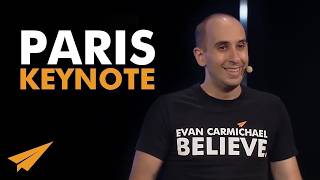
Evan Carmichael argues HR should focus on employees' strengths and let them work in ways that suit their talents, not force one-size-fits-all schedules. He suggests HR leaders monitor employees' social media to uncover hidden aspirations and support their goals. HR manages the most valuable resource but is underrepresented in senior leadership.
Chapters
Let's call our last speaker today, last but not least. He is a successful entrepreneur on a mission to help 1 million entrepreneurs just that, right? He is the author of this absolutely great book, "Find Your One Word," and is a rock star on YouTube with more than 700,000 subscribers. Ladies and gentlemen, please give a warm welcome to Evan Carmichael. Evan Carmichael!
Hello, Paris! Oh, nice, I like it. I love being in a room full of leaders. I love being in a room full of people who want to be inspired, who come to learn, who want to improve themselves, who want to take the knowledge that they took here and apply it to their business, and most importantly, I love being with people who want to take action, because that's what we do as leaders, because we're not here just to learn things and not do anything with it. We're here to take action. And so I want to start by just recognizing you guys for coming out, for investing in yourselves, and for being leaders who will take action after going home. Give yourselves a round of applause. [APPLAUSE] And while we're doing that, actually, I want everybody to stand up. Everybody stand up, just quickly. Quick exercise, everybody stand up. Get the house lights up a little bit. I didn't prep these guys for it. Everybody stand up. I want you to put your hands up like this. Everybody put your hands up like this. There we go, all right. When I count to 3, what we're going to do is we're going to turn to the person next to us, we're going to give them a high 10, and we're going to say, "You're a leader, baby." Don't laugh, I'm serious, okay? You're a leader, baby. 1. 1, 2, 3, you're a leader, baby! Other side, other side, you're a leader, baby! I love it! Alright, okay, sit down. Thank you, thank you for humouring me, that was great. I love leaders, I love leaders. So my name is Evan Carmichael, I'm not from a big corporation, I'm from the entrepreneurial world, I'm from the social media world, and I was asked to come and give you guys a little bit of a different perspective. See what I see in the world and maybe you can apply it to your organizations when you go back home. I want to start by just quickly redefining at least the public perception around human resources, because I think a lot of people, not in this room because we're leaders, but a lot of people see human resources as just an administrative function. And I don't believe HR is just administrative. I don't believe that we are in the business of just keeping track of how many sick days somebody has left and pushing paperwork out there. I believe, and I hope you guys agree, I believe that human resources is the single most important function in any business. There we go. Okay, now, when I was practicing in my hotel room, I imagined a much bigger response to that. So I'm going to try it again. I'm going to visualize. I'm going to say it and in my head, you guys are all going to freak out and clap and cheer and go nuts when I say that again. We'll see what happens. I believe that human resources is the single most important division in any business. Yeah, I love it. And I don't say that just because I'm talking to a bunch of people from human resources. I believe it. Because you can have a business without finance. Startup entrepreneurs do that all the time. You can have a business without manufacturing. You can have a business without technology. But you can't have a business without people. Just doesn't happen. Not until the robots take over the world. But you can't have a business without people. And so I see human resources as not just being administrators, but we are in the business of human potential. We are in the business of taking people who come to our organizations at this level, and we see them being able to come up here. And our job as leaders and as people in HR is to help close that gap. Even if they don't believe in themselves, to give them the skills, the mindset, the confidence, to help them become the best version of ourselves and themselves. That's what I believe HR and leadership is really about. I've got a few ideas for you that may be scary, that may be different, that may push some boundaries, but we're leaders here, so that's what we do. We embrace different ideas and we take action. But before I get to my ideas, I want to share a quick story. So this will be Pierre the rabbit. And Pierre is a happy rabbit, and when he was growing up, he went to animal school like all the other young animals do. And he learned all the skills that you need to learn to be a successful adult animal. And after the first year, there was a problem with Pierre. You see, he got A+ on his report card for hopping, right? For hopping. "Il peut sauter." My French isn't that great, but I'll try to throw a little bit in there. But he failed at climbing. He couldn't climb a tree. And so his parents were really disappointed in him. His family, his grand-mère, his teachers, his friends were really disappointed in Pierre and said, "Pierre, you're failing. Don't worry so much for the next year about the hopping because you're good at that. We got to work on the climbing. We got to teach you the skills of how to climb." And so for the next year, that's what he did. He went to extra classes. And he got special climbing teachers. And every day after school, Pierre would go and learn to climb. And something happened over that next year. He spent so much time practicing how to climb a tree that he forgot how to hop. And as for climbing trees, have you ever seen a rabbit climb a tree? The point of the story is you need to focus on your strengths. The point of the story is if you're a rabbit, you hop. You don't climb trees, both for yourself and for the people in your organization. If our role as human resources is to help people reach their potential, you need to help the rabbits hop. If you have a business full of rabbits that are hopping high, like Pierre is there, you're having success. If you have a business full of rabbits that are trying to climb trees, It's not going to work out that well. And so how do we start? How do we start helping our rabbits hop in our organizations? Well, it can start with policies. We've talked a lot about different policies and rules and regulations. When I first started my business— I have two companies, I have 70 people on my team between the two businesses— and when I first started, I had this dream. I want to have this office, and we're all going to show up at the office every day and work. And we're all going to show up at the same time that I show up, we're all going to leave at the same time I leave, and it's just going to be perfect. And then I started hiring people, and I realized that not everybody is like me. Everybody has different schedules and routines and desires. Some people loved coming to the office every single day. Some people wanted to work from home. Some people wanted to work remotely. Some people wanted to work remotely but come in for meetings and collaborations. Some people wanted to come in early and leave early. Some people want to come in late and leave late. Some people wanted to come in early and leave late. I love those people. As an entrepreneur, I love those people. But I had a tough choice to make. Do I let these people go who are really talented, but they don't fit into the box that I had created? Do I force somebody to do something they don't want to do? Do I take that guy who wants to work from home and wants to work at night and force him to come to the office every day and work early? That'd be the equivalent of taking the rabbit and making him try to climb a tree. Or do I change my policies? And I realized that the vision I had of everybody coming to the same office, working the same hours every day, Wasn't really realistic. And so we changed the policy. And so I would strongly encourage you guys, and we've heard a lot of speakers already talk about it today too, but to look at the policies in your company and think, are they helping the bunnies hop? Right? Are we helping our team hop? Or are we forcing them to climb trees? We forcing them to do the things that they don't want to do. And if we redefine human resources as helping people reach their potential, as opposed to just administration, then it becomes the new filter through which we see our role. And we can look at every policy we have and say, "Is this gonna help our bunnies hop?" Right? Is this gonna help people reach their potential or is it just getting in their way? And I would strongly encourage you to look at those policies you have and see what might need to be eliminated or changed to help your rabbits hop. But that's just administration, right? We're not in the administration game, right? That's old HR. We're about human potential. The challenge then becomes not every person is the same. My potential is different than your potential. What I like, what I want, where I want to go is different from other people. Hopping is different for everybody in the company. And so if you want to get people from here to here, You have to understand for each person what their passions are, what their goals are, what their objectives are, what their desires are, what their needs are, what they want to do. And we have a lot of those tools already built into traditional human resources. You know, we have our annual meetings with them, we have our performance reviews, we've got a lot of things kind of already baked in. And we try to create a culture of openness and understanding and fairness and you can tell me anything. But no matter how great a culture you have, there will still be things that the people on your team will not tell you. And it may not even be because they're trying to hide it from you. They just may be embarrassed. They may not think it's relevant to their job. They may not see how it fits into their growth path. There will just be things that they won't tell you, that you won't know. You won't have the information. They may tell their friends, they may tell their family, They may post it on social media, but they won't tell you. And that becomes a problem. If we're in the business of helping people realize their growth, we need to have the information to help them get there. And so I would tell you that if they are out there posting things about themselves, their lives, their passion or interests on social media, then you need to be there too. And you need to be there following them. I would suggest that you follow everybody on your team, on every social media channel that they're a part of. If they're on Twitter, you follow them on Twitter. If they have a YouTube channel, you subscribe to their YouTube channel. You follow them on Facebook, on Medium, on Snapchat, on Instagram. Everywhere they are, you want to be. Now, some people say, "Well, that's an invasion of privacy." They're posting on Twitter. It's public. Everything is totally out in the open. It's hard to get more public than Twitter. Some people say, "Well, what if I discover something bad? You know, if somebody goes out to a party and gets drunk and then shows up to a meeting with a customer the next day, how do I handle that?" Well, how do you handle any difficult situation as a leader? Use your heart and use your head to make the right decision. But the answer isn't to just ignore it. There's this wealth of information out here that the people on your team are sharing about themselves, their interests, their passions, desires, and you just don't know about it. You only have a small section of the information, and you can't make the best decisions without the best information. And so I follow the people on my team on social media. I'll give you a couple examples of how it's worked out. I had one guy who asked for some time off. "Hey Evan, I need a week time off, personal reasons." Great, no problem. He posts later on social media that he's going back to his mother's hometown to stay with her for a week because she's really sick, he's got to look after her. And I reached out to him and said, "Hey, I heard about your mom." I didn't say, "I found it on social media that you posted about your mom." I said, "I heard about your mom." It's really sad to hear. If I can be of any help, any resource, let me know. If you need more time off, let me know. If you want to work from your mom's city for the next little bit, let me know. We'll figure it out because your mom is important. She's important to you, and therefore she's important to me. And he didn't go into the details with me because maybe he felt embarrassed, he felt it wasn't relevant. But when I found out about it, It made it easier to help him, and then he is so grateful that the company cares enough about him and his situation to do the best we can to help him out. Second example: a guy on my team posts on social media that he's so grateful that he's able to improve his English recently. I didn't know he wanted to improve his English. And again, these are people that I meet all the time, right? It's not like I'm meeting them once a year, and we have no context in between. I'm constantly meeting with the people on my team, but there's still information that they just won't bring up because he just may not think it's relevant to his job function or his potential path. And so I found out that he was grateful for being able to practice his English. I said, "This is great." See, for him, English is hopping. Right? He wants to get better at English. In my company, we're English-speaking only. Every piece of content we create is in English. All of my YouTube videos are in English. The books are in English. And so if he's able to improve his English, it doesn't just help him on his path, it helps my company as well. And because I found out on social media, I was able to help him. Do you want an accountability partner? Do you want to "Match up with somebody in the company and have regular conversations? Are there courses or classes or books or DVDs that I can buy for you to help you improve your English?" And one, he's really appreciative of the tactics, of like, "Here's a plan for you to get better," but even more important is he understands that I have his back, that I care about his path, that I care about where he wants to go. And I found out through social, where otherwise he would never tell me. One last example: a woman on my team posted on social media that she was looking for opportunities to be a public speaker. She wants to improve her speaking skills. She's nervous to speak. Again, she never told me. It's not part of her job right now, what she's doing at my company, speaking. So it makes sense that she wouldn't tell me in our performance reviews and any meetings. But finding that out on social media allows me to create a path for her because for her, Speaking is hopping, right? I need her to hop. I could try to force somebody to be a speaker. They're not going to have fun, right? It's going to be climbing a tree for them. But for her, that's what she wants to do. I have the information. I can make a great decision. So I have a YouTube channel. How about you join me on my YouTube channel? And she did 5 to 6 videos with me. I'm speaking at an event in September in my hometown of Toronto, Canada. And I convinced the organizers to allow her to have her own little section of it. Now, she's not the keynote, and she's not getting paid either, but she's scared, and she's nervous, and she's excited. She gets to do the thing that she wants, to grow and learn. And it helps my company too. Having somebody who can deliver a speech, who can communicate better, helps my business out as well, even though it wasn't originally on her career path. And so I'd encourage all of you to pay attention to what your team is talking about on social media. A lot of it's gonna be irrelevant, but the more you get to know what your team cares about, the more data points that you have, the better decisions you can make. And we need the right information to help people go from here to here. Now this is coming. Right now, it's not common in the HR business to do this, but it's coming. This will be standard practice. I'm old enough to still remember the days where people didn't have email addresses, where companies didn't have websites. So not everybody is doing this yet, but it's going to happen. Social media is not going anywhere, and people are only going to share more and more and more and more. And so are you the kind of organization that's going to pay attention and listen and get the information to help your team out as best as possible, or are you going to pretend like that information doesn't exist and then be blind? While other organizations pass you. The last point I want to touch on is, I want to talk about you guys a little bit. 'Cause everything that we've talked about so far at the conference has been about the employee journey, all the people that you care for and are underneath you. But I want to talk about your journey as well, 'cause you're important, and the work that you do is important, and your journey needs to continue forward as well. I want to talk about CEOs quickly. I love CEOs, but there's one thing that CEOs say that bothers me. CEOs will always say, "Our most valuable resource is our people," right? "Our most valuable resource is our people." Well, that means you guys manage the most valuable resource in every company. So why are you not getting more respect? Why do more CEOs not come from human resources? In North America at least, I don't know the European data, but in North America, the number one path to being a CEO is through finance. You're in finance, that's your best shot at being CEO. Number two is operations, number three is sales and marketing, number four is outside the business, and then way down on that list is HR. We shouldn't be laughing, we should be upset. If the CEO of your company left, your business, your company is more likely to hire somebody from outside the company than from HR. And you manage the most valuable resource in the business. To me, that's crazy. And so instead of complaining, because leaders don't complain, we don't complain. We make changes. Mahatma Gandhi said, "Be the change you want to see in the world." So that's what we do. We make the change. And if you want people to take you more seriously, then you start by taking yourself more seriously, to really feel that you manage the most important resource in the company, to fight for the resources that you need to be successful and to implement the programs that you have. How many of you guys learned something at some point in this conference that you're gonna take home to your company? Put your hand. You learned something at one of the events that you're gonna take home to your company? Great. And how many of you, even before you came here, had other ideas that you wanna put into your company that you haven't implemented yet, but you have ideas, you have a vision for what you want your team to look like at your company? Great. So pretty much everybody. You guys are all thought leaders. You're not just a cog in a machine. And so I would encourage you to share that, to not just share it with, you know, keep it in your head or just share it with your team, but to share it publicly, openly. Because I want to see more CEOs come from human resources. And so I wanna encourage you not just to follow your team on social media, but for you to be active yourself on social media. I want you to find the platform that best fits you. If you like being in front of a camera like I do, you go YouTube. If you like writing, you can go LinkedIn. Find the platform that best suits you, because until HR professionals start standing up for themselves and letting their voices be heard, they're not gonna get the respect. So we can't complain about it, we gotta make a change. I wanna see more CEOs come from HR. I wanna see more HR professionals be keynote speakers at events. We've heard from some great ones today, but this is an HR conference, it's what you expect. I wanna see HR professionals keynoting sales and marketing events, because sales and marketing has to care about the people. I wanna see HR professionals keynoting finance events, because the business isn't just about the numbers, it's about the people. I look out here, we all did the, "You're a leader, baby." I see a bunch of leaders. I see the future keynote presenters across all different industries. I see future CEOs sitting before me if you guys are willing to take the action. And so as much as we focus on our team, And helping them hop— oh, the slide's gone. Helping them hop— I still see Pierre here in front of me. Let's put Pierre back up. As much as we want to see our team hop— there he is. I want you to also focus on your journey and understand that you've already come so far, right? You started at the bottom, you're here now, but you still have a long way to go. And I want you to find your feet, believe in yourself a little bit more, and start to hop a little bit higher. Thank you guys for your time.
More from Evan


How the Biggest Mistake in History Created A Trillion-Dollar Empire | Sergey Brin



9 Machiavelli Principles That Force People To Respect You | Machiavellian Philosophy



The First 10 Words That Instantly Ruin A Sales Conversation | Vanessa Van Edwards

The Top 1% Mindset Behind The First $5 Trillion Company | Jensen Huang (Nvidia)

