How Jack Welch Changed GE With Bold Leadership
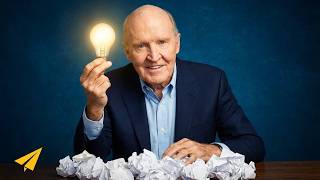
Jack Welch shares his top 10 rules for leadership at GE, where he grew the company's market value 4,000%. He emphasizes celebrating wins to keep energy high, treating top and bottom performers differently, and using metrics as feedback. Innovation happens everywhere, not just in labs, and leaders must be transparent about failures and give people freedom to dream while demanding results.
Chapters
We had breakdowns in the system. We ended up on the front page of the Wall Street Journal. Find every excuse to have a party. So I think innovation is everywhere. I think it's in the structure of your organization. You gotta be over here with the needle to get the needle here. Somebody's out there waiting to pluck you. Or anybody in the world can say, "I'm dreaming. Please, I'm not gonna make any numbers for a while." People today are just better. You grow from the reflected glory of your people. Never do what the assignment is, do more than that. Thousands of people are walking around frightened to death about what's going to happen.
He's a retired American business executive, author, and chemical engineer. He was chairman and CEO of General Electric between 1981 and 2001. During his tenure at GE, the company's value rose 4,000%. He's Jack Welch, and here's his top 10 rules for success.
Well, I was tumultuous in the early career. I was totally impetuous. I have always had a stammer, so that's a weakness from the beginning to the end. I think that'll be there. I think if I go at it— I made mistakes on deals. I'd openly admit it. I'd walk around talking about, if I can make this big a dopey move, anybody can make a move. Be paralyzed. I made lots of mistakes on people. I hired people in the early days, I hired them almost always on resumes and slickness, which is probably inversely proportional to talent. So, I did a number of these things on a fairly frequent basis, but I talked about it. I think the thing is talking about what your mistakes are. Helps an organization enormously. It allows them to feel free to make them. I mean, I bought Investment Bank Kidapipi. No one could make a mistake bigger than that. Boo-boos that we had, we didn't know how to run it, we had breakdowns in the system. We ended up on the front page of the Wall Street Journal 17 times in 14 months. Right-hand column, being called dopes. That's not fun. And we went through that because it was a cultural error that I personally made. And I owned up to it, talked to everybody about it. A boss's entire job is to get the combined intellect of his team to be raised to a new level and to instill spirit. Find every way to celebrate. Find every excuse to have a party. Every little victory counts. I mean, it is so— if a boss can't energize, if he or she can't excite and make people want to be there, they shouldn't have that title. Well, I think people too often think of innovation as going to the lab, going off in the garage and designing something new and bringing it to market. I think innovation is all around you. See or smell something that somebody else is doing, you adapt it to your place and take it to new, new levels, that's a breakthrough for your company. And the process never stops. And if you've got a company that has a mentality inside that is filled with searching for a better idea every day, not just as a slogan, but as a real concept, you will have innovation around you all the time. Classic example, we had an innovation by going to India. We went to India in the late '80s. And we went there to sell lots of products to a billion people. Well, 15 years later, we still haven't reached a billion dollars in sales. But we've got 41,000 employees because we found intellect. And we were the first people to go there and build huge R&D centers, technology centers. By using the intellect. That was it. That's innovation. Getting stuck in one corner when bureaucracy won't let you sell products, but finding another answer— intellect— and capitalizing on it. So, I think innovation is everywhere. I think it's in the structure of your organization. I think it's in every process you deal with. It's just finding a better way to do things every day. I think everything has to be a closed loop. You drive it with people, You measure it with the people, and then you go visit it. And you go visit the progress. Now you'll get a lot of air and nonsense when you go visit. And you'll see it'll be— I mean, for example, in Six Sigma, if the amount of savings I was presented in the course of Six Sigma were all added up, it would have been larger than the GDP of the United States. So I mean, the PowerPoint slides can accumulate enormous amounts. So all these things are hyped to an extent, but they gotta be. You cannot make change with rational behavior. You cannot make change by, like, let's have quality programs. Quality is good, everybody. Let's go at it. Let's make sure our customers feel good with our quality. You gotta say no. Our quality stinks. We've got to improve it dramatically. Only the best people can be on it. Half of our offices by the year 2005 will have been black belts in quality. The stock options and the awards are going to those leading the efforts. And you've got to be— you've got to be a maniac about it to move it. You've got to be over here with the needle to get the needle here. If you're sitting there comfortable in what you're doing, you can be sure with your with your nice awards of number one here, number one here, number one Zagat, and number one this one, number one that one, somebody's out there waiting to pluck you. And you can't get comfortable. And at that rate of change, if you start seeing stuff, you gotta move. The only job of a leader is you— when you ran Ford Europe, or anyone in this room running businesses, The only reason for having the job is to make the right trade-offs between cutting costs, productivity, efficiency, and developing new ideas and new products. Anybody in the world— for example, I love these CEOs that say, oh, I'd like to have it— I hate these analyst presentations. Analysts are pressing me for quarterly earnings, et cetera, et cetera. Look. Any jerk in the world can squeeze all day and say, "Talk to me in 5 years about my growth." Or anybody in the world can say, "I'm dreaming. Please, I'm not going to make any numbers for a while." You can squeeze or you can dream, but a manager does both. A leader does both. You dream and you squeeze. You eat while you dream. And there's no— and there's no getting around— that's why you're paid. Any jerk can do one or the other. But it's your job to make those trade-offs. You gotta see everyone as a mentor. The whole— your whole crowd. Somebody who works for you might be a mentor. I remember when I became CEO, I was not a great financial wizard. I never did become a financial wizard, but I— at least I had this fellow who worked for me, 10 years my junior, 33 years old, who I made CFO. He basically dumped his brain into mine. I lived with him as we went through all of this stuff— left side, right side, etc., the balance sheet from A to Z. And he was an enormously valuable person. I've had people who were on my board who were completely committed to our success, who would challenge every people appointment I would make, who would ask me, are you sure? You're right. I think the business media is a great mentor. You may laugh at that, but I think Fortune, Business Week— there's a business language. I find them mentors. Read every story. I can't understand why somebody can be in business and not read all those stories. I think you learn what strategies didn't work, did work. Some of the stories aren't quite accurate, some of them aren't true, so what? You're constantly learning the rhythm of business. So education and teaching is all around you. As far as today's— we have an enormous cadre. People today are just better than they were before. It's more competitive. It's no longer— when you become CEO today, it's no longer the coronation. It's the beginning of a new competitive career. I remember in 1980 when I became CEO, I would go to these meetings where people would sit around and they had briefing books prepared by huge staffs. And they had pontificated about the economy and this other— Nonsense stuff. Meant nothing. They were just mouthing words. It was ridiculous. Now today, people are in shirtsleeves, getting in there and doing it, because the global competition is so tough. I think building an organization, building a team— the idea that Jack Welch is the hero of creating all this value is silly. Getting great people in all these jobs, it's a team that makes this thing happen. And so building a team is your strongest suit, and you've got to love your team. You've got to want your team to be promoted. And when you're coming up, the biggest problem I find with young MBAs, at first the job is you shining, raising your hand, having the answers. They want to do that all the time. They just got out of school. They want to show you how smart they are. Now the transition to manager, it all changes. It's about growing your people, not you. You grow from the reflected glory of your people. So it's all about making them flourish. I like to use the line that your job is walking around with a can of water in one hand, a can of fertilizer in the other hand, sprinkling it on the seeds and watching them grow. You'll get some weeds, and you gotta pull those weeds out. So everyone's not going to flourish, but you've got to be thinking about all the time loving to see your people thrive, loving to see them get promoted. It's a real turn-on. It is what management's all about. It's about bringing to people great lives, great futures, changing their family's life. That's a turn-on. It's a big deal. That's what you gotta think about. When you work in a business and you're asked to do something, if you just do what the boss asks you to do, you will end up just confirming what the boss wanted to have written down. They already knew the answer when they asked the question. So your job in a new job is to overdeliver. Give them new perspectives. When anybody asks you, schools ask you for a problem, problem solving in a case study, then they ask you the questions. So you answer the questions. You don't get the answer, you don't get the questions in business. You have to develop a perspective that's wider. And I always tell the story of my first job. I was a project manager on a little plastic operation in Pittsfield, Mass. And my boss from New York was coming up to see, not my boss, my boss's boss, and they wanted me to come in one of those G white shirt pitches to present the cases for my new plastic. Tell them where I was going. So I got all prepared and everything else. But what I did do was I didn't talk about my project alone. I talked about the 10 plastics in the industry, where they were going to be in 5 years, their cost structure from DuPont, etc. I developed that package and I gave my bosses boss this picture of the industry. I think that's how I got noticed there. I was— I got out of the pile because I didn't just give him my project report. Here's what I did yesterday, here's what I did tomorrow, here's what we'll do next day. I gave him a perspective and made him look smarter. He now knew more about the industry than he ever knew. And that's what you want to do. You always want to overdeliver. Never do what the assignment is Do more than that. Wider, new insights, new horizons. Well, if you're a leader, you clearly have to demonstrate it. You have to be open. You have to be able to admit mistakes. You have to be able to cut through the businessese. You've got to be able to talk to every person in your organization in such a way that they know where they stand. No one can be a manager without— no one can call themselves a manager and have employees working for them when the employees don't know exactly where they stand, where they are relative to others, where they're going in their career. When you're debating a deal, you've got to lay your— you've got to have an atmosphere where everybody gets it on the table. Not massive PowerPoint slides, numbing charts that put people to sleep, but really dialogue face-to-face, eyeball-to-eyeball confrontation about why the deal works or doesn't work. And you demonstrate that yourself. You yourself will be— if the place is tied up in its knickers, it'll be because you are setting an atmosphere that isn't open, isn't fun. We used to make fun of people that wouldn't be open, you know, josh about it, just to try and lighten the thing up so they'd get there. Kanda can kill you though, because Kanda, if you're in a stiff, rigid hierarchy, you've got to be able to use it right. Because if nobody above you is practicing it, and you coming in swing for the fences, it could be troublesome. So, I happen to believe it speeds everything in business. It speeds decision-making. It moves the organization competitively faster. It gets people to be open about where they fit. I was over at the BBC this week. And this place is the most paralyzed place I've seen in my lifetime. I mean, thousands of people are walking around frightened to death about what's going to happen. Are they going to get sacked? Every interview I had, they asked about, well, you know, somebody here is going to get sacked in this new —round we're going through here, and no one knew where they stood. And so the management there is just being cruel. So employees are walking around not knowing where they stand. You can't have an organization where people don't know where— you as the professor of organizational dynamics, you know that you've got to let people know where they stand. They can't be in this frightened paralysis state. Nothing happens.
Thanks so much for watching. We made this video because Ryan J. Davis asked us to. So if you have a famous entrepreneur you want us to profile next, leave it down in the comment section below and we'll see what we can do. Also, we'd love to know which one of Jack Welch's top 10 rules meant the most to you. Leave it in the comments below and we'll join in the discussion. Thank you so much for watching. Continue to believe, and we'll see you soon.
Differentiation is a big value of mine. I don't believe you can run a company without having an organization that differentiates. Differentiates on how it treats different businesses, some with more— not equal, and people not equal. Takes care of the stars, motivates the middle, and asks the bottom to move on. I believe that. Do you think the Patriots keep the worst players? Why should a sports team keep the worst players? The silliest thing that I hear when we talk about differentiation— and we get this all the time— is, how can you possibly be telling somebody they're not that good and somebody else is that good? Well, why should you stop getting grades the day you leave BU? Why should a grown-up— not be able to get great, but a 6th grader is given best in the class and weakest in the class. It's the dumbest idea in the world. So, you want to tell people where they stand. As a manager, people always have to know where they stand. You can't be turning away from it and then one day going in saying, "We're having a layoff." Now, when Ford has this big 30,000 layoff, hopefully they got a performance appraisal system that somebody won't be saying, "Why me?" And somebody says, "Well, you weren't very good," and they pull out the appraisals that say they were great for the last 10 years. You want candor, you want differentiation, and those are values I believe in. I walked around GE preaching constantly, "Don't you ever think you're a victim. If you ever feel like a victim, get out. Because if enough of you get out, we'll find out who's making you feel like a victim." It's your job to take responsibility. Go find another game. There's plenty of games here. Unemployment's low here. Go find something else. Go on your own. Do something. But Jesus, don't spend most of your waking hours feeling like a victim. If you ever say something's important in your organization, you better put your best person on it. Because your whole organization is evaluating how important it is by who you staff it with. The biggest mistake CEOs make is, let me give you this big puffy speech about how critical this is. Inventory turns are critical. We need to get our cash flow improved. And then they hire Joe, 4 months from retirement, to lead the effort. And the whole place just goes into a yawn. Joe is like a gas pain. He'll go away. And that's what happens to the initiative. And so it's an enormous problem. You say something's important, staff it that way. Follow up that way. Close loop measure that way. But I'm sure many of you have had experiences where people would articulate the criticalness of an issue and then put some OK player on it. Only your best.
More from Evan


How the Biggest Mistake in History Created A Trillion-Dollar Empire | Sergey Brin



9 Machiavelli Principles That Force People To Respect You | Machiavellian Philosophy



The First 10 Words That Instantly Ruin A Sales Conversation | Vanessa Van Edwards

The Top 1% Mindset Behind The First $5 Trillion Company | Jensen Huang (Nvidia)

