How LEONARDO DICAPRIO Keeps Improving (Even After an Oscar Win)
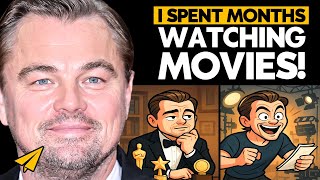
Leonardo DiCaprio credits constant improvement to choosing great material over money, working with acting coach Larry Moss, and relentless script research. He survived a near-fatal skydiving accident and engine failure on a flight to Russia, experiences that shaped his willingness to confront fear and pursue excellence.
Chapters
But I got up and I— he said, "Now, is it empty? Is it empty?" And I got up and I screamed, "No!" I'm sort of on a tirade trying to promote this film because I just want to see more films like this out there as a fan of movies.
I—
it was the first memory that I had. It's the first thing I can think of is saying, "I want to be an actor." Don't you pull that shit with me! He's like, "You get in that goddamn cockpit right now!" When you find a great piece of material or great script, it's like You should see what happens. It's like a piranha feeding fest. I don't know where I got those little balls at 16 years old to say, "No, I'm gonna— I'm gonna wait it out." I kind of felt like I'd already died and gone to heaven because no one said anything. And I was screaming at the top of my lungs, saying, "What the hell is going on here?" He's an American actor and film producer.
He achieved international fame with James Cameron's epic romance Titanic in 1997. He's been nominated for 6 Academy Awards, and in 2016, won the Academy Award for Best Actor for his movie The Revenant. He's Leonardo DiCaprio, and here's my take on his top 10 rules for success.
Do you remember the audition when you first met De Niro?
That was, yeah, I mean, that was one of those incredible auditions that came around that I suppose every kid had been waiting for for a long period of time because it's just not that often that you get a starring role above Robert De Niro in this incredible screenplay, and it was Ellen Barkin and Michael Caden Jones, and it was just, everyone was sort of fiending for this role. And I got down, I suppose, to the final 5, and there was like a last sort of day. Tobey was there, and I do remember thinking to myself, "I gotta do something. I gotta do something to stand out." And in the audition, there was Art Linson, Michael Caton-Jones— Art Linson was the producer— and De Niro. And I remember there was a mustard jar scene, and he had to jam a mustard jar in my eye repeatedly. It was an abuse scene. And the script sort of didn't call for it, but I got up and I— he said, "Now, is it empty? Is it empty?" And I got up and I screamed, "No!" Aah! Like completely unnecessary, but I screamed in his face. And I sat there with my head looking like a red tomato. And everyone started laughing at me in the entire room. De Niro, everybody was in hysterics. And I sat there frozen thinking, oh my God, I just screwed this entire opportunity up. And I just sat there frozen. And then Bob had— in traditional De Niro fashion, kind of just looked at me and went, "It's good, it's good, it's good." And then, you know, we carried on doing the scene, and I think I actually had dinner with De Niro recently, and he told me, "No, I was the one who said you should get the job." I'm very proud that a movie like this got made. It's very, very, very rare to see films that are this ambitious coming out of the Hollywood studio system. So I'm sort of on a tirade trying to promote this film because I just want to see more films like this out there as a fan of movies. But as far as awards are concerned, you know, the truth is there's a lot of peace of mind in it because you really realize that you ultimately have no control over these things. Is it something you hope for or set off to the side? Like I said, I, you know, honestly, I do these movies because I really love, love movies and I want to make great movies. All that stuff is totally beyond your control. It really is. I do these Jack Nicholson imitations— Oh!
Ni ken ni ken? Thank you!
Has acting turned out to be all that you wanted it to be? Um... It's incredible. It's incredible. You know, I never knew that I could do it as a career. I never knew— it was the first memory that I had, it's the first thing I can think of, is saying, "I want to be an actor," to my parents. And if I hadn't lived in Los Angeles and been in such close proximity to sort of the mecca of moviemaking, if I didn't have parents that said, "OK, we'll drive you to auditions"— we didn't have the economic means to, you know, move camp from Idaho to Los Angeles because some snotty any 10-year-old kid says, "I wanna be an actor." We did it, and after school I got to go on auditions, but it was always, and I've said this before, it felt like an elite group of people, and it felt like I would never belong to them. So once I got the opportunity to, for example, get the movie This Boy's Life with Robert De Niro, I said, "Wow, now I'm able to, I might be able to steer the course of my career. I might be able to have a career similar to these guys that I'm, you know, I so admire. And that, I knew at 15 years old, was the biggest gift in the world. And that's never left me. You know, I've never— that thirst or that hunger for wanting to give one great performance that I'm truly satisfied with, or be in one movie that I said, "I love this film," is something that I don't know will ever be quenched. I don't know. And that's— and I think that— that's a good thing because it keeps making— it keeps pushing you, you know. Constantly dissatisfied, in other words. I mean, I never went to formal acting. It was only until really The Aviator that I started working with Larry Moss, who, you know, it was the first film that I had produced, that I had thought of. It was sort of my concept, and I felt like I needed to brush up on my technique. So that's when I really started doing formal training. And he was— it was an amazing experience with him. I mean, he was— it was more than learning how to be a better actor. He was a life coach. It was like— he's like, the first day, he was like, "All right, you want to go over this stuff?" I'm like, "Yeah, yeah, let's do it." And he's like, "Okay, you're Howard Hughes. You're in your plane. This is your cocoon. This is your sanctuary." "Show me how you fly a plane." I'm like, "Well, I haven't really—" He's like, "Come on." You know, basically, "Sit in that chair and do it for me right now." I'm like, "Well, I haven't quite prepared." He's like, "Don't you pull that shit with me." He's like, "You get in that goddamn cockpit right now, and you show me who the hell Howard Hughes is. You do it in front of me right now." I'm like, "Okay, shit." I mean, and from there, we, you know, started working on breaking down this script in a way that I never had before.
I have to say I'm impressed because most people, you know, don't get an Oscar nomination and have like many hit films behind them and then choose to go see an acting coach.
I think everyone can always, you know, brush up on their technique. It is, you know, what we do is takes a lot of research. I mean, if you really want to inhabit a role, it takes a lot of work and training, and I think it's I think it's incredibly important to constantly, no matter what, how successful you are, it's incredibly important. You know, what gives me strength all the time is to be able to have formulated a group of people around me that are my friends and my family. You know, those two words are meshed in my opinion, but it's given me a a grounding that, as, as insane as my life can be sometimes, is always refreshing, and they're always so honest with me, and I'm so thankful for that. Everything at the end of the day when you're making a movie starts with the material and, and, and how well-written the script is. I've never seen a silk purse made from a sow's ear. I've never seen it happen wherein a crap script with crap characters, a director somehow found a way to make a masterpiece out of it. And that's the constant struggle that we all sort of have as actors is finding those gems, and that's why people grab onto them like vultures. When you find a great piece of material or a great script, it's like— you should see what happens. It's like a piranha feeding fest. Everyone wants it. Being an actor is the first thing that I remember wanting to do in life. I remember at 14, 15 years old watching some classic films, not— well, spending months and months watching all the great classics, all the great performers of the past, and being so incredibly inspired by them and saying to myself, one day I want to come close to doing something that good. So I think that that thirst or that drive to just achieve what I believe is something as good as, you know, those heroes that I have is what continues to make me want to do this.
After This Boy's Life, you went on to play Arnie Grape in Once Eating Gilbert Grape. And this was a turning point. I know. This was a turning point in a lot of ways because I understand you actually turned down another movie just for the opportunity. I don't even think you had an audition lined up for Gilbert Grape.
I did have an audition lined up for it, yeah. No, it was one of those situations where, you know, I did this movie, This Boy's Life, and it hadn't come out yet, but there was this one role that I wanted to play desperately, but I started to get offers for other movies. And there was a big Disney movie that they wanted me to do. And I don't know where I got those little balls at 16 years old to say, "No, I'm gonna wait it out because I wanna audition for this other film." But if there's one thing that I'm really proud of in my entire career, it's that moment at 16 to say that. And do that and have that sort of conviction of what I wanted to do. That's the one thing I'm really proud of.
Because the other movie was an offer, wasn't it?
Yeah. For a lot of money at that time, which sounded great at the time. But I said no. Yeah.
So you've always been like a daredevil. But you've done— I think I've talked to you about you swim with sharks, or you have. Yeah. And you jump out of an airplane. Yeah. On a regular basis, or will you—
I only did that once. Once.
Will you do it again?
When both parachutes don't open, you tend to not go repeat something like that. Yeah.
What are you talking about? Well, then how'd you get down?
I had— I jumped out of the airplane, and then my first chute didn't open. They cut— it's tandem, so somebody's on your back. They cut that line. We started free falling towards Earth, and that's when you get the 8x10 glossies of your whole life flashing before your eyes. And then the second one was tangled as well, and I saw my friends sort of popping off with their parachutes, and I'm still plummeting towards planet Earth. And then that was tangled for about a good— I don't know— 20, 30 seconds. And then he untangled it, and then he told me, oh, you're probably going to break your legs now because we're going too fast. So it was one of the worst experiences of my life, and I'll never do it again.
And did you break your legs?
I did not break my leg.
Wow. So he's whispering in your ear— or yelling in your ear.
He's screaming. Screaming in your ear. You're going to break your leg. You're going to break your leg. [Speaker] What? I can't hear you!
Wow, that's just horrible. So what's the scariest thing you've ever done?
[Speaker] I was on a plane to Russia, and the engine exploded. I was looking out the window, and the entire engine just turned into a fireball. It was right after Sully had that incident happen to him where the geese flew into both engines.
[Speaker] Right, and he landed on the river. [Speaker] Yeah.
This happened in one of the engines. Russians, and I was the only person there that seemed to see this, but it was a flaming fireball, and it was all Russian passengers, and I kind of felt like I'd already died and gone to heaven because no one said anything. And I was screaming at the top of my lungs saying, "What the hell is going on here?" And these people just kind of looked back to me, and the stewardess came out and said, "We seem to have a slight problem here." And the Russian guy finally said, "Squeak, squeak." And he said, what is the problem? And I said, well, we lost one of our engines. And he goes, how many engines did we have? Well, we had two. Now we have one. And he proceeded to say, that is not good. That is not good. And we basically dumped fuel for 45 minutes and did an emergency landing, and all our tires exploded, and there was a hundred different ambulances there, and it was on CNN. And that was another bummer.
Thank you guys so much for watching. I made this video because Jacob Salem asked me to. So if there's a famous entrepreneur that you want me to profile next, leave it in the comments below and I'll see what I can do. I'd also love to know which of Leonardo's top 10 rules had the biggest impact on you and why? What did you take from this video? Leave it in the comments below and I will join in the discussion. Thank you so much for watching. Continue to believe and I'll see you soon.
I always felt like an outsider because I knew of people, you know, that were in the industry. I just didn't know how to get into it. And I remember going to cast— different agents when I was 9 or 10 years old. I was rejected twice. I remember there was like this sort of cattle call of kids and I lined up. It was like a prison photo or something like that. I'm standing there like this. And I had this crazy breakdancing haircut from when I was breakdancing. And I kind of dressed in hip-hop clothes. And I remember they went, "Yes, yes," went to me, went, "Nope, yes, yes, nope, yes, yes." Wow. And that was it. So I got rejected a couple times, and then I just kept asking and asking and asking. I remember my dad saying, "Just stick with it. Someday you'll have your day." And then I came back, I think, 2 years later and finally got an agent. Meryl Streep and Diane Keaton were just my 2 favorite actresses of all time, even before I did this film. And, you know, Meryl is just such a presence when you work with her. I mean, she throws you so many curveballs all the time. You've gotta be on your toes with her because, you know, she may do something completely different the next take, and you gotta sort of be prepared. So, you know, anytime you work with people of that caliber, you learn a lot.
More from Evan


How the Biggest Mistake in History Created A Trillion-Dollar Empire | Sergey Brin



9 Machiavelli Principles That Force People To Respect You | Machiavellian Philosophy



The First 10 Words That Instantly Ruin A Sales Conversation | Vanessa Van Edwards

The Top 1% Mindset Behind The First $5 Trillion Company | Jensen Huang (Nvidia)

