How Lin-Manuel Miranda Creates MAGIC! The Untold Story of Hamilton
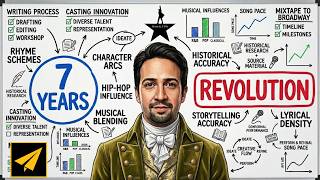
Lin-Manuel Miranda describes writing "My Shot" after a lyric about death struck him on the subway, and credits Stephen Sondheim's early encouragement and weekly Friday songwriting sessions with Tommy Kail. He explains how freestyle rap became Freestyle Love Supreme and uses mixtape structure to show how he builds musicals.
Chapters
I was on my way to my friend's birthday party when that lyric showed up, when "death doesn't discriminate" showed up in my head. Anytime you're gonna put something new into the world, there's a million people who will tell you how they've done it better before.
And he's a really reserved guy, and he went, "That is the most incredible idea!" No one's gonna write your dream thing for you.
You've gotta make it.
I hope I don't drop these cards.
You ready, guys?
You ready? We're getting the cue?
All set.
Alright.
He's an American actor, composer, rapper, and writer. He's best known for creating and starring in the Broadway musicals Hamilton and In the Heights. He's won a Pulitzer Prize, 2 Grammys, an Emmy, and 3 Tony Awards, among others. He's Lin-Manuel Miranda, and here's my take on his top 10 rules for success. Rule number 1 is my personal favorite, and make sure to stick around all the way to the end for some special bonus clips. Also, as he's talking, if he says something that really, really resonates with you, Please leave it in the comments below, put quotes around it so other people can be inspired as well. Enjoy!
I know it took you 6 years to write Hamilton, but I know we like as teenagers, like if we're writing an essay and we have trouble, we're like, "Oh my God, I just want to give up." Did you ever feel like that?
All the time. All the time. And then you push through it. Like, you push through it, 'cause what's the alternative? You're gonna leave that idea stuck in your head forever? That sucks. The alternative is you go through life and you had this great idea and nothing came of it 'cause you got tired. And yeah, sometimes you don't go to the party that all your friends are at because the idea is calling to you in that moment. Wait for It's a great example of that. I was on my way to my friend's birthday party when that lyric showed up, when death doesn't discriminate showed up in my head. Idea came on the A down. I started writing it down on the train, in la quinita of the A train. Breakdancers are dancing, I have my headphones on. I get out, the whole chorus comes all at once. I write it down. And I suddenly see the shape of the whole song. I was just like, the chorus is Burr, that's who he is. I go into my friend's party. I go, hey, what's up, man? Happy birthday. I gotta go. I get on the L train and I write the rest of the song on the way back home from the L to the A back up to 207th Street. You have to do that sometimes. You have to say no to your friends to say yes to your work. Because what are you gonna do, like lose that idea because you decided to like have a drink with your friends? Like, it's not worth it. Your friend will be there. You know, yes, the answer is yes. You always get a lot of rejection. Anytime you're gonna put something new into the world, there's a million people who will tell you how they've done it better before, or how that's already been done, or how it's not gonna work. And you have to look at those as motivators. Just like if you're going into acting, you can't look at auditioning as a way of getting a job. You have to look at auditioning as the job. Because that's what you're gonna spend the majority of your time doing. And if you love it, getting the job is gravy. So, sure. The trickiest thing is continuing to work. And I was very lucky with Heights that I had Tommy Kail, because I had someone who wasn't me saying, "Bring in something Friday." Bring in something on Friday. This is good. This part feels weird. Bring in another song on Friday. Every week for 8 years.
You send unfinished work to Stephen Sondheim for him to critique.
Yeah.
What was that like?
Well, it was pretty well polished by the time I sent it to him.
Okay, I was gonna say, Steve, just tell me what you think. How does that work? And are you really, really—
Yeah, well, you know, again, it's— Hamilton's a crazy idea. It's a crazy idea, but in my head it was a really good idea. And sometimes what you need are people to just not say, "That's a terrible idea." And you have to be very careful about who you let in when you've had a good idea, because people can crush it for you. People can go, "Oh, I would stick to this other thing." And if you trust that person and you love that person, it can really affect your own view of your work. I've learned that the hard way. I've had ideas die in front of me because people I respect go, "Oh, maybe not that one so much." My— when I was on vacation and I picked up Chernow's book and I started reading it and reading it to my wife and being like, "There's something here, right?
This is like—
I'm not a crazy person." And my wife was like, "No, that's a really cool idea. Like, that's as responsible for this as anything." And I remember when I first met Sondheim, it was to do translations for the last revival of West Side Story. And we talked shop, and we talked about what I should translate, what I shouldn't, and we kind of talked about that for about half an hour. Then he asked me, like, what are you thinking about next? Because Heights was running at the time, it was its first year. And I said, I think I have this idea for Alexander Hamilton. And he threw up his head, and made this— and he's a really reserved guy— and he went, that is the most incredible idea! But I just instantly got it, and I was like, And that's also as responsible for us being here as anything, that early encouragement. 'Cause he just, you know, his whole thing, and he's proved it with his career, is continue to vary and like lean into what scares you and lean into what people don't think makes a good musical and make that.
Listen, this show ain't medicine.
It's not like you take a hit of Hamilton and you start making good decisions.
Would that it were. It's a show, it's a musical. It's not gonna cure your hiccups and it's not gonna cure your rash. It's an evening of entertainment. But what I think it does across the board, and I know this from the 3:00 AM emails I get from the friends who have seen it, is because Hamilton did so much in his short time on earth, it forces you to reckon with what you're doing with your time. The last questions of the song are, the last words of the show, are time and who tells your story. Who lives, who dies, who tells your story. And so you leave the theater wondering, who tells my story? And that's always a good perspective to have, I think. I think it, you know, we get so caught up in the day-to-day of living that it's, you know, Thornton Wilder taught it to us in Our Town. How many of us really experience life while we're living it? And I think the takeaway from Hamilton is a bracing reminder to do that. I think Hamilton was ready to die from the time he was 14 years old. I think he had— I think what he has is what I have, which is that thing of tomorrow's not promised. I got to get as much done as I can. So I think he had this curious fascination with and obsession with death because he saw it at such a young age. His mother died in bed next to him. They both got sick. She never got better. So what does that do to you? What does that do to your psyche?
What does it do to you?
What does it do to me? Yes. Well, it makes me think that my main character's got, you know, he sees death everywhere. I know I do. That's my point.
You just said to me that what he had in him, I have in me.
Yeah.
Do it.
Do it. Do it. Yeah. But, you know, and you know, we can say, well, yes, but we get things done and we still have to plan for, you know, next week. You know, Hamilton had an appointment on the books that day that he went to that duel in the morning. He still was gonna have lunch that day. He didn't know he was gonna die. I mean, a part of him thought he might die that morning, but he also had plans, you know? And that's how we all live.
To live a great life, you must be prepared to fail, sure, and to die maybe as well.
Yeah. And that's why the things that are the scariest to us are those seeds we plant that might outlive us. Having children, getting married, you're putting into the world things that you might not live out to see. And it's so scary, but it's also so hopeful.
What words of advice do you have about choosing to be an artist for a career?
If you want to do anything else, do it. That's not glib, that's not meant to scare you away, that's not even a joke. It's, you will not make your rent by being an artist. You will not live a comfortable life. You will not afford house in the Montclair School District being an artist. You won't. You will if you beat insurmountable odds and have an extraordinary amount of good luck, as I have had. And, but if it is something that you can't help but do anyway, if it's the thing you're doing when no one's paying you to do it, then if they pay you to do it, it's going to be gravy. So what I would say is figure out the job that you you like that will pay your rent if you want to be an artist. Figure out the job that allows you time to feed your soul that way, and then everything else is gravy.
I think it's forged in part by I couldn't see a way for me to have a career in musical theater based on the musicals that already existed. I don't dance well enough to play Bernardo or Paul in A Chorus Line. And I don't really have an operatic enough voice to play the Man of La Mancha. And if you're a Latino dude, that's all you get. Or that's all you got for a while. That's just, that was the reality. And my senior year in high school, there was a musical called The Capeman by Paul Simon. It was written by Paul Simon. It starred Marc Anthony, Reuben Blades, Anita Nazario. If you were to write my dream collaborators and cast, you would have created The Cape Man. And it came and went. It was sort of a notorious Broadway flop. And it was also, in addition to opening and closing very quickly, it was like a slap across the face. Hey, no one's going to write your dream musical. No one's going to do it for you. And that's when I started— I think In the Heights was born out of the ashes of The Cape Man. It was out of the ashes of— No one's gonna write your dream thing for you. You've gotta make it. And I had been writing one-act musicals in high school, and I doubled down on that. Because I realized the only way to have a career in this world that I loved—Conrad Birdie, gold lamé jacket—was to write it. And that's what "In the Heights" was. "In the Heights" was my way of writing a Latino storyline in which we never played gang members once. And, you know, that was—
That was, I felt, very well explored by the musical theater community section.
Puerto Rican gang members, you guys got it. Zoot Suit, you know, West Side Story, Caveman, like, well covered. Let's do, cover the million other things Latinos do.
I'm out of college, I'm 23 years old, and Tommy Kail and I are meeting with a veteran theater producer. To pay rent, I am a professional substitute teacher at my old high school. Tommy is Audra McDonald's assistant. Tommy is directing In the Heights, and with his genius brain in my corner, my 80-minute one-act is now two acts. This big deal theater producer has seen a reading we put on in the basement of the Drama Bookshop in Midtown Manhattan, and he is giving us his thoughts. We hang on his every word. This is a big deal theater producer, and we are kids desperate to get our show on. We are discussing the character of Nina Rosario, home from her first year at Stanford, the first in her family to go to college. The Big Deal theater producer says, "Now, I know in your version Nina's coming home with a secret from her parents. She's lost her scholarship. The song is great, the actress is great. What I'm bumping up against, fellas, is that this doesn't feel high stakes enough. Scholarship, big deal. What if she's pregnant?" What if her boyfriend at school hit her? What if she got caught with drugs? It doesn't have to be any of those things. You're the writer. But do you see what I'm getting at, guys? A way to ramp up the stakes of your story.
I resist the urge to crack my shoulder.
We get through the meeting, and Tommy and I, again alone, look at each other. He knows what I'm gonna say before I say it. Pregnant. I know. Nina on drugs, I was there. But he wants to put our show up. Tommy looks at me.
That's not the story you want to tell, and that's not the show I want to direct.
There are ways to raise the stakes that are not that. We'll just keep working. If I could get in a time machine and watch any point in my life, it would be this moment. The moment where Tommy Kail looked at uncertain, frazzled me, desperate for a production and a life in this business, tempted and said no for us. I keep subbing, he continues working for Audra, we keep working on In the Heights for 5 years until we find the right producers in Jill Furman and Kevin McCollum and Jeffrey Seller, until Philly native Quiara Hudes becomes my co-writer and reframes our show around a community instead of a love triangle. Until Alex Lacamoire and Bill Sherman take my songs and make them come to life through their orchestrations, it will be another 5 years before Heights reaches Broadway exactly as we intended it.
How you were able to learn and improve your freestyle rap skills?
Oh, this is a great question. Um, there— you're kidding yourself if you think anyone comes by it naturally. Um, it's a power that you have to develop over time. And when I was in high school, I was too shy to do it. I had friends in high school who were really good at it, and I was the beatboxing kid. I was like, "No, no, no, not beatboxing, pass it." I don't have anything, I don't have anything. And then in college, I guess I had written so much by the time I got into college that I started doing it for fun with my friends and just getting less and less afraid. And I can remember one college road trip I took. It was— I was with 3 friends. We decided to drive— I don't recommend this— we decided to drive to Vegas and back in a week. From Connecticut to Vegas and back. Wow. Everyone who left us was like, they're never coming back. But I got the Kansas 1 AM to 5 AM shift. So it's me driving, all we have are these cans of Red Bull, and everyone else in the car is passed out. And I remember popping in, we made a bunch of mixtapes for the ride. We'd worn them all out by the time we got to, I don't know, 20 hours in. But I just started drinking Red Bulls and popping in these hip-hop cassettes and rapping to myself like, I am in Kansas, I'm crazy man, This is crazy, yep, and just literally talking to myself for 4 hours. By the time we survived Kansas and it was the next person's turn to drive, I was good at freestyling. It was a long, lonely night of the soul. There's nothing to see in Kansas at night. It's just like gas station, barn, gas station, barn, and by the end of it I was I knew what rhymed. And then Freestyle Love Supreme is the other part of that, is that I'm in a hip-hop improv group where we do shows where we don't plan what's going to happen. We get suggestions from the audience and we have a beatboxer, we have two guys on keys, and we just make up the show. And we just forced ourselves into that insane situation and did it until we got good at it. And so I've had my 10,000, my Malcolm Gladwellian 10,000 1,000 hours of practice at that. And now it's sort of— now it's almost like an Instagram filter in my brain. Like, if I make an acceptance speech at the Grammys or at the Tonys, like, it's easier for me to make it rhyme than to have to speak as myself. I find that less— like, when I did the Jimmy Fallon thing, I was much less nervous to play Wheel of Freestyle than I was to talk as myself to Jimmy on the couch.
Here's how it's going to work. I'm going to hit this button here. When which activates a random word generator, and it'll land on 3 random words, and it's your job to work all 3 of them into a freestyle rap. Sound good? Yes, sir. Okay, good. Great. Now, since I'm not a freestyle rapper, tonight you'll be facing off against our very own Tariq Trotter from The Roots.
And that's— this is the dream.
All right, here we go.
Uh, here's the microphone here. Okay, let me push the button here, or you push the button here to start the word generator.
Come on, no whammies, no whammies. Here we go.
Rainbow pancake slam dunk. He's not heard these words before. So this is not rehearsed. Rainbow pancake slam dunk. Ruz, can you give him a beat?
Microphone check. What is this? I fly my rainbow flag LGBTQ business. Oh, yes, I got so much love to give. I look at the colors, it's like ROYGBIV. Oh, started from the bottom like my man Drake. I flatten it, flour, eggs like a pancake. And oh, yeah, I'll bring any style you brung out.
I slam dunk like Michael Jordan with his tongue out. Like, yeah. Oh, my gosh. Oh, my gosh. Michael Jordan with his tongue out. Come on. Oh, my gosh. How do you do that?
Oh my gosh, that was awesome!
That was awesome, man.
Oh man, that's fantastic. There's some serious business right here. It's a—
are we in the Rose Garden right now?
We are.
This is the Rose Garden right here. Yeah, it must be a little nerve-wracking. I hope I don't drop these cards. You ready, guys? You ready? We're getting the cue. All right. Drop the beat.
He's throwing up some words. I'm gonna say some freestyling that you never heard. Constitution, the POTUS, I'm freestyling, you know this. Obamacare, okay, I'm looking up because it was hopeless before you enacted that system. The Federalist Papers, Hamilton wrote the other 51 and greater.
And Sonny and Bone is canine, it's insane.
That's a 9. Oh my gosh. I'm freestyling down the line to NASA. I want to see if we can get over to Mars and rap more bars. I spit bars and leave a carbon footprint on it and lower my emissions. And this is Limeth freestyling to Congress. This is transmission. I hope Congress works to our agenda. Innovation's important. You really got to center yourself and create something. We need a new justice for the Supreme Court. Short. Oh my gosh, this is my book report. And immigrants, we get the job done. This is so fun. POTUS is holding up the signs. I'm not done. This is the Oval Office. Oh my gosh, I can't believe I'm there. It's so much more intimidating than if it was square. Opportunity knocks and I can't stop. I'm here with the president and my pops. And yo, the mic drops.
How good is that? You think that's going viral? That's going viral.
I did not see those words prior.
So thank you guys again for watching. I believe in you. I hope you continue to believe in yourself and whatever your one word is. Much love. I'll see you soon.
I think of mixtapes as sonic love letters, and I think a lot of my creative energy in high school was spent literally making mixtapes to girls I liked, for friends of mine who I wanted them to get to know who I was. It was easier for me to say this 90 minutes on this Maxell cassette tape defines who I am, and I put And the difference between a mixtape or a mixed CD or a data CD or whatever they have now is that you have to listen to it consecutively. So I'm taking you on a ride. I'm gonna start with a high-energy song, then I'm gonna switch it up, then I might put in a funny interlude from like an Adam Sandler CD or something. Then I'm gonna hit you with, my fourth song's always the most important. That's the one who tells you who I really am. But I have, I mean. The fourth. The fourth one. It's batting cleanup. It's literally fourth in the lineup. I really, I think I still build scores the way I used to make mixtapes for girls. I'm thinking of, okay, we've been in this energy for a while, now I gotta wake you up. All right, now we can afford to sit in a ballad for a little while. And so when I approached, when I read Ron's book and I started thinking about, I thought of it the way I thought of making mixtapes for my friends. It's, I'm going to take you on this ride and the ride's going to happen to tell the story of this man's life.
And the first step is to draw you in? Yes.
Yeah, the first song on a mixtape is everything.
It depends whether you fast forward. If you fast forward through the first song, you messed up. Right? Right? You're not gonna press play.
When you get a good role, like, I'm not tired of playing Hamilton. I could, I mess up in a new place every night. I get one certain part better than I've ever gotten it every night. I think I will be revisiting it for the rest of my life. But it's no accident the best idea I ever had happened on vacation. So that's important too, as Ariana Huffington knows. Resting is just as important. And I always knew I'd do a year. I did a year when I was in In the Heights. And so I'm just kind of, you know, that's my capacity. And then I can let other ideas into my brain.
I am not throwing away my shot. I am not throwing away my shot. Hey yo, I'm just like my country, I'm young, scrappy, and hungry, and I'm not throwing away my shot. We gonna rise up, ain't time to take a shot. We gonna rise up, ain't time to take a shot. We gonna rise up, rise up. It's time to take a shot. Rise up, rise up. It's time to take a shot. Rise up. It's time to take a shot. Rise up. Take a shot, shot, shot. Rise up. It's time to take a shot. Time to take a shot. And I am not throwing away my shot.
Throwing away my shot. I am not throwing away my shot. I am Alexander Hamilton. Hamilton, just you wait. I am not throwing away my shot.
More from Evan


How the Biggest Mistake in History Created A Trillion-Dollar Empire | Sergey Brin



9 Machiavelli Principles That Force People To Respect You | Machiavellian Philosophy



The First 10 Words That Instantly Ruin A Sales Conversation | Vanessa Van Edwards

The Top 1% Mindset Behind The First $5 Trillion Company | Jensen Huang (Nvidia)

