How MATT Damon Defied The Odds | Top 10 Rules for Success
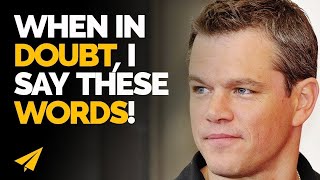
The video, narrated by entrepreneur Evan Carmichael, profiles actor Matt Damon and extracts ten rules for success from his life and career. Through a mix of interview excerpts, film clips, and commentary, Damon shares personal anecdotes about his early struggles, the necessity‑driven creation of Good Will Hunting, the importance of self‑belief despite external doubt, relentless work ethic (“just do your work, kid”), strategic risk‑taking (joint bank account with Ben Affleck, taking low‑budget roles to build experience), perseverance through physical and health challenges (extreme weight loss for Courage Under Fire), the value of authentic collaboration (friendship with Ben Affleck, advice from Tom Hanks), and the principle of having something meaningful to say. The video concludes with a call to action for viewers to reflect on which rule impacts them most, while also featuring bonus clips and promotional shout‑outs. The content blends motivational messaging with concrete career milestones, offering high‑signal insights into Damon’s mindset and practices that contributed to his success.
Chapters
You need to believe in yourself despite what everybody you love and trust tells you.
Ben and I had a joint bank account. We'd go to New York, and if you made money acting, it went into the account, and the account was only to be used if you were going to New York for an audition.
But I mean, we really wrote Good Will Hunting out of necessity. I mean, we just needed a job.
You don't get anywhere being, you know, genuflecting to, you know, somebody.
He's an American actor, film producer, and screenwriter. He's ranked by Forbes magazine as one of the most bankable Hollywood stars and is among the highest-grossing actors of all time. He's received numerous accolades, including one Academy Award from four nominations. He's Matt Damon, and here's my take on his top 10 rules for success. Rule number one is my personal favorite, and make sure to stick around all the way to the end for some special bonus clips.
When I was younger, everybody told me not to be an actor. To this day, I say that to people who come up to me and say, "I'm thinking of going into acting.
What do you think?" I say, "Absolutely not.
It's a terrible idea. Don't do it." Because that's what everyone said to me. And I think if you're gonna make it in this business that is so full of rejection and hardship, you need to believe in yourself despite what everybody you love and trust tells you. And it's a very personal journey. And so that was really helpful, I think, You know, the advice to stay away from this career was really helpful in my own understanding that it was that important that I pursue it.
You know, the first job I got was a real job, besides commercials and things like that, local radio commercials and things that kind of gave us the money. Ben and I had a joint bank account. We'd go to New York, and if you made money acting, it went into the account, and the account was only to be used if you were going to New York for an audition or if we took $10 out to, like, play video games at the arcade. And, uh— I got a line in the movie Mystic Pizza, and the line was, "Mom, do you want my green stuff?" And literally, but it was a scene that was a big dinner table scene. Julia Roberts, it was like a big movie for her, and it was this whole dinner table scene, and so it took us 3 nights to shoot down in Mystic, Connecticut. And I was a minor, so my mother had to come with me. And, you know, we shot from 5 to 5 every night, and I just remember being so in love with the process of film. I just knew, I was like, this is the greatest. It was the best time I'd ever had in my life.
And it was, you know, I was like, this is amazing.
I want this to never, ever, ever stop. Like, I loved it.
But I mean, we really wrote Good Will Hunting out of necessity. I mean, we just needed a job and we, and, and, you know, as you all know, they don't really give those out here. So, uh, so it was just, you know, two guys who were were eager and young and had a lot of energy and a lot of creative energy. And that's a big prob— it was always a big problem with LA and New York was you'd meet these other actors and they'd— and it's like you're raring to go and there's nowhere to put that energy. And so, you know, it can get put in horrible places. It can get put in, you know, drugs and all that. Or you can try to somehow channel it into something that feels productive. And even if it doesn't— nothing comes of it, it's still productive in the sense that you're working. Even if you're getting together in groups and doing scenes or taking classes. Or trying to cobble together a screenplay, the energy's going somewhere.
You have never seemed shackled, Matt, over your career by the fear of needing to maintain some sort of particular image. You've always been happy to speak out on issues that you are concerned about or to do whatever projects take your fancy. How have you managed to slip those chains?
I just never thought that you could micromanage an image, you know. I just didn't, you know. And the things I've spoken about, I've just— are things that I believe, and it doesn't mean that I'm right, it just, you know, and I'm happy to learn and evolve in my thinking, but if I'm saying something, it's because it's what I'm genuinely feeling, and you know, and that's, I don't think I've taken too many hits for that.
My high school acting teacher, Jerry Specka, who had a huge influence on me and Ben and Casey, 5 words, he said, "Just do your work, kid," and he repeated that so many times to me, "just do your work, kid." And that is kind of what I can always retreat to. You know, that's my touchstone. If, you know, when in doubt, just focus on my work. You know, if everything on the movie's going wrong, all right, you know, I'll make sure that my work is tight and go from there. And that's a great place to base from, and it's a good foundation.
I looked at the odds, you know, like, how am I even gonna break into this? Business, right? All the good parts, you know, if you— as an unknown actor to get a great role, you know, every other actor has to pass on it, right? Every other actor has to pass on it, and then it gets opened up to you and thousands of other people like you, right? And you all go. And, you know, there are a few parts Like I was looking at the, you know, a big part when I was younger was Primal Fear. Remember that movie with Richard Gere? Yes. Edward Norton got the part.
After everyone passed.
Yeah, I mean, so that part became open. Every young actor knew it. I mean, we went, I paid with money I did not have to take dialect lessons, you know, hired a dialect coach 'cause the kid was, you know, His alter ego was from Kentucky and he was from somewhere else and I didn't, I had never been to Kentucky and so, you know, we knew that that was it, you know, that was gonna launch somebody. There just weren't opportunities, you know, and so Courage Under Fire was one of those roles that was small. It was really only, it was 2 scenes, right? I had 2 scenes with Denzel and then the rest of it was I'm the medic and I'm, you know, You know, Tim Guinea, an actor who I love, who's in Promised Land actually, is like bleeding out on my lap for— so for 6 weeks we're in El Paso and he's like moaning and I'm just sitting there and I'm like, "I don't think the camera's on us, man." You know? But, you know, so it was a really thankless job for both of us except for those 2 scenes that I had with Denzel. So I had 2 days of work on that movie. And so I went, "Well, what do I do?" You know, it's a— It's told in flashback. So let me see, how can I change myself? What can I do? The guy's supposed to become a heroin addict. OK, well, so what do I do to make that seem like it happened? And the only thing I could come up with was to lose as much weight as I could and then put it back on as fast as I could to go do the flashback stuff.
And so that's what I did.
I heard that wasn't good for your health. Like, your doctor was surprised.
No, it was terrible. It was bad because I didn't, I asked them for a nutritionist, which was probably $1,500 or $2,500. And they said no. And I don't think they, in their defense, I don't think they really knew what I was gonna do. And they probably have requests like this all the time and they think they're vanity requests. But it was a serious request and they turned it down. And so I went to, we had a friend. We knew a guy who was also a— he was Austrian. I mean, funnily enough, he was Austrian and he was trying to be an actor, but he literally, because he was Austrian, he had Arnold's accent and he was a former bodybuilder. So he was really aiming at a small bullseye, you know, because his spot was really taken by somebody else. But he put me on his this program that he would do for bodybuilding shows. But they would do that program 3 weeks out. You know, they would do this really kind of reckless thing when they're just, you know, and so those guys walk on stage and like you could push them. They look strong but you could knock them over. They're really suffering at that point to kind of leech every bit of everything out so that the veins and the muscles pop out. So, I did it for like 3 and a half or 4 months. Which was just too much, you know, too much. But at the same time, you know, it worked. It worked. And, you know, when I got "The Rainmaker" a year or so later, Coppola said that he'd seen "Courage Under Fire." [Speaker:KATHY LEE] Really? [Speaker:CHRIS NOLAN] And that that made a big difference. And funnily enough, it was Edward Norton and I who were going against each other again for that. And that "Courage Under Fire" pushed me over the edge. And when I met Spielberg later and he looked at me and he said, "What?" And I'd put myself on tape for Saving Private Ryan. I never heard anything. I don't think the tape ever got to him. Casting director maybe looked at it and chucked it. And so I thought he'd seen it. And he said, "Well, what do I know you from?" And I said, "I put myself on tape for your movie." He goes, "No, I didn't see any tape." He goes, "What movies have you been in?" I said, "I was in a movie called Courage Under Fire." He goes, "You know, I turned to my wife when I saw that movie and said, 'That's the exact guy I want for Private Ryan. I just wish he wasn't so skinny.'" So.
Wow.
I feel like I read an interview at the time that said like you couldn't even kiss your girlfriend 'cause you could taste potato chips on her lips.
The oil from them, yeah. No, I mean, it went— People who have those disorders, I got it. I totally understood it. Like, if you want to be— because there, I just told myself, I can't allow anything. There's no, no compromising, none. Like, because the second you open that door, you know, it's a slippery slope. And I just want— I wanted to look back on it and go, I did absolutely everything I could.
This relationship between you and Ben, um, is a kind of— he busts you and you bust him back. There's a little bit of that, a lot of that. It's the nature of two guys growing up together.
Yeah.
Yeah, but there's also this thing that we're talking about, we just saw in the scene. Is that there? Is that who the two of you are in terms of to each other?
Oh yeah, I mean, we— I mean, growing up together, blocks apart in Cambridge and all that.
Sure, yeah, growing up together, best friends all our lives. We don't have very— I wouldn't say we have moments that are that kind of dramatic where we're like, listen, man, you know. But, you know, I'd, you know, lay down in traffic for the guy. I mean, you know, he's my best pal, you know. I mean, You know, I'd pretty much do anything for him. So, yeah, I mean, it's a great friendship. I can't imagine a better way to make a movie and do something I love to do that much than with Ben, and to have this go the way it did and have this happen, you know.
And Tom Hanks said something to me when we were doing Saving Private Ryan that always stuck with me, which was— I was asking him about a movie he did with Jackie Gleason, And I said, what was it like to work with Jackie Gleason? And he thought about it for a second. He said, you know, I made a decision to not be nervous. And I went, what? And he goes, I just, I knew everyone was so nervous around him. And I just said, you know what? I'm not going to be nervous around him. And he, and once he realized I was treating him like, you know, a fellow human being, we really had this great working relationship. And it was really good advice, you know.
And so you try to do that yourself?
I was trying to do it with Tom Hanks at the time, you know, and yeah, you don't get anywhere being, you know, genuflecting to somebody.
And I know a lot has been said and written about the experience of Good Will Hunting, but could you ever have imagined that it would have such an effect on people? You touched so many lives with that movie. It was amazing.
I know, it's really great looking back. I mean, it, Ben and I made this, had this pact that we just wanted the movie, that no matter what, we wanted to love it. And even if nobody saw it, and it was a great early lesson that, you know, because even if the movie hadn't been successful, we still would have loved it. And it would have meant as much to us. So I've, you know, not to be a horrible name dropper, but Clint Eastwood Al Pacino said to me a couple years ago, I was asking him about just stuff, we were sitting on the set while they were setting up a shot, and he said, "You know, people talk about my movies, you know, they say, 'Well, this one's a masterpiece,' or, 'That one's no good.'" And he goes, "I love all of them." He goes, "And I know exactly why I made each one of them, and I wouldn't do anything differently if I had to do it again." Al Pacino said the secret to success is— But what does he know?
Yeah, exactly.
Well, yeah, well, I was gonna say, he said the secret to success learning his lines or learning your lines. What do you reckon the secret to success?
I never heard him. I never heard that.
That's great.
That is definitely one of the secrets to success.
Yeah.
Having something to say and knowing what it is.
Yeah.
Thank you guys so much for watching. I made this video because MrPlaythroughs101 asked me to. So if there's a famous entrepreneur that you want me to profile next, leave in the comments below and I'll see what I can do. I also love to know which of the top 10 rules here had the biggest impact on you and why. What change you're gonna make? What realization did you come to after watching this video? Leave it in the comments and I will join in the discussion. Finally, I want to give a quick shout out to Xavier from ScentLion.com. Thank you so much for buying my book. It really means a lot to me. Those of you watching, you want a chance at a shout out in a future video, make sure to pick up a copy of the book and email in your receipt so we can keep track. Thank you guys so much for watching. Continue to believe, or whatever your one word is, and I'll see you soon.
Oh, hello. Oh, hello.
Hi, how are you?
Fine.
So do you ladies, uh, come here often?
Do I come here?
I come here a bit.
I'm here, you know, from time to time.
Do you go to school here?
Yeah. Yeah.
That's it.
'Cause I think I had a class with you.
Oh, yeah?
What class?
History. Maybe.
Yes.
I think that's what it was.
You don't necessarily—
might not remember me.
You know, I like it here. It doesn't mean 'cause I go here I'm a genius.
I am very smart.
Hey, how's it going?
How are you?
Good.
How you doing? You want— I don't— What class? What class did you say that was? History.
History.
Yeah.
Just history? It must have been a survey course then, huh?
Yeah, it was.
It was surveys.
Right.
You should check it out.
It's a good course.
It's a good—
big class. Oh.
How'd you like that course?
You know, frankly, I found the class, you know, rather elementary.
Elementary?
Yeah.
You know, I don't doubt that it was.
Yeah.
I, uh— I remember that class. It was, um— it was just between recess And lunch.
Clark, why don't you go away?
Why don't you relax?
Why don't you just go away?
I'm just having fun with my new friend, that's all.
You gonna have a problem?
No, no, no, no, no. There's no problem here. I was just hoping you might give me some insight into the evolution of the market economy in the Southern colonies. My contention is that prior to the Revolutionary War, the economic modalities, especially in the Southern colonies, could most aptly be characterized as agrarian, pre-capitalist.
Of course that's your contention.
You're a first-year grad student.
You just got finished reading some Marxian historian, Pete Garrison, probably. You're gonna be convinced of that till next month when you get to James Lemon. Then you're gonna be talking about how the economies of Virginia and Pennsylvania were entrepreneurial and capitalist way back in 1740. That's gonna last until next year. You're gonna be in here regurgitating Gordon Wood, talking about, you know, the pre-revolutionary utopia and the capitalistic the social-forming effects of military mobilization.
Well, as a matter of fact, I won't, because Wood drastically underestimates the impact of social—
Wood drastically underestimates the impact of social distinctions predicated upon wealth, especially inherited wealth? You got that from Vickas. Work in Essex County, page 98, right? Yeah, I read that too. What, you gonna plagiarize the whole thing for us? Do you have any thoughts of your own on this matter? Is that your thing? You come into a bar, you read some obscure passage, and then pretend you pawn it off as your own idea just to impress some girls? Embarrass my friend? See, the sad thing about a guy like you is in 50 years you're gonna start doing some thinking on your own, and you're gonna come up with the fact that there are two certainties in life. One, don't do that. And two, you dropped $150 grand on a fucking education you could have got for $1.50 in late charges.
The public library.
Yeah, but I will have a degree, and you'll be serving my kids fries at a drive-through on our way to a skiing trip. Yeah, maybe.
Yeah, but at least I won't be unoriginal. But I mean, if you have a problem like that, I mean, we could just step outside, we could figure it out.
Oh man, there's no problem.
It's cool.
It's cool.
Yeah. Cool. Fucking damn right it's cool. How you like me now?
My boy's wicked smart.
Do you like apples?
Yeah.
Well, I got a number. How do you like them apples?
More from Evan


How the Biggest Mistake in History Created A Trillion-Dollar Empire | Sergey Brin



9 Machiavelli Principles That Force People To Respect You | Machiavellian Philosophy



The First 10 Words That Instantly Ruin A Sales Conversation | Vanessa Van Edwards

The Top 1% Mindset Behind The First $5 Trillion Company | Jensen Huang (Nvidia)

